January 21, 2026 · Texas Autopsy Services
What Families Should Know About Who Determines Cause of Death in Texas
As a forensic pathologist, I explain who determines cause of death in Texas, from medical examiners to private autopsies. Learn the roles and process.
On this page
- In Texas, cause of death is officially determined by an attending physician, a Justice of the Peace, or a Medical Examiner, depending on the circumstances.
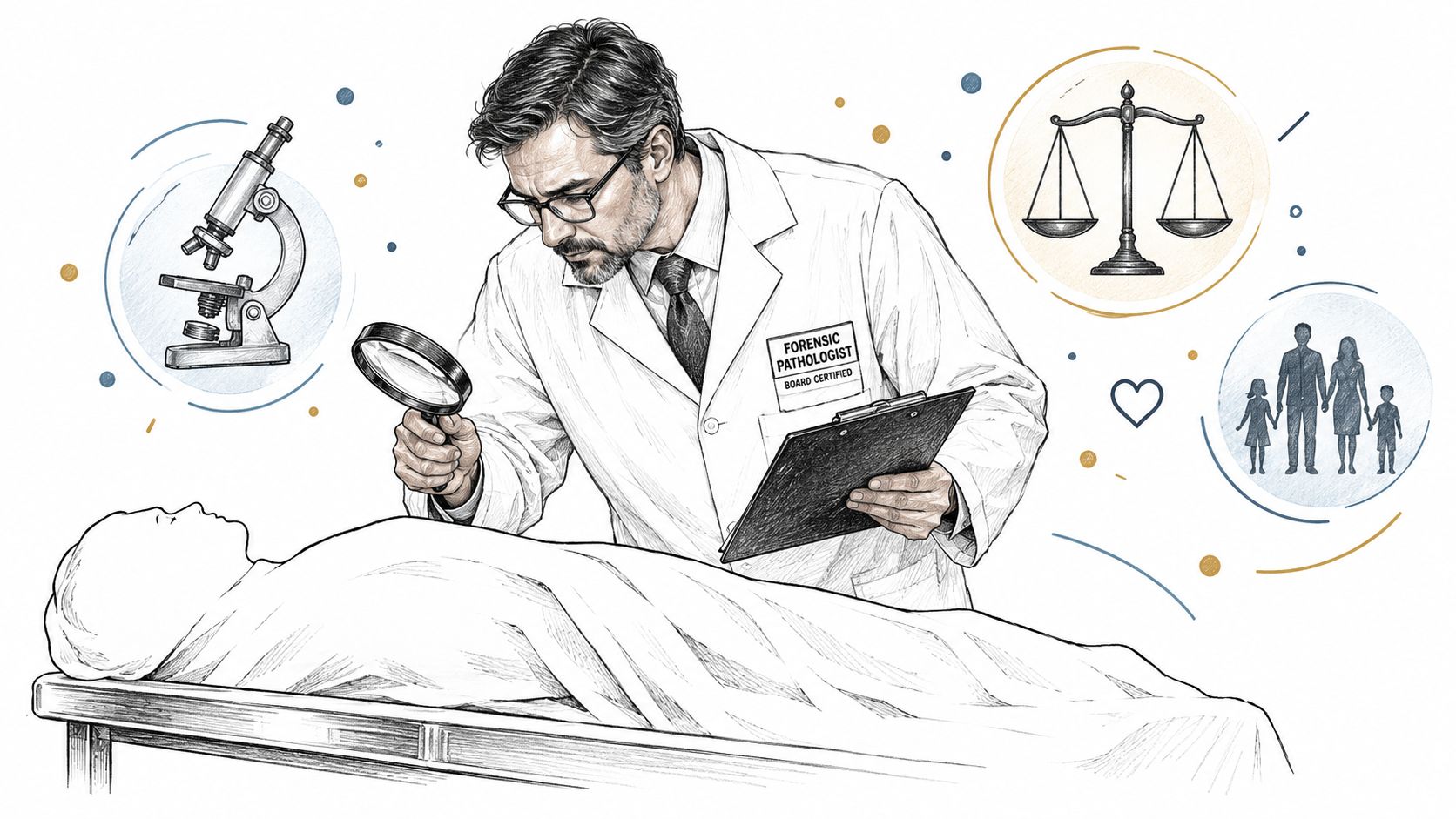
- As a board-certified forensic pathologist, I provide the objective medical evidence needed for these officials to make a final determination.
- A private autopsy offers families an independent, confidential path to answers when a county-mandated examination isn't performed or when a second opinion is needed.
- The investigation distinguishes between the cause of death (the specific medical reason) and the manner of death (the circumstances, classified as natural, accident, suicide, homicide, or undetermined).
- My process at Texas Autopsy Services is transparent, compassionate, and fully compliant with all Texas legal and ethical standards.
The Critical Question After a Loved One Passes
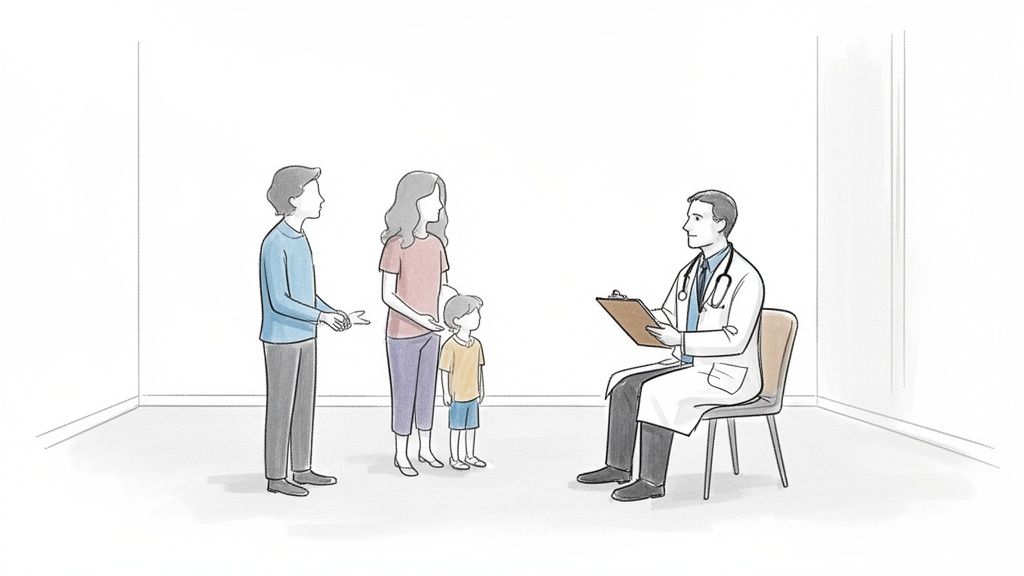
When a loved one passes, the most immediate and painful question is always, "What happened?" As a forensic pathologist with over 1,000 autopsies performed, I understand that a clear answer is not just a medical detail. It is the foundation for emotional closure and a necessary first step in navigating the legal and personal matters that follow a loss.
Determining why someone died is a structured investigation, not a single action. The final answer documented on a death certificate is vital not only for a grieving family but also for legal proceedings, insurance claims, and even public health. This guide explains who makes that official determination in Texas and why their work is so important.
Why a Definitive Answer Matters
An accurate cause of death has serious, far-reaching implications. For families, it can confirm or alleviate concerns about medical care. It may also uncover hereditary health conditions that could affect living relatives, providing a factual basis to begin processing grief.
From a legal standpoint, the findings are essential for:
- Settling an estate and executing a will.
- Processing life insurance claims.
- Claiming workers' compensation benefits if the death was work-related.
- Pursuing a civil lawsuit if there is reason to suspect negligence.
While the medical facts are central, families also need to be aware of legal deadlines, like the Florida wrongful death statute of limitations, if they are considering legal action after losing a loved one.
The Official Determination
The formal process begins the moment a death is reported. If someone passes away in a hospital from a well-documented illness, the attending physician typically certifies the death.
However, for deaths that are sudden, unexpected, or occur outside a medical facility, a government official must investigate. My work at Texas Autopsy Services is to supply the medical evidence needed for these official determinations, whether for a county-mandated exam or for Private Autopsies requested by families seeking answers. The goal is always the same: to provide an unbiased, scientific conclusion.
The Professionals Who Certify a Death in Texas
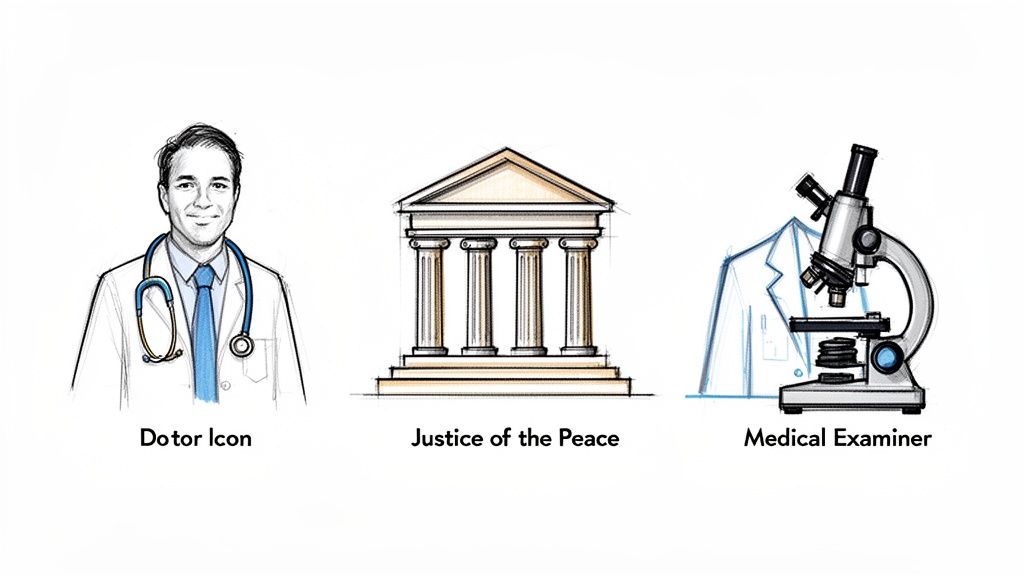
In Texas, the law clearly outlines who has the authority to officially certify a death. Understanding these roles helps families navigate a confusing process and know who is in charge of finding the answers they need. The specific professional who makes that final call depends entirely on the circumstances surrounding the death.
The Attending Physician’s Role
Most of the time, the process is straightforward. When a person dies from a known illness while under a doctor's care, their attending physician certifies the death.
The doctor is familiar with the patient's medical history and can confidently state that the death was a natural result of their condition. This is the common path for deaths in hospitals, nursing homes, and hospice facilities. The physician completes the medical portion of the death certificate, and the process is finished.
When a Medical Examiner or Justice of the Peace Is Required
For deaths that are sudden, violent, or unexpected, Texas law requires a medicolegal authority to conduct an impartial review.
Depending on the county, that authority is either a Medical Examiner or a Justice of the Peace.
- Medical Examiners are physicians, often forensic pathologists like me, who are appointed to serve more populated counties. We lead the entire death investigation.
- Justices of the Peace are elected officials who serve this function in smaller, rural counties. While they aren't required to be doctors, they hold the legal authority to order an autopsy when one is needed to find the cause of death.
It’s a system that can seem confusing, so we’ve created a guide explaining the difference between a coroner and a medical examiner in more detail.
This table breaks down who is responsible for certifying a death in different situations in Texas.
Who Officially Determines Cause of Death
| Professional | Primary Role | Typical Scenarios |
|---|---|---|
| Attending Physician | Certifies death from known medical conditions | Death in a hospital, nursing home, or hospice from a diagnosed illness. |
| Medical Examiner | Investigates and determines cause and manner of death | Sudden, violent, or unexplained deaths in populous counties. |
| Justice of the Peace | Acts as the coroner to order investigations | Sudden, violent, or unexplained deaths in less-populated counties. |
Each role is a crucial part of a system designed to ensure every death is properly documented and understood. My role as a forensic pathologist is to provide the scientific foundation for these officials. When a Justice of the Peace or Medical Examiner requires an autopsy, I perform the medical examination that gives them the objective evidence needed to make their official determination.
This official chain of command ensures every death receives the right level of scrutiny. It is a system of checks and balances designed to protect public health and provide factual, unbiased answers.
Cause vs. Manner of Death What's the Difference
In my work, I find that people often use "cause of death" and "manner of death" interchangeably. In a death investigation, these two terms answer very different questions. Getting them right is fundamental to creating an accurate and legally sound death certificate.
The cause of death is the specific medical reason a person died. It's the disease or injury that initiated the chain of events leading to their passing, such as a heart attack, a gunshot wound, or complications from pneumonia. It is a purely biological determination.
The manner of death is the legal classification describing the circumstances surrounding the cause. It tells the story of how the cause of death came to be.
The Five Official Manners of Death
Every death certificate in Texas must list one of five official manners of death. This classification is a conclusion drawn from all available evidence, including the autopsy, scene investigation, toxicology reports, and the person's medical history.
The five manners are:
- Natural: The death was caused solely by disease or the aging process.
- Accident: The death was the result of an unintentional event, like a car crash or a fall.
- Suicide: The death was caused by a purposeful, self-inflicted act.
- Homicide: The death occurred at the hands of another person. This is a neutral medical term; it doesn't automatically mean a crime was committed.
- Undetermined: This is used when there isn't enough evidence to confidently choose one of the other four categories.
Putting It All Together
Let's use an example. Imagine the medical cause of death is "drug toxicity." The how—the manner—can change dramatically based on the circumstances.
If the person accidentally took too much of a prescription medication, the manner would be Accident. If they intentionally took a lethal overdose, it would be classified as Suicide. If someone else administered the fatal dose, the manner would be Homicide.
Same cause, three completely different stories. For a deeper dive into this, you can read our guide on the legal manner of death definition.
As a forensic pathologist, my role is twofold. First, I identify the medical cause through a detailed examination. Then, I assemble all the puzzle pieces—the autopsy findings, lab results, and investigative reports—to help the certifying official determine the correct manner. This process ensures the complete story of a person's death is told accurately.
The Investigation Process How Answers Are Found
Determining why someone died is a careful, step-by-step process. I treat every case as a methodical investigation designed to find the medical truth, ensuring every conclusion is built on solid evidence.
The work often begins before the physical examination. The first step is to understand the circumstances by reviewing medical records, reports from law enforcement or paramedics, and sometimes speaking with family to learn about the person’s recent health. This background information is critical, as it provides the context that guides the entire investigation.
The Autopsy The Medical Examination
When necessary, an autopsy provides the concrete medical evidence we need. It's a respectful and detailed procedure with several key stages that create a full picture of what was happening inside the body.

The autopsy reveals the medical cause of death, a crucial piece of evidence used to determine the legal manner of death when combined with all other information.
I always start with a thorough external examination, documenting everything from height and weight to any subtle marks, injuries, or signs of illness. This first step often provides many clues.
Next, the internal examination allows me to inspect each organ system directly. By carefully examining and weighing the organs, I can identify abnormalities, such as a blocked artery in the heart indicating a heart attack or the signs of pneumonia in the lungs. This hands-on part of the investigation provides the physical evidence needed to construct an accurate timeline of physiological events.
Uncovering Microscopic and Chemical Clues
Sometimes, the most important answers are hidden from the naked eye. That’s why additional tests are a vital part of a complete cause of death investigation.
These studies take the physical exam to a much deeper level.
- Toxicology: We test blood and tissue samples to screen for alcohol, prescription drugs, illegal substances, or other chemicals. This tells us not only if a substance was present but also whether it was at a therapeutic or dangerously high level.
- Histology: We take tiny samples from major organs and examine them under a microscope. This reveals diseases at the cellular level, helping me identify conditions like cancer, hidden infections, or damage from chronic illnesses that might otherwise go unnoticed.
Each step builds on the last. My focus is always on finding the unbiased, medical truth. This commitment to objective, evidence-based pathology gives families and legal teams the clear, reliable answers they need.
When to Consider an Independent Autopsy
Sometimes, the official process doesn't provide the answers a family needs. A county might decide an autopsy isn't necessary if a death appears natural, leaving families with painful, unanswered questions. This is where a private or independent autopsy can be a critical tool for finding the truth.
In Texas, families often turn to this option when the official cause of death is "undetermined" or when they have concerns about the quality of care a loved one received in a hospital or nursing home. An independent examination provides an objective, unbiased look at the medical facts.
An Independent Path to Answers
The purpose of a private autopsy is to provide a clear, medically sound cause of death directly to the family. My role as an independent forensic pathologist is to focus entirely on the medical evidence, free from the caseload pressures of a public investigation. The process is confidential, and the final report belongs only to the family who commissioned it.
This independent review can be crucial in several situations:
- Unanswered Medical Questions: For sudden deaths that don't meet the criteria for a mandatory county exam.
- Concerns About Medical Care: To investigate whether a medical mistake or negligence played a role in the death.
- Genetic Conditions: To uncover hereditary diseases that could be vital information for living relatives.
- Legal and Insurance Claims: To provide solid documentation for wrongful death lawsuits or insurance disputes.
The World Health Organization reported that in 2019, while 70% of global deaths were registered, only 52% were medically certified. This global gap highlights the importance of rigorous, expert-driven examinations when questions arise.
Seeking a Second Opinion
Even after a county autopsy, a family might still have doubts. You have the right to get a second opinion.
When official reports seem contradictory or you suspect negligence, your family and legal team need an impartial review. A second opinion autopsy involves a thorough re-examination of all the evidence, from tissue samples to initial reports. When the stakes are this high, consulting with an expert like an Atlanta Wrongful Death Attorney can also be a necessary step to protect your rights and ensure every angle is investigated.
A private autopsy empowers families, giving them control over the search for answers and providing a path to factual certainty when official channels fall short.
A Compassionate Path to Factual Certainty
Understanding who determines the cause of death is the first step toward closure after a loss. The final answers might come from a family doctor, a county medical examiner, or an independent forensic pathologist. Regardless of who is involved, the goal is always the same: to provide accurate, unbiased, and medically sound information.
My work at Texas Autopsy Services is centered on providing these answers with both clinical precision and genuine compassion. We assist families, attorneys, and officials across the state, from Central Texas to the most rural communities. If you're struggling with unanswered questions about how a loved one died, please know there are resources to help you find the truth.
Finding clarity is a fundamental part of the grieving process. It replaces uncertainty with facts, allowing families to begin healing with a foundation of truth. If your family is seeking answers, I encourage you to contact my office for a confidential conversation.
Frequently Asked Questions
After years of working with families and attorneys, I've found that the same questions come up time and again. The process of determining a cause of death can feel overwhelming, so my goal is to provide clear, straightforward answers.
Can our family request an autopsy if the county says no?
Yes. In Texas, the legal next-of-kin has the right to authorize a Private Autopsy even when the local medical examiner or justice of the peace decides not to order one. This often happens when a death seems natural, but the family has unanswered questions or concerns about potential medical malpractice. An independent examination is your right and can bring peace of mind.
How long does it take to get autopsy results?
The timeline depends on the complexity of the case. I can usually provide a preliminary cause of death within a few days of the examination based on direct observation. The final, detailed report takes longer because we must wait for specialized lab results, like toxicology and microscopic tissue studies, which can take several weeks. At Texas Autopsy Services, we keep families updated throughout this period.
A complete and accurate answer is worth the wait. My commitment is to thoroughness and precision.
Is an autopsy report a public record in Texas?
The answer depends on who ordered the autopsy. If it was ordered by a county medical examiner's office, the report is generally considered a public record, though some sensitive information may be redacted.
However, a private autopsy report that you commission is 100% confidential. It is your private medical information. The findings belong to you, and I will not release the report to anyone without your direct permission.
What is the difference between a coroner and a medical examiner?
Texas has a blended system. More populated counties have a medical examiner system, where a physician—usually a board-certified forensic pathologist like me—is appointed to lead death investigations.
Smaller, rural counties often rely on an elected Justice of the Peace, who acts in a role similar to a coroner. They do not need a medical degree but have the legal authority to investigate deaths and order an autopsy when necessary, at which point they call on a forensic pathologist to conduct the medical examination.
If you have more questions or need to discuss your specific situation, my team at Texas Autopsy Services is here to offer confidential guidance. Please contact us directly for support.