March 1, 2026 · Texas Autopsy Services
A Forensic Pathologist's Guide to Asbestos Claims After Death
Learn how to file an asbestos claim after death. A forensic pathologist explains the steps Texas families can take to secure justice and compensation.
On this page
A family recently called my office. Their father had passed away from lung cancer, and they were convinced his decades-long career as an industrial mechanic was to blame. That suspicion is the first step in pursuing an asbestos claim after death. As a forensic pathologist, my role is to provide the scientific certainty that can turn that suspicion into a successful legal action for Texas families.
- Understanding the Process: An asbestos claim after death is a legal process, typically a wrongful death lawsuit or a trust fund claim, to secure compensation for a death caused by asbestos exposure.
- The Power of Proof: A private autopsy provides definitive medical evidence by identifying and quantifying asbestos fibers in lung tissue, creating a direct link between exposure and the fatal illness.
- Act Quickly: Texas has a strict two-year statute of limitations for wrongful death claims, making it crucial to start the evidence gathering process promptly.
- Autopsy and Funeral Plans: A private autopsy is performed respectfully and efficiently, and it does not delay or interfere with your family’s funeral, viewing, or cremation plans.
- Evidence is Key: A successful claim requires a combination of medical proof (autopsy report), employment records, military service history, and witness statements.
Your First Steps in an Asbestos Claim After Death

Losing a family member is a devastating experience. When you believe their death from an illness like mesothelioma or lung cancer was caused by past asbestos exposure, the idea of a legal process can seem overwhelming. It's important to know that an asbestos claim is a structured process, one designed to bring a measure of justice and financial security to the family left behind.
My work as a forensic pathologist often begins with a call from a family or an attorney in this exact situation. They might have a death certificate that simply lists "cancer" but lack the concrete evidence to connect that diagnosis to a specific factory, shipyard, or product from years ago. That’s where I can help.
Understanding Your Legal Options
In Texas, families have a few different paths for pursuing compensation. Each legal action is built on the premise that the death was preventable and resulted from another party's negligence. It’s helpful to understand these options.
Most families will choose between a lawsuit and a trust fund claim, and sometimes both are possible. The table below breaks down the key differences.
Types of Asbestos Claims Available to Texas Families
| Claim Type | Primary Goal | Who Files the Claim | Typical Recipient of Funds |
|---|---|---|---|
| Wrongful Death Lawsuit | Compensate family members for their personal losses (lost income, companionship) | Spouse, children, or parents of the deceased | The surviving family members |
| Survival Action | Recover damages the deceased could have claimed if they had lived (medical bills) | The representative of the deceased's estate | The estate (then distributed) |
| Asbestos Trust Fund Claim | Get compensation from bankrupt companies that used asbestos | An attorney on behalf of the family or the estate | The estate or designated heirs |
As you can see, the goals and processes differ. A wrongful death suit is a personal claim for the family's loss, while trust fund claims are more administrative and target companies that are no longer in business.
Understanding the legal framework for filing a Wrongful Death Lawsuit in Texas can make the process feel more manageable.
Why You Need to Act Quickly
The single most critical factor in any post-death asbestos claim is the statute of limitations. This is a strict legal deadline for filing a lawsuit.
For wrongful death cases in Texas, you generally have two years from the date of death to file your claim. If you miss that deadline, your family will likely lose its right to seek compensation forever.
That two-year clock is why it’s so important to speak with an attorney and a forensic expert like me as soon as possible. Building a strong case takes time. The evidence gathering, the historical research, and my work performing a private autopsy must happen well before that deadline. The autopsy is often the foundational piece of evidence that makes the entire legal case possible.
As a forensic pathologist, I see my role as providing the unassailable medical truth. A private autopsy can deliver the definitive link between asbestos fibers and the cause of death, which is the cornerstone of a successful claim.
The long latency period of these diseases explains why these claims are so common today. Globally, occupational asbestos exposure was linked to an estimated 190,000 lung cancer deaths in 2021 alone, a significant increase from 130,000 in 1990. This heartbreaking rise shows how exposures from 30, 40, or even 50 years ago are now leading to deaths and the claims that follow. You can read more on these findings in the Global Burden of Disease study on asbestos-related fatalities worldwide.
The Critical Role of a Private Autopsy
When an attorney calls me about a potential asbestos claim after death, our conversation almost always turns to one critical challenge: proving, without a doubt, that past asbestos exposure caused their client's loved one to die. From my perspective as a forensic pathologist, the answer is clear. A private autopsy isn't just helpful; it’s often the single most powerful piece of evidence you can have. It moves a case from suspicion to scientific certainty.
A death certificate might list "respiratory failure" or "cardiac arrest" as the official cause. While true, that's just the final event. It doesn't explain why it happened. A detailed postmortem examination can uncover the hidden disease process that actually led to that failure.
This is especially true for asbestos-related illnesses. Many conditions, like lung cancer, can be attributed to other factors such as smoking, especially if the person's work history wasn't top-of-mind for their doctors. A private autopsy cuts through those assumptions to deliver an independent, unbiased look at what was happening inside the body.
Uncovering the Microscopic Evidence
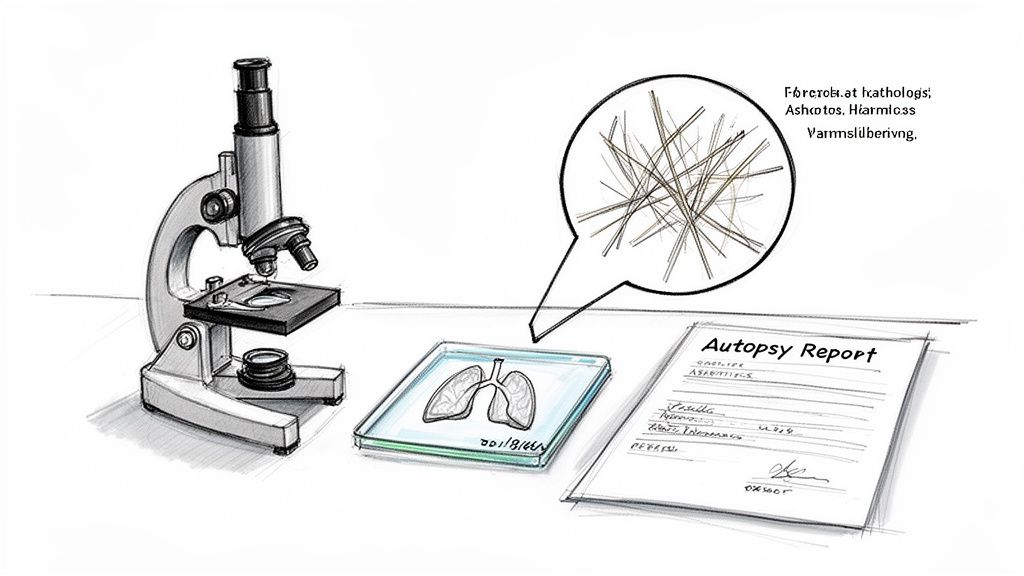
At Texas Autopsy Services, my approach to a suspected asbestos case is highly specific. As a board-certified pathologist, I focus on carefully collecting tissue samples from the lungs and the surrounding pleural lining.
The real work happens after that. We use specialized lab techniques to find what the naked eye cannot. This often involves two key steps:
- Tissue Digestion: We use a chemical process to dissolve the lung tissue itself. What remains are the inorganic materials, including asbestos fibers.
- Electron Microscopy: This powerful imaging technology allows me to see, count, and even identify the specific types of asbestos fibers present in the tissue.
Finding and quantifying these fibers provides irrefutable proof of exposure. When I can document that a person had thousands, or even millions, of asbestos fibers per gram of lung tissue, it forges a direct, causative link that is incredibly difficult for an opposing legal team to dispute.
A comprehensive autopsy report with a quantitative fiber analysis is more than just a medical document. It becomes the bedrock of your entire legal strategy, giving your attorney the concrete proof they need for settlement negotiations or court.
This level of detail is frequently the deciding factor between a dismissed case and a successful claim for your family.
From Medical Findings to Legal Proof
My job is to translate these complex scientific findings into a clear, understandable report that leaves no room for ambiguity. This document will detail the complete pathologic diagnosis, for example, "adenocarcinoma of the lung," and then explicitly connect it to the asbestosis or the significant asbestos fiber burden found in the tissues.
This report serves several vital functions in a legal claim:
- It establishes the cause of death with medical and scientific certainty.
- It provides objective, third-party validation that the asbestos exposure occurred and was significant.
- It arms your attorney with the facts needed to stand up to asbestos trusts or corporate defendants.
The statistics are a stark reminder of why this matters. In the U.S., nearly 40,000 people die from asbestos-related diseases every year. Since 1991, these preventable illnesses have claimed over 1.1 million American lives. Of those annual deaths, lung cancer accounts for 34,270, more than 87% of all asbestos fatalities. As the asbestos disease experts at Sokolove Law report, the true cause is often only discovered through a postmortem examination.
Is a Private Autopsy Always Necessary?
While it provides the strongest possible evidence, an autopsy isn't required for every single case. If a loved one’s death certificate already lists mesothelioma, for example, the link to asbestos is generally considered established.
However, for the vast majority of cases involving lung cancer or other respiratory diseases where the connection isn't as obvious, a private autopsy is invaluable. It’s also a time-sensitive procedure. The sooner an autopsy is performed after death, the better the quality of the tissue samples, which leads to more definitive results.
An experienced forensic pathologist knows how to work directly with your chosen funeral home to ensure the process is handled respectfully and doesn't interfere with your family’s arrangements. To learn more about how this works, you can check out our guide on private autopsies.
Ultimately, investing in a private autopsy is an investment in the strength of your case. It provides the clarity and factual foundation your family needs to seek justice.
Gathering Evidence Beyond the Autopsy Report
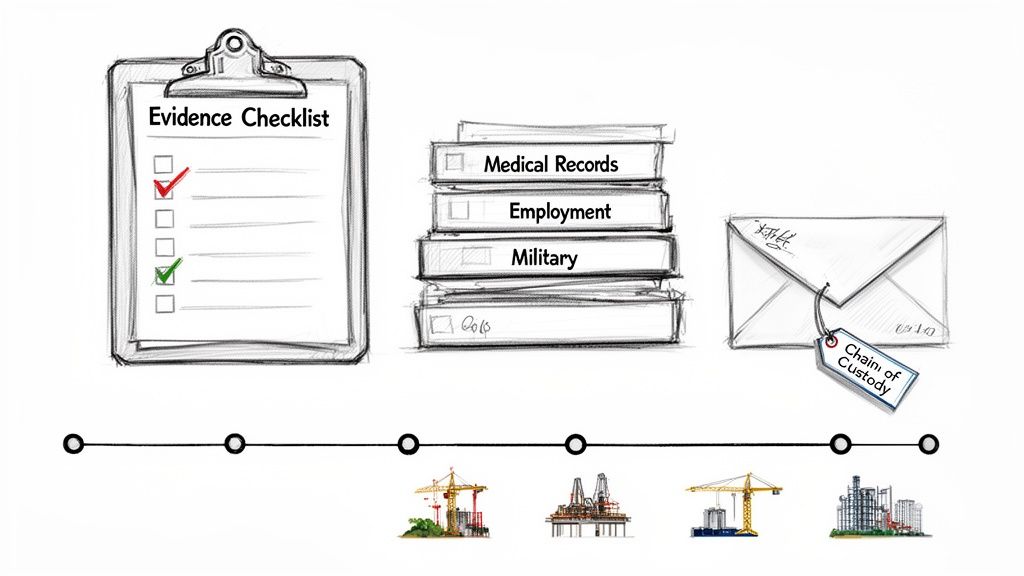
While the autopsy report I prepare establishes the critical medical link, it’s just one piece of the puzzle. For a successful asbestos claim after death, your attorney must build a solid case on that scientific foundation, connecting the dots from your loved one's illness back to their exposure.
This is a methodical process of piecing together a timeline that covers not just the medical journey, but the entire work and life history that led to the disease. As a forensic pathologist, I live by the principle of chain of custody for tissue samples. That same meticulous approach to documenting and handling evidence must apply to every document your legal team collects.
Building the Exposure Timeline
The core challenge for your legal team is proving when, where, and how your loved one was exposed to asbestos. It's not enough to say they worked in a high-risk industry. You need to be able to point to specific job sites, products, or even military assignments.
Your attorney will work closely with you to gather several types of crucial documents:
- Complete Medical Records: This means everything, from the first doctor's visit and diagnosis to every treatment, X-ray, CT scan, and biopsy report from their lifetime.
- Employment History: A detailed list of every single job is vital. This includes company names, locations, job titles, and the exact dates they worked there.
- Military Service Records: For veterans, records like the DD-214 can pinpoint specific roles, ships, or bases with known asbestos hazards, particularly for those who served in the Navy.
- Witness Affidavits: Statements from former coworkers can be a game-changer. They can provide firsthand accounts of asbestos materials at a worksite and describe the hazardous conditions.
All these documents come together to tell a clear, compelling story that a judge, jury, or trust fund administrator can easily understand.
Why Medical and Employment Records Are So Crucial
Medical records do more than just confirm the diagnosis. They create a timeline of the illness, show the pain and suffering involved, and spell out the financial toll of treatment. This is all fundamental for calculating damages in a wrongful death claim.
Employment records are the other half of the equation. They are the map that leads to the companies that can be held liable. For instance, if a work history shows someone worked at a Texas shipyard in the 1970s or a chemical plant in the 1980s, your attorney immediately has a list of potential defendants to start investigating.
Don't overlook your family's own records. Old pay stubs, union cards, or even family photos of your loved one at a job site can be incredibly valuable. These small, personal details can be the key to corroborating a work history and making the entire claim stronger.
Proving Product Identification
Once you've identified a job site, the next hurdle is proving which specific asbestos-containing products were used there. This is where an experienced asbestos law firm's resources truly shine. These firms often maintain massive databases of corporate documents, product lists, and historical records that can connect a specific manufacturer's product to a factory or shipyard during a certain period.
Your attorney might depose former employees or site managers, getting them on record about which brands of insulation, gaskets, or fireproofing materials were on-site. It's this level of detail that turns a general claim into a targeted legal action. Every piece of paper, from an old work order to a coworker’s testimony, helps forge another undeniable link in the chain of evidence.
Navigating Asbestos Trust Funds and Lawsuits
When a loved one passes away from an asbestos-related illness, families often face two primary legal routes for compensation. Understanding your options is the first step toward justice.
The forensic evidence I uncover during a private autopsy is foundational for either path. Let’s walk through what each one entails so you and your attorney can map out the best strategy.
Filing a Claim with an Asbestos Trust Fund
Many of the largest corporations that mined, manufactured, or used asbestos products eventually filed for bankruptcy. As a condition of that process, the courts required them to set aside massive amounts of money in asbestos trust funds. These trusts are specifically designed to pay claims for families and individuals harmed by their products.
Filing a trust fund claim is less like a courtroom battle and more like an administrative process. Your lawyer will compile a claim package and submit it directly to the trust administrators.
The core evidence required usually looks like this:
- Medical Proof: This includes the official diagnosis of an asbestos-related disease, like mesothelioma or asbestosis. My autopsy report can provide the definitive link by identifying asbestos fibers in the lung tissue itself.
- Exposure History: You'll need to show that your loved one was exposed to that particular company's products. This is where employment records, military service documents, and testimony from former coworkers become invaluable.
- Legal Standing: Paperwork that confirms you are the rightful person to file the claim on behalf of the deceased.
Each trust has its own rules and set payment amounts based on the specific disease. Since the process is standardized, it can often lead to a faster payout than a traditional lawsuit.
Filing a Wrongful Death Lawsuit
A wrongful death lawsuit is a different process. Instead of filing against a trust, this legal action is brought against companies that are still in business and financially solvent. This route is adversarial; your attorney will face off against the company's legal team.
Unlike a trust fund claim, a lawsuit aims to prove that a company's negligence directly caused your loved one's death. These cases typically end in one of two ways:
- Settlement: The vast majority of asbestos lawsuits conclude with an out-of-court settlement. The company agrees to pay a negotiated sum to avoid the cost, risk, and negative publicity of a trial.
- Trial: If a fair settlement isn't offered, the case proceeds to a judge and jury. This is where having ironclad scientific evidence is make-or-break. My role can expand here, as I often serve as a pathology expert witness to clearly explain complex medical findings to the court.
Lawsuits often result in larger compensation awards than trust funds because they can cover a broader spectrum of damages, such as pain and suffering, lost future wages, and in some cases, punitive damages meant to punish the company.
The scale of this issue is truly global. Occupational asbestos exposure causes over 200,000 deaths worldwide each year, accounting for more than 70% of all work-related cancers. In 2021 alone, asbestos was linked to 190,000 lung cancer deaths. These aren't just numbers; they represent families torn apart by corporate negligence. For more details, you can review the 2024 WHO update on asbestos safety and health figures.
Choosing the Right Path for Your Family
The good news is, you often don't have to pick just one path. It’s very common for a family to file claims with multiple asbestos trusts and simultaneously pursue a lawsuit against other solvent companies.
A skilled asbestos attorney will investigate your loved one’s work and service history to identify every potential source of exposure. From there, they'll determine which companies have established trusts and which are still operating and can be sued directly.
This multi-pronged approach is usually the most effective way to secure the full compensation your family deserves. It provides a measure of financial stability after a terrible loss, and it all starts with gathering the right evidence. A private autopsy is often the most powerful first step you can take.
What to Expect from the Claims Process
When you’re grieving, the thought of a legal claim can feel overwhelming. I’ve spoken with countless families and attorneys right at the beginning of this journey, and they all want to know one thing: what does this actually look like?
These cases don’t get resolved in a week. They take time, often months or even years, because building a case that can’t be ignored requires careful, methodical work. Knowing the key milestones can help you feel more in control during a difficult time.
Key Milestones in a Post-Death Asbestos Claim
While no two cases are identical, most follow a well-established path. Your attorney will be your guide, but here’s a look at the road ahead.
First Contact & Case Review: It all starts with that first call to an experienced asbestos law firm. They'll listen to your story and do an initial review of your loved one's work history and medical records to see if there's a strong foundation for a claim.
Scientific Proof: This is often where I come in. If the connection between asbestos exposure and the death isn’t clear from existing records, your attorney will engage a forensic pathologist. A private autopsy gives us the definitive scientific evidence needed to anchor the entire case.
Digging for Evidence: Once the medical link is established, your legal team starts the heavy lifting. They’ll hunt down employment records, military service files, witness testimony, and medical charts to build a detailed picture of how, when, and where the asbestos exposure happened.
After this initial fact-finding, the claim typically heads down one of two main paths, or sometimes both at the same time.
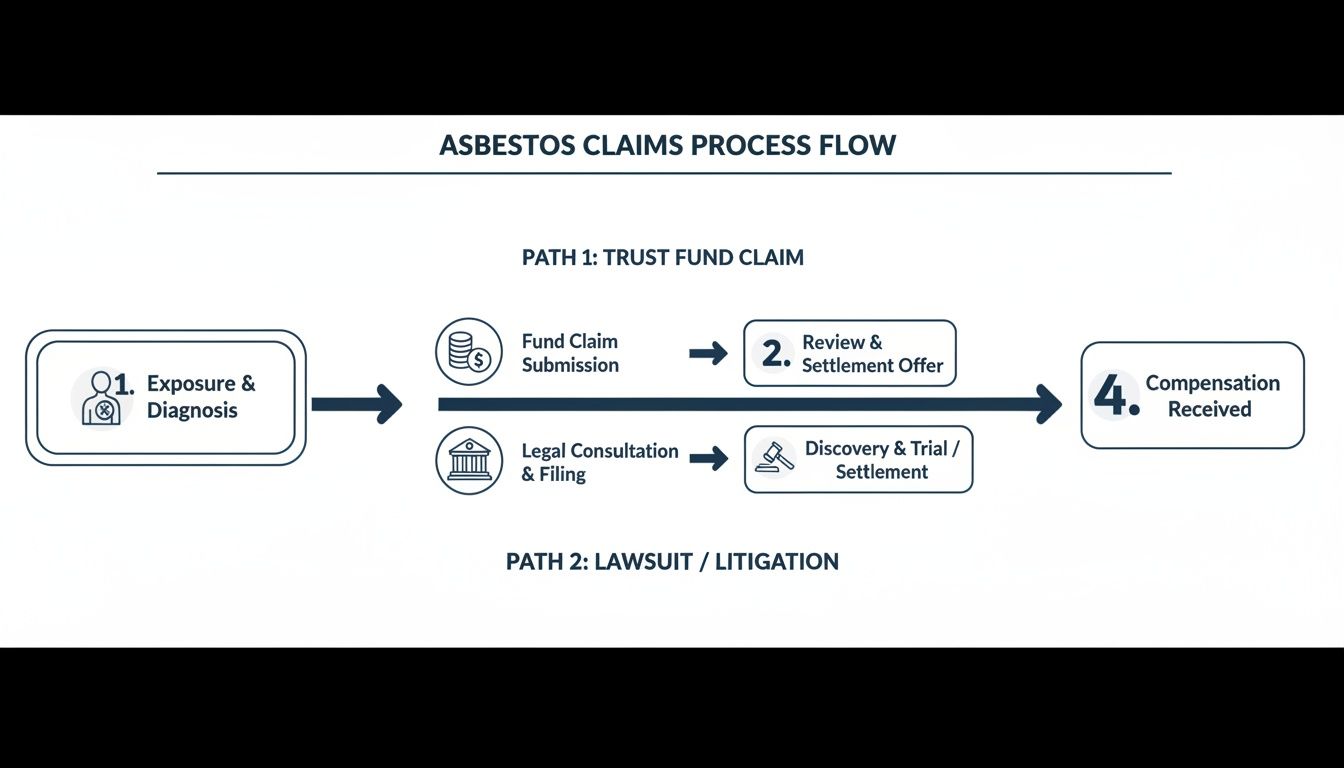
As you can see, the case can proceed as a claim against a trust fund set up by a bankrupt company, as a lawsuit against a solvent one, or a combination of the two.
The Legal Phases of a Lawsuit
If your attorney decides a wrongful death lawsuit is the best path forward, the process becomes more structured.
First, your attorney will file the claim. This is a formal legal complaint filed in court against the companies responsible for the exposure.
Next is the discovery phase, which is almost always the longest part of the legal battle. During discovery, both sides are required to share information and evidence. It’s an intense back-and-forth that involves:
- Written Questions (Interrogatories): Each side sends formal questions that the other must answer in writing, under oath.
- Document Requests: Your lawyer will demand that defendant companies hand over everything from internal safety memos and product specs to sales records.
- Depositions: These are sworn, out-of-court interviews with key people, including witnesses, company officials, and expert specialists like me. I’m often deposed to explain my autopsy findings.
The discovery phase is where cases are often won or lost. A detailed, professional autopsy report becomes an incredibly powerful piece of leverage here. It provides the kind of objective, scientific truth that holds up under the toughest legal scrutiny.
Finally, the case moves toward resolution. The vast majority of asbestos lawsuits end in a settlement. Lawyers for both sides negotiate to agree on a fair compensation amount. However, if a fair settlement can't be reached, the case is scheduled for trial, where all evidence is presented to a judge or jury for a final verdict.
Understanding these steps from the outset helps set realistic expectations. It’s a deliberate process, but every step is designed to build an undeniable case and hold negligent companies accountable. My job is to provide the clear, timely medical answers that give your legal team the confidence to fight for justice.
Answering Your Questions About Asbestos Claims
As a forensic pathologist with over 1,000 autopsies performed, I’ve worked on numerous asbestos cases. In that time, I've found that families and their attorneys almost always have the same core questions. When you're grieving and facing a complex legal process, you need clear, straightforward answers. Let's walk through the practical concerns I hear most often.
How much does a private autopsy for an asbestos claim cost?
The cost is understandably a major concern for families. At Texas Autopsy Services, my fee for a Private Autopsy is all-inclusive. It covers my professional services as a board-certified forensic pathologist, the facility fees, and the detailed final report. It's helpful to think of this not as an expense, but as a critical investment in your legal claim. Most asbestos law firms will advance the cost of the autopsy and recover it from the settlement or award, so your family doesn't have to bear the financial burden upfront.
Will an autopsy delay our funeral plans?
This is the most common question I get, and the answer is no. A private autopsy will not disrupt your family's plans for a funeral, viewing, or cremation. We handle all coordination directly with your funeral home. In Central Texas, for instance, we frequently partner with Waterloo Mortuary to make the entire process seamless and respectful. The examination is usually done in a single day, and your loved one is promptly returned to the funeral home's care, allowing you to proceed with your arrangements exactly as planned.
How long until we get the autopsy results?
While the physical part of the autopsy is quick, the real work for an asbestos case happens in the lab. I can typically provide a verbal report with my initial findings within just a couple of business days. However, the final, comprehensive written report, the one that includes tissue digestion and electron microscopy to count the asbestos fibers, is usually ready in 60 to 90 days. This detailed, scientific process is what produces the powerful evidence your legal team needs to build an airtight case.
The death certificate already lists cancer. Do we still need an autopsy?
Yes, in most cases. This is a critical point. A death certificate that lists "lung cancer" or "mesothelioma" is a doctor's medical opinion on the disease. It does not prove what caused it. Defense attorneys will argue that a history of smoking or other environmental factors caused the cancer, not their client's asbestos product. An autopsy shuts that argument down. By physically identifying and quantifying asbestos fibers in the lung tissue, my report provides the direct, scientific link between the exposure and the fatal disease. It turns suspicion into a medical fact that is incredibly difficult to refute. This is often the single most powerful piece of evidence in winning an asbestos claim after death.
If you're facing these difficult questions after a loss, getting definitive medical answers is the first step toward justice. The team at Texas Autopsy Services is here to help guide you through the process with compassion and precision. Please reach out to us to see how my expertise as a forensic pathologist can support your family.