March 26, 2026 · Texas Autopsy Services
Is a Pathologist a Doctor? Yes and Here is Why it Matters
Is pathologist a doctor? Yes! Learn about their rigorous training, board certifications, and vital diagnostic role in 2026 healthcare.
On this page
As a board-certified forensic pathologist, one of the most common questions I hear is, “Is a pathologist really a doctor?” The answer is simple: Yes, every pathologist is a medical doctor. We complete the same rigorous medical training as surgeons and pediatricians; our specialty is just different. We are the physicians who work behind the scenes to provide the definitive answers that guide patient care and, in my line of work, bring closure to families.
- Pathologists are medical doctors (MDs or DOs) who have completed medical school and a specialized residency.
- Our job is to diagnose disease by examining tissues, organs, and bodily fluids.
- We are often called the “doctor’s doctor” because other physicians rely on our findings to make treatment decisions.
- Forensic pathologists, like myself, apply this medical expertise to legal investigations to determine the cause and manner of death.
The “Doctor’s Doctor” Medical Experts Behind the Scenes
I am often called a “doctor’s doctor.” It’s a fitting title. Other physicians—from family doctors to surgeons—depend on my work to make critical decisions. When I diagnose a disease or perform a private autopsy, my medical expertise provides the factual foundation for a treatment plan or the answers a family needs after a loss.
Becoming a pathologist is a demanding journey. Every one of us holds a Doctor of Medicine (MD) or Doctor of Osteopathic Medicine (DO) degree. The path begins with a four-year bachelor's degree, followed by four years of medical school. We take the same science courses and pass the same national board exams as every other physician. This shared foundation is crucial; it ensures our diagnoses directly and accurately inform the care our colleagues provide.
A pathologist’s diagnosis is a medical conclusion, not an opinion. It is built on years of training in understanding disease at a cellular level, providing the factual bedrock for medical care.
After medical school, we complete a three to four-year residency focused entirely on pathology. This is where we analyze thousands of tissue samples and master complex procedures like autopsies. The commitment is just as intense as any other medical specialty. If you’re curious about the full scope of our work, our guide on a pathologist's job profile offers a detailed look at the vital role we play in healthcare.
The Rigorous Training Path of a Pathologist
The journey to becoming a pathologist is the same long road every physician travels, followed by years of specialized training. I know this process well because I’ve walked it myself. This extensive education is what solidifies our role as medical doctors who specialize in diagnosis.
It all starts with a four-year bachelor's degree, typically in a science like biology or chemistry. Next comes another four years of medical school to earn an MD or DO degree. Just like our colleagues in surgery or pediatrics, we master the same core medical sciences and must pass the same national board exams.
This timeline shows the foundational medical education every pathologist completes before we begin to specialize.

As you can see, the path is built on a solid foundation of general medicine we share with all other physicians. But that's just the beginning.
The Specialization Phase: Residency and Certification
With a medical degree in hand, our specialized training begins. We enter a pathology residency program, an intensive, hands-on immersion lasting three to four years. During this time, we are responsible for the diagnostic work on thousands of real cases, analyzing tissue specimens, interpreting blood tests, and performing autopsies under the supervision of senior pathologists.
This is where we build the deep expertise needed to identify disease at a microscopic level. After residency, the final step is passing a series of difficult exams from the American Board of Pathology. Earning that board-certified status is the gold standard in our field; it proves we have met the highest standards of competency.
Board certification isn't just a certificate. It's a formal validation by a medical board that a physician has demonstrated exceptional expertise in their specialty. For a pathologist, it signifies an expert-level ability to provide accurate diagnoses.
Fellowship: The Final Step to Subspecialization
For those of us who want to focus on a specific area, the training continues with a fellowship. A fellowship is an extra one to two years of highly focused training in a subspecialty like forensic pathology, which is my area of expertise. My own fellowship prepared me for the unique challenges of investigating cause and manner of death for legal cases, serving Texas families, attorneys, and counties.
All told, the entire process takes 11 to 14 years from the start of college to the end of a fellowship. It's a long road, but it's what’s required to provide definitive medical answers when they matter most. For a closer look at the training in my specific field, you can read our guide on the education required for a forensic pathologist.
Anatomic vs. Clinical Pathology: A Tale of Two Specialties
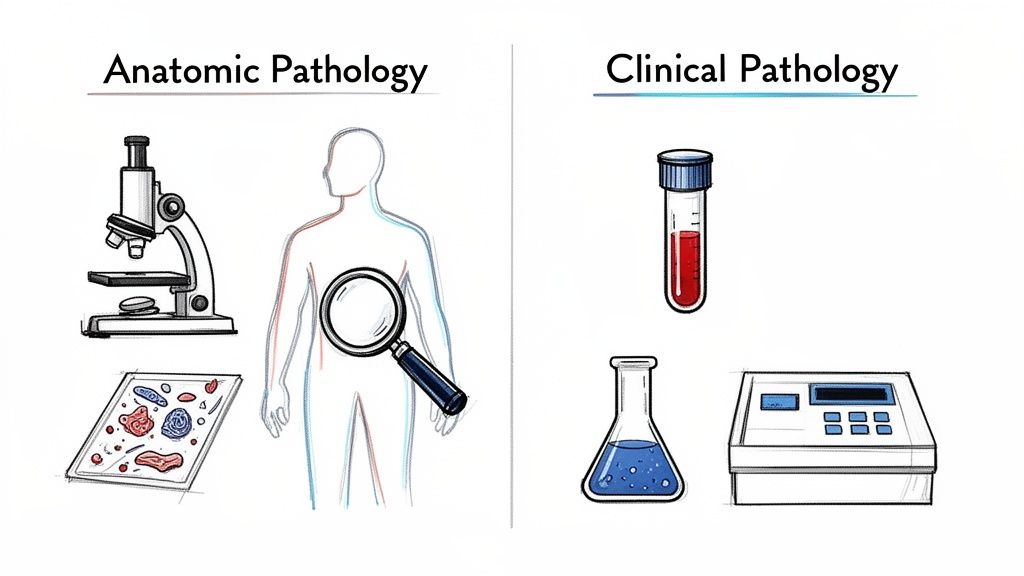
When people hear I’m a pathologist, their minds often jump to autopsies. While that’s a big part of what I do as a forensic pathologist, it’s only one part of a much larger field. Pathology has two major branches that examine the body in different ways: Anatomic Pathology and Clinical Pathology.
I am board-certified by the American Board of Pathology in Anatomic, Clinical, and Forensic Pathology. This triple certification gives me a comprehensive perspective, allowing me to see how disease affects everything from the body's largest organs down to the chemical reactions in blood. Understanding these two fields reveals just how vital pathologists are as medical doctors.
Anatomic Pathology: The Body's Architect
Anatomic pathology is what most people picture when they think of my job. We diagnose disease by looking directly at tissues, organs, and whole bodies.
When a surgeon removes a suspicious growth, it is sent to an anatomic pathologist. We are the doctors who examine it under a microscope and make the definitive call: Is it cancer? That diagnosis is what an oncologist uses to create a patient’s entire treatment plan.
My work in conducting a cause of death investigation is a form of anatomic pathology. It involves a systematic approach to get concrete answers:
- Gross examination: A detailed visual inspection of organs and tissues.
- Histology: Microscopic analysis of tissue samples to see disease at the cellular level.
- Autopsy: The comprehensive postmortem examination that brings all the evidence together.
At its core, anatomic pathology is about finding the physical evidence of disease.
Clinical Pathology: The Body's Chemist
Clinical pathology takes place in the laboratory, focusing on the analysis of bodily fluids like blood and urine.
When you have blood work done, a clinical pathologist is the doctor in charge of that lab. They oversee the teams that run your blood counts, check your cholesterol levels, and test for infections. More importantly, they ensure those test results are accurate and help other doctors understand what they mean for patient care.
Their expertise is in the body’s chemistry and function, not its physical form.
The easiest way to think about it is this: Anatomic pathology examines the body's hardware—the tissues and organs—while clinical pathology analyzes its software—the millions of chemical processes that keep it running.
This table highlights the key differences between these two critical medical specialties.
Anatomic vs. Clinical Pathology Key Differences
| Aspect | Anatomic Pathology | Clinical Pathology |
|---|---|---|
| Primary Focus | Diagnosing disease through tissue and cell examination. | Managing and interpreting laboratory tests of bodily fluids. |
| Materials Examined | Biopsies, surgical resections, organs, and whole bodies. | Blood, urine, spinal fluid, and other liquid samples. |
| Key Procedures | Microscopic analysis, surgical pathology, and autopsies. | Blood banking, chemistry analysis, microbiology, and toxicology. |
| Common Questions | "Is this tissue cancerous?" or "What was the cause of death?" | "Does the patient have an infection?" or "Are their kidneys functioning properly?" |
Both of these disciplines demand a full medical degree and years of specialized training. My experience in both allows me to connect the dots in complex cases. During a private autopsy, I can link a chemical abnormality found in a toxicology screen directly to the physical damage I observe in the liver, giving families and attorneys a complete and clear picture of what happened.
What a Forensic Pathologist Does
While all pathologists diagnose disease, my specific field of forensic pathology exists at the intersection of medicine and law. As a forensic pathologist, I'm a medical doctor who uses specialized training to answer legal questions, usually surrounding a sudden, unexpected, or violent death.
My work is a medical investigation. I don't just perform an examination; I piece together a story based on objective medical facts, all within the strict procedures of a legal investigation.
Determining Cause and Manner of Death
In every case, my main goal is to determine two critical pieces of information: the cause of death and the manner of death. They sound similar, but they are very different things and together they form the core of a death certificate.
Cause of Death: This is the specific injury or disease that started the chain of events leading to death. It’s a medical conclusion. Examples include a heart attack, a gunshot wound, or complications from pneumonia.
Manner of Death: This is the legal classification of how the death occurred based on the available evidence. In Texas, as in most places, we use five categories: Natural, Accident, Suicide, Homicide, and Undetermined.
The easiest way to remember the difference is that the cause is why the person died, and the manner is how it happened. For example, the cause of death might be "blunt force trauma to the head," while the manner could be "Homicide" or "Accident," depending on the circumstances.
The Role of an Independent Investigator
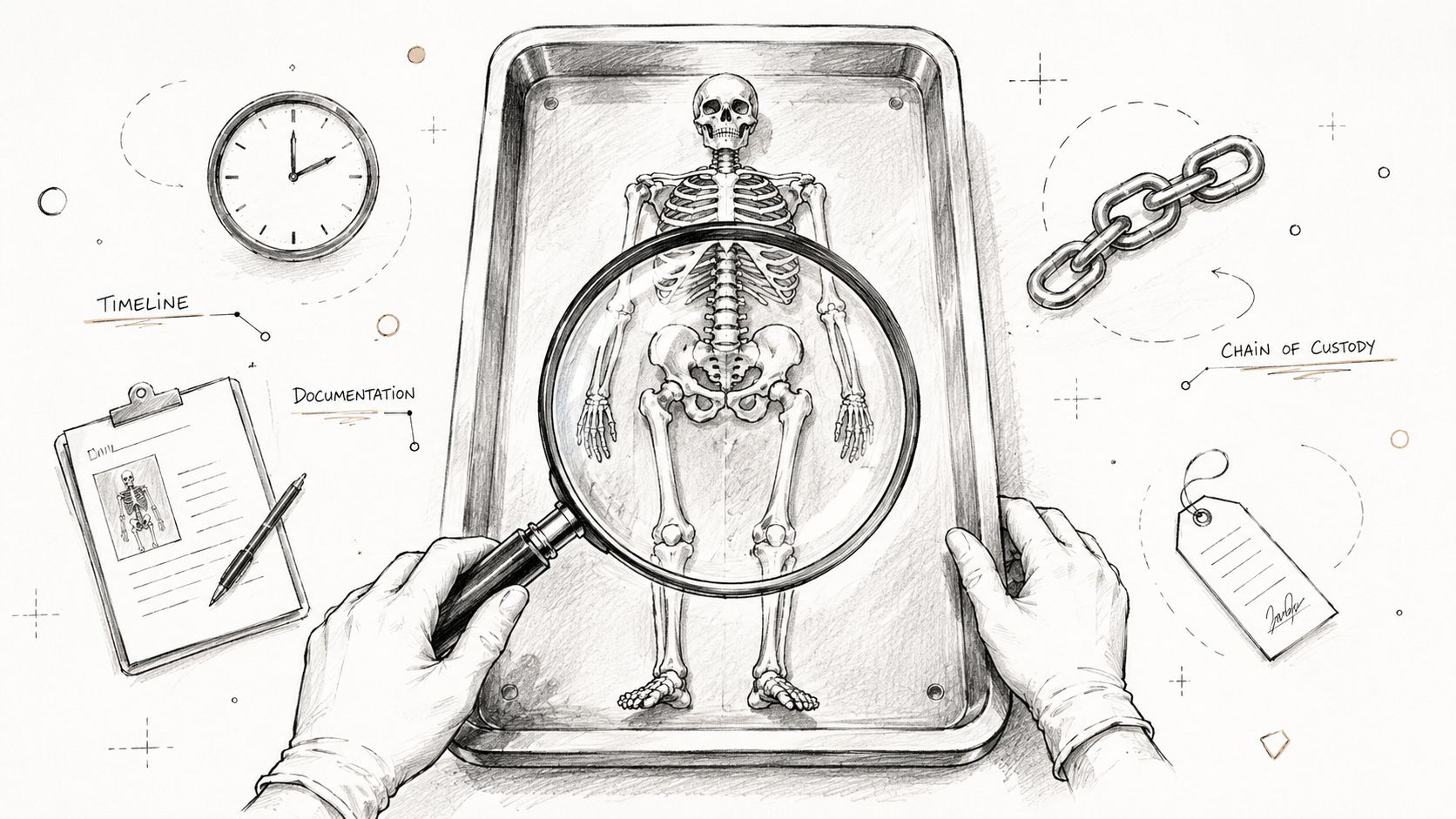
This work demands absolute precision. Every step, from collecting evidence to documenting findings, must be handled with extreme care to preserve the chain of custody. This ensures that all evidence is reliable and can hold up in court.
You can learn more about the specifics of our work in this guide on what is a forensic pathologist.
At Texas Autopsy Services, I offer this specialized medical expertise to families, attorneys, and agencies who need clear, unbiased answers. Whether it’s a family looking for closure, an attorney building a case, or one of the many Texas counties we support, my job is to find the truth through medicine. It is a profound responsibility, and I am committed to handling every case with the dignity the deceased deserves.
Why Only a Pathologist Can Perform an Autopsy
People often ask why an autopsy must be done by a specific type of doctor. The answer is that an autopsy isn't just an examination—it's the final act of medical diagnosis. As a pathologist, I’m a medical doctor who has spent years training to perform this exact procedure. It is a methodical and respectful investigation aimed at finding definitive answers.
While a family doctor is an expert in treating living patients, they aren't trained to interpret the complex story a body tells after death. My specialty is understanding the language of disease and injury at a cellular level. This is why only a pathologist is qualified to conduct an autopsy. We are trained to see the clues that others would miss.
A Systematic Medical Investigation
An autopsy is a careful process that moves from the big picture down to the smallest detail. It's a combination of different analytical methods.
- Gross Examination: This is the first step, where I methodically inspect the body and its organs with the naked eye. I’m looking for visible signs of trauma, disease, or other abnormalities.
- Microscopic Analysis: After the initial examination, I take small tissue samples from key organs. Looking at these under a microscope provides a cellular-level view, which is critical for spotting hidden infections, early-stage cancers, or subtle heart problems that are otherwise invisible.
Connecting what the eye sees with what the microscope reveals is the core of my work. An accurate and reliable cause of death investigation is impossible without a medical degree and the years of specialized residency training that a pathologist completes.
An autopsy is fundamentally a medical procedure. It is the practice of medicine on a person who has passed away, requiring the same diagnostic expertise as treating a living patient. It is not a technical task that can be delegated to someone without a medical license and specialized pathology training.
This isn't just professional opinion; it's reflected in the legal and ethical standards here in Texas and across the country. For a death certificate to be signed and for the findings to hold up in court, the autopsy must be performed by a qualified physician. This ensures families get trustworthy answers and that any legal matters are built on a foundation of solid medical evidence.
The Pathologist's Role on the Medical and Legal Teams
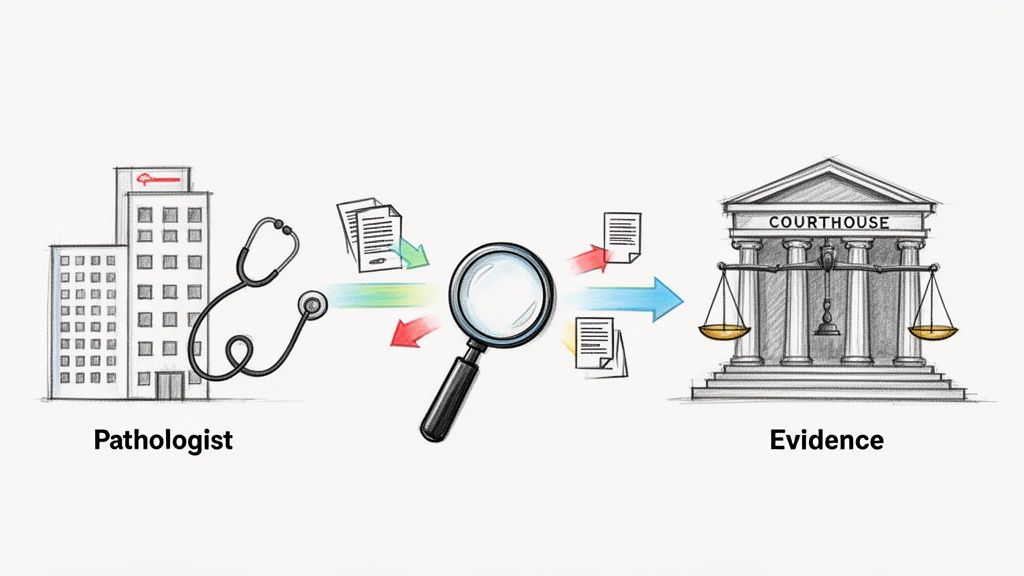
Though we often work behind the scenes, pathologists are trusted consultants for both doctors and lawyers. In a hospital, a pathologist’s diagnosis of a tissue biopsy determines a cancer patient’s treatment plan. In the legal world, my findings from a forensic autopsy can become the linchpin of an investigation, offering objective proof that a crime did—or did not—occur.
We are an essential part of the medical team. We provide the diagnostic backbone by analyzing everything from tissue samples to lab work, such as understanding blood count tests. Our medical expertise provides the definitive answers that other professionals and families depend on.
An Independent Voice for Truth
Let me give you an example from my experience. A family was told their loved one died from natural causes, but the circumstances didn't sit right with them. They came to me for a second opinion autopsy, hoping for an independent review.
During my examination, I discovered subtle but clear signs of an adverse drug reaction that had been missed. This single finding completely changed the family’s understanding of what happened, giving them the clarity they desperately needed. It’s a perfect illustration of our most important function: to provide objective truth.
A pathologist’s duty is to the evidence. We follow the medical facts wherever they lead, providing unbiased findings that bring clarity to complex situations for families, attorneys, and medical teams.
As of June 2019, there were 21,292 active pathologists in the U.S. We aren't a small part of medicine; we're an integral group of physicians. That number includes doctors across 15 recognized subspecialties, including forensic pathology. These numbers confirm just how many doctors are dedicated to the science of diagnosis.
Ultimately, our work isn't just about science; it's about delivering definitive answers. Whether for a family struggling with a loss or an attorney building a case on facts, the medical doctor performing the analysis must be an impartial expert.
Your Questions About Pathologists Answered
Over the years, I’ve found that families and attorneys often have the same questions about what my work as a pathologist really involves. I want to clear up some of the most common points of confusion and give you a straightforward look into my profession.
Can a Pathologist Prescribe Medication?
Technically, the answer is yes. Every pathologist is a fully licensed medical doctor (MD or DO), which means we legally can write a prescription.
In practice, however, we almost never do. Our specialty is diagnosing disease, not treating patients directly. Our job is to give a primary care doctor, surgeon, or oncologist the precise information they need to make the right treatment decisions. While we have a deep knowledge of pharmacology, our work happens in the lab, not the exam room.
Do Pathologists Ever Talk to Patients or Families?
Absolutely. While you might not see us making rounds in a hospital, communication is a huge part of our job. In a clinical setting, we constantly consult with other physicians about what we see under the microscope.
In my work at Texas Autopsy Services, talking with families is one of the most important things I do. After I complete a private autopsy, I make it a priority to personally call the family. My goal is to walk them through my findings in plain language, answer every question they have, and provide the clarity they are searching for.
I believe a pathologist's duty extends beyond the microscope. Taking the time to compassionately explain the truth to a family is a core part of our responsibility as physicians.
Is a Coroner the Same as a Pathologist?
This is a common point of confusion, but the roles are entirely different. A pathologist is always a medical doctor who has completed years of specialized training to become an expert in disease.
A coroner, on the other hand, is an elected or appointed official responsible for investigating certain deaths. Here in Texas, that role is filled by the Justice of the Peace. A coroner or Justice of the Peace is a legal authority who may have no medical background. Their job is to decide if a death warrants an official investigation and, if so, order an autopsy. When they order that autopsy, it must be performed by a medical expert—a board-certified forensic pathologist. Simply put, the Justice of the Peace asks the legal "why," and the pathologist provides the medical answer.
At Texas Autopsy Services, my promise is to provide not just answers, but clarity and understanding with compassion. If you have more questions or need guidance, please do not hesitate to reach out. Our team is here to help you.