March 29, 2026 · Texas Autopsy Services
A Guide to Pathologist Medical Terminology for Families and Attorneys
Understand key pathologist medical terminology with this plain-language guide. Learn what terms in an autopsy report mean for legal cases and family clarity.
On this page
- Your Guide to Foundational Pathology Terms
- Terms Describing the Autopsy Process
- Defining Cause, Manner, and Mechanism of Death
- Glossary of Common Pathological Findings by System
- Understanding Toxicology and Laboratory Terminology
- The Pathologist's Role: A Commitment to Clear Answers
- Common Questions After an Autopsy
As a board-certified forensic pathologist, I have sat with countless families and attorneys in Texas. I know that the technical language in an autopsy report can feel like another wall to climb during an already difficult time. My goal is to break down that wall by translating the essential pathologist medical terminology you’ll encounter into plain, straightforward language.
A Compassionate Guide to Medical Language
Whether you’re a family member seeking answers or an attorney building a case, understanding what a report says is the first step. This guide is built so you can find what you need, when you need it. You can look up specific words or read through entire sections to get a better handle on the bigger picture, from the core parts of a report to the precise terms used to describe cause and manner of death.
This isn't just a challenge for families. Even within medicine, the language of pathology can be inconsistent. One study examining just 26 terms found a staggering 416 possible definitions across different sources. Worse, only about 27% of those definitions were documented, and no single resource defined them all. When terms aren't clear, communication breaks down and accuracy suffers, something I am dedicated to preventing in every report I write.
Why This Guide Is for You
I created this for anyone who must make sense of an autopsy report but doesn't have a medical degree. The language looks intimidating, but it has its own logic. We'll break it down together.
Here’s my approach:
- Simple Definitions: I translate complex medical terms into clear, easy-to-understand explanations. No fluff, just what you need to know.
- Real-World Context: You won’t just learn what a word means; you'll see why it matters and how it appears in an actual report.
- Organized for Quick Lookups: The guide is arranged by topic, so you can easily find information about the autopsy process, specific injuries, or internal findings.
At Texas Autopsy Services, my commitment has always been to provide not only a thorough service but also true clarity and compassion when it's needed most. Understanding these terms is about learning the building blocks of the final report.
Your Guide to Foundational Pathology Terms
An autopsy report can feel like it's written in another language. But once you get a handle on a few key terms, the whole document starts to make sense. These are the building blocks of every postmortem examination.
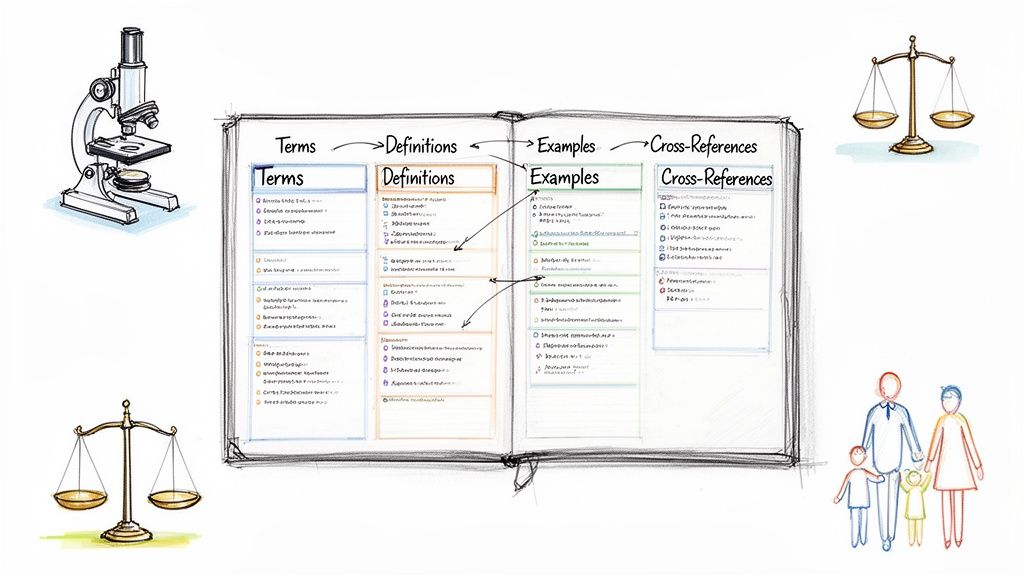
To get you started, I’ve put together a quick-reference table. It cuts through the medical jargon to give you simple definitions for the most common terms you'll see right away.
Foundational Autopsy and Pathology Terminology
| Term | Plain-Language Definition | Why It Matters |
|---|---|---|
| Gross Examination | This is the hands-on, physical inspection of the body and its organs, done with the naked eye. I document all measurements, weights, and anything that looks abnormal or injured. | This is where I find the most direct evidence. It reveals obvious trauma, tumors, or organ abnormalities that don't need a microscope to be seen. |
| Histology | The microscopic study of tissue. I take very small samples from organs, which are then stained and put on slides to be examined under a microscope. | Histology is how I see what's happening at a cellular level. It's essential for diagnosing things like hidden heart disease, infections, or subtle changes that are invisible otherwise. |
| Toxicology | The testing of blood, urine, or tissue samples to look for drugs, alcohol, poisons, or other chemicals. | This tells us whether substances played a role in the death. It’s crucial for sorting out if a drug was used therapeutically, was at an overdose level, or if poisoning occurred. |
Think of these three as the core pillars of any autopsy. The gross examination gives the big picture, while histology and toxicology provide the critical microscopic and chemical details.
Understanding how these elements fit together is the key to reading the report. For a deeper dive into this, I recommend our complete guide on how to read a pathology report.
Terms Describing the Autopsy Process
When I begin an autopsy, my approach is always the same: methodical, thorough, and respectful. The specific terms I use in my reports aren't just jargon; they describe a precise sequence of events, and understanding them is the first step to making sense of the findings.
The entire procedure is called a postmortem examination, which literally just means "after death." This is the formal name for the comprehensive process I undertake to find the cause and manner of death.
The External and Internal Examinations
Every autopsy unfolds in two main parts. We start with the external examination, which is a careful, head-to-toe inspection of the outside of the body.
Here, I’m documenting everything visible on the surface. This creates a baseline and often provides the first clues. The record will include:
- Basic physical traits like height, weight, and hair and eye color.
- Unique identifying features, such as scars, tattoos, or birthmarks.
- Any signs of recent medical care, like IV lines, EKG pads, or surgical staples.
- Evidence of injury, no matter how small, from bruises and scrapes to more significant wounds.
Once the external review is complete, I move on to the internal examination. This involves making a standard incision to get a clear view of the organs in the chest and abdomen. Each organ is then carefully removed, weighed, and inspected.
This leads to the next step, organ dissection. I examine each organ one by one, looking for any sign of disease or injury. For instance, I'll slice into the heart to look for the signs of a heart attack (a myocardial infarction) or check the lungs for pneumonia or a blood clot (a pulmonary embolism). It's during this phase that I take small tissue samples for histology, which is the microscopic examination that happens later.
As a forensic pathologist, I've learned that you have to let the evidence speak for itself. You can't walk in with a preconceived theory. Every finding, whether it's a tiny bruise on the outside or a subtle change deep inside an organ, is a piece of the puzzle. My job is to collect all those pieces without bias.
Securing the Integrity of Evidence
In any case, but especially those that might end up in court, the chain of custody is non-negotiable. Think of it as a formal paper trail that meticulously documents who had control of a piece of evidence and when.
From the second I receive the body, everything I collect—tissue samples, toxicology specimens, personal belongings—is labeled, sealed, and tracked. This unbroken chain proves that the evidence I analyze is the exact same evidence that was collected, with no chance for it to have been tampered with or contaminated.
When performing a private autopsy in Texas, maintaining a solid chain of custody is essential for providing families and their attorneys with a report they can trust completely.
Defining Cause, Manner, and Mechanism of Death
When I conduct a death investigation, my job is to piece together the full story. To do that, I focus on three core concepts: the cause, the manner, and the mechanism of death. People often use these terms interchangeably, but in my work as a pathologist, they each have a very specific and distinct meaning.
Getting these terms right isn't just a matter of semantics. A clear and accurate determination is the foundation for everything that follows, from insurance claims and wrongful death claims to giving a family the answers they deserve.
Cause of Death: The Underlying Reason
The cause of death is the specific injury or disease that started the sequence of events that ultimately led to death. It’s the "why." This could be a sudden, violent event or a chronic disease a person has battled for years.
Here are a few straightforward examples of a cause of death:
- Coronary Artery Disease: The progressive hardening and narrowing of the heart's arteries.
- Gunshot Wound to the Chest: A specific, traumatic injury.
- Blunt Force Head Trauma: An injury from an impact, like in a fall or an assault.
- Metastatic Lung Cancer: A disease that has spread from the lungs to other parts of the body.
Pinpointing the cause of death is the primary objective of the autopsy itself.
Manner of Death: The Classification
Next is the manner of death, which isn't a medical finding but a legal classification of the circumstances. Based on the evidence and the established cause, I assign one of five categories, which are standard in Texas and most other places.
The 5 Manners of Death:
- Natural: Death resulting exclusively from disease or old age.
- Accident: An unintentional death from an unforeseen event or injury.
- Suicide: A death caused by a person's own deliberate, self-inflicted act.
- Homicide: Death resulting from the actions of another person.
- Undetermined: When the evidence is insufficient to confidently assign one of the other four manners.
My role here is not to assign blame but to classify the death based on the forensic evidence at hand. The chart below shows the systematic process I follow to gather that evidence.

Following this process ensures that every piece of information, from external observations to internal organ analysis, contributes to a reliable conclusion.
Mechanism of Death: The Final Step
Finally, we have the mechanism of death. This is the immediate physiological process—the specific way the body finally shut down. It's the end result of the cause of death. For example, if the cause of death was coronary artery disease, the mechanism might be a cardiac arrhythmia (a fatal irregular heartbeat).
It's easy to confuse the mechanism with the cause, but they are different. The cause is the root problem; the mechanism is the final biological failure it produced. It's a subtle but crucial distinction, and getting it right is at the heart of what pathologists do. For an in-depth look at this concept, you can read our detailed explanation of the mechanism of death.
Glossary of Common Pathological Findings by System
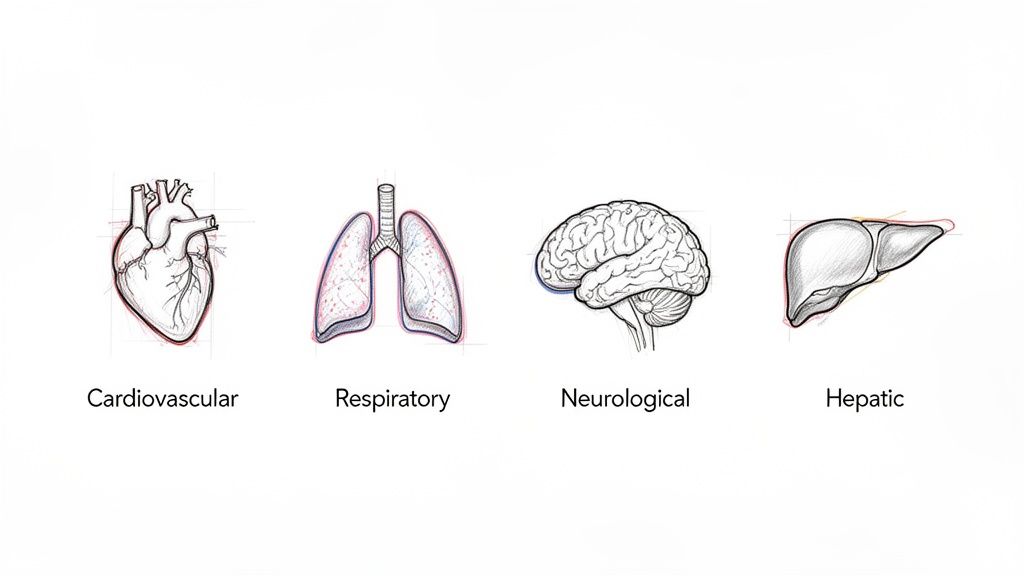
When you read an autopsy report, you'll notice I organize my findings organ by organ. This systematic approach is how we build a complete medical story. To really understand the conclusions, you need to be familiar with the pathologist medical terminology I use to describe what I've found.
This glossary is laid out by organ system so you can easily find the terms that appear in your report. I'll give you a plain-language definition for each and explain what it might mean for the cause of death, connecting my specific observations to the big picture.
Cardiovascular System
The heart and blood vessels are frequently at the center of a death investigation. While many conditions here lead to natural death, they can also be impacted by outside factors like trauma or toxicology.
- Atherosclerosis: This is the hardening and narrowing of arteries from plaque buildup. When I find severe atherosclerosis in the coronary arteries—the ones feeding the heart muscle itself—it's a major indicator of underlying heart disease.
- Myocardial Infarction: This is the clinical term for a heart attack. It happens when blood flow to a section of the heart gets cut off, causing that muscle tissue to die. I look for specific cellular changes under the microscope that help me pinpoint how long ago the heart attack occurred.
- Cardiomegaly: This just means an enlarged heart. It isn't a cause of death on its own, but it's a critical clue. It tells me the heart was working too hard for too long, often due to high blood pressure, valve disease, or other chronic issues.
- Aortic Dissection: This is a tear inside the body's main artery, the aorta. Blood then forces its way between the layers of the artery wall, causing them to peel apart. This is a catastrophic event that can cause death very quickly from internal bleeding.
By documenting these findings from both the visible (gross) and microscopic exams, I can construct a clear picture of the person's heart health when they died.
Respiratory System
When I examine the lungs, I'm looking for evidence of long-term disease, sudden injury, or infection. What I discover in the respiratory system can often point directly to what caused death, whether it was sudden or happened over time.
- Pulmonary Embolism: This is a blockage in one of the lung's arteries. It's usually caused by a blood clot that formed elsewhere, typically in the legs, and traveled to the lungs. A massive pulmonary embolism is a well-known cause of sudden death.
- Pneumonia: This is an infection that inflames and fills the tiny air sacs in the lungs. Microscopically, I'll see the lung tissue flooded with fluid and white blood cells fighting the infection. Pneumonia can be the primary cause of death, especially for the elderly or people with compromised immune systems.
- Pulmonary Edema: This term means there is excess fluid inside the lungs. It's often a consequence of heart failure but can also be triggered by direct lung injury, severe infections, or a drug overdose.
Neurological System
The brain is well-protected by the skull, but it remains incredibly vulnerable to injury, disease, and problems with its blood supply. My examination of the brain and central nervous system is absolutely crucial, particularly when the circumstances around the death are not immediately obvious.
During an autopsy, the brain provides a silent but detailed account of a person's final moments and long-term health. Subtle changes in its structure can reveal everything from chronic high blood pressure to the immediate effects of trauma or a stroke.
- Cerebral Edema: This is brain swelling. It can result from a traumatic head injury, stroke, infection, or a critical lack of oxygen. When swelling becomes severe, it raises the pressure inside the skull, which can compress vital brain structures and turn fatal.
- Intracranial Hemorrhage: This just means bleeding inside the skull. In my report, I specify the exact location—like subdural (under the brain's tough outer lining), subarachnoid (on the surface of the brain), or intraparenchymal (within the brain tissue itself). Bleeding can be caused by trauma or a spontaneous rupture of a blood vessel.
- Cerebrovascular Accident (CVA): This is the formal term for a stroke. Strokes are either ischemic, meaning they're caused by a clot blocking a vessel, or hemorrhagic, meaning they're caused by active bleeding in the brain.
Hepatic System (Liver)
The liver can withstand a lot, but it is certainly not invincible. It's often damaged by toxins like alcohol, viral infections, and metabolic problems.
- Cirrhosis: This is advanced, irreversible scarring (fibrosis) of the liver. It's the end stage of long-term damage from sources like chronic alcoholism or hepatitis. The functional liver tissue gets replaced by hard, useless scar tissue, leading to liver failure.
- Steatosis: This is a buildup of fat within the liver cells, more commonly known as "fatty liver." When severe, it can cause inflammation (steatohepatitis) and eventually progress to cirrhosis. It’s most often linked to alcohol abuse or metabolic syndrome.
Understanding Toxicology and Laboratory Terminology
When the cause of death isn't obvious from the physical exam, we turn to the laboratory. Toxicology, in particular, often holds the key, giving us a window into what substances were in the body at the time of death. Understanding the terms we use in these lab reports is the first step to truly understanding the findings.
A toxicology screen is our starting point. Think of it as casting a wide net to check for the most common drugs and chemicals. It’s a broad, initial search to see what, if anything, is there.
Presumptive vs. Confirmatory Testing
Those initial screens are what we call presumptive tests. They’re designed to be very sensitive and can quickly flag the possible presence of a whole class of drugs, like opioids or benzodiazepines. Their sensitivity, however, can sometimes lead to false positives.
That’s why a positive presumptive test is never the final word. We always follow up with confirmatory testing. This involves much more sophisticated methods, like mass spectrometry, that can pinpoint the exact drug and measure how much of it is present. Only a confirmed result is considered definitive proof.
Interpreting Substance Levels
Just finding a substance isn't the whole story; the amount, or concentration, is what really matters. When you read a toxicology report, you'll see specific terms used to describe these concentrations. To see these terms in a real-world format, you can review this example toxicology report.
- Therapeutic Level: This is the expected concentration when someone is taking a medication correctly, as prescribed by their doctor. It generally suggests the drug was being used as intended.
- Toxic Level: At this concentration, a substance can cause harm or significant side effects. It’s above the therapeutic range and indicates an overdose, though not necessarily a fatal one.
- Lethal Level: This is a concentration that has been shown in medical literature to be high enough to cause death on its own.
You’ll also see the term metabolites. These are the byproducts the body creates as it breaks down a drug. Finding metabolites helps me understand if a drug was taken recently and how the person’s body was processing it before death.
A toxicology report doesn't exist in a vacuum. A pathologist's job is to interpret the numbers within the full context of the deceased's medical history, autopsy findings, and the circumstances surrounding the death. A therapeutic level of a drug could still contribute to death in a person with severe underlying heart disease.
Beyond Toxicology: Other Essential Lab Tests
While toxicology gets a lot of attention, other lab tests are often just as vital to the investigation. Two of the most important are histology and microbiology. As we've covered, histology is the microscopic study of tissue samples. It’s how I can see disease at the cellular level, confirming things like a heart attack, pneumonia, or even subtle cancers.
Microbiology is all about testing for infections—bacteria, viruses, or fungi. If I suspect sepsis or meningitis might be the cause of death, microbiology cultures can identify the exact organism responsible. Together, all these laboratory disciplines provide the detailed scientific evidence needed for an accurate and complete conclusion.
The Pathologist's Role: A Commitment to Clear Answers
As a forensic pathologist with board certification from the American Board of Pathology, I've learned that my job doesn't end in the laboratory. The most careful scientific work means little if the people who need the answers can't understand the results. My true role is to be a communicator—to translate complex medical findings into a clear, accurate, and unbiased report that delivers answers with compassion.
This commitment to clarity is the foundation of Texas Autopsy Services. We work with families, attorneys, and county officials across Texas. My goal is simple: to make sure every report is not just medically exact but also completely understandable.
More Than Just Medical Terms
Knowing the vocabulary in a pathology report is a good start, but it's not the whole story. The real work is connecting all those individual findings into a clear picture of what happened. That’s where my experience from performing over 1,000 autopsies comes in.
My responsibilities go far beyond the initial examination. It's my job to:
- Put the Pieces Together: I bring together findings from the physical examination, histology, toxicology, and any other labs to form a single, logical conclusion.
- Explain the "Why": I don't just report what I found; I explain why it matters in the context of what happened to the person.
- Answer Your Questions: I make myself available to families and attorneys to walk through the report and clear up any confusion.
This work is about honoring the person who has passed by creating a factual and respectful record. It's also about honoring their loved ones by giving them the straightforward answers they deserve.
As a pathologist, I have two duties. The first is to the scientific truth I uncover. The second is to the family and legal professionals who depend on that truth. I believe both deserve equal dedication.
Meeting a Critical Need in Texas
The work of a pathologist is incredibly specialized, and there aren't enough of us. Globally, there are over 108,000 pathologists, but that’s only 0.8% of all doctors. In the United States, the number is around 21,215 active pathologists, which works out to about 6.4 for every 100,000 people. You can learn more about the global state of the pathology workforce and its challenges00511-5/fulltext).
With many pathologists nearing retirement, the need for clear, dependable services has never been more urgent. This is precisely the gap Texas Autopsy Services was created to fill. My personal commitment is to bridge the divide between complex pathologist medical terminology and the clear, definitive answers your family or your case needs. It's a responsibility I take very seriously.
Common Questions After an Autopsy
Once a family has the report in hand, the questions often start. And that’s a good thing. These conversations are where the dense medical terminology on the page gets translated into real, meaningful answers. It's completely normal to need some help deciphering it.
I've talked with hundreds of families and attorneys over the years, and many of the same questions come up. My hope here is to answer some of them for you.
What Should I Do If I Don’t Understand a Term in the Report?
First, don't ever feel like you have to guess. Asking for help is the single most important thing you can do. My job isn’t finished when I sign the report; it's finished when you understand what it says.
If you come across any pathologist medical terminology you don't recognize, just reach out to my office. I’m always happy to schedule a call to walk you through the report, line by line.
To get the most out of our conversation, a little preparation can go a long way:
- Highlight or jot down the specific words and sentences you find confusing.
- Write out your questions as they pop into your head while you're reading.
- Make a note of which sections of the report you'd like me to spend more time on.
Doing this helps us stay focused and make sure every single one of your concerns is addressed. No question is too small.
What Does an 'Undetermined' Manner of Death Mean?
It can be incredibly frustrating to get a report back that lists the manner of death as "Undetermined." It feels like a non-answer. But from a pathologist's perspective, it’s a sign of scientific integrity.
An "Undetermined" conclusion means the evidence simply isn't strong enough to classify the death as natural, accident, suicide, or homicide. There are a few common scenarios where this happens:
- Competing Possibilities: Sometimes, the evidence points in two different directions. For instance, imagine someone with severe heart disease is found at the bottom of a staircase. Did they have a fatal heart attack and then fall (natural), or did they trip and die from the fall itself (accidental)? If we can't say for sure, the manner is undetermined.
- Lack of Scene Information: This is common with skeletal remains or when a body is found long after death. Without the context of the scene or circumstances, it's impossible to rule out different possibilities.
- Toxicology Ambiguity: A specific drug level might be lethal for one person but therapeutic for someone who has built up a tolerance. Without more information, we can't definitively prove the drug caused the death.
An "Undetermined" finding just means that, by professional and ethical standards, the pathologist cannot make a definitive call. It shows a commitment to sticking to the facts, not speculating.
This doesn't always have to be the final word. If new information comes to light down the road, it's sometimes possible to amend the death certificate.
How Do I Request a Second Opinion or Another Autopsy?
If you have doubts or lingering questions about an official autopsy, you absolutely have the right to get an independent review. This usually happens in one of two ways: either as a second opinion on the original findings or, in some cases, a completely second autopsy.
A second opinion is when an independent, board-certified pathologist like me reviews all the case materials—the original report, tissue slides, toxicology results, scene photos, and medical records. My job is to see if I come to the same conclusions or if the evidence could point to a different interpretation.
A second autopsy is a much bigger step and is only an option if the person has not been cremated or buried in a way that makes exhumation impossible. Here, I would perform an entirely new physical examination. This can be critical if the first autopsy was very limited or if specific concerns weren't addressed. Here at Texas Autopsy Services, we can help you figure out which path—a second opinion or a new autopsy—makes the most sense for your situation.
Going through a loss is hard enough without having to decode a complex medical document. If you need an independent pathologist to perform an autopsy or just need help making sense of a report you already have, my team and I are here to give you clear, compassionate, and scientifically sound answers. Please contact Texas Autopsy Services at (806) 230-1889 for a confidential consultation. https://www.texasautopsyservices.com