March 2, 2026 · Texas Autopsy Services
Understanding Your Surgical Pathology Report in Texas
I'll help you understand your surgical pathology report. This guide explains key terms, sections, and what the findings mean for your health.

On this page
- Why a Surgical Pathology Report Matters
- Understanding Each Section of Your Report
- Common Medical Terms and What They Mean for You
- The Growing Need for Accurate Pathological Analysis
- Surgical Pathology Reports vs Autopsy Reports
- When to Seek a Second Opinion on Your Report
- Answering Your Questions About Pathology Reports
A surgical pathology report is often the most important document I create for a living patient. As a board-certified forensic pathologist, my work involves translating what I see in a tissue sample under a microscope into clear, definitive answers. After a biopsy or surgery, this report becomes the diagnostic blueprint that guides your medical team’s treatment decisions. Understanding it is a critical first step in managing your health.
- A surgical pathology report is a medical document that provides a diagnosis based on the examination of tissue removed during a procedure.
- The report is written by a pathologist and includes a gross (visual) and microscopic description of the tissue, culminating in a final diagnosis.
- Key terms like "benign" (non-cancerous) vs. "malignant" (cancerous), tumor grade, and surgical margins determine the next steps in treatment.
- The report is a legally protected health record; you have the right to obtain a copy and should discuss it with your doctor.
- If the diagnosis is complex or uncertain, seeking a second opinion from another board-certified pathologist is a standard and valuable step.
Why a Surgical Pathology Report Matters
A family from Central Texas recently contacted me. Their mother had surgery to remove what was thought to be a benign growth. Their initial relief turned to confusion when they received the surgical pathology report. It contained terms like "atypical cells" and "undetermined significance," which left them anxious and unsure about what to do next. This situation is common, and it highlights why understanding this document is so vital.
My role is to translate cellular observations into clear answers. This report is the foundation of a treatment plan; it informs your doctors about the nature of a disease and what they must do. It’s a critical piece of your medical record, and learning its structure is an important part of your healthcare journey. For those who want more background, you can learn more about what a pathology report is in our detailed guide.
The Purpose of the Report
A surgical pathology report is a diagnostic blueprint. It’s not just a list of medical terms; it’s a structured narrative that tells a story about your health at a cellular level. Each section builds on the last to give your medical team a complete picture.
Ultimately, its main functions are to:
- Confirm a Diagnosis: It verifies or rules out conditions like cancer, infections, or inflammatory diseases.
- Guide Treatment: The details in the report—like the tumor type, its grade, and the status of surgical margins—directly influence the next steps. These may include observation, medication, radiation, or additional surgery.
- Provide a Prognosis: The findings offer crucial insight into the likely course of a disease, helping you and your doctors make well-informed decisions.
- Offer Peace of Mind: In many cases, the report simply confirms that a growth was benign, which provides significant and welcome reassurance.
Privacy and Security of Your Information
The details in a surgical pathology report are deeply personal, so the document is protected by strict privacy laws like HIPAA. Understanding the importance of a pathology report also means recognizing the tight regulations around patient data. All communication must follow the principles of secure messaging for healthcare. At Texas Autopsy Services, I handle every report with the highest level of confidentiality and respect, in full compliance with all Texas and federal laws.
Understanding Each Section of Your Report
When you first receive a surgical pathology report, it can feel overwhelming. My goal is to walk you through it, piece by piece. Think of it as a logical story where each section builds on the one before it to provide a clear answer for you and your doctor.
The entire process is designed to turn a physical piece of tissue into a definitive medical diagnosis. The report follows this same path, starting with basic identification, moving to what the tissue looks like with the naked eye, and ending with a final diagnosis based on what's seen under the microscope.
This flowchart shows how everything connects—from the report itself, to the sample being examined, and finally to the answer.
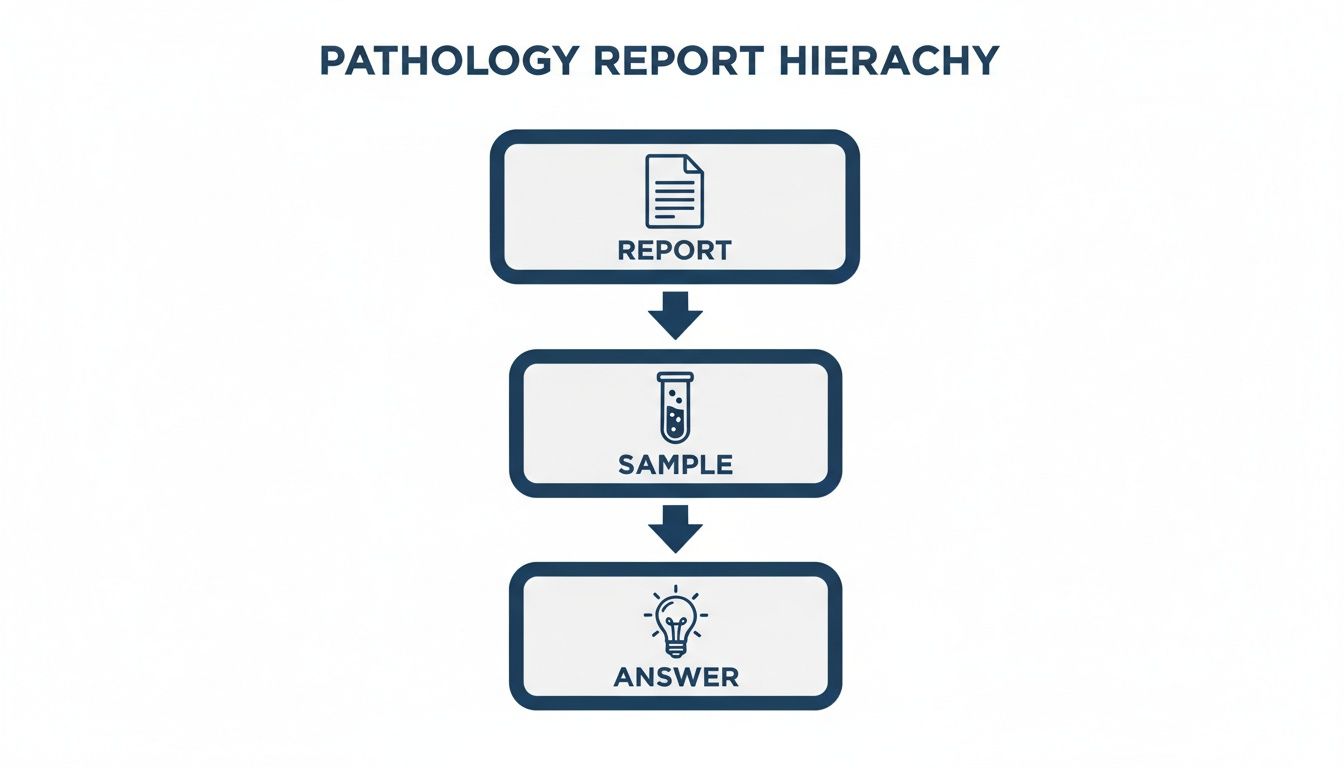
As you can see, it's a structured investigation. Let's break down exactly what goes into each of those steps.
The table below gives you a quick overview of the key sections you'll find in a standard report. We'll explore the details of each one right after.
Key Sections of a Surgical Pathology Report
| Section Name | What It Contains | Why It's Important |
|---|---|---|
| Patient & Specimen Info | Your name, DOB, medical record number, and where the tissue came from. | Ensures the report belongs to the right person and links the tissue to the correct surgical site. |
| Clinical History | A brief note from your doctor explaining why the biopsy was done. | Provides crucial context for the pathologist to interpret the findings accurately. |
| Gross Description | A description of the tissue's appearance to the naked eye (size, color, texture). | This is the first step in the physical examination and helps guide which areas to study microscopically. |
| Microscopic Description | A detailed account of what the cells and tissue structures look like under the microscope. | This is the heart of the analysis, where the pathologist identifies normal vs. abnormal cellular patterns. |
| Final Diagnosis | The conclusive summary and bottom-line answer (e.g., benign, malignant, inflammation). | This is the most critical part of the report, guiding all future treatment and follow-up decisions. |
Each part plays a specific role in creating a complete and accurate picture. Now, let’s look closer at what each one really means.
Patient and Specimen Information
The first part of the report is an essential safety check: making sure we have the right person and the right sample. While it might seem like simple administrative data, getting this right is non-negotiable.
- Patient Identification: This is where you'll see your full name, date of birth, and medical record number. It’s the first checkpoint to confirm the report is yours.
- Specimen Source: This line tells us exactly where the tissue was taken from. For example, it might read "skin biopsy, left forearm" or "colon polyp, sigmoid colon." This confirms the link between your procedure and the tissue I'm examining.
- Submitting Physician and Dates: You’ll also see the name of the doctor who performed the procedure, plus key dates, like when the sample was taken and when it arrived in my lab. This creates a clear timeline and chain of custody.
Clinical History and Gross Description
Once we've confirmed the "who" and "what," we get to the "why." The Clinical History is a short summary from your doctor explaining the reason for the biopsy. It might say something like, "screening colonoscopy revealed a 1 cm polyp" or "patient presents with a suspicious mole." This context is valuable because it helps me connect what I see under the microscope to your actual health situation.
Next comes the Gross Description. "Gross" here simply means what I can see with my own eyes, before using a microscope. I'll examine the tissue, measure it, and describe its appearance—its size, shape, color, and texture.
This is my first hands-on interaction with the tissue. I might describe a skin sample as a "0.5 cm tan-brown, raised skin fragment" or a larger specimen as "a 5 x 4 x 3 cm segment of colon with a 2 cm cauliflower-like mass." Every detail I note here becomes a foundational piece of the diagnostic puzzle.
Microscopic Description
This is where the real detective work happens. After the gross exam, I take small, representative pieces of the tissue, process them overnight, and slice them into sections that are unbelievably thin—thinner than a single human cell. These sections are placed on glass slides and stained with special dyes to make the cells and their structures visible.
The Microscopic Description section of the report is my narrative of what I see through the microscope. I describe the architecture of the tissue, how the cells are arranged, and the features of their nuclei. I'm looking for anything out of the ordinary: disorganized growth, odd changes in cell size and shape, or signs that abnormal cells are invading nearby tissues.
If you're interested in a more in-depth look at the terminology used here, our guide on how to read a pathology report offers more examples.
The Final Diagnosis
This is the most important part of the report for you and your doctor. It's the bottom line. The definitive answer.
The Final Diagnosis (sometimes called the "Impression") pulls everything together from the gross and microscopic findings into one clear, conclusive statement. It will tell you plainly if the tissue is benign (non-cancerous), malignant (cancerous), or if it shows another condition like inflammation or an infection.
If it is cancer, the diagnosis will provide critical details, such as:
- The exact type of cancer (e.g., "Invasive Ductal Carcinoma").
- The grade, which tells us how aggressive the cancer cells appear.
- Information on the surgical margins, which lets your surgeon know if they successfully removed all the abnormal tissue.
Ultimately, this final diagnosis is the compass that will guide your entire medical team in making the best decisions for your treatment and care.
Common Medical Terms and What They Mean for You
When you first open a surgical pathology report, the language can feel dense and intimidating. My job as a pathologist is to be precise, but I also know that medical jargon can be a barrier for patients and their families.
My goal here is to translate some of the most common terms you'll find in your report. This isn't about making you a medical expert. It's about giving you the tools to understand your diagnosis, ask better questions, and have more meaningful conversations with your doctor about what comes next.
Benign vs. Malignant
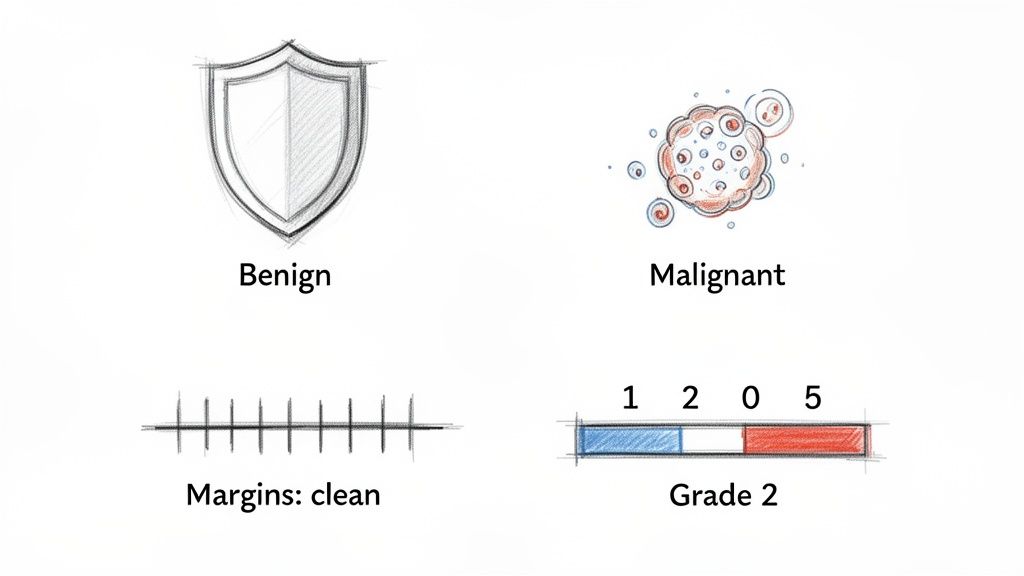
These are the two most important words on a report dealing with a tumor or growth. They sit on opposite sides of a crucial line: non-cancerous versus cancerous.
Benign: This is good news. It means the growth is not cancer. Benign cells don't invade surrounding tissues or spread to other parts of the body. While a benign tumor might cause problems if it gets large and presses on an organ, it isn't life-threatening like cancer.
Malignant: This word means the growth is cancer. Malignant cells have the ability to grow out of control, invade healthy tissue, and even metastasize—a process where they travel through the bloodstream or lymphatic system to form new tumors elsewhere in the body.
The difference between benign and malignant is the first, most critical question I answer when examining your tissue. Everything else, from treatment to prognosis, hinges on this finding.
Terms Describing Cancer Characteristics
If the diagnosis is malignant, the report will go deeper, using specific terms to describe the cancer's personality and behavior. These details are what your oncologist uses to build the most effective treatment plan.
Think of it this way: a "malignant" diagnosis tells you that a storm is coming. These other terms tell you the storm's category, speed, and direction. It’s the difference between knowing you need to prepare and knowing exactly what you're up against.
Here are a few of the most important descriptors:
Carcinoma: This is the most common category of cancer. It starts in epithelial cells, which line the surfaces of your body, inside and out. Breast, lung, colon, and skin cancers are often carcinomas.
Differentiation: This describes how much the cancer cells resemble the normal, healthy cells they grew from. Well-differentiated cancer cells look a lot like normal cells and usually grow more slowly. In contrast, poorly-differentiated or undifferentiated cells look very abnormal and tend to be more aggressive.
Grade: Grade is a formal scoring system for differentiation, often ranked on a scale like Grade 1, 2, or 3. A low-grade (Grade 1) cancer is well-differentiated and less aggressive, while a high-grade (Grade 3) cancer is poorly-differentiated and more aggressive.
Surgical Margins Explained
When a surgeon removes a tumor, they also take a small rim of healthy-looking tissue around it. This border of tissue is called the surgical margin. I examine this margin under the microscope to see if any cancer cells are present at the very edge of the removed tissue.
Negative or Clean Margins: This is what everyone hopes for. It means no cancer cells were found at the edge of the tissue, which strongly suggests the surgeon removed the entire tumor.
Positive Margins: This means cancer cells were present right at the edge of the removed tissue. This finding raises a concern that some cancer might have been left behind. It could mean you'll need more surgery or another treatment, like radiation, to address any remaining cells.
The margin status is one of the most practical pieces of information in the report, telling your surgeon how successful the operation was. To learn more about how all these pieces fit together, exploring our guide on the meaning of a pathology report can offer even greater clarity.
The Growing Need for Accurate Pathological Analysis
Your surgical pathology report isn't just a piece of paper; it's a critical medical document created in a system that's under more pressure than ever. As a pathologist, I see this firsthand. The rise in chronic diseases, particularly cancer, means the demand for precise and timely diagnoses is higher than ever. Understanding this context can help you appreciate what goes into your report.
Every report I sign represents a pivotal moment in someone's life. It holds immense weight, directly shaping treatment plans and future health. This increasing volume of cases, both here in Texas and nationwide, puts a real strain on pathology labs. It also reinforces just how vital meticulous, expert analysis is for every sample we receive.
Why Accuracy Is More Critical Than Ever
The stakes are incredibly high. The global increase in new cancer cases directly translates to a heavier workload for pathologists. In fact, projections from the American Cancer Society estimate 27.5 million new cases and 16.3 million deaths by 2040. This makes the surgical pathology report a cornerstone of modern cancer care.
This isn't just a statistic. I see it reflected in my daily work and in labs everywhere, where caseloads have jumped significantly. It's a trend you can read more about if you're interested in the market trends impacting anatomic pathology services. More families and physicians are relying on our reports to make life-altering decisions. That's a responsibility I don't take lightly, and it's why there's no room for error.
The Impact of High Caseloads
When pathology departments get stretched thin, the risk of diagnostic errors or delays can increase. While the overwhelming majority of diagnoses are accurate, the sheer volume means even a tiny error rate can affect a significant number of people.
Here's how high caseloads can affect the process:
- Turnaround Time: It might take longer to get your report back, and I know that waiting can cause a lot of anxiety.
- Complexity: Some cases aren't straightforward. They might require special stains or molecular tests that demand extra time and a pathologist's focused attention, which is harder to manage in a high-volume setting.
- Consultation: For complex or unusual cases, we often consult with colleagues. When everyone is busy, finding time for this crucial collaboration can be a challenge.
Every report represents a person, a family, and a future. The growing demand for our services doesn't change the fundamental requirement of my profession: to provide an accurate, clear, and definitive diagnosis. This is the foundation of trust between a patient, their doctor, and the pathology lab.
This is precisely why my work at Texas Autopsy Services is so focused on delivering certainty. When a diagnosis is complex, or if you simply need the peace of mind that comes from another expert review, a second opinion can be invaluable. Getting the diagnosis right is the most critical part of this entire journey, and I’m dedicated to providing that certainty to patients and their families across Texas.
Surgical Pathology Reports vs Autopsy Reports
As a board-certified forensic pathologist, I often see families and attorneys confuse two very different kinds of reports: the surgical pathology report and the autopsy report. It’s a common point of confusion. While both involve looking at tissue under a microscope, their goals, scope, and legal implications are distinct.
Knowing the difference is key to finding the answers you're actually seeking.
What is a Surgical Pathology Report For?
A surgical pathology report is for the living. When a surgeon takes a biopsy or removes tissue, it gets sent to a pathologist. In that scenario, my job is to determine what’s happening with that specific piece of tissue to help guide treatment.
Is that growth cancerous? If so, what kind? Did the surgeon get all of it? This report is a forward-looking tool, created to give doctors the diagnostic information they need to care for their patient.
How is an Autopsy Report Different?
In contrast, an autopsy report—the main focus of my work at Texas Autopsy Services—is a comprehensive investigation performed after someone has passed away. Its purpose is to look backward and determine exactly why that person died.
It's a much larger undertaking than a surgical pathology report, which only looks at a single, targeted tissue sample.
An autopsy involves a full external and internal examination of the entire body. My goal isn't just to find the immediate cause of death but to uncover any contributing diseases or hidden injuries. It’s a complete medical story.
Think of it this way: A surgical pathology report is like a mechanic checking just the alternator to see if it’s broken and needs replacing. An autopsy report is the full diagnostic workup on the whole car after it has already broken down, figuring out exactly what failed and why.
One report guides treatment for the living. The other provides answers, closure, and legal clarity for the family left behind.
Surgical Pathology Report vs. Autopsy Report
To make it even clearer, let's compare the two reports side-by-side. Recognizing their unique roles helps families and legal professionals know which examination to request and how to interpret the findings correctly.
| Attribute | Surgical Pathology Report | Autopsy Report |
|---|---|---|
| Subject | A living patient | A deceased individual |
| Purpose | To diagnose disease and guide medical treatment | To determine the cause and manner of death |
| Scope | Examines a specific tissue sample (e.g., a mole, a polyp, a tumor) | Examines the entire body, including all major organs and systems |
| Key Question | What is this disease, and how should we treat it? | Why did this person die, and what factors contributed? |
| Outcome | A treatment plan (e.g., surgery, medication, observation) | A final cause of death for legal, medical, and family records |
Ultimately, one report is a clinical tool used in active medical care, while the other is an investigative document for legal purposes and family understanding. My role is to provide unbiased, medically sound answers that bring clarity during an incredibly difficult time, whether I’m performing a private autopsy for a family or a forensic autopsy for a Texas county.
When to Seek a Second Opinion on Your Report
As a pathologist who has reviewed thousands of cases, I can tell you that pathology is as much an art of interpretation as it is a science. It's a field built on deep training and hands-on experience. While we aim for 100% certainty with every surgical pathology report, the reality is that it involves expert human judgment. Because of that, there are times when getting a second opinion isn't just a good idea—it's a crucial step.
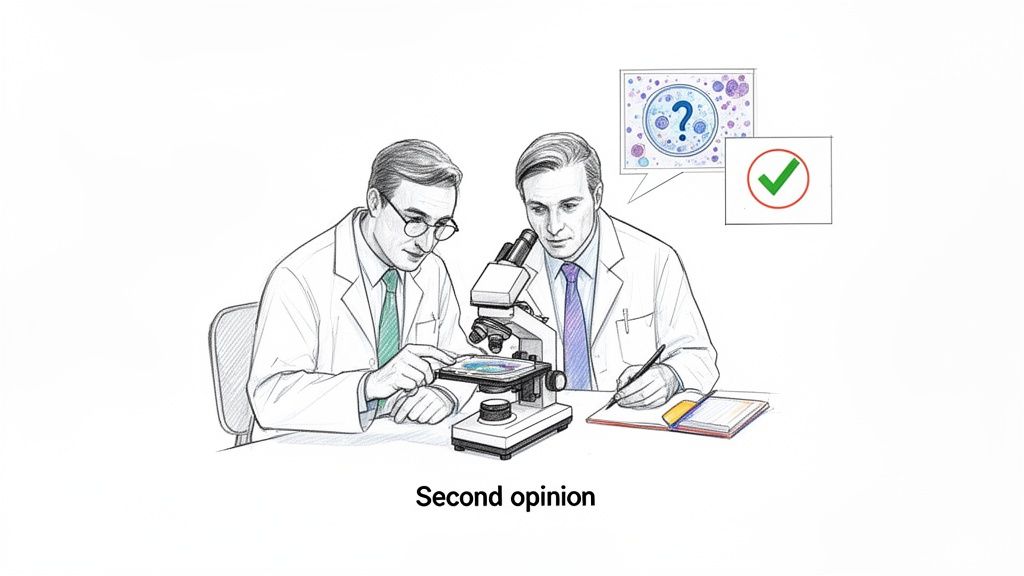
Your diagnosis is the foundation for every single treatment decision that follows. Feeling completely confident in that diagnosis is essential, especially when you're dealing with a serious illness. Having another board-certified pathologist review your slides isn’t about questioning the first doctor; it’s about being proactive and ensuring you have the most accurate information possible.
Key Scenarios for a Second Review
Certain situations should make you or your doctor think about getting a second look. This isn't about creating doubt, but rather about adding another layer of expertise to what can be a complex medical puzzle. It's a standard practice for quality control in medicine.
Here are some of the most common reasons to request a second opinion on a surgical pathology report:
- A Rare or Unusual Diagnosis: If you've been diagnosed with a condition that is uncommon, getting confirmation from another expert is simply good medical practice.
- Conflicting Information: If the pathology report seems out of sync with your symptoms or other test results, like an MRI or CT scan, a second review can help resolve these discrepancies.
- Uncertain or Ambiguous Findings: When you see words like "atypical," "suspicious for malignancy," or "of undetermined significance," it means the pathologist isn't entirely sure. Another expert might provide a more definitive answer.
- High-Stakes Treatment Decisions: Before you begin an aggressive treatment like chemotherapy, extensive surgery, or radiation, confirming the diagnosis is essential for your peace of mind and for validating the treatment plan.
The Value of Confirmation and Clarity
A second opinion generally leads to one of two outcomes, and both are valuable. Most of the time, the second review confirms the original diagnosis. This might not sound like a wasted step, but the reassurance it provides is priceless. It gives you and your medical team the confidence to move forward with the recommended treatment.
A second opinion isn’t about proving someone wrong. It's a collaborative process aimed at one thing: achieving the most accurate diagnosis for the patient. It’s about ensuring that before you take the next step in your medical journey, you’re standing on the most solid ground possible.
In some cases, however, the second review can offer a new or slightly different perspective. Another pathologist might interpret the cells differently, spot a subtle detail that was missed, or recommend further specialized tests. This can sometimes lead to a different diagnosis or a revised treatment strategy—a change that could be vital for your health.
The process itself is simple. The second pathologist just needs the original glass slides and reports to review. As an independent pathologist at Texas Autopsy Services, I regularly provide these kinds of consultations for families and doctors across Texas who need that extra layer of clarity. It's a fundamental part of providing the definitive, unbiased answers people deserve.
Answering Your Questions About Pathology Reports
To wrap things up, let's go over some of the most common questions I get from families and attorneys. My hope is to give you direct, clear answers that help you move forward with confidence.
How Long Does It Take to Get a Surgical Pathology Report?
The turnaround time for a surgical pathology report depends on the complexity of the case. A simple biopsy might be ready in just a few business days. However, more complicated cases—those that need special stains, have to have bone decalcified, or require extra molecular tests—can take one to two weeks, and sometimes longer.
A few things can affect the timeline:
- The type and size of the tissue sample.
- Whether specialized testing is needed to confirm a diagnosis.
- The current workload at the pathology lab.
For the most accurate estimate, it's best to check with the office of the doctor who ordered the test. They are in direct contact with the lab and will have the most up-to-date information for your specific case.
Can I Get a Copy of My Own Report?
Yes, absolutely. The Health Insurance Portability and Accountability Act (HIPAA) gives you the legal right to your own medical records, and that includes any pathology reports. You can get a copy by contacting the medical records department at the hospital or clinic where you had your procedure.
I always recommend that patients get and keep their own copy. It’s a critical piece of your medical history, especially if you ever decide to see another specialist or want to get a second opinion. Having it on hand helps ensure everyone is on the same page and empowers you to be an active participant in your healthcare.
What Should I Do if I Don't Understand My Report?
First, don't worry. These are complex medical documents, so it’s completely normal to feel lost or overwhelmed when reading one. The most important first step is to schedule a follow-up appointment with the doctor who ordered the report. They can walk you through the findings in the context of your overall health and explain what it all means for your treatment.
It's their job to make sure you understand the results. Never feel shy about asking them to explain a term or go over anything that seems confusing.
If you've spoken with your doctor and still feel uncertain, or if you're dealing with a serious diagnosis and just want to be absolutely sure, getting a second opinion from another qualified pathologist is a wise and reasonable next step. It can provide crucial confirmation and, just as importantly, peace of mind.
At Texas Autopsy Services, I am dedicated to providing definitive, unbiased answers for families, physicians, and attorneys across Texas. While my primary focus is on private autopsies and providing forensic services to Texas counties, I also offer expert consultations and second opinions for complex pathology cases. If you're looking for clarity or confirmation on a report, please reach out to our office for guidance.
You can learn more by visiting our website: https://www.texasautopsyservices.com.