April 11, 2026 · Texas Autopsy Services
Decode Your Biopsy Pathology Report
An expert explains your biopsy pathology report: how to read it, understand terms, and when to seek a second opinion. Get clear, vital answers.
On this page
- Receiving a Report Is Only the First Step
- What Is a Biopsy Pathology Report
- Deconstructing Your Pathology Report Section by Section
- Translating Common Findings and Medical Terms
- The Importance of a Second Opinion Autopsy or Report Review
- When a Biopsy Report Becomes Part of a Forensic Investigation
- Frequently Asked Questions About Pathology Reports
- A biopsy pathology report is the medical record that explains what tissue was removed, what it looked like, what the cells showed under the microscope, and what diagnosis the pathologist reached.
- The document is structured, but the language can feel impersonal. Families and attorneys often need help separating the key finding from the technical detail.
- Some reports are clear. Others are incomplete, equivocal, or difficult to reconcile with the full clinical picture.
- A second review of pathology materials can be reasonable when the report is ambiguous, the facts do not fit, or a death later raises new questions.
- In a forensic setting, a biopsy pathology report may become one piece of a larger cause of death investigation rather than the final word.
At Texas Autopsy Services, every examination is performed by a board-certified forensic pathologist experienced in medicolegal death investigations. Our work centers on one principle: follow the evidence carefully, explain it plainly, and treat the deceased and their family with respect.
A biopsy pathology report often lands in someone’s hands with the promise of answers. Instead, it can feel like a cold, dense document written for other doctors. That reaction is normal.
Sometimes the report follows a biopsy done during life. Sometimes it becomes important only after a death, when an old diagnosis is reviewed in light of autopsy findings, toxicology, imaging, or the timeline of decline. In both settings, the same principle applies. The report matters, but understanding it correctly matters more.
Receiving a Report Is Only the First Step
A family member opens a portal message, downloads a PDF, and sees phrases like “microscopic description,” “atypical cells,” or “consistent with.” An attorney receives the same kind of record in a case file and sees measurements, specimen labels, and a conclusion that seems shorter than the pages before it. Both readers usually ask the same thing.
What does this mean?

That confusion isn’t a sign that you missed something obvious. A pathology report is written as a technical diagnostic record. It serves clinicians first. Families and lawyers often have to translate it after the fact.
In my field, I also see a second layer of confusion. People assume the report is self-explanatory because it sounds definitive. Sometimes it is. Sometimes it isn’t. A report may be accurate and still incomplete for the question you need answered.
A pathology report can answer what was seen in the tissue sample and still leave open what happened to the person as a whole.
That distinction matters in grief work and in legal review. A biopsy samples part of a process. It does not always capture the entire disease, the full extent of injury, or the mechanism of death.
If you’re holding a biopsy pathology report right now, start with a simple idea. You do not need to master every term on the first read. You need to understand the structure, identify the bottom-line diagnosis, and know when the document deserves a closer look.
What Is a Biopsy Pathology Report
A family may be holding a report from a breast biopsy done months before death, while an attorney is reading the same pages to see whether the diagnosis was clear, delayed, or disputed. Both are looking at the same document. They are often asking different questions.
A biopsy pathology report is the pathologist’s written interpretation of a tissue sample removed from the body. It works like a laboratory case file. It records what tissue was submitted, how it appeared on gross examination, what the cells and structures showed under the microscope, and what diagnosis those findings support.
The format is fairly consistent from one lab to another. You will usually see patient and specimen identification, a description of the tissue received, microscopic findings, and a final diagnosis. The wording changes by organ system and by laboratory, but the basic purpose stays the same.
What the report is designed to answer
A biopsy pathology report links a procedure to a medical conclusion. A clinician removes tissue because something needs to be clarified. The pathologist studies that sample and produces the formal medical record that states what was found in that piece of tissue.
That record may lead to several different outcomes:
- Treatment planning when the diagnosis points to a condition that needs care
- More testing when the sample raises concern but does not settle the question
- Reassurance when the findings are benign
- Later review when the case is questioned in a hospital review, lawsuit, insurance dispute, or death investigation
For that reason, the report is more than a label. It is the pathologist’s reasoning, condensed into a structured medical document.
What the report cannot answer by itself
A biopsy pathology report speaks for the tissue sampled. It does not automatically explain the whole patient.
That limitation causes confusion. A needle biopsy may confirm cancer but not show the full size of the tumor, whether nearby structures are involved, or how the disease affected the body as a whole. A skin biopsy may identify inflammation or malignancy, yet still leave open why symptoms progressed the way they did. In a postmortem setting, an older biopsy may be accurate and still fall short of explaining the mechanism of death.
The distinction matters. The body is the full scene. The biopsy is one piece of physical evidence collected from that scene.
Why this matters in a medico-legal or postmortem case
In clinical care, a biopsy report often answers the immediate question. In legal review or after a death, the question is usually broader.
Families may ask whether the biopsy missed something, whether the disease was more advanced than the report suggested, or whether treatment should have changed earlier. Attorneys may need to know whether the wording reflects a firm diagnosis, a limited sample, or a finding that should have triggered additional workup. Those are not abstract questions. They affect causation analysis, standard-of-care review, and the decision to seek a private autopsy or independent pathology review.
That is why I tell families and counsel to read a biopsy pathology report as strong evidence, not as the entire story. In complex cases, especially when death follows a disputed diagnosis or a rapidly changing illness, the biopsy report may need to be interpreted alongside imaging, hospital records, operative findings, and sometimes a second opinion autopsy.
Deconstructing Your Pathology Report Section by Section
A family receives a pathology report after a death and goes straight to the line that sounds like the answer. An attorney does the same, looking for the diagnosis that will anchor causation or standard-of-care review. Both are understandable reactions. Both can miss what the rest of the document is doing.
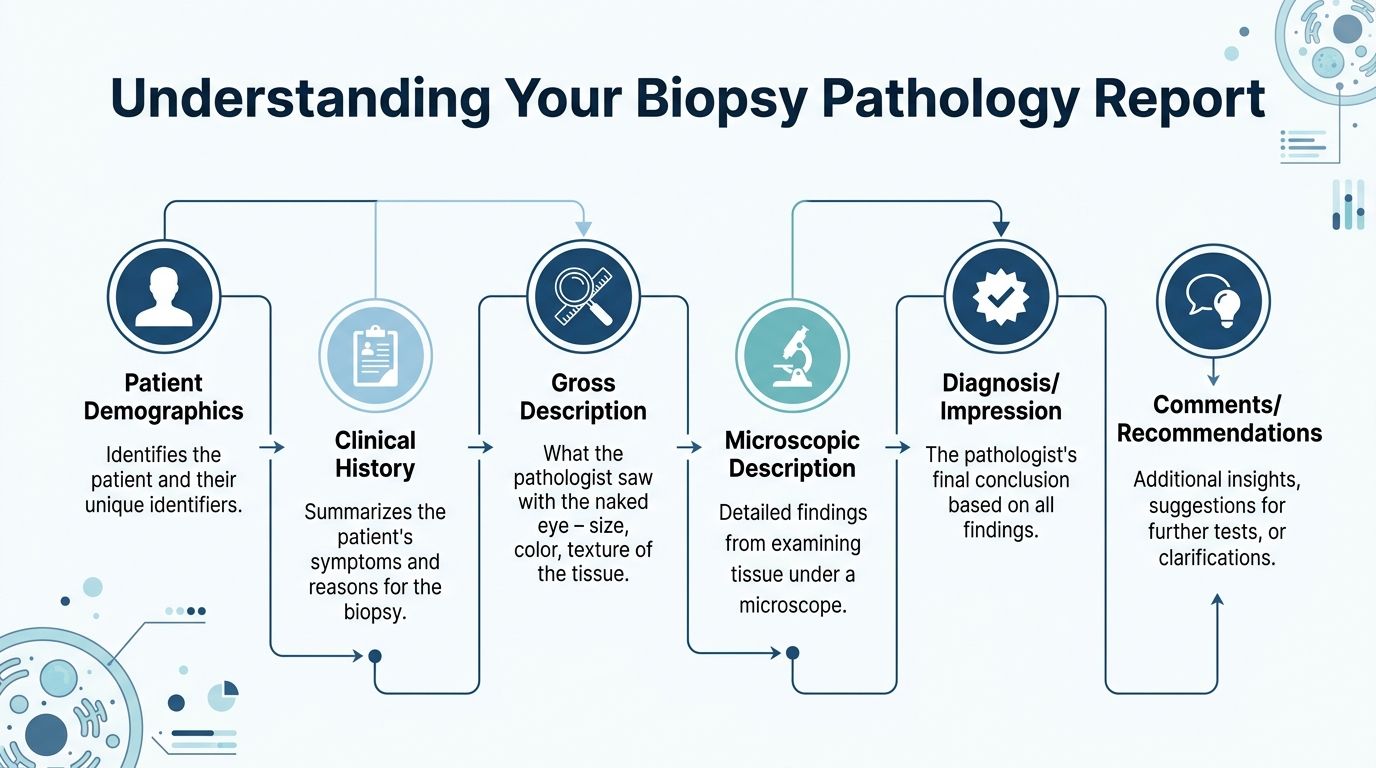
A biopsy pathology report works like a chain of custody plus a scientific explanation. Each section answers a different question. Was the right tissue examined? What did it look like with the naked eye? What did the cells show under the microscope? How firm is the conclusion? In a medico-legal or postmortem case, those distinctions matter because a later autopsy review may depend on whether the biopsy report is specific, limited, or internally inconsistent.
Patient and specimen information
Start at the top, not the bottom.
This section identifies the patient, the submitting clinician, the date, and the tissue source. It can look administrative, but it sets the boundaries of the entire report. "Left breast mass," "right colon polyp," and "skin, forearm" are not interchangeable labels. The same microscopic finding can carry a different meaning depending on the organ and the exact location sampled.
Check three things first:
- Patient identifiers match the correct person
- Specimen source names the exact body site
- Procedure details show whether the tissue came from a needle biopsy, shave biopsy, excision, or another type of sampling
In legal review, an error here can distort everything that follows. In postmortem review, it can also raise the question of whether the reported diagnosis belongs to the tissue everyone assumes it does.
Clinical history
The clinical history tells the pathologist why the tissue was taken. It may mention symptoms, imaging, prior diagnoses, operative findings, or the physician's main concern.
That background shapes interpretation. A pathologist reading "rule out vasculitis," "suspicious lung mass," or "persistent ulcer despite treatment" approaches the slide with a different frame than if no context is given. Sparse history does not make the microscope wrong, but it can narrow what the report can confidently answer.
This point is easy to overlook. A report may sound definitive while still resting on limited clinical context. In a second-opinion review, that can become important. If the history omitted prior cancer, recent infection, trauma, or treatment response, the wording of the final diagnosis may deserve closer scrutiny.
Gross description
The gross description records what the specimen looked like before slides were made. Many readers skip it because it sounds technical. They should not.
This section usually includes size, weight, color, texture, and whether the specimen arrived in one piece or fragments. It may also describe orientation stitches or colored inks placed on edges so the pathologist can later tell which margin is which. That is not trivial detail. It helps answer whether the sample was small, disrupted, poorly oriented, or suitable for margin assessment.
An oncology reference describing pathology reports notes that gross findings often include features such as a firm white mass and inked resection edges used to evaluate margins, as described by Oncology Nurse Advisor.
For a family, the gross description helps answer, "What exactly did they remove?" For counsel, it helps answer, "How much material was available for diagnosis, and were there practical limits built into the specimen itself?"
If you want to see how these sections appear on an actual document, this example of a pathology report can make the layout easier to follow.
Here is a short explainer before moving deeper into the report:
Microscopic description
This section describes the report's work.
The pathologist examines stained tissue sections on glass slides and records what is present at the cellular level. That may include inflammation, fibrosis, necrosis, infection, atypical cells, tumor architecture, vascular invasion, or other features. For a grieving family, this section can feel almost unreadable. For an attorney, it is often the section that reveals how strong the final diagnosis really is.
Read it the way you would read the reasoning portion of an expert opinion. The key question is not whether you understand every term. The key question is whether the observations described support the conclusion below.
A few clues help:
- Specific wording usually reflects greater diagnostic confidence than broad or cautious phrasing
- Negative findings can be highly important, especially when the report states that invasion, necrosis, microorganisms, or malignancy were not seen
- Correlation statements signal that the slide findings alone may not settle the issue
- Sampling limits matter. A tiny biopsy can miss a process that is present elsewhere in the body
That last point often becomes central after a death. A biopsy can accurately describe the piece of tissue examined and still fail to explain the full disease burden, treatment course, or mechanism of death.
Final diagnosis
The final diagnosis is the formal conclusion. It is usually the shortest section and the one readers quote first.
Read it carefully, but read it in context. A one-line diagnosis may look absolute even when the microscopic description is cautious, the history is thin, or the sample is limited. Pathologists often write concise conclusions because that is the function of this section. The support for that conclusion is found above.
In medico-legal review, I look for fit. Does the diagnosis match the specimen source, the gross description, and the microscope findings? If not, the report may still be usable, but it may need outside review or comparison with imaging, operative notes, and later postmortem findings.
Comments and recommendations
Comments, notes, and addenda often contain the part families and attorneys need most. In this section, the pathologist may explain uncertainty, qualify the diagnosis, suggest additional stains, or recommend clinicopathologic correlation.
A comment can change the practical meaning of the report. "Consistent with" is not the same as "diagnostic of." "Cannot exclude" is not the same as "present." "Recommend correlation with radiology" often means the slide alone does not answer the whole question.
In a disputed death, this section may also point toward the next sensible step. That could be an outside slide review, a re-cut of the block, additional testing, or a private autopsy that places the biopsy finding in the context of the entire body. That broader context is often what turns an isolated pathology result into a medically and legally useful explanation.
Translating Common Findings and Medical Terms
A family receives a biopsy report after a death, or an attorney reviews one while preparing a case. The diagnosis line looks short and firm. Then the surrounding terms start to blur together. Benign. Atypical. In situ. Margins. Grade. Each word carries weight, and each has limits.
Pathology language works like the legend on a map. If you read the symbols correctly, the report becomes more useful. If you miss the qualifiers, you can mistake a partial answer for a final one.
The table below translates common terms into plain language. These are general explanations. They do not replace a case-specific review of the slides, records, or postmortem findings.
| Term | Plain-Language Meaning | General Implication |
|---|---|---|
| Benign | Non-cancerous | Usually does not behave like cancer, though location, size, bleeding, or pressure on nearby structures may still matter |
| Malignant | Cancerous | Indicates cancer and usually leads to staging and treatment decisions |
| Atypical | Abnormal, but not clearly cancer | Means the cells do not look fully normal, yet the finding stops short of a definite cancer diagnosis |
| Indeterminate | Not fully settled | The sample does not support a clear yes-or-no answer |
| In situ | Abnormal cells remain in their original place | Suggests a more limited process than an invasive one |
| Invasive | Abnormal cells have moved beyond where they started | Usually points to a more serious process than in situ disease |
| Margins | The edges of removed tissue | Helps show whether abnormal tissue reaches the cut edge of what was removed |
| Grade | How abnormal the cells look under the microscope | Helps estimate how aggressive a tumor may appear |
Some words sound more definite to lay readers than they do to pathologists.
A phrase such as “consistent with” means the findings fit a diagnosis, but the wording leaves room for clinical context, additional testing, or limits in the sample. “Suggestive of” is a step more guarded. “Features of” often means some elements are present, but the full pattern is incomplete. In a medical treatment setting, that may guide the next test. In a legal review, that distinction can affect whether the report supports a strong conclusion or only a possible one.
A diagnosis may be brief. Its certainty often depends on the qualifying words around it.
Other terms carry practical consequences outside cancer care. “Necrosis” means tissue death. “Inflammation” describes the body’s response to injury, infection, autoimmune disease, or other stress. “Reactive changes” often means cells are responding to irritation or healing rather than showing a specific disease. “Dysplasia” refers to disordered cell growth and can raise concern without proving invasion.
That difference matters in postmortem review. A premortem biopsy may describe one small piece of a process, while the autopsy answers the larger question of extent, cause, timing, and relation to death.
Biomarker sections often cause a different kind of confusion. Readers may assume every item listed helps prove the diagnosis. Often, those tests help classify a known disease or guide treatment choices. In breast pathology, for example, ER, PR, and HER2 results can shape treatment planning even after the main diagnosis is already established, as noted earlier in the article.
When I explain a report to a grieving family or a detail-oriented attorney, I usually sort the language into three practical questions:
What does the tissue show?
This is the core label, such as benign tissue, malignancy, inflammation, necrosis, or scarring.How strong is the conclusion?
The answer comes from words such as “diagnostic of,” “consistent with,” “suspicious for,” or “cannot exclude.”What changes the meaning of that finding?
Margins, grade, biomarker results, specimen size, and sampling limits can all change how much weight the report should carry.
That framework helps prevent a common error. People read a single term as if it answers the whole case. A biopsy rarely does that by itself.
If you want a deeper plain-language glossary, this guide to pathologist medical terminology can make the wording easier to follow. In complex deaths, that translation is not just educational. It can help determine whether the biopsy report stands on its own, whether the slides need outside review, or whether a private autopsy is needed to place one tissue sample in the context of the whole body.
The Importance of a Second Opinion Autopsy or Report Review
A family sits across from me with a biopsy report in hand. The wording sounds firm in one paragraph and uncertain in the next. An attorney may read the same document and ask a different question. Does this report settle the issue, or does it leave important room for doubt?
A second opinion is often a careful quality check. In pathology, that review involves more than reading the final paragraph again. The reviewing pathologist may study the glass slides, tissue blocks, gross description, clinical history, and any later records that change how the specimen should be understood. In other words, the review goes back to the evidence itself.
That distinction matters in medicine. It matters even more in a legal setting.
As noted earlier, published research shows that pathology interpretation and reporting can vary, especially in difficult cases. That does not mean the first pathologist was careless. It means pathology is an interpretive science built on sampled tissue, and sampled tissue never tells the whole story by itself.
When a second review makes sense
The need for another review usually appears when the report, the clinical course, and the known facts no longer line up cleanly.
Common situations include:
- Guarded or qualified language such as “suggestive of,” “consistent with,” or “cannot exclude”
- Clinical facts that do not fit the diagnosis when the patient declined in a way the biopsy alone does not fully explain
- High-stakes disputes involving malpractice questions, insurance coverage, disability claims, or wrongful death review
- Death after a limited pre-death workup when one small tissue sample may have carried more weight than it should have
A biopsy works like a window, not the whole house. It can show a real and important finding, yet still miss the larger disease process surrounding it.
Review of slides versus a full autopsy
These are different forms of review, and they answer different questions.
A slide review asks whether the original tissue supports the diagnosis that was issued. A full autopsy asks how all of the findings fit together across the body, including natural disease, treatment effects, injury, infection, and toxicology. In a postmortem case, that wider frame often matters more than families expect.
For some cases, a records-and-slides review is enough. For others, especially after an unexpected or disputed death, the better question is broader: what caused the death, and did the biopsy reflect only one piece of it? In that setting, a second opinion autopsy review may provide the right medico-legal framework.
Why families and attorneys ask for another review
Families usually want a clear account of what happened. Attorneys usually need an opinion that can withstand scrutiny. Both goals depend on the same thing. A careful reading of the medical evidence.
A second review can confirm the original diagnosis and give it more weight. It can also identify a meaningful disagreement, a sampling limitation, or a missing connection between the biopsy and the cause of death. In my work, that is often the turning point. The question is no longer whether a report contains medical terminology. The question is whether the report answers the core issue the case presents.
Sometimes it does. Sometimes it needs the wider context that only a forensic review or private autopsy can provide.
When a Biopsy Report Becomes Part of a Forensic Investigation
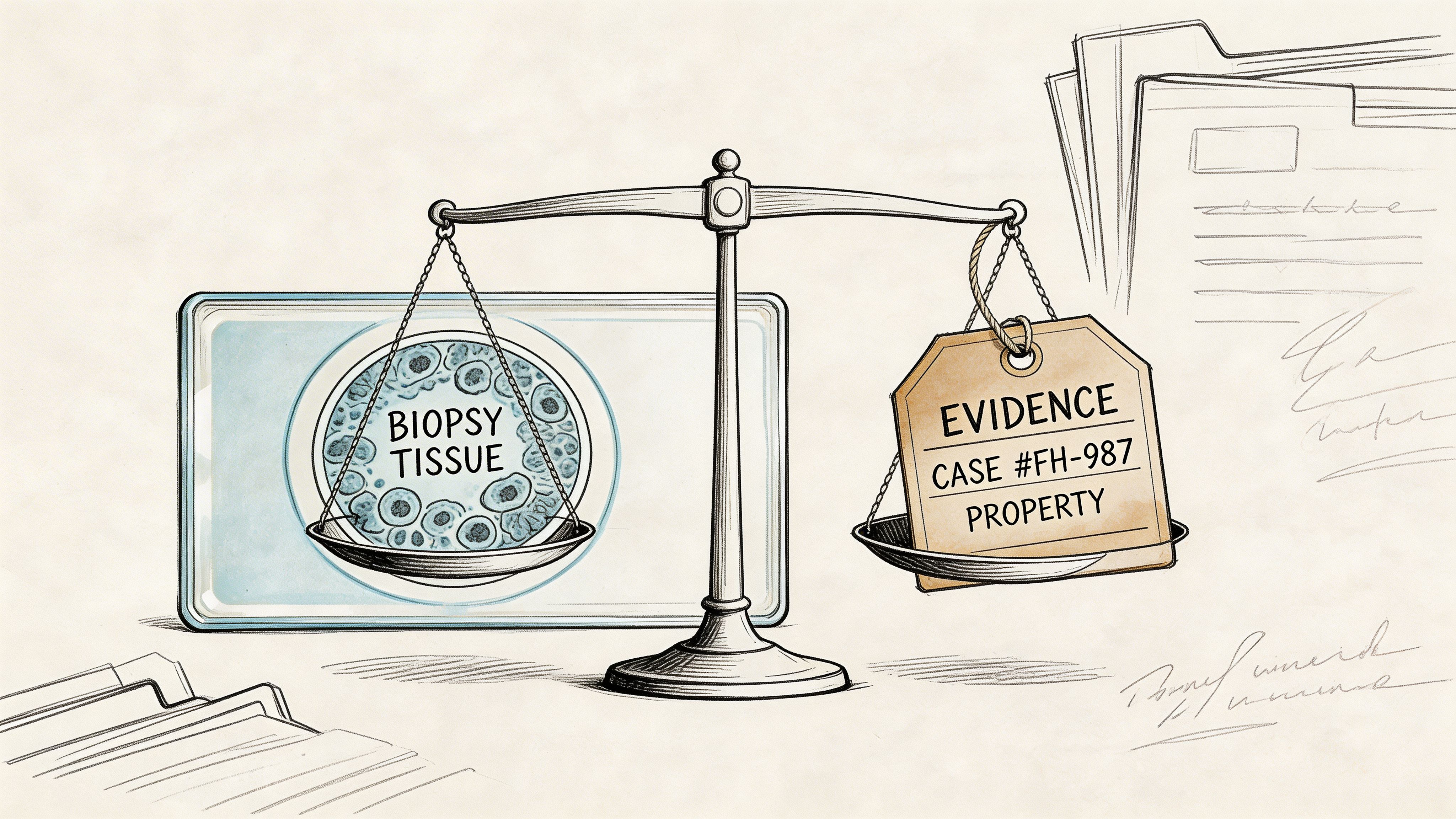
A biopsy pathology report is created during life, but it may take on new meaning after death. In forensic practice, I may review that report alongside hospital records, imaging, scene information, toxicology, and the findings of an autopsy.
Why antemortem and postmortem findings may differ
A biopsy samples tissue from a selected place. An autopsy evaluates the body more broadly. Those are different methods with different scopes.
Verified material states that sampling differences can cause 10-20% discordance between antemortem biopsies and final autopsy histology, and that a small biopsy core may not represent the full extent or aggression of a disease. It also notes that a full autopsy is sometimes the only way to validate or correct a pre-death diagnosis and establish a definitive cause of death, as described in this discussion referencing those findings.
That point is often hard for families to hear. They may assume the biopsy should have captured the entire disease process. Sometimes it did. Sometimes the disease was patchy, progressed later, or involved areas not sampled during life.
How a forensic pathologist uses the report
In a medico-legal case, the biopsy pathology report becomes one piece of evidence. I ask questions such as:
- What tissue was sampled, and from where?
- Did the biopsy diagnosis match the later clinical course?
- Did the process identified on biopsy contribute directly, indirectly, or not at all to the death?
- Does the autopsy support, narrow, or contradict the earlier interpretation?
This section covers cause of death, manner of death, and chain of custody.
Cause of death is the disease or injury that led to death.
Manner of death is the classification of how the death occurred, such as natural, accident, suicide, homicide, or undetermined.
Chain of custody is the documented handling of evidence so that the integrity of slides, specimens, and records can be defended if questioned.
A practical issue for families and attorneys
After a death, records often contain private details that family members did not expect to circulate widely. If a case becomes public or adversarial, families may also start thinking about digital privacy. In that setting, a practical guide on how to remove personal information from the internet can be useful alongside the medical-legal review.
For county agencies and attorneys, these cases often require objective reconciliation of pre-death records with postmortem findings. That is also why some jurisdictions rely on specialized services for County Forensic Autopsies when the medical facts are disputed or incomplete.
Frequently Asked Questions About Pathology Reports
How do I get a copy of the biopsy pathology report
Start with the hospital, clinic, or physician who ordered the biopsy. Ask for the full pathology report, not just a portal summary or after-visit note.
If the case later becomes legal or forensic, request the related records too. That may include operative notes, imaging reports, discharge summaries, and any addenda issued after the initial pathology report.
How do I request a second opinion on the actual slides
The basic process is formal. The original institution usually holds the slides and tissue blocks. A second pathologist reviews them only after they are properly requested and transferred.
Verified material notes that obtaining a second opinion commonly involves formally requesting the slides and blocks from the original institution and having them sent to a second pathologist, and that digital pathology platforms are making remote second reads faster, in some cases within 48 hours, according to this patient-facing discussion on how to properly read a pathology report.
A simple order of operations helps:
- Request the full report so the reviewing doctor sees the original wording.
- Ask where the slides and blocks are held because they may be stored by the hospital or by an outside pathology group.
- Confirm the receiving pathologist’s requirements before transfer.
- Keep records of the request if the matter has legal significance.
What if the biopsy report and the autopsy findings do not match
That can happen. It does not automatically mean negligence or misconduct.
A mismatch may result from limited sampling during life, progression of disease after the biopsy, or a broader process that only becomes visible at autopsy. The right response is careful reconciliation of the records, slides, and postmortem findings.
The question is not which document “wins.” The question is which interpretation best fits all of the available evidence.
What is the role of a forensic pathologist in a legal case involving a biopsy report
A forensic pathologist reviews the biopsy report as one item in a larger evidentiary record. The role is not to advocate for one side. It is to explain, in medically defensible terms, what the tissue findings do and do not establish.
That may include evaluating whether a disease contributed to death, whether the reported diagnosis fits the later course, and whether additional postmortem examination is needed to answer unresolved questions.
When should a family or attorney ask for outside review
Consider outside review when the wording is unclear, when the timeline of illness and decline does not fit the diagnosis, when a death was unexpected, or when legal responsibility may turn on the medical interpretation.
It is also reasonable when a family wants confidence that the available tissue and records have been examined independently and carefully.
If you’re facing unanswered questions after a biopsy, serious illness, or an unexpected death, it may help to speak directly with a forensic pathologist who can explain the records in plain language. At Texas Autopsy Services, I provide independent, evidence-based review with the goal of clarity, accuracy, and respect for the person at the center of the case.