June 25, 2026 · Texas Autopsy Services
Toxicology Reports Scimago: Forensic Data Insights 2026
Master toxicology reports Scimago data to evaluate scientific evidence. We cover SJR, quartiles, & metric importance in forensic investigations. Updated
On this page
- Why Journal Quality Matters in a Death Investigation
- Understanding Scientific Journal Quality with Scimago
- A Practical Walkthrough of Toxicology Reports on Scimago
- Interpreting the Key Metrics for Toxicology Reports
- Practical Implications for Forensic and Legal Cases in Texas
- Our Commitment to Verifiable Scientific Standards
What Toxicology Reports Scimago Means for Forensic Review in Texas
- Journal quality affects case quality. In forensic pathology, a toxicology opinion is only as dependable as the research used to support it.
- Scimago helps separate stronger journals from weaker ones. It offers an objective way to judge whether a publication is active in credible scientific discussion.
- Toxicology Reports has measurable standing. Its current profile includes an SJR of 0.817, Q2 placement, an Impact Factor of 4.16, and an h-index of 72 according to Resurchify's journal profile for Toxicology Reports.
- Those numbers matter in practice. For many Texas legal and hospital settings, a Q2 toxicology journal can support defensible scientific citation when used carefully and in context.
- Open access also matters. When attorneys, physicians, and families can review the same literature directly, the process becomes more transparent.
A common situation reaches our office in some form every week. A family has a report with a toxicology finding they don't fully understand, or an attorney is preparing to question whether a cited article is reliable enough to support a cause of death opinion. The issue usually isn't whether a study exists. The issue is whether the study comes from a journal that deserves confidence.
That is where Toxicology Reports Scimago review becomes useful. In death investigation, published science can't be treated as a stack of interchangeable articles. We vet the journal, the article type, the subject fit, and whether the publication is recognized enough to support a medically sound and legally defensible conclusion.
Why Journal Quality Matters in a Death Investigation
When a toxicology citation becomes a legal issue
In a death investigation, toxicology rarely stands alone. A laboratory result has to be interpreted alongside scene information, medical history, autopsy findings, and known pharmacology. If the published literature behind that interpretation is weak, the opinion can become vulnerable very quickly.
That vulnerability often appears during review by counsel, another physician, or a court. A paper may look polished on first reading, but if it comes from a marginal journal, lacks recognized indexing, or sits outside the main scientific conversation in toxicology, it may not carry enough weight when the conclusion is challenged.
Practical rule: A toxicology article is not automatically useful just because it is published. The journal itself has to be vetted.
For families, this matters because they deserve answers grounded in science that can withstand scrutiny. For attorneys, it matters because every citation used in a report or testimony may become part of a dispute over reliability, method, and professional judgment.
What we look for before relying on a paper
Our board-certified forensic pathologists don't treat journal selection as an academic formality. We use it as part of source control. Before a paper informs a cause of death investigation or a second opinion autopsy review, we examine several practical questions:
- Field fit: Does the journal publish work relevant to toxicology, pharmacology, or related forensic interpretation?
- Visibility: Is the journal recognized enough that other serious researchers are citing and engaging with it?
- Review context: Does the publication appear to maintain a real peer review process rather than functioning as a repository for lightly screened submissions?
- Usability in dispute settings: If an opposing expert questions the source, can the journal's standing be explained clearly to a judge, jury, hospital committee, or reviewing attorney?
That process helps us avoid a common mistake. Some readers focus only on the article's conclusion and skip the harder question of whether the publication venue deserves trust. In private autopsy services Texas families and counsel often request, that distinction matters. An independent autopsy or second opinion autopsy is only as strong as the evidence chain behind it, including the literature.
A few terms are also worth defining plainly. Cause of death means the disease or injury that started the fatal sequence. Manner of death classifies the death, such as natural, accident, suicide, homicide, or undetermined. Chain of custody means the documented handling of evidence from collection through testing and reporting so the integrity of the material can be verified.
Understanding Scientific Journal Quality with Scimago
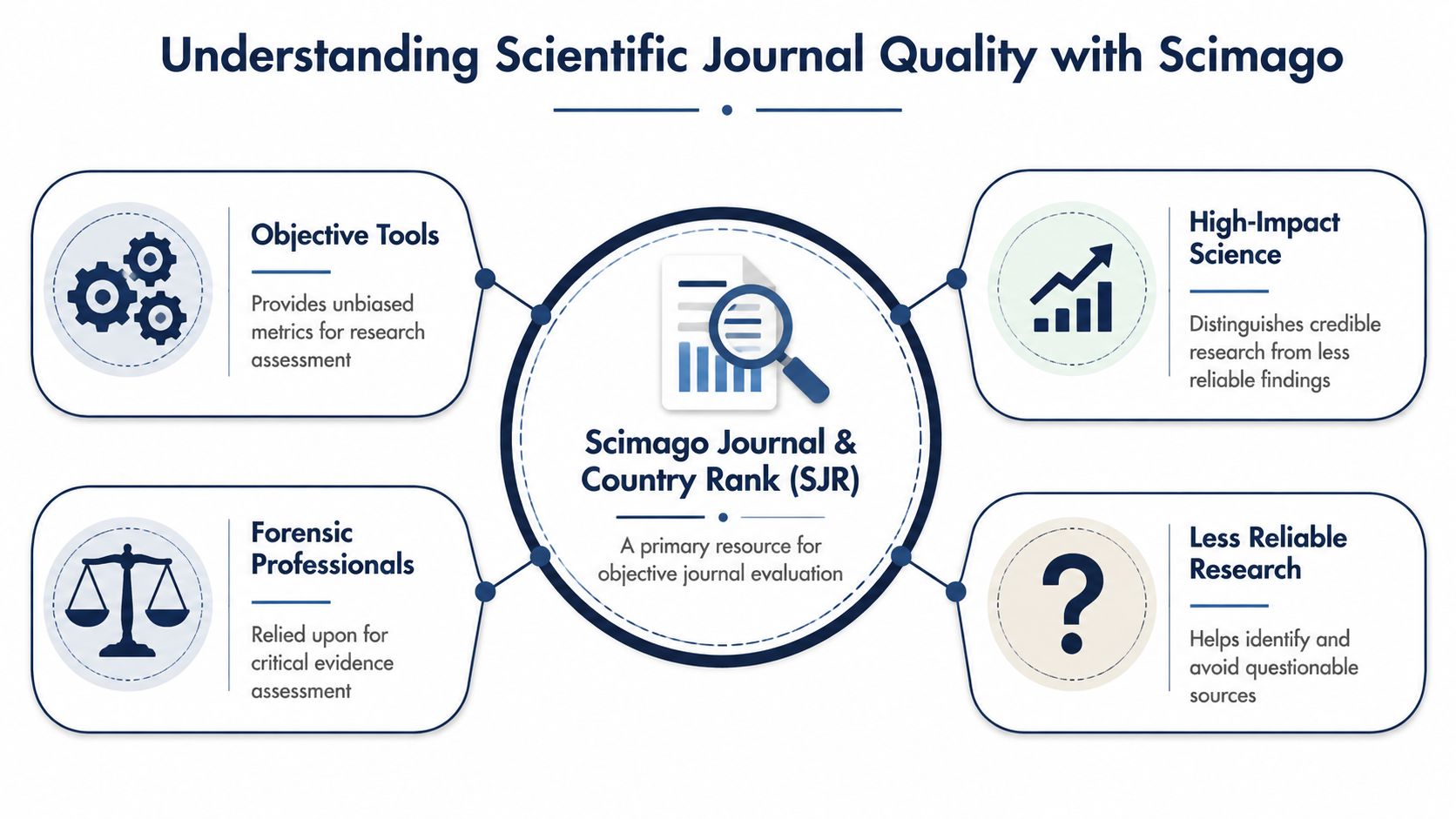
What SJR actually measures
When we evaluate journal standing, one of the tools we use is the SCImago Journal Rank, usually shortened to SJR. It helps answer a practical question. Is this journal participating in meaningful scientific exchange, or is it merely adding volume?
For Toxicology Reports, one published aggregation lists an SJR of 0.902 and explains that the metric is based on Scopus data and reflects weighted citation impact rather than a raw citation count, as summarized by Journal Searches in its Toxicology Reports listing.
That weighted approach matters. A citation from a well-regarded journal carries more influence than a citation from a less established one. The idea is simple enough for non-academic readers. If two professionals recommend a source, the recommendation from the more trusted and better established expert carries more weight.
For readers who want a practical foundation before looking at journals, our discussion of what forensic toxicology includes in death investigation practice helps place these rankings in context.
Why weighted citations matter in forensic work
In forensic pathology, not every citation should count the same. A journal can gather attention without earning durable trust. Weighted ranking systems try to filter for that difference.
A useful journal metric doesn't replace judgment. It helps narrow the field before judgment is applied.
That is why Scimago is a good starting point rather than an ending point. We don't read an SJR score and stop there. We use it to determine whether the journal deserves closer review, then we assess the actual article, the methods used, the population studied, and whether the paper answers the forensic question at hand.
A higher SJR doesn't make every article in a journal correct. A lower SJR doesn't make every article unusable. But as a screening tool, it helps a forensic pathology expert avoid weak foundations before those weaknesses appear in a report, deposition, or courtroom challenge.
A Practical Walkthrough of Toxicology Reports on Scimago

How to find the journal page
If you're reviewing a citation and want to check the journal yourself, the process is straightforward. Start on the Scimago journal search page and enter the journal title exactly as it appears in the article reference. In this case, search for Toxicology Reports.
Once the journal profile opens, read the page as a dashboard rather than a verdict. The profile gives you a quick view of the journal's category placement, ranking indicators, and historical context. That is often enough to tell whether the source deserves deeper review.
A helpful companion to this process is seeing what a finished toxicology document looks like in practice. Our explanation of a sample toxicology report and how to read it shows why source vetting and report interpretation go hand in hand.
What to notice on the profile
Readers often go straight to one number and stop. That isn't enough. A better approach is to scan the page in a fixed order.
- Confirm the journal identity. Make sure the title matches the citation exactly so you're not evaluating a similarly named publication.
- Check subject categories. A toxicology journal should appear in categories that fit the scientific question you are trying to answer.
- Review ranking information. Quartile placement and related metrics help show the journal's standing within its field.
- Look at impact indicators together. A single metric may be misleading if read in isolation.
- Use common sense about relevance. A respectable journal still has to publish work that applies to your issue.
If a cited paper is doing most of the work in a disputed opinion, the journal behind it deserves its own review.
This is especially useful for attorneys and medical professionals who receive an independent autopsy report and want to understand why one article was relied on while another was not. The process is transparent. It isn't reserved for academics, and it doesn't require specialized software or paid access just to understand the journal's public standing.
Interpreting the Key Metrics for Toxicology Reports
Reading the numbers without overreading them
A toxicology article may look persuasive on first read. In forensic pathology, that is never enough. Before we rely on a paper in a death investigation, we review the journal's publicly available metrics to judge whether the publication has standing in its field and whether its editorial environment supports serious scientific work.
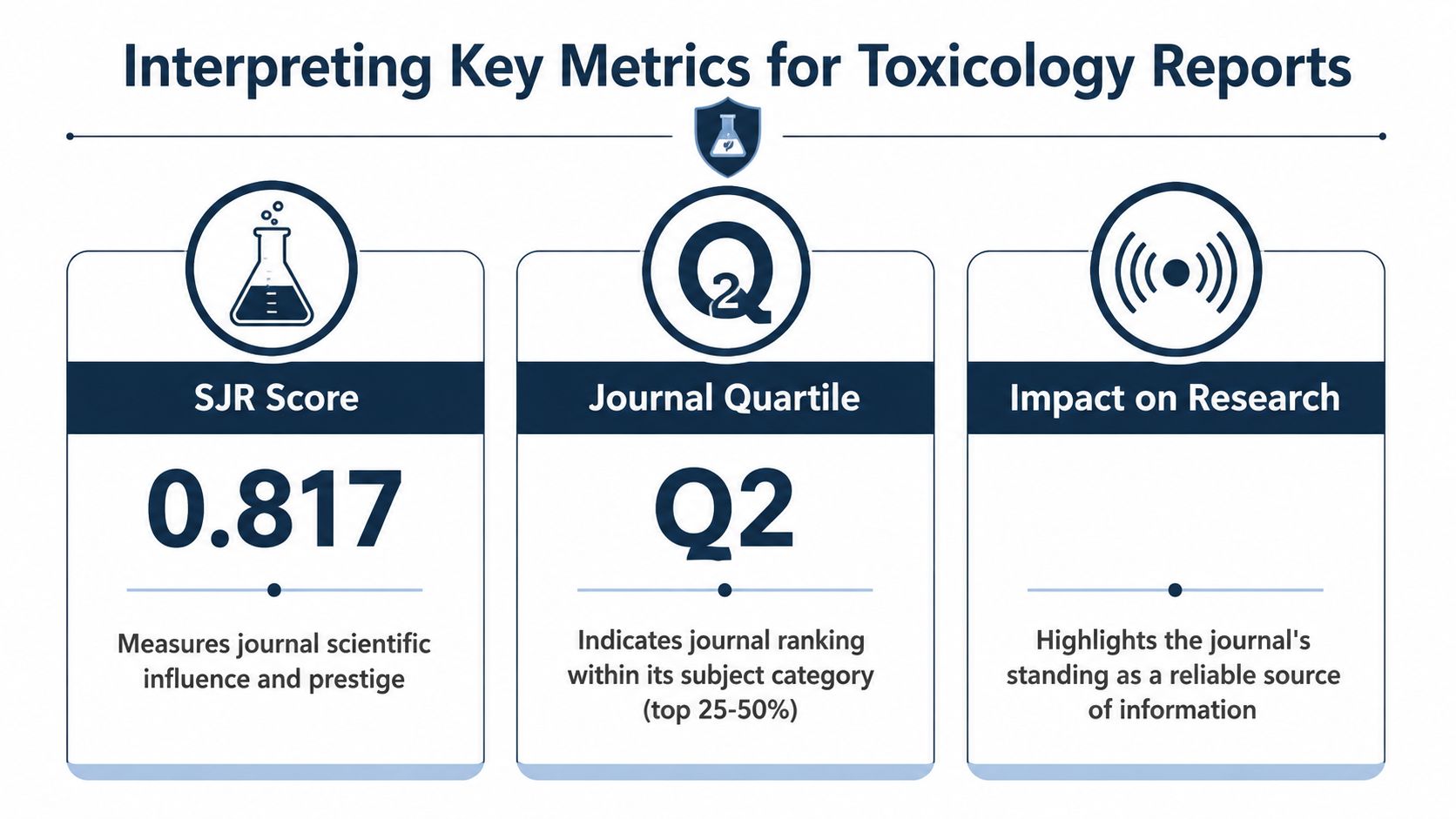
For Toxicology Reports, the commonly cited indicators include an SJR of 0.817, Q2 placement in relevant subject categories, an Impact Factor of 4.16, and an h-index of 72, based on publicly available metrics already noted earlier in this article. Those figures are useful because they answer different questions about the journal's influence, consistency, and position within toxicology publishing.
| Metric | What it helps answer | Why it matters in case review |
|---|---|---|
| SJR 0.817 | How much weighted influence the journal has among other journals | It helps us judge whether the publication is part of a credible scientific conversation |
| Q2 | Where the journal ranks within its field | It places the journal in the upper half of journals in its categories |
| Impact Factor 4.16 | How often articles are cited on average | It gives context for current visibility and use by other researchers |
| h-index 72 | Whether the journal has published work with lasting influence | It shows the journal has produced articles that continued to matter over time |
These metrics support credibility. They do not decide admissibility, causation, or manner of death.
In our practice, a journal's ranking is one screening step. We still examine whether the article's methods fit the question in dispute, whether the analytes match the substances identified in the case, whether the paper addresses postmortem redistribution, and whether the authors acknowledge limits that matter in medicolegal work. A paper can come from a respectable journal and still offer little help if it studies living subjects, controlled dosing conditions, or laboratory settings far removed from an actual death investigation.
That distinction matters in Texas cases because the key question is practical. Can an expert explain, under oath, why this paper belongs in the analysis? If the answer depends only on a journal metric, the foundation is thin. If the answer includes journal quality, sound methods, careful chain documentation, and relevance to the facts, the opinion is far more defensible. Our review of forensic chain of custody procedures follows the same logic. Scientific reliability depends on both the literature and the handling of the evidence.
Physical evidence management matters for the same reason. Agencies that invest in secure systems such as mobile shelving for evidence reduce preventable questions about storage, retrieval, and documentation. Source vetting and evidence handling are separate tasks, but they serve the same goal. Give the court a record that can be checked, explained, and defended.
How these metrics affect source credibility
For attorneys and families, the plain-language answer is straightforward. Toxicology Reports is credible enough to deserve serious consideration. It is not a journal we would dismiss out of hand, and it is not one we would treat as self-validating solely due to its indexing and citations.
Our board-certified forensic pathologists use metrics to place the journal, then evaluate the article on its own merits. We review study design, sample size, analytical methods, postmortem applicability, and whether the conclusions stretch beyond the data. That is how scientific evidence becomes medically sound and legally usable.
A credible journal can publish a weak paper. A mid-tier journal can publish a strong one. The work is in the review.
For that reason, metrics help determine whether a journal is a credible source, but the specific article must still be scrutinized before it supports a forensic conclusion. That layered approach protects the integrity of our findings and gives courts, counsel, and families a clearer basis for trust.
Practical Implications for Forensic and Legal Cases in Texas

What a Q2 journal means in practice
In Texas casework, the question is usually not whether a journal is famous. The question is whether the source is reliable enough for the setting in which it will be used. According to the SCImago journal page for Toxicology Reports, the practical impact of an SJR like 0.817 is significant, and a Q2 ranking can signify enough prestige for peer-reviewed evidence used in many Texas court cases and hospital protocols, even though it is not the absolute top tier.
That distinction is important. In a legal challenge, a Q2 journal generally stands on firmer ground than a lower-tier publication that has limited visibility or uncertain indexing. For a cause of death investigation, that can affect how comfortably an expert can explain the scientific basis for an opinion. It can also affect how opposing counsel frames cross-examination.
A stronger journal does not end the dispute, but it changes the starting point. Instead of defending why the expert relied on a questionable publication, the discussion can move to the article's actual relevance and the interpretation of the facts.
For attorneys working through an independent autopsy or reviewing Private Autopsies and County Forensic Autopsies, that is a meaningful difference in litigation posture.
Why documentation discipline matters too
Journal quality is only one part of defensibility. The rest is process. Evidence handling, specimen tracking, and report integrity matter just as much when a case enters formal review.
That is why we pay close attention to chain of custody, meaning the documented path of evidence from collection through storage, transfer, testing, and reporting. Our overview of chain of custody procedures in forensic case review explains why even good science can be undermined by poor documentation.
The same principle applies to physical evidence management more broadly. Agencies reviewing storage practices may find examples like mobile shelving for evidence in a Texas police department setting useful because they show how organization and retrieval systems support integrity in real evidence environments.
- Strong literature helps explain the science.
- Clear documentation helps prove the science was handled correctly.
- Both are necessary if findings may be tested in court or administrative review.
For grieving families, this may sound technical. It is technical. But the reason is simple. Careful forensic work has to remain reliable after the initial conversation ends and the file is examined by others.
Our Commitment to Verifiable Scientific Standards
How we apply literature review in real casework
Our work as an independent private autopsy and forensic pathology practice depends on disciplined source review. Every examination is performed by a forensic pathologist certified by the American Board of Pathology, and that standard carries a practical obligation. Findings must be medically sound, clearly written, and capable of standing up to outside scrutiny.
That responsibility extends beyond the examination room. It includes how we evaluate the literature used to interpret toxicology, drug interactions, environmental exposure, and other complex postmortem questions. We do not assume that a published article is enough. We check whether the journal is credible, whether the article is relevant, and whether the conclusions fit the known facts of the death.
Another point matters here. Toxicology Reports has been published by Elsevier Inc. since 2014, is open access, and carries the ISSN 2214-7500, as noted in the earlier journal listing source. Open access is more than a publishing feature. It allows legal teams and medical professionals to review the same materials promptly, which supports transparency when opinions are examined by multiple parties.
This approach fits the broader obligations that govern our field. In Texas, families, attorneys, and county officials often need clear guidance that respects both the medical facts and the legal framework. That includes compliance awareness under the Texas Funeral Service Commission and relevant provisions of the Texas Health & Safety Code, including Chapters 711, 716, and 651. We also avoid making guarantees about timing because case complexity, testing scope, and outside laboratory factors can affect completion. Most cases are completed within 24–48 hours, but specific circumstances can extend that process.
Careful forensic work is not just about reaching an answer. It is about showing why that answer deserves confidence.
FAQ
What is a private autopsy
A private autopsy is a non-government postmortem examination arranged outside a public medical examiner system. Families, attorneys, hospitals, or agencies may request one when they need an independent autopsy, additional review, or a second opinion autopsy.
What does cause of death mean
Cause of death is the disease, injury, or toxic exposure that began the fatal sequence. It is different from manner of death, which classifies the death as natural, accident, suicide, homicide, or undetermined.
Why does journal rank matter in forensic pathology
Journal rank helps evaluate whether a cited study comes from a publication with recognized scientific influence. In forensic pathology expert review, that matters because the literature may later be challenged in litigation, administrative review, or hospital review.
Is Toxicology Reports strong enough to cite
It can be, depending on the article and the issue involved. Its public metrics show that it is a recognized Q2 toxicology journal, which supports serious consideration. The final decision still depends on article quality and case relevance.
Can families ask about the science used in a report
Yes. Families and attorneys should feel comfortable asking what literature informed a finding, how toxicology was interpreted, and how the chain of custody was maintained. Those are reasonable questions in any cause of death investigation.
If you need help understanding a toxicology finding, a private autopsy, or a second-opinion forensic review, our team at Texas Autopsy Services is available to speak with you directly. We serve families, attorneys, medical professionals, and county officials across Texas with respectful communication, full chain of custody, and medically sound reporting grounded in verifiable science.