November 21, 2026 · Texas Autopsy Services
Types of Forensic Tests and What Each One Reveals
Explore the main types of forensic tests, including toxicology, DNA, imaging and firearm analysis, and what each can reveal in a death investigation.
On this page
- Major Forensic Test Types and What Each Reveals
- How the Autopsy Sets Up Every Other Test
- Toxicology Results and What a Negative Report Does Not Prove
- DNA Testing and Identifying Biological Material
- Imaging, Histology and Newer Molecular Tests
- Firearm Residue and Trace Evidence Testing
- Deciding Which Tests Your Case Needs
You may be reviewing an autopsy report that lists several laboratory tests without explaining why each was ordered. While you're trying to understand a death, unfamiliar terms and separate results can make it difficult to see what has been answered and what remains uncertain.
At Texas Autopsy Services, we explain types of forensic tests by pairing each test with a question and a limit. A finding becomes useful when our pathologists connect it to the examination, medical history, and circumstances.
- Different questions need different tests. Identifying biological material isn't the same as determining why someone died.
- Sampling affects later options. The specimens collected and preserved determine which follow-up tests remain possible.
- Negative results have boundaries. A substance or condition may fall outside the method used.
- Interpretation matters. Families and attorneys need an explanation of what a result supports, not just a laboratory label.
Major Forensic Test Types and What Each Reveals
A death is under review, and the pathologist orders toxicology, tissue microscopy, and DNA testing. Each returns a different kind of information, so the reports don't necessarily resolve the same question.
We use the following comparison to separate what a test examines from what it can establish.
Forensic test categories, specimens, questions and limits
| Test category | Specimen or evidence | Question it answers | Main limitation |
|---|---|---|---|
| Toxicology | Blood, urine, vitreous humor | Was a drug, alcohol, or poison present, and at what level? | Presence alone doesn't prove cause of death |
| DNA profiling | Blood, saliva, tissue, hair root | Whose biological material is this, and does it match a known person? | Partial or mixed profiles need statistical interpretation |
| Histology | Tissue samples on microscope slides | What changes are visible in organs and tissues? | Some changes are subtle or depend on timing |
| Postmortem CT imaging | Whole-body scan | Are there fractures, gas, bleeding, or foreign objects? | Cannot show every internal disease |
| Firearm and gunshot residue | Hands, clothing, wound edges | Do residue findings support a nearby firearm discharge? | Residue alone doesn't identify who fired |
| Trace evidence | Fibers, hairs, paint, glass, soil | Do materials support transfer between a person and a place or object? | Transfer is common, so context is essential |
| Molecular autopsy | Tissue for genetic analysis | Is there a possible inherited or genetic cause? | Results require validated methods and careful interpretation |
| Identification through fingerprints, dental records, or radiographs | Fingerprints, dental records, skeletal X-rays | Is the body the person it is believed to be? | Needs a prior record to compare against |
Read each row from left to right: material, question, limitation. A suitable specimen doesn't make every possible conclusion available, and an association doesn't automatically explain an event.
For attorneys evaluating an accident, the Lawyer in Martin County reconstruction guide provides a separate resource on reconstruction analysis. Reconstruction questions should remain distinct from questions about disease, injury, and biological evidence.
No single test answers every question in a death investigation. The appropriate choice begins with the uncertainty that remains, not with ordering the longest possible list.
How the Autopsy Sets Up Every Other Test
Many postmortem testing decisions begin at the examination table, before a specimen reaches a laboratory. Our pathologist first reviews the available history and circumstances to identify what needs closer investigation.
During the external examination, we record injuries, identifying marks, and signs of medical treatment. Clothing and material on the body may also require documentation or preservation before handling changes their condition.
From examination to specimen collection
During the internal examination, the pathologist inspects organs, records their weights, and selects tissues for further study. An abnormal-looking area may need targeted sampling, while an organ that appears unremarkable may still require microscopic examination.
Blood and urine may be retained for toxicology, tissue blocks for histology, and a reference specimen for DNA comparison. Vitreous humor, the fluid within the eye, can provide another testing option when the question involves alcohol or other selected substances.
Our explanation of the autopsy procedure describes how these examination stages fit together. Laboratory testing extends the physical examination rather than operating separately from it.
Practical rule: Preserve the material needed to answer the question before deciding that follow-up testing can wait.
Some specimens that weren't collected during the examination may no longer be obtainable later, particularly after cremation. Even when later collection remains possible, decomposition, embalming, or other changes can reduce its usefulness.
What an independent examination means
A private autopsy is an independent post-mortem examination performed by a board-certified forensic pathologist at a family's request, rather than by a county or government office. Families can ask which specimens were retained, which tests were performed, and whether additional analysis remains possible.
We distinguish cause of death, the disease or injury responsible for death, from manner of death, the classification of the circumstances surrounding it. A laboratory test may help establish the cause without resolving the manner.
After an autopsy, the practical starting point is a specimen inventory: what was collected, what was sent out, and what remains in storage.
Toxicology Results and What a Negative Report Does Not Prove
Forensic toxicology detects and interprets drugs, alcohol, poisons, and other chemicals in biological samples. It addresses both an analytical question, what was detected, and a medical question, whether that finding helps explain the death.
The National Institute of Standards and Technology identifies drug cases as forensic laboratories' most frequently requested analysis and reports that the National Forensic Laboratory Information System recorded 575,000 drug reports during the first half of 2022. That workload describes forensic drug analysis broadly, not postmortem toxicology alone.
Why the specimen matters
Different specimens provide different views of exposure. A urine finding, for example, shouldn't be treated as if it were a blood concentration measured at death.
Postmortem specimens and what each is used for
| Specimen | Typical use | Main strength | Main limitation |
|---|---|---|---|
| Blood | Primary toxicology specimen; also a DNA source | Commonly tested and widely interpreted | Concentrations can shift after death |
| Urine | Drug screening | Useful when blood is limited | Reflects past exposure more than the level at death |
| Vitreous humor | Ethanol confirmation and selected drug analysis | Relatively protected from some decomposition and contamination | Not always available |
| Hair | Longer-term drug exposure history | Longer detection window than blood | Doesn't reliably establish use immediately before death and can be affected by external contamination |
| Liver tissue | Drug concentration and distribution | Useful when fluids are unavailable or unsuitable | Distribution requires careful interpretation |
Testing may begin with screening, followed by more specific confirmatory analysis when indicated. Not every laboratory workflow is identical, and some targeted methods directly identify and measure the substances being investigated.
The Illinois State Police forensic toxicology manual describes using vitreous humor for a second analysis after positive volatile testing, with urine or another suitable specimen used when vitreous humor isn't available. This illustrates why a laboratory may examine more than a single blood sample.
A positive result still requires interpretation. Our pathologists consider the substance, concentration, specimen, postmortem changes, prescribed use, tolerance, and interactions with other substances.
A medication may be incidental, contributory, or the primary cause of death. The distinction requires scene information, medical records, autopsy findings, and other relevant testing, not a concentration viewed in isolation.
For readers also dealing with a driving-related legal matter, Brian Hansford Law's blood test guide addresses blood-test results in that separate context. Postmortem interpretation requires additional attention to changes after death and the source of the specimen.
What a negative result actually means
A family receives a negative toxicology report and understandably assumes that poisoning has been excluded. The more precise conclusion is that the laboratory didn't detect the reported substances under the conditions of that test.
A negative result can reflect a limited testing panel, an unsuitable specimen, drug degradation, or a concentration below the method's detection capability. Emerging synthetic drugs and novel psychoactive substances may require a targeted assay that wasn't included initially.
The NIST report on forensic science measurement challenges emphasizes method limitations, uncertainty, variability, and potential sources of error. These boundaries matter when deciding whether an apparently reassuring result addressed the suspected exposure.
A negative result is meaningful only in relation to what the laboratory was capable of detecting.
Our guide to autopsy toxicology reports helps families distinguish laboratory findings from the pathologist's final interpretation. Expanded testing should address a specific concern, such as a documented medication, suspected exposure, or finding that the initial panel couldn't explain.
Questions for reviewing a toxicology report
- Panel scope: Which substances and metabolites were included?
- Specimen: Which fluid or tissue was tested, and was its condition suitable?
- Collection timing: How long after death was the specimen collected, and how was it stored?
- Analytical range: Could the method detect and measure the suspected substance at relevant concentrations?
- Emerging substances: Were novel drugs considered when the circumstances supported that concern?
These questions help distinguish an adequately investigated negative result from an unanswered question. They don't establish poisoning by themselves or justify assuming that additional testing will change the conclusion.
DNA Testing and Identifying Biological Material
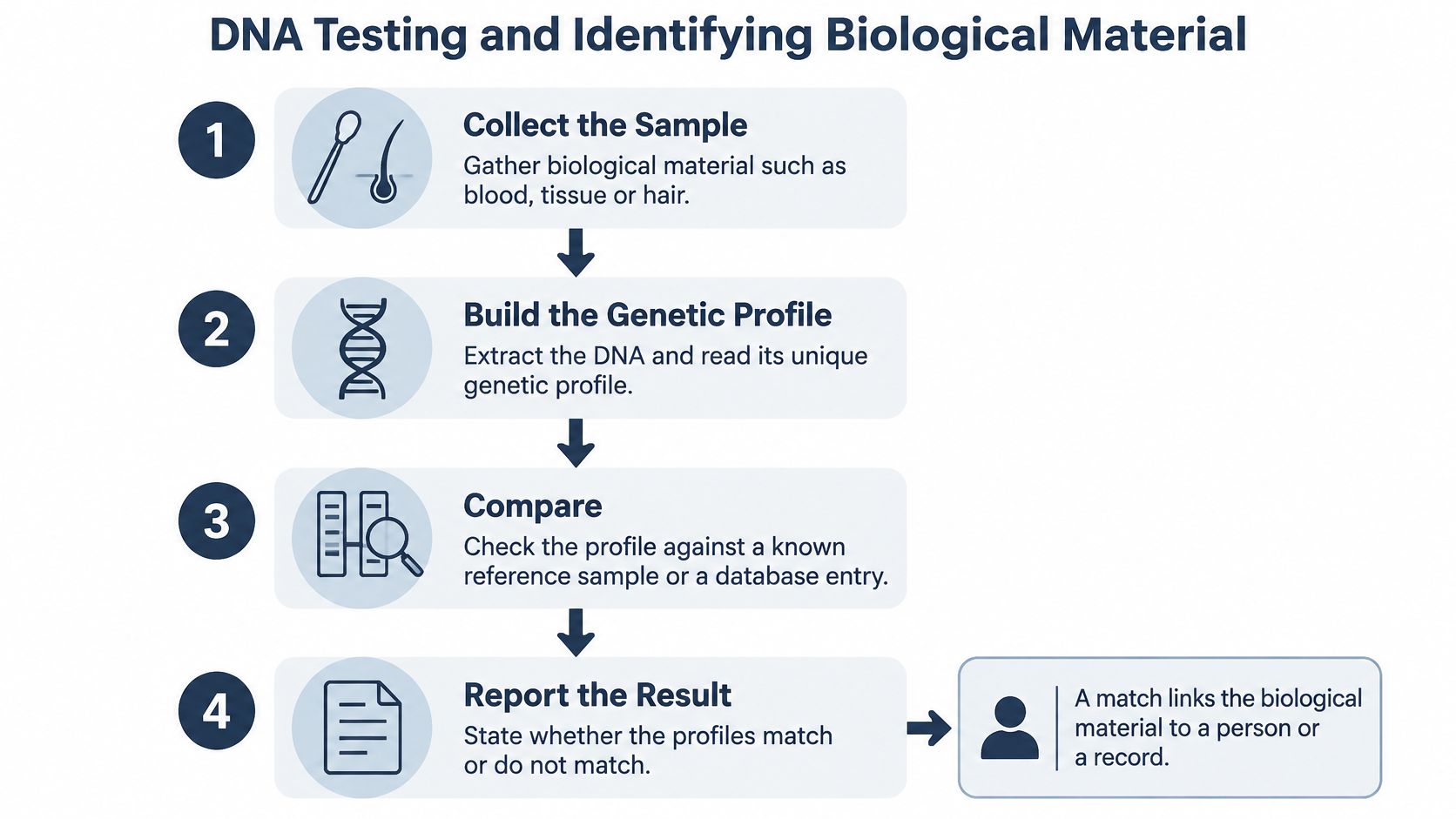
DNA testing compares a genetic profile from biological material with a known reference or an eligible database profile. The FBI's CODIS overview explains the use of short tandem repeat markers, repeated stretches of DNA used for comparison.
How a profile is developed
- Collect the sample. Blood, tissue, a hair root, or a swab provides biological material. Poor collection or contamination can complicate the result.
- Extract the DNA. Laboratory staff separate DNA from other material. Degraded specimens may yield too little usable DNA for a complete profile.
- Amplify STR markers using PCR. This makes selected DNA regions easier to detect. Low starting quantities can produce imbalances or missing signals.
- Read the markers. Analysts evaluate the results at each tested location. A mixture can contain overlapping contributions from several people.
- Compare profiles. The questioned profile is compared with a reference sample or an eligible database entry. Insufficient recovered markers may prevent a meaningful database search.
- Interpret the evidence statistically. The laboratory assesses support for competing explanations. Visual similarity alone isn't enough.
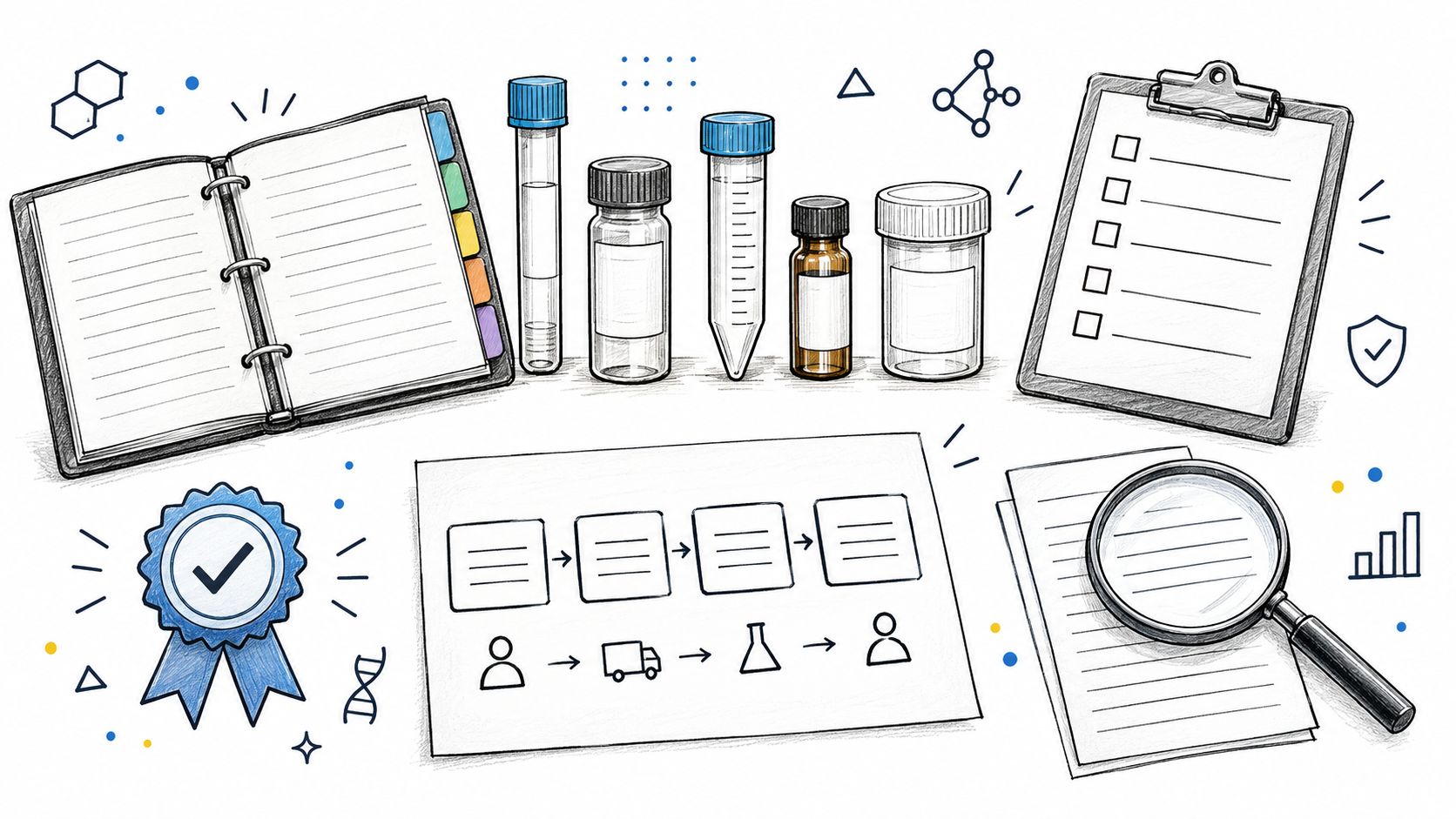
The following illustration summarizes the laboratory pathway; the written statistical interpretation remains essential.
What an inclusion supports
A complete single-source profile provides interpretable results across the intended markers from one contributor. A partial profile lacks usable results at some markers, while a mixture contains DNA from multiple contributors.
The NIST publication on complex DNA interpretation describes amplification artifacts, missing alleles, and the use of probabilistic genotyping and likelihood ratios. A likelihood ratio compares how probable the findings are under competing propositions, such as contribution by the person being considered versus an unrelated person.
A DNA inclusion therefore isn't automatically an identification. Its strength depends on the sample, validated modeling, assumptions, and resulting statistical support.
For families: Ask whether a suitable reference sample was obtained and what comparison the laboratory can actually perform.
Without a reference or suitable database comparison, the laboratory may develop a profile without being able to associate it with the person under consideration.
Imaging, Histology and Newer Molecular Tests
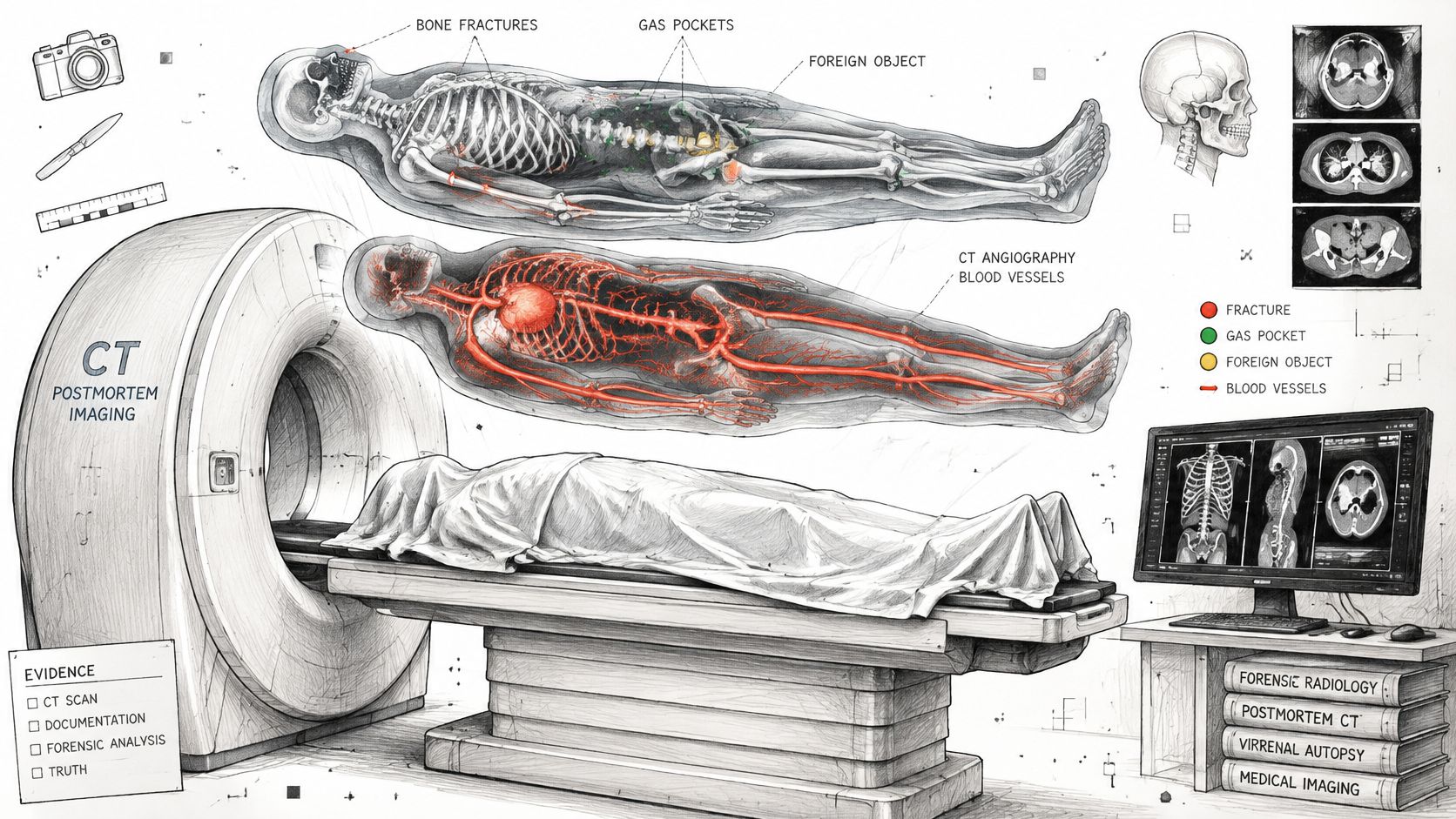
Postmortem CT uses a scan to document internal structures. It can help locate fractures, gas, bleeding, and foreign objects before dissection; CT angiography adds examination of blood vessel anatomy using a specialized technique.
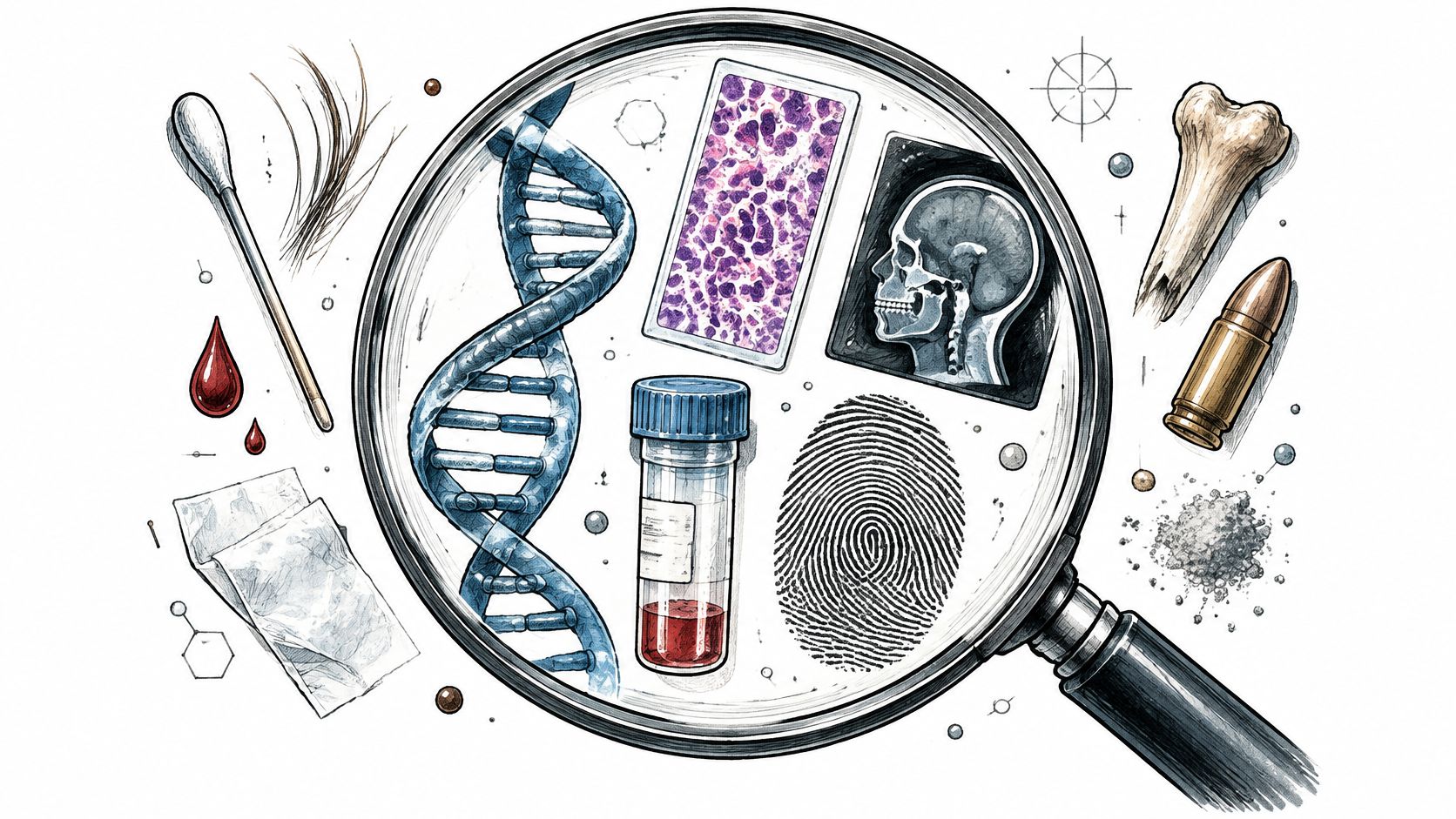
This illustration shows the structures that postmortem imaging can help document.
Looking beyond visible anatomy
Histology means examining thin tissue sections under a microscope. It can reveal inflammation, disease, or injury that isn't apparent to the naked eye, although tissue quality and the time available for changes to develop affect what can be seen.
Molecular autopsy investigates possible genetic explanations for death. It may be appropriate after an otherwise unexplained sudden death when an inherited condition, including certain heart rhythm disorders, is suspected.
A genetic finding needs more than a laboratory label to establish its significance. Our explanation of molecular profile testing addresses why the clinical history, physical findings, and interpretation of the genetic variant matter.
The video below provides an additional visual resource alongside these explanations.
Evidence and implementation limits
A review of newer forensic technologies identifies the strongest evidence among the approaches reviewed for postmortem CT, CT angiography, and molecular autopsy, while describing digital pathology as still in early forensic implementation. It also emphasizes external validation, quality assurance, explainability, digital chain of custody, cybersecurity, and human oversight.
Digital pathology involves examining digitized tissue slides. Computer-assisted analysis can support a pathologist's work, but a generated classification still needs appropriate validation and professional review.
- Screening versus confirmation: A suspicious image or genetic finding may identify what needs further examination rather than establish a final diagnosis.
- Association versus explanation: A biological association doesn't necessarily establish cause or manner of death.
We consider advanced testing when it can resolve a defined uncertainty. These educational descriptions aren't medical advice for living relatives, and postmortem genetic findings may require separate clinical evaluation before anyone draws conclusions about personal health.
Firearm Residue and Trace Evidence Testing
Gunshot-residue examination looks for microscopic material associated with firearm discharge. Relevant evidence may be collected from hands, clothing, or areas around a wound, but those locations don't all support the same interpretation.
The National Institute of Justice firearm examination guidance describes low-power microscopy, chemically specific color-producing tests, and examination of residue patterns around suspected bullet holes. Specialists may fire the suspected firearm and ammunition at documented distances to compare test patterns with the evidence.
What residue can establish
A residue pattern can help assess firing distance when appropriate comparison testing is possible. Interpretation must account for the firearm, ammunition, clothing, collection method, and circumstances.
Residue on a hand and a pattern around a bullet hole answer different questions. Neither should be treated as a standalone determination of who fired a weapon.
What transferred material can establish
Trace evidence includes fibers, hairs, paint, glass, and soil. Specialists compare material from a person or object with material from a possible source, assessing whether the findings support an association.
Collection and packaging matter because handling can introduce or move small particles. Similar material doesn't necessarily establish direct contact, the time of transfer, or the sequence of events.
- Collection record: Identify what was recovered from the body and clothing, and when.
- Preservation record: Establish whether items were separately packaged and retained.
- Handling record: Determine who held each item after collection.
Chain of custody is the documented record of who handled an item, when, and why. For families and attorneys, obtaining that record helps establish whether the evidence being interpreted is the evidence originally collected, with its handling history accounted for.
Deciding Which Tests Your Case Needs
We begin a cause of death investigation with the unresolved question, not a predetermined conclusion. Every test described in this article answers one question and carries its own limit, so the testing plan works when the question comes first. Independence means reporting both findings that support an explanation and findings that limit it.
- Write down the question. State whether you need clarification about how the death occurred, why it occurred, or whether something was missed.
- Find the matching test category in the comparison table.
- Confirm which specimens the agency or pathologist collected, retained, and submitted.
- Check whether the report explains what each test can and cannot establish.
- If the medical examiner declined the case, the cause remains unclear, or you want an independent second opinion, discuss whether a private autopsy is appropriate.
Brief questions from families and attorneys
How soon are initial findings available?
Our board-certified forensic pathologist contacts the family with preliminary findings within 24 hours of the examination. Expanded toxicology, DNA comparison, histology, and molecular testing take longer because of laboratory workload, specimen condition, and testing scope; final lab-confirmed results typically return in about four weeks.
Who explains our findings?
Every examination is performed by a forensic pathologist certified by the American Board of Pathology. The same pathologist prepares the written report and walks the family through each finding, so families are never handed off to a technician.
What if authority to request an examination is unclear?
Call (806) 230-1889 for direct guidance. We clarify authorization before arrangements; a private request doesn't override an agency's jurisdiction.
Which authorization requirements apply?
Authorization, disposition, and cremation each carry separate requirements, and our team handles them as distinct steps. Families shouldn't treat consent for one procedure as consent for every procedure.
A clear question supports a clearer testing plan. We recognize that making these decisions after a loss can be difficult.
Texas Autopsy Services provides independent examinations and second-opinion reviews from Elgin, serving all 254 Texas counties with direct communication and in-house licensed transport. If you need help understanding which tests could address an unresolved question, visit Texas Autopsy Services or call our team to discuss the available records, specimens, and next steps respectfully.