July 27, 2026 · Texas Autopsy Services
Navigating American Board Pathology: Your 2026 Guide
Discover what the american board pathology credential means for families, attorneys, and officials in 2026. Evaluate pathologist qualifications with expert
On this page
- Why This Credential Comes Up After a Death
- What the American Board of Pathology Is
- How a Pathologist Becomes and Stays Board Certified
- Why the Credential Travels Across Hospitals, Labs, and Courtrooms
- How to Verify a Pathologist's Certification Yourself
- Where the Credential Shows Up in Real Texas Cases
- What the Credential Does Not Promise
- Questions Families and Attorneys Ask Most Often
When a family is sorting through a death certificate, an attorney is checking an expert's background, or a county official is trying to line up a forensic autopsy, the phrase American Board of Pathology suddenly matters. It is the kind of credential that can decide whether a report feels trustworthy, whether an institution accepts a physician's qualifications, and whether a death investigation can move forward with less friction.
At Texas Autopsy Services, we treat that credential as a practical tool, not an abstraction. For grieving families, it helps answer whether the person examining the body is properly qualified. For attorneys and county officials, it helps show whether the work can stand up to review, deposition, or court scrutiny.
Why This Credential Comes Up After a Death
A family may not care about boards and certifications until they need to know whether a death was examined by the right kind of physician. At that point, the phrase board certified stops sounding like office language and starts sounding like a safeguard.
That's especially true when someone is reading a report and trying to understand whether the doctor who signed it had the right training for a cause of death investigation. In plain terms, cause of death means the medical reason someone died. Manner of death means the broader category, such as natural, accident, suicide, homicide, or undetermined.
Practical rule: if the case could end up in court, under county review, or in a second-opinion file, the credential matters as much as the report itself.
The same is true for attorneys and county officials. They are not just asking whether a physician is licensed. They're asking whether the person has been certified through a national pathology board that hospitals, laboratories, and courts recognize as part of the mainstream physician-credentialing system.
That is why the American Board of Pathology comes up so often in private autopsy services Texas families search for. It's not about prestige for its own sake. It's about whether the person doing the work has met a national standard that can be verified, documented, and defended.
What the American Board of Pathology Is
The American Board of Pathology is an ABMS member board, part of the larger American Board of Medical Specialties system used for physician credentialing in the United States. ABMS says its member boards certify physicians across more than 40 specialties and subspecialties in the United States, and its 2022 to 2023 report says it issued 30,329 new board certifications in 2022 and had 994,744 active board-certified physicians at the end of 2023. Those figures show the size of the system ABPath works within. ABMS board certification report
That matters because families often mix up three separate things. A doctor can hold a medical license, have hospital privileges, and be board certified, but those are not the same. A license lets someone practice medicine in a state. Privileges let a hospital or lab grant specific access. Board certification shows the physician has met a national specialty standard.
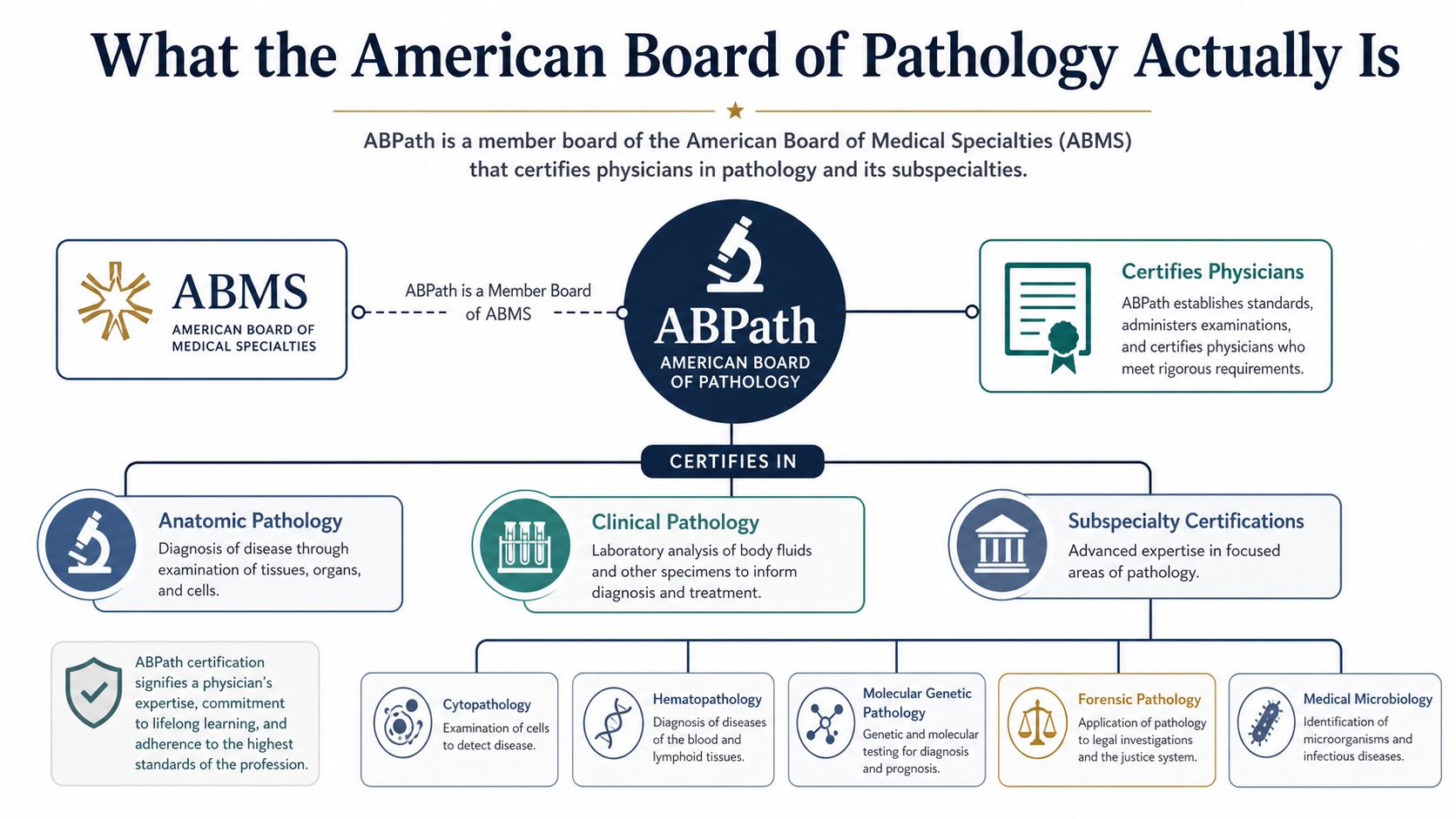
ABPath is also a nonprofit organization that has been tax-exempt since August 1945, which shows it operates as a long-standing credentialing body rather than a commercial service. ProPublica nonprofit record
For readers trying to place the credential in everyday terms, ABPath is the national body that sets and verifies pathology certification standards. It is not the autopsy report itself. It is not a guarantee of a particular conclusion. It is the credentialing framework behind the physician who performs the work.
For a broader background on board status in pathology, our board certification in pathology guide gives a plain-language overview of how certification fits into medical practice. If you want to see how that credential shows up in independent forensic work, the guide to becoming a therapist in India is not relevant here, so the more useful comparison is a pathologist whose training and certification can be checked before a case reaches a family, an attorney, or a county review.
Bottom line: ABPath certification tells you the pathologist has cleared a national credentialing bar. It does not tell you the answer to a specific case.
How a Pathologist Becomes and Stays Board Certified
A family, an attorney, or a county official may only see a signature on a report, but the credential behind that signature has a long path. ABPath certification starts with medical school, moves into pathology residency, and, for forensic work, usually continues with fellowship training in forensic pathology. That route is one reason qualified forensic pathologists are not easy to replace on short notice. The work calls for medical training, medicolegal judgment, and formal testing, all at once.
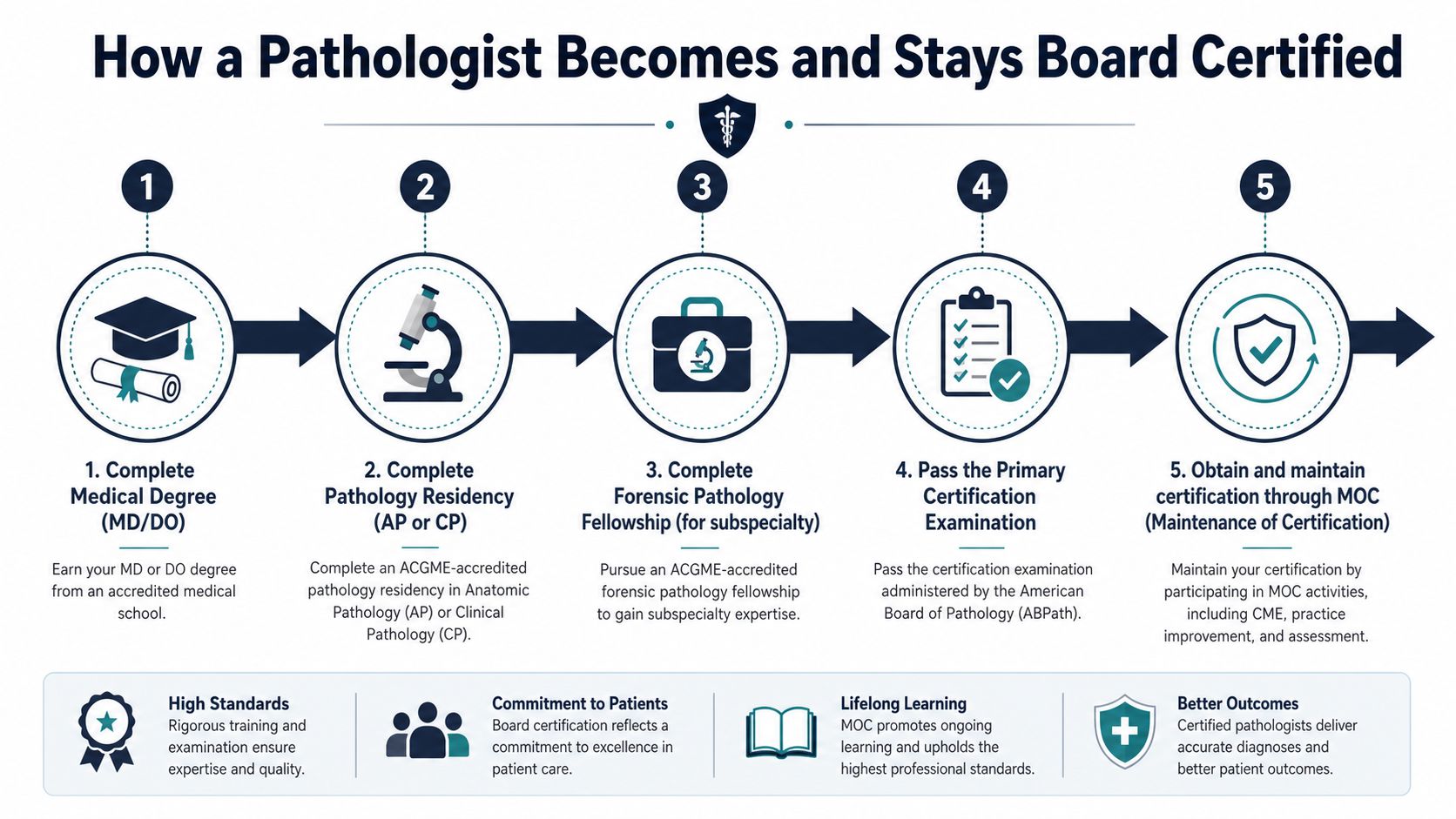
ABPath materials also set a clear gate before exam registration. Candidates must hold, or apply for, an unrestricted medical license and document at least 50 autopsies to register for the exam. That requirement helps explain why forensic pathologists who are ready for independent casework are not easy to find on short notice.
A 2023 analysis in Archives of Pathology & Laboratory Medicine reported that the overall mean pass rate for ABPath subspecialty examinations over the prior 15 years was 89%, with a range from 78.9% to 100%, and that pass rates were significantly higher in 2017–2021 than in earlier years. Archives of Pathology & Laboratory Medicine analysis
Certification does not end with the first exam. ABPath maintenance includes peer attestation covering interpersonal and communication skills, professionalism, ethics, and effectiveness in systems-based practice. For families and legal reviewers, that means the board is checking more than medical knowledge, it is also asking whether the physician continues to practice with steady professional conduct.
ABPath's continuing certification pathway also includes CertLink, a longitudinal assessment option. ABMS describes CertLink as a way to assess knowledge over time, and says ABPath began offering it as an alternative to the traditional continuing certification exam. ABMS CertLink overview
The practical point is simple. A current ABPath credential shows that the physician has met a national standard and stayed connected to it. It is a continuing professional status, not a one-time achievement that can sit untouched on a wall.
For readers comparing credential paths across professions, the structure can feel similar to the way licensing and continuing competency work in other fields, such as the guide to becoming a therapist in India. The fields are different, but the underlying idea is the same, public trust depends on a defined pathway and ongoing verification.
Why the Credential Travels Across Hospitals, Labs, and Courtrooms
ABPath certification matters because it travels well. A physician with that credential is easier for institutions to evaluate because the standard is already recognized inside the broader physician-board system.
In laboratory regulation, ABPath certification is explicitly recognized in federal CLIA rules. A technical consultant in a nonwaived laboratory can qualify by being an MD or DO licensed in the state and certified in anatomic or clinical pathology by ABPath or the American Osteopathic Board of Pathology. That is a real compliance advantage, because the credential lines up with federal laboratory rules instead of relying only on local custom.
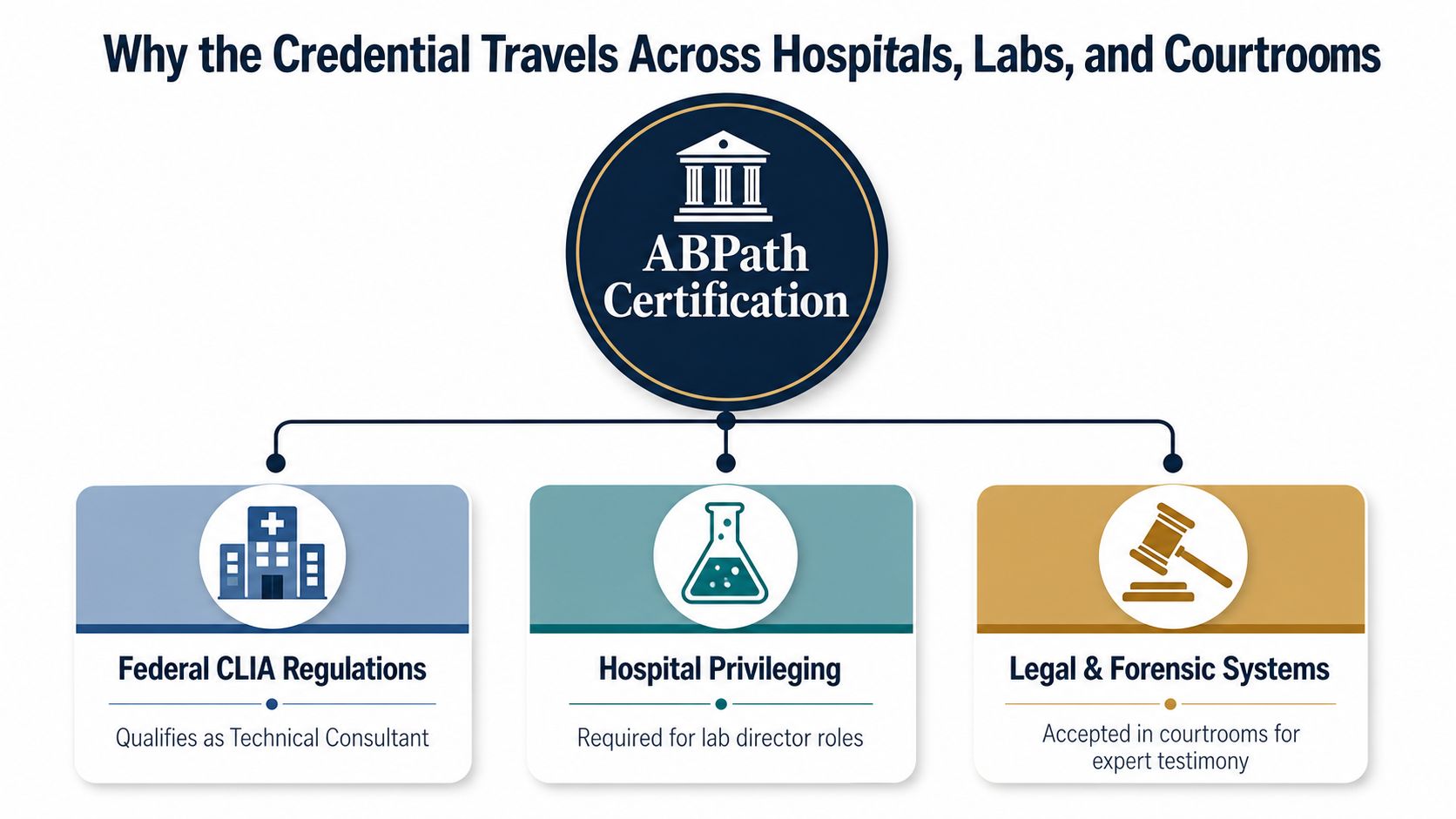
That same recognition helps in hospitals, where privileging committees often want a credential they can verify quickly. It also matters in court, where expert qualifications need to be clear enough to withstand challenge. Our forensic pathologist expert witness guide explains how those qualifications are usually reviewed in legal settings.
For pathology departments that rely on physical setup and compliance-ready workflows, even resources about outfitting a pathology laboratory are tied to the same reality. The lab's infrastructure, the physician's credential, and the regulatory rules all have to fit together.
That is why chain-of-responsibility claims are stronger when the credential is verifiable. If a report, a consult, or an expert opinion is challenged, the institution doesn't have to guess what the certification means. It can check it against a nationally standardized board system.
In independent forensic practice, that reduces friction. The same credential supports records review, autopsy work, and testimony, which helps keep the focus on the medical facts instead of on re-litigating the physician's background.
How to Verify a Pathologist's Certification Yourself
Families, attorneys, and county officials should verify a pathologist's status the same way they would verify any other critical credential. It's not rude. It's responsible.
Start with ABPath's public verification resources and confirm three things. First, whether the physician holds primary certification in pathology. Second, whether the physician has subspecialty certification in forensic pathology, if that matters for the case. Third, whether the current status shows active continuing certification or a maintenance note that needs clarification.
| Status | What It Means | What to Ask |
|---|---|---|
| Board eligible | The physician has completed training but has not finished full certification | Ask whether the person is actually certified for the work you need |
| Board certified | The physician has met the national certification standard | Ask for the subspecialty, if forensic pathology is required |
| Meeting maintenance of certification | The physician is current in the continuing certification program | Ask when the status was last updated |
| Certified, not currently meeting MOC requirements | The physician once held certification but is not current on maintenance requirements | Ask what the current standing means for your case |
If the name does not appear, ask for a written explanation and cross-check with state medical board records. A qualified pathologist should expect that question and answer it plainly.
Practical rule: if a credential can't be verified, don't assume it exists, ask for the documentation.
A useful internal reference for readers trying to understand the credentialing process is our board certification requirements overview. It puts the verification step into a larger professional context without requiring readers to sort through board language on their own.
Verification is not about suspicion. It's about making sure the right physician is doing the right kind of work, especially in a death investigation where the findings may carry legal weight.
Where the Credential Shows Up in Real Texas Cases
In Texas, the credential shows up differently depending on who needs the work.
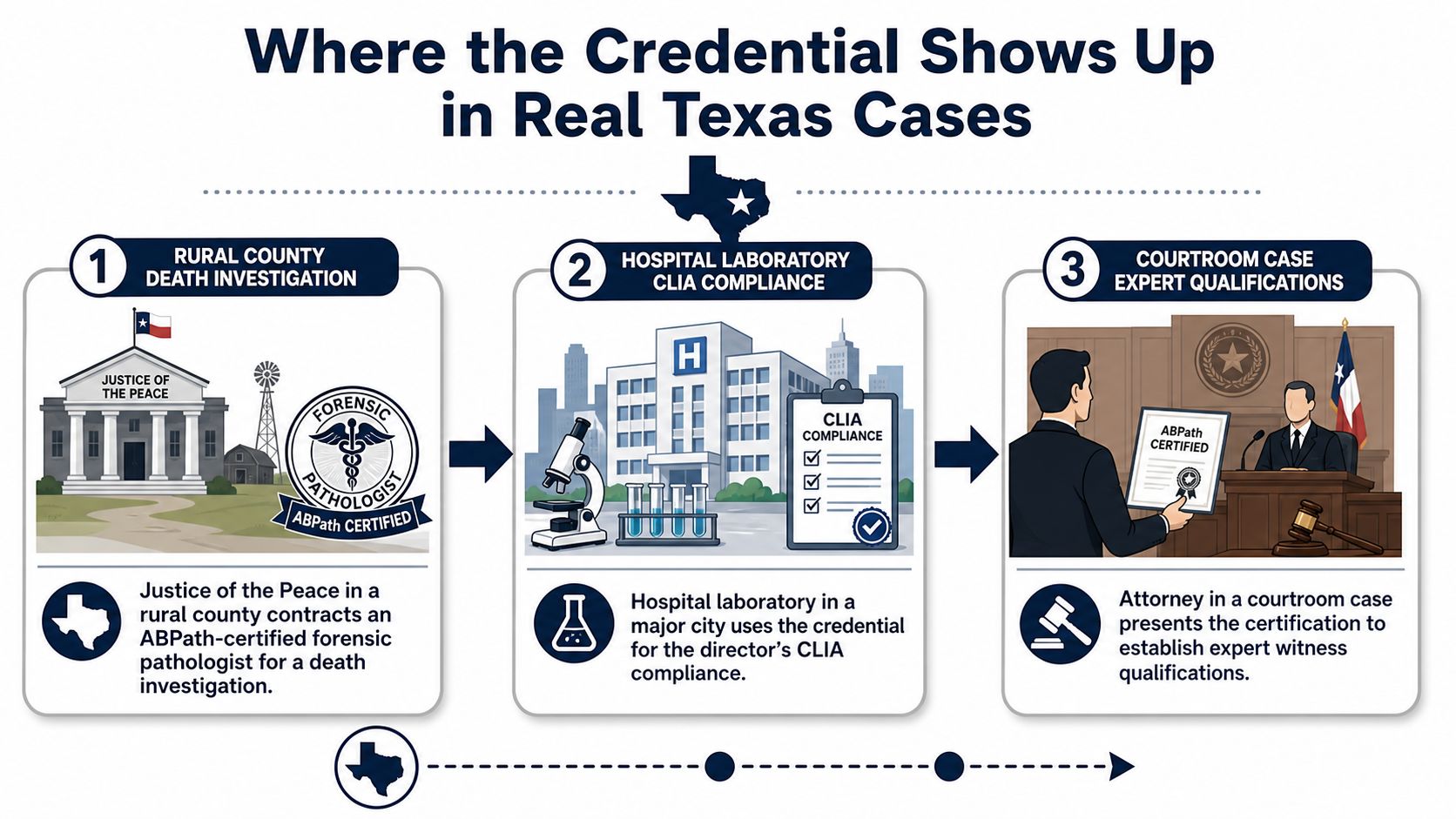
A justice of the peace in a county without a medical examiner may need an independent forensic pathologist for a death that falls under Texas Health & Safety Code Chapter 716. In that setting, the county is not buying a generic medical opinion. It is relying on a physician whose certification can be checked against the national pathology framework.
A family may seek a private autopsy or a second-opinion review after reading a prior report and still having questions about cause or manner of death. In that situation, the credential helps the family know the case is being reviewed by a forensic pathologist who meets a national standard, not just a physician with broad medical experience.
An attorney preparing for deposition or trial needs the same thing in a different form. The opposing side may challenge the expert's background, but ABPath certification gives counsel a clear credential to present and defend.
Our practice applies that structure through statewide coverage across all 254 Texas counties, in-house licensed transport, and direct communication with our team. Those are operational details, not slogans, and they matter because the credential has to work inside a real service model.
A practical comparison from the legal world can help here. Readers who are following a broader investigation, such as the Delphi Murders ongoing case, can see how expert qualifications become part of the record when facts are disputed. The point isn't the publicity. The point is that credentials become evidence of professional standing.
In every one of these Texas settings, ABPath certification acts as the common baseline. It helps move the case from uncertainty toward documented medical review.
What the Credential Does Not Promise
ABPath certification is a strong baseline, but it is not a promise of a specific result. It does not guarantee a particular cause-of-death finding, a specific turnaround, or a favorable courtroom outcome.
That distinction matters because some readers assume a board-certified physician must always arrive at the same conclusion as a prior report or a family's expectation. Medicine doesn't work that way in death investigation. Different records, different injuries, different histories, and different specimen findings can lead qualified physicians to different opinions.
Maintenance certification also doesn't predict how one case will go. It shows that the physician is participating in ongoing professional review, including conduct and professionalism requirements, but it can't guarantee performance in a single autopsy or testimony session.
ABPath's own public-facing mission is about setting certification standards and promoting lifelong competency. That is a professional framework, not a warranty. The honesty of that limit is part of why the credential is credible.
For families, that means the board is one filter, not the whole answer. For attorneys, that means the credential supports admissibility and credibility, but not automatic victory. For county officials, that means the credential helps reduce risk, but it doesn't remove the need for good records, clear questions, and careful review.
Questions Families and Attorneys Ask Most Often
How long most private autopsy cases take depends on the case itself. Complex records, toxicology, tissue review, or outside testing can add time, so no responsible practice should promise the same pace for every matter.
Why a second opinion sometimes differs from a prior report is usually straightforward. A new pathologist may have access to different records, may inspect the body differently, or may interpret the same facts through a different but still medically sound lens. That doesn't automatically mean one physician was careless.
Chain of custody means the body, specimens, photographs, and records are tracked carefully from one handoff to the next. In plain language, it is the paper trail that shows who had what, when they had it, and what happened next. That matters when the report may be reviewed by a court, county, or other institution.
A clean chain of custody protects the facts, not just the file.
If you're starting a case, begin with a board-certified forensic pathology practice that can explain the scope, the records needed, and the likely next steps in plain language. Texas families and attorneys often start by reviewing our private autopsies page, our county forensic autopsies page, or our Waterloo Mortuary Partnership information when logistics are part of the plan.
Texas Autopsy Services provides independent autopsy and forensic pathology support across Texas with direct communication, careful documentation, and board-certified forensic pathologists on every examination. If you need help understanding an autopsy report, planning a second opinion, or confirming whether a case should move forward under a recognized credentialing standard, visit Texas Autopsy Services and contact our team for clear guidance.