August 13, 2026 · Texas Autopsy Services
Drunk Couple Falling Down Stairs: What Happens Next
A drunk couple falling down stairs can raise serious medical and forensic questions. Learn what injuries occur, how autopsies determine cause, and next steps.
On this page
- A Typical Night That Turns Into a Forensics Question
- What a Stair Fall Actually Does to the Body
- Cause of Death Versus Manner of Death in Plain English
- How Toxicology and the Autopsy Reconstruct the Fall
- Preserving the Scene Before the Pathologist Arrives
- What Families and Attorneys Can Expect From Our Texas Practice
- Common Misconceptions About Alcohol-Related Deaths
- Questions Families and Attorneys Ask Most Often
A drunk couple falling down stairs is rarely just one fall. In a home, one person may miss a step after drinking, another may go after them, and the scene can end with head injuries, confusion, and a question that lingers long after the ambulance leaves. Families often get the first answer in the emergency department, but the forensic answer usually comes later, after toxicology, imaging, and a full postmortem exam are pulled together by a forensic pathologist.
That difference matters because a stair fall can look simple from the outside and be far more complex inside the body. Alcohol can change how hard someone lands, how they protect their face and head, and how injuries spread across the body. It can also sit alongside heart disease, stroke, or other medical problems that help explain why a fall happened in the first place, as seen in the forensic review of 9,156 autopsies over 10 years that found only 43 fatal stair-fall cases, or 0.47% of the total, with 19 cases involving severe internal disease that may have contributed to the fall (PubMed study on fatal stair falls).
For families, the hard part is that the scene at home is only the beginning. Emergency clinicians treat the injury they see, but the autopsy asks a different question, what happened to the body in the seconds before and after the fall, and what role did intoxication, disease, or body position play? When substance use is part of the picture, it can help to understand the broader substance abuse physical and mental toll in context, including how alcohol affects judgment and injury risk (Integrity Together LLC).
A Typical Night That Turns Into a Forensics Question
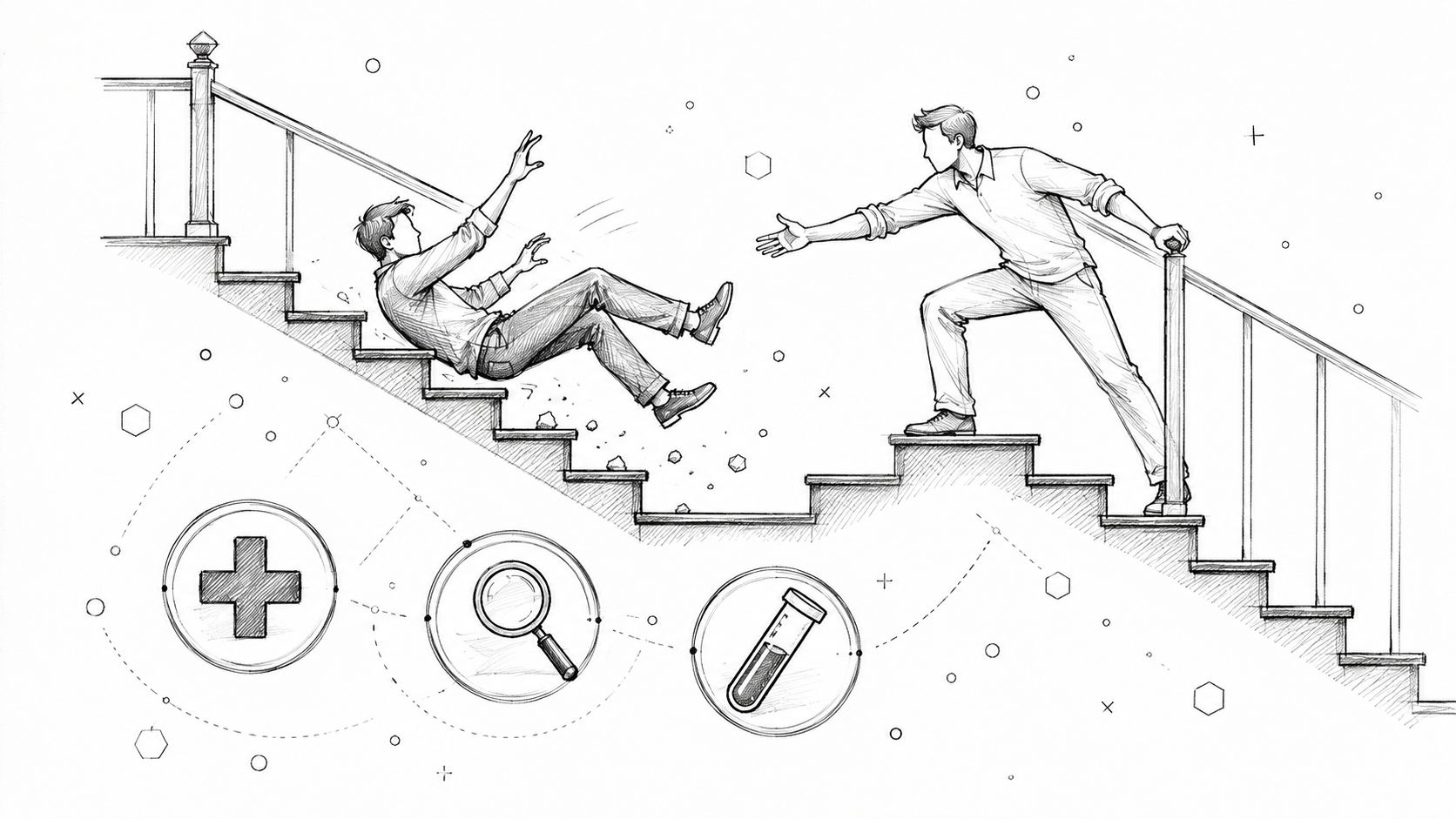
A couple is at home, drinking, and moving between a living room and an upstairs bedroom. One person slips on the stairs. The other comes to help, loses balance, and falls too. By the time first responders arrive, there may be blood on the steps, one body at the bottom, and another person who is injured, stunned, or already gone.
That kind of scene leaves families with questions that can't be answered by a quick look at the stairs. Did the first person fall because of intoxication, weakness, or a medical problem? Did the second person hit the same steps, or did they suffer a different injury pattern from trying to catch or reach the other person? Those are not small distinctions. They change how a cause of death investigation is built, and they can matter later in insurance, civil claims, or in understanding what happened.
A home death also feels different from a hospital death because no one has been watching the person's condition minute by minute. That's why a private autopsy can matter. It gives families a separate medical review when the scene, the injuries, and the toxicology don't fit neatly into a single explanation.
Practical rule: the person lying second at the bottom of the stairs is not automatically the easier case. Their injuries, blood alcohol level, and medical history can point in a very different direction than the first fall.
For families trying to make sense of a sudden loss, it helps to think in layers. The emergency team sees the injury. The pathologist later sees the injury plus the internal findings, the toxicology, and the disease burden. That second layer is often where the explanation begins.
What a Stair Fall Actually Does to the Body
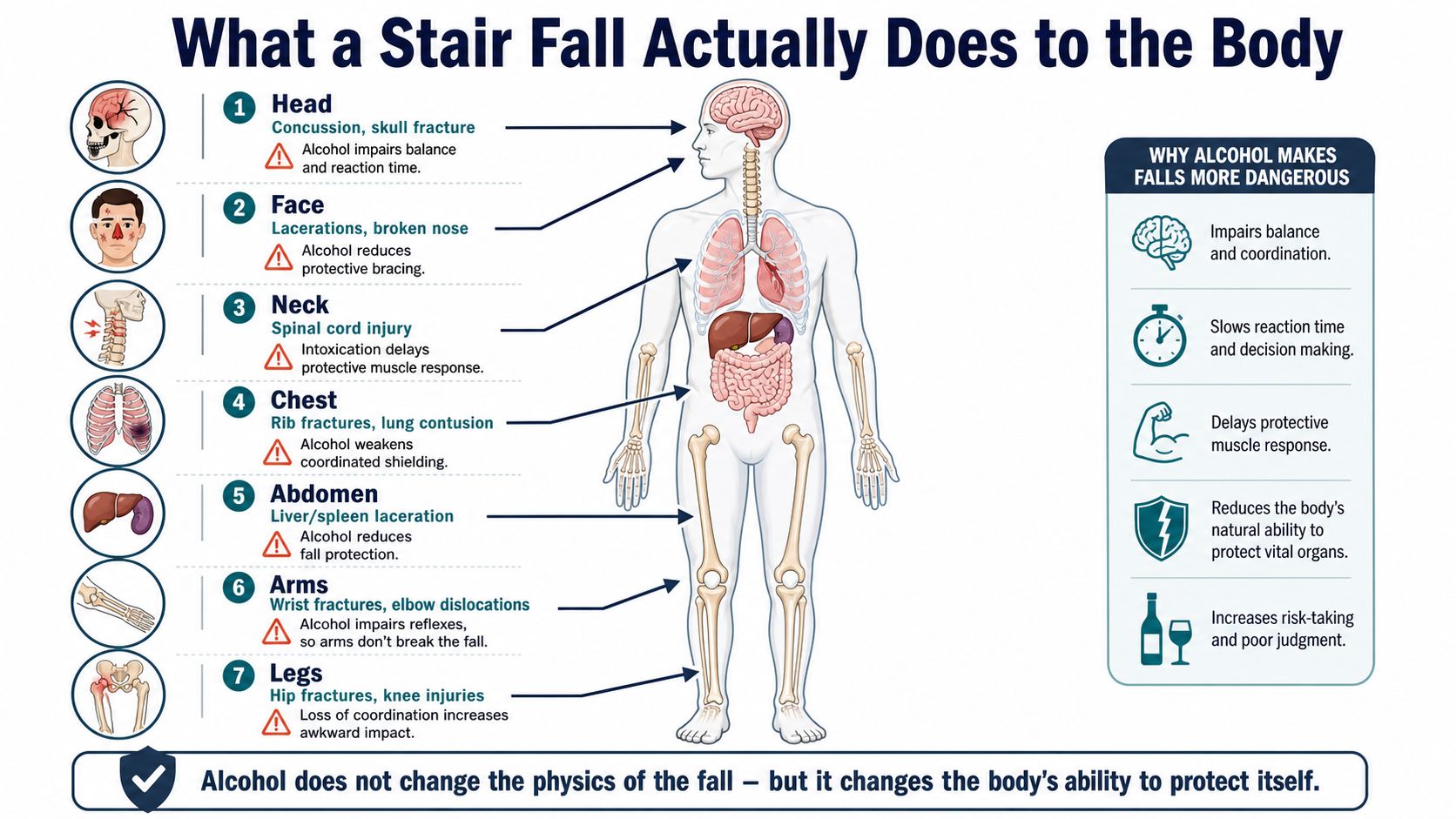
Alcohol doesn't change gravity. It changes the body's ability to respond to it. When a person is intoxicated, reflexes are slower, balance is less reliable, and the hands-up reaction that normally protects the face and skull is weaker. That is one reason intoxicated stair-fall patients show more severe head and facial injury patterns, including a 2.7-times higher prevalence of traumatic brain injury and a 2.5-times higher prevalence of craniofacial injury than non-intoxicated patients in a U.S. emergency-department study (Journal of Epidemiology and Community Health).
The injury map starts at the head
In forensic work, we look first at the head and face because that's where the most dangerous force often lands. A hard hit can leave scalp injuries, fractures, or brain trauma. In a clinical series of 464 stair falls, traumatic brain injury appeared in 5.6% of patients, limb fractures in 22.4%, thoracic injuries in 7.4%, and 7 patients needed ICU care (SAGE trauma-center cohort). Those numbers remind us that a staircase injury is not just a bruise problem, it can be a multi-system trauma pattern.
Age and disease change the pattern
Older adults often present differently. The same trauma-center work found that older patients were more likely to have polytrauma and more severe spinal injury, while intoxicated patients were younger on average and had more head-and-neck injuries (SAGE trauma-center cohort). That matters because age and pre-existing disease shape how a body fails under stress. A person with coronary artery disease, a prior stroke, or a brain tumor may not react to a fall the same way a healthy person would.
Alcohol changes the way the body meets the stairs, not the staircase itself.
A forensic pathologist reads the injury map from top to bottom, then compares it with the scene. Facial cuts, neck trauma, rib injuries, or fractures in the arms and legs can tell a coherent story about how the body moved. When the distribution doesn't make sense, that's when the autopsy has to go deeper.
Cause of Death Versus Manner of Death in Plain English
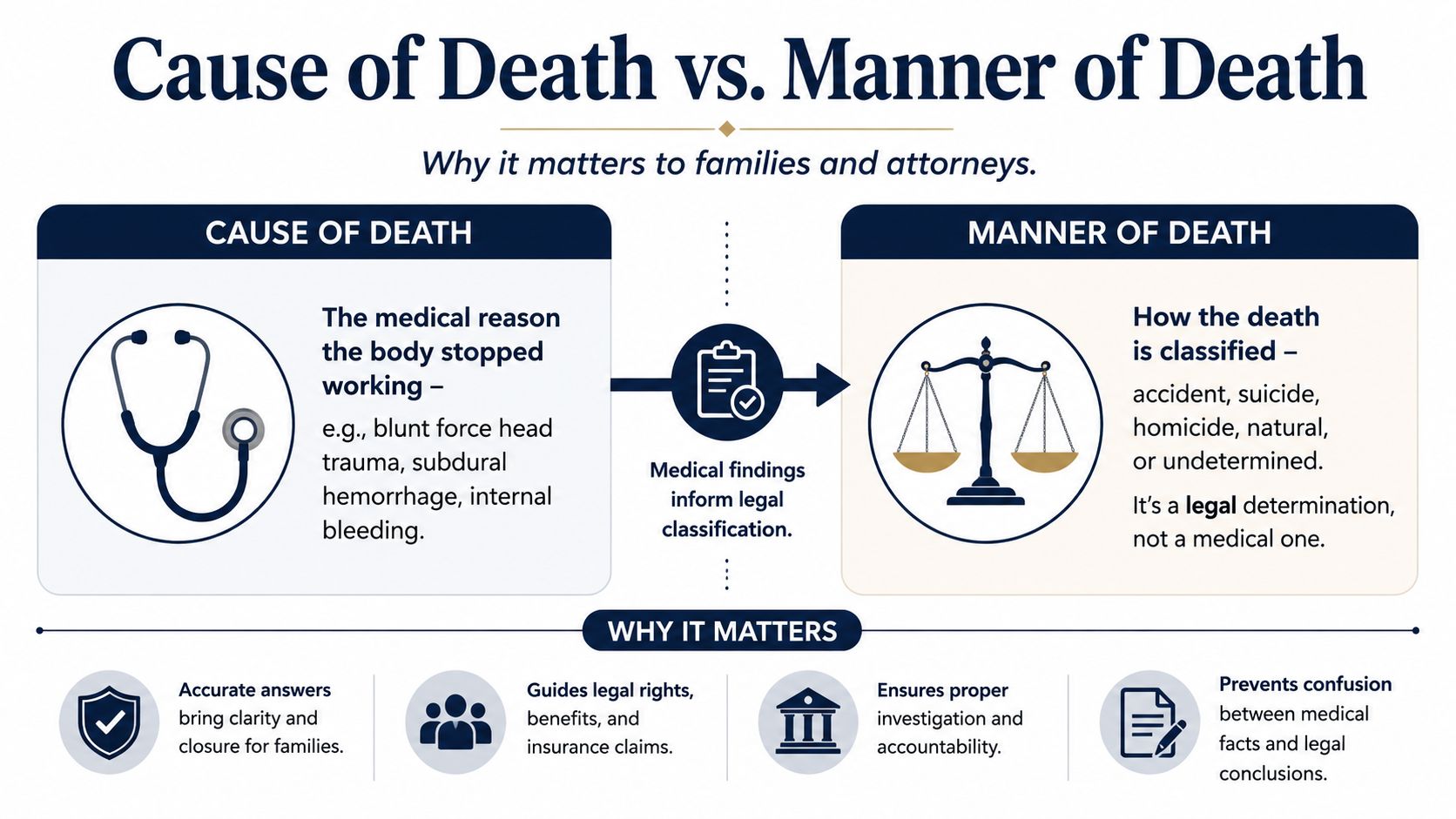
A family may hear two terms after a fatal stair fall and assume they mean the same thing. They do not. Cause of death is the medical reason the body stopped functioning, while manner of death is the legal category used to describe how the death is classified.
Cause of death is the medical answer
If someone dies after falling down stairs, the cause of death may be blunt force head trauma, a subdural hemorrhage, or another internal injury. That answer comes from the body, not from assumptions made at the scene. The pathologist reviews the external exam, the internal exam, and any toxicology or imaging to trace the medical chain that led to death.
Manner of death is the classification
The manner of death explains the legal story. It may be natural, accident, suicide, homicide, or undetermined. A stair fall involving alcohol is often an accident, but that conclusion is not automatic. It has to fit the injury pattern, the scene, and the medical findings.
A simple way to separate the two is this. Cause tells what killed the person. Manner tells how the death is categorized. That distinction matters for insurance, civil litigation, and family records. It also matters because the emergency department and the autopsy answer different questions. The emergency team treats the injuries in front of them, while the forensic pathologist makes the final postmortem determination after examining the body and the circumstances together.
Plain-language guide: if the cause is the wound or disease process, the manner is the legal box that case gets placed into.
When a death involves stairs, alcohol, or possible medical illness, the cause and manner can point in different directions unless the whole case is examined together.
How Toxicology and the Autopsy Reconstruct the Fall
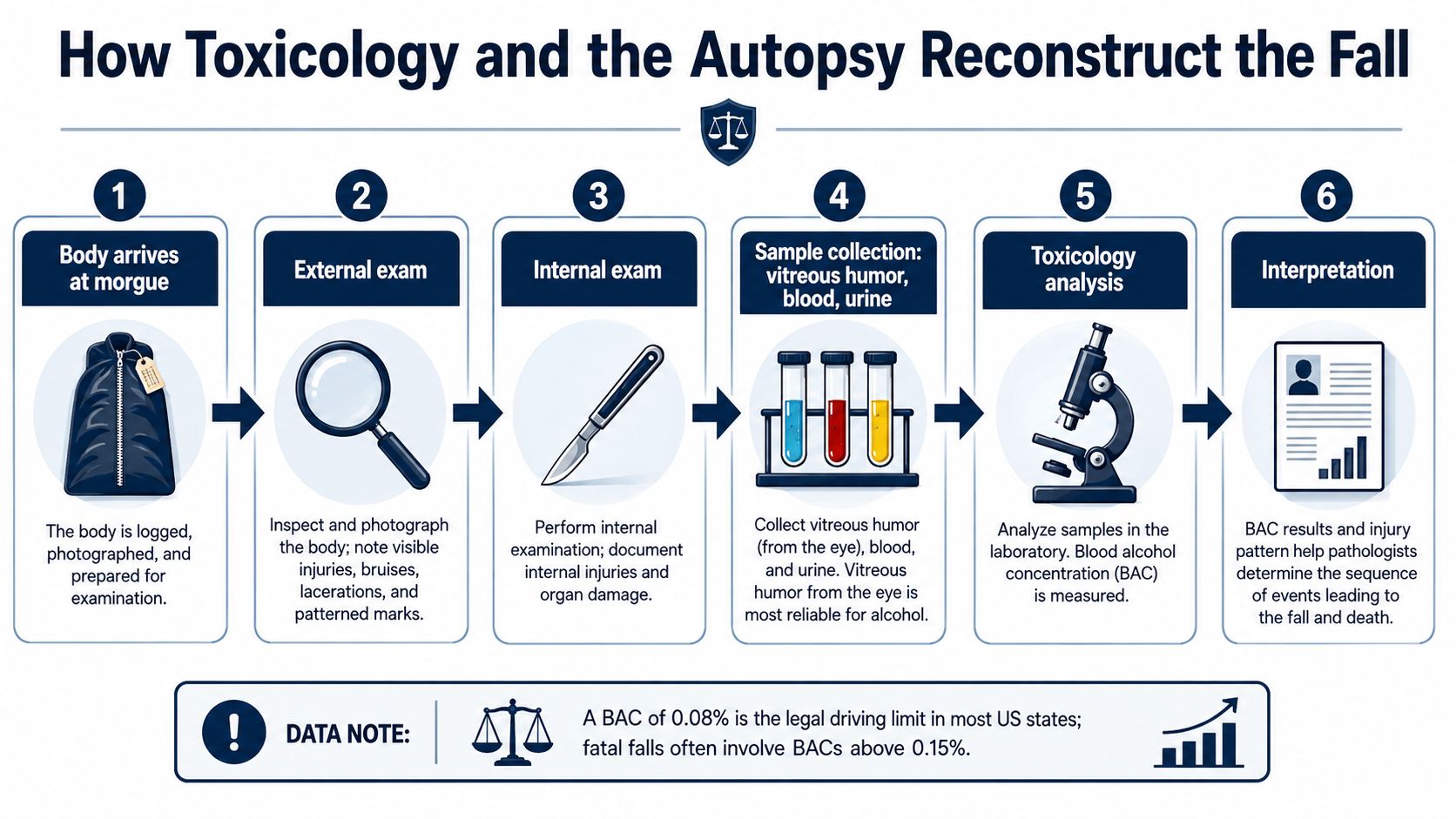
The autopsy doesn't start with a cut. It starts with samples, records, and pattern recognition. In suspected alcohol-related stair falls, pathologists commonly rely on blood, urine, and vitreous humor, the clear fluid from the eye, because each sample gives a slightly different view of alcohol exposure.
Blood alcohol tells part of the story
Blood alcohol concentration, or BAC, measures how much alcohol is in the blood. In the forensic review of fatal stair falls, 53.5% of victims were under the influence of alcohol, with an average blood alcohol concentration of 2.56 per thousand (PubMed study on fatal stair falls). A separate BBC-reported inquest described a man with 180 mg of alcohol per 100 ml of blood, compared with a legal driving limit of 80 mg per 100 ml in that setting (BBC report).
Those figures don't prove a fall by themselves. They do show why toxicology is more than a side note. In a stair-fall death, intoxication can help explain why balance failed, why the head struck first, and why the body didn't protect itself.
The body and the scene have to agree
After toxicology, the autopsy ties the numbers to the injuries. A laceration on the forehead, fractures in the face, bleeding around the brain, or internal injuries in the chest can fit the geometry of the steps, the landing, and the direction of the fall. That reconstruction is often what turns a rough story into a reliable medical explanation.
A practical detail matters here. Pathologists prefer samples that reduce distortion from postmortem change, and femoral blood is often more useful than heart blood for interpretation because it's less affected by redistribution. That's part of why the sample collection step is so important.
For readers who want a fuller breakdown of that lab side, our plain-language explanation of what toxicology testing is may help.
Preserving the Scene Before the Pathologist Arrives
The moments after a stair death can feel chaotic, but small actions matter. The scene should be left as close to intact as possible until the body is released and transport is arranged. Cleaning the stairs, moving objects, or discarding bottles can erase details that tell the story later.
What families should protect
Footwear, spilled containers, broken glasses, blood patterns, and the position of the body all matter. Photographs of the stairs, the landing, and anything the person may have been carrying can help the pathologist compare injuries with the environment. A careful record from the home can also support later review by counsel or investigators.
One useful outside reference for that kind of preservation mindset is this guide on evidence after a slip and fall from Mattiacci Law. The setting is different, but the principle is the same, details disappear fast if no one documents them.
Chain of custody starts after release
Families often mix up scene preservation with chain of custody. They're related, but not the same. Scene preservation is what happens at the home. Chain of custody begins once the body and any relevant evidence are formally transferred to the transport team or autopsy service, with documented handling from that point forward.
Texas families sometimes assume a county office must take every adult death at home. That isn't always true. When the circumstances are consistent with a witnessed accident and there's no obvious jurisdictional need for a medical examiner case, a private autopsy can be the path to answers. For a detailed look at evidence handling, our internal guide on forensic evidence collection explains why those first details matter.
What Families and Attorneys Can Expect From Our Texas Practice
At Texas Autopsy Services, the first contact usually comes by phone, and it can happen any time of day. From there, our team coordinates statewide transport from all 254 Texas counties, secures the body in temperature-controlled storage, and prepares the case for examination in our Elgin facility. Every examination is performed by a forensic pathologist certified by the American Board of Pathology.
The workflow in practical terms
The case usually moves through a sequence that makes sense to families and attorneys alike.
- Initial intake: We gather the known facts, scene details, and any hospital or law-enforcement records available.
- Transport and storage: Our licensed team handles in-house transport and secure custody.
- Examination: The pathologist performs the external and internal exam, with digital imaging as needed.
- Ancillary testing: Toxicology and molecular testing are ordered when they help answer the question.
- Report: The final written report explains the findings in plain language and can support civil or probate review when appropriate.
Most cases move through examination within 24 to 48 hours of receipt, but final report timing depends on toxicology and other ancillary studies. We don't promise a fixed date when the science itself determines the schedule. We do keep communication direct and HIPAA-compliant, so families and attorneys aren't left guessing.
For families exploring options, our pages on private autopsies and county forensic autopsies explain the types of cases we handle and the settings we serve. In alcohol-related stair deaths, that clarity is often what helps everyone understand what happened and what didn't.
Common Misconceptions About Alcohol-Related Deaths
A stair death that involves alcohol can look simple from a distance. The emergency department may see a person who arrived with severe trauma, while the family later hears a different story at autopsy, one that asks whether the fall caused death, whether disease helped make the fall worse, or whether both were part of the same chain of events. Alcohol can be part of that chain, but it does not answer every medical question by itself.
Myths families hear often
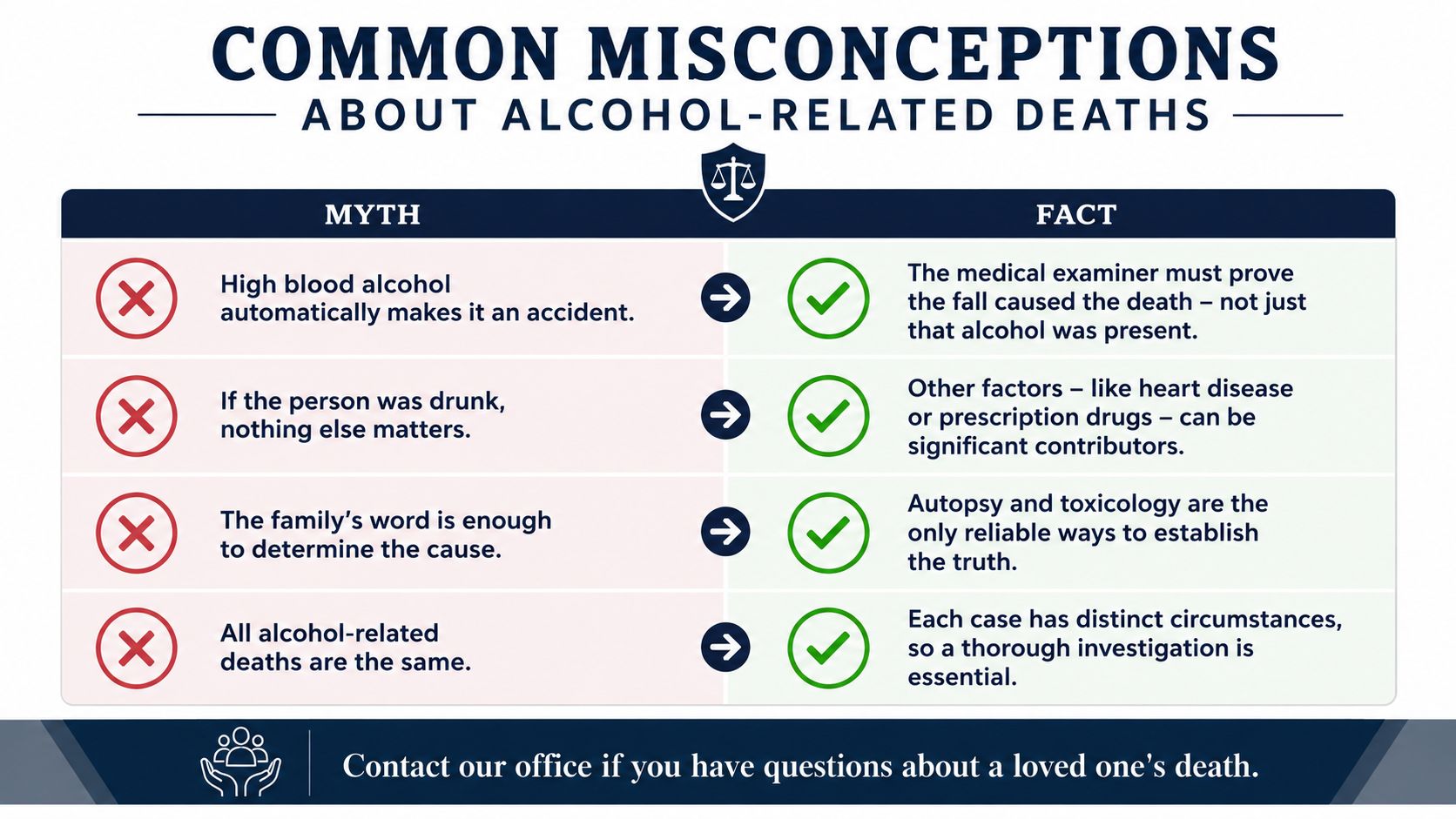
One common myth is that a high BAC settles the cause of death. It does not. A toxicology result may show intoxication, but the pathologist still has to connect the injuries to the fatal event and separate what alcohol may have contributed from what ended the person's life.
Another mistake is assuming intoxication explains everything else away. A person may have heart disease, a stroke, or another serious medical problem that contributed to the fall or changed how the body responded after impact. The fatal stair-fall study in PubMed makes that point clearly, the medical examiner review found severe internal disease in 19 cases, which means alcohol and preexisting illness can overlap in ways that are easy to miss if someone focuses on intoxication alone (PubMed study on fatal stair falls).
Another common error is treating the family's account as the final answer. Family history matters, because it helps explain what happened before the fall, but the autopsy and toxicology are the medical record that tests those details against the body itself. That is especially important in a two-person fall, where the injuries, blood alcohol level, and timing may differ from one person to the other, even if the same staircase was involved.
Why the paperwork rules matter
Texas law and professional rules also shape what can be done and who can do it. Texas Health & Safety Code Chapters 711, 716, and 651, along with Texas Funeral Service Commission rules, govern how deaths are handled, how remains are managed, and how forensic services are provided. Those safeguards exist for a reason, they keep the process documented, lawful, and respectful.
A stair-fall death is not explained by alcohol alone. It is built from the injury pattern, the person's medical condition, the scene, and the written record that follows. When those pieces are examined carefully, families get a clearer answer about what happened and what did not.
Questions Families and Attorneys Ask Most Often
Families dealing with a stair death often need practical answers, not generalities. Here are the questions we hear most.
How soon can a private autopsy be arranged after a stair fall at home? We can usually begin coordination right away once the body is released and transport is authorized. The timing depends on jurisdiction, release status, and whether the scene has already been documented.
Will toxicology be ordered automatically? Not in every case. Our board-certified forensic pathologists decide whether toxicology will help answer the question based on the scene, injuries, and history.
Can the report be used in a civil case? In many cases, yes. A properly documented private autopsy report can support a premises liability or other civil review when the facts and the court's rules allow it.
Can the family speak directly with the pathologist? Yes, families can speak with our team, and communication is direct rather than routed through a call center. If you need help sorting through a loss, you can reach us any time at (806) 230-1889.
For families who also need emotional support, this plain guide to grief and loss counselling in Grande Prairie is one example of the kind of outside help that can matter after a sudden death.
If you need a careful, independent review after a stair fall involving alcohol, Texas Autopsy Services can examine the body, document the injuries, and explain the findings in plain language. We provide private autopsy services across Texas with direct communication, full chain of custody, and reports built for families, attorneys, and county officials. Visit Texas Autopsy Services or call (806) 230-1889 to speak with our team.