November 19, 2026 · Texas Autopsy Services
Autopsy Report PDF Sections and How to Request One
Learn what an autopsy report PDF contains, how to read the cause and manner of death, and how to request a copy in Texas.
On this page
- Sections Every Autopsy Report PDF Should Include
- How to Read the Cause and Manner of Death
- Reading Toxicology, Histology and Lab Results
- Preliminary and Final Reports and Why Timing Varies
- Who Can Request a Copy and How to Ask
- Protecting Privacy When You Share a Report
- How Texas Law Separates Private and Official Autopsies
- Choose the Next Step After the Report Arrives
A folder, an email attachment, sometimes a printed envelope arrives weeks after the funeral. Inside is a document that answers questions nobody could answer at the time, and it's written in a language of its own. Gross examination. Ancillary studies. Manner of death. Readers often get through the first page and set it down.
That's understandable. An autopsy report PDF is a medical record and a legal record at the same time, and it follows a fixed structure that nobody explains to the family receiving it. Once you know the order of the pages, and which sentences carry the actual opinions, the document stops being intimidating.
What follows is a walk through that document, section by section, written for the person holding it now. It's also for the attorney, clinician, or county official who needs to read it the way a pathologist does.
Sections Every Autopsy Report PDF Should Include
A complete report isn't written in whatever order the pathologist felt like that day. It follows a fixed sequence, and that helps a reader who has never seen one. You can hold the document against the expected order and tell within a minute whether something is missing, thin, or still waiting on a laboratory.
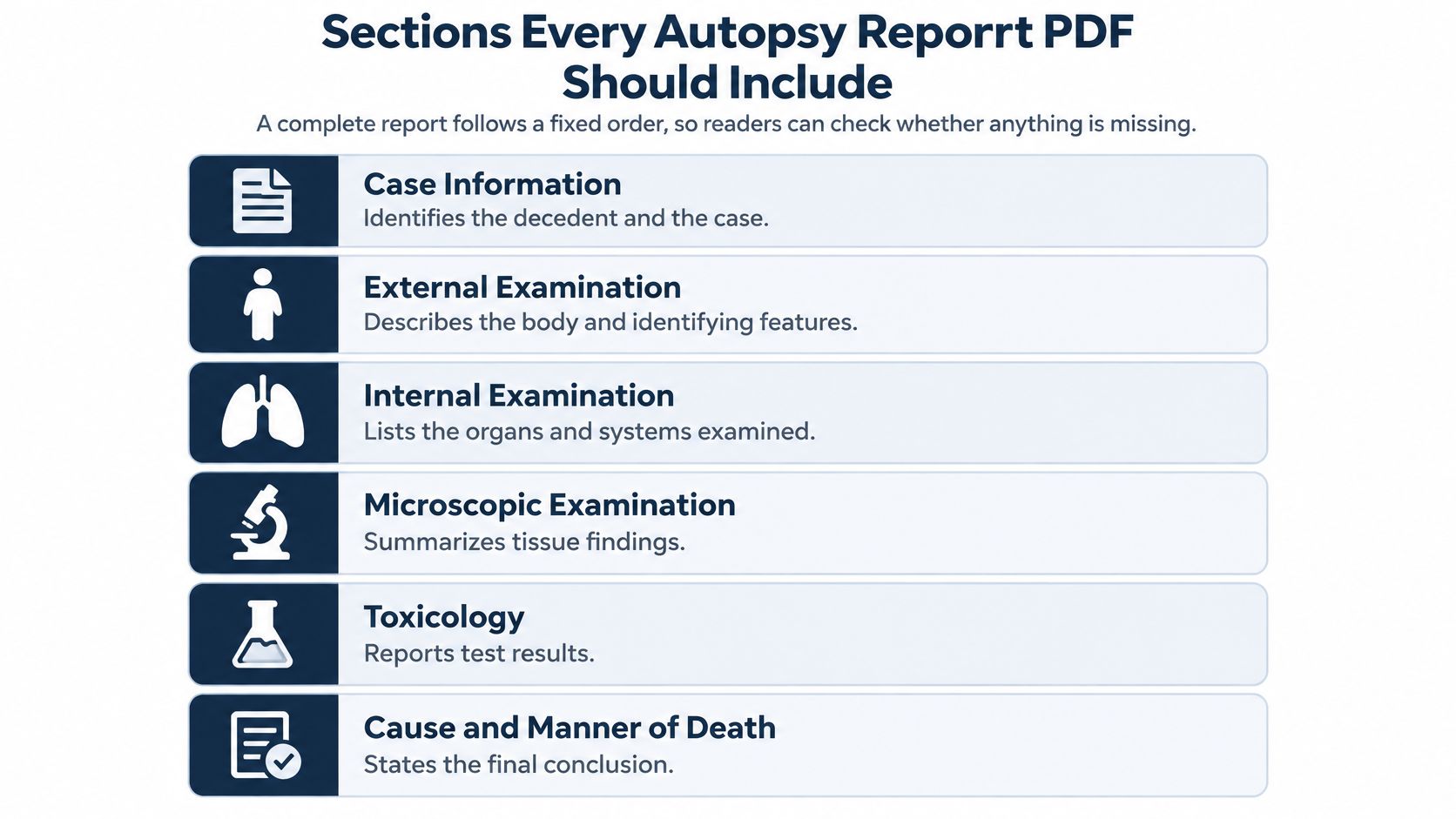
The sequence isn't house style. The NAME forensic autopsy standards call for a written report for every postmortem examination, one that identifies the date, place, and time of the examination, the decedent's name when known, and a unique case number. The same standards require external and internal findings, a distinct injury section, and a visible line from what was observed to the diagnoses and opinions that rest on it.
Core sections of a standard autopsy report
| Report section | What it records | What to check |
|---|---|---|
| Case identification | Case number, decedent name when known, exam date, time and place | Case number matches any letters or records you hold |
| Relevant history | Medical history and circumstances of death drawn from records | Notes whether the records were complete |
| External examination | Visible findings on the body, with photographs when used | Matches the injury section |
| Internal examination | Organ and tissue findings from the dissection | Organ findings line up with the cause opinion |
| Injury description | Each injury with its location, size and pattern | Each injury is described on its own |
| Ancillary testing | Toxicology, histology, imaging and other laboratory results | Results are cross referenced, not summarized alone |
| Interpretation | The pathologist's reasoning connecting findings to diagnoses | Facts are separated from opinion |
| Cause and manner of death | The final opinions and the terms used for them | Manner matches the findings and the terms are defined |
| Limitations | Gaps such as decomposition, missing records or pending tests | Limits are listed, not hidden |
| Certification | Signature, date and authorship of the report | Signed and dated by the pathologist who issued it |
Facts first, opinions second
Read in two passes. The first pass collects what was directly documented: weights, wounds, organ findings, test values. The second collects what the pathologist concluded from them. Well-built reports keep those layers apart under headings like findings, interpretation, and opinion.
That separation is what makes a document reviewable. You can question an interpretation while accepting the observation beneath it, and so can a second pathologist asked to look at the case. When case identifiers, examination timing, or injury descriptions are missing, the gap runs the other way too, because nobody can reconstruct what was done.
Confirming the report was signed by the right professional
The last page should name the pathologist and carry a signature and a date. Certification is a checkable fact rather than a courtesy claim. The American Board of Pathology book of information requires an applicant to already hold certification in anatomic pathology or in anatomic and clinical pathology, complete 12 months of training in an ACGME-accredited forensic pathology program, and document at least 30 autopsies by the time the application is submitted.
A quick check before you rely on the document
- The case number matches. Compare it with the number on the death certificate, the funeral home paperwork, or any letter from the office. A mismatch means you may be reading a different case or an earlier version.
- The examination date and place are listed. A report without timing can't be tied to the death certificate or to hospital records.
- Injuries have their own section. Each injury should appear with its location and pattern, not folded into a paragraph about something else.
- The cause opinion points back to specific findings. If it doesn't, ask which findings support it. That question is reasonable and offices answer it.
How to Read the Cause and Manner of Death
Two short lines near the back of the report carry most of the weight, and they're the lines families read first and understand least. They sit under headings like cause of death and manner of death, and they mean different things.
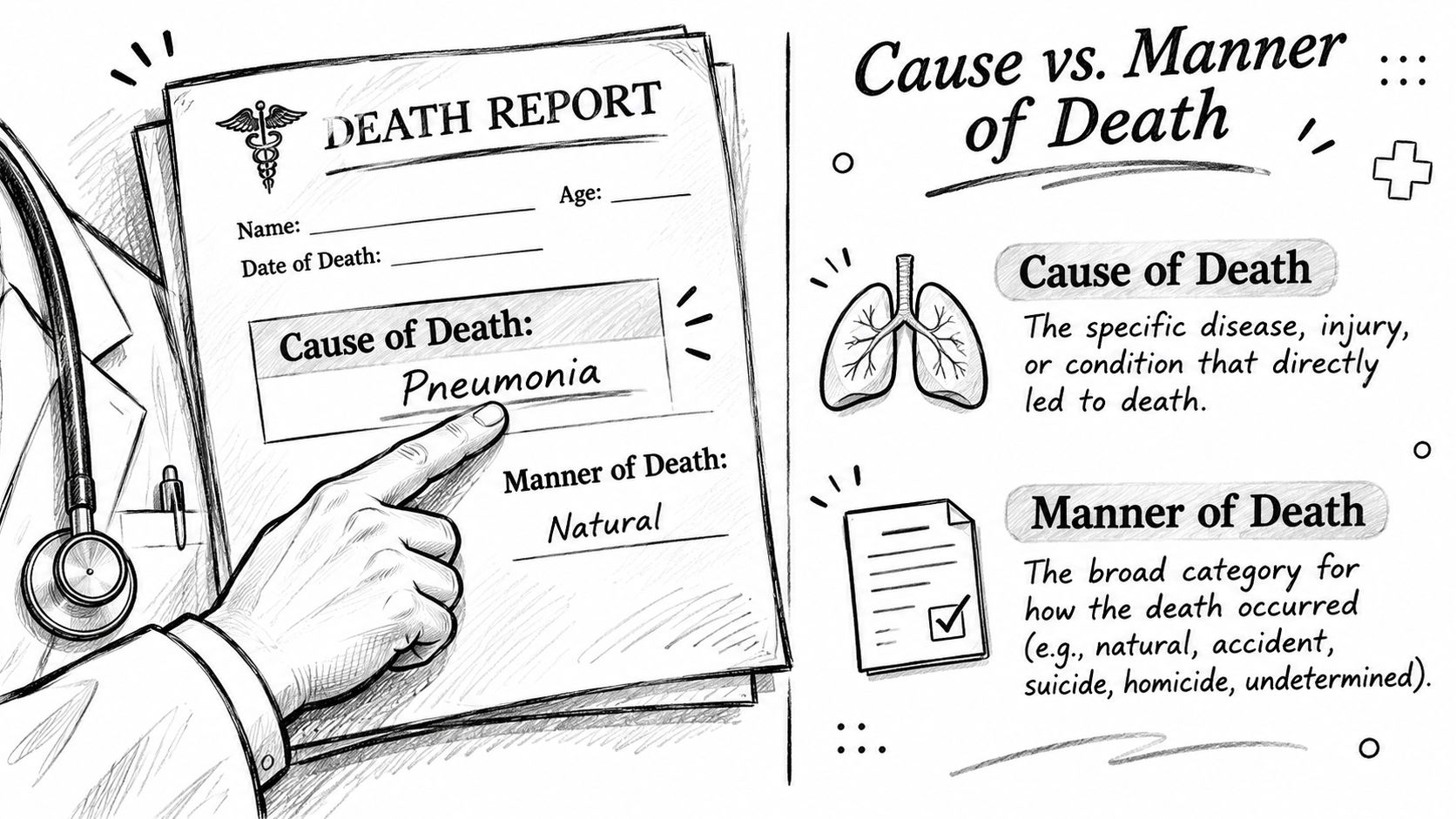
Cause of death is the disease or injury that began the sequence ending in death. Pneumonia. A gunshot wound. A blocked coronary artery. Reports often add contributing conditions, the problems that made death more likely or more severe, such as advanced heart disease or long-standing diabetes.
Manner of death describes how that cause came about. It comes from a short, closed list, and it's a medical classification rather than a legal ruling. Keep the table below open while you read the last pages.
Manner of death terms in plain language
| Manner of death | Meaning in plain language | Example |
|---|---|---|
| Natural | Death from disease or the body's natural processes | Heart attack with no outside injury |
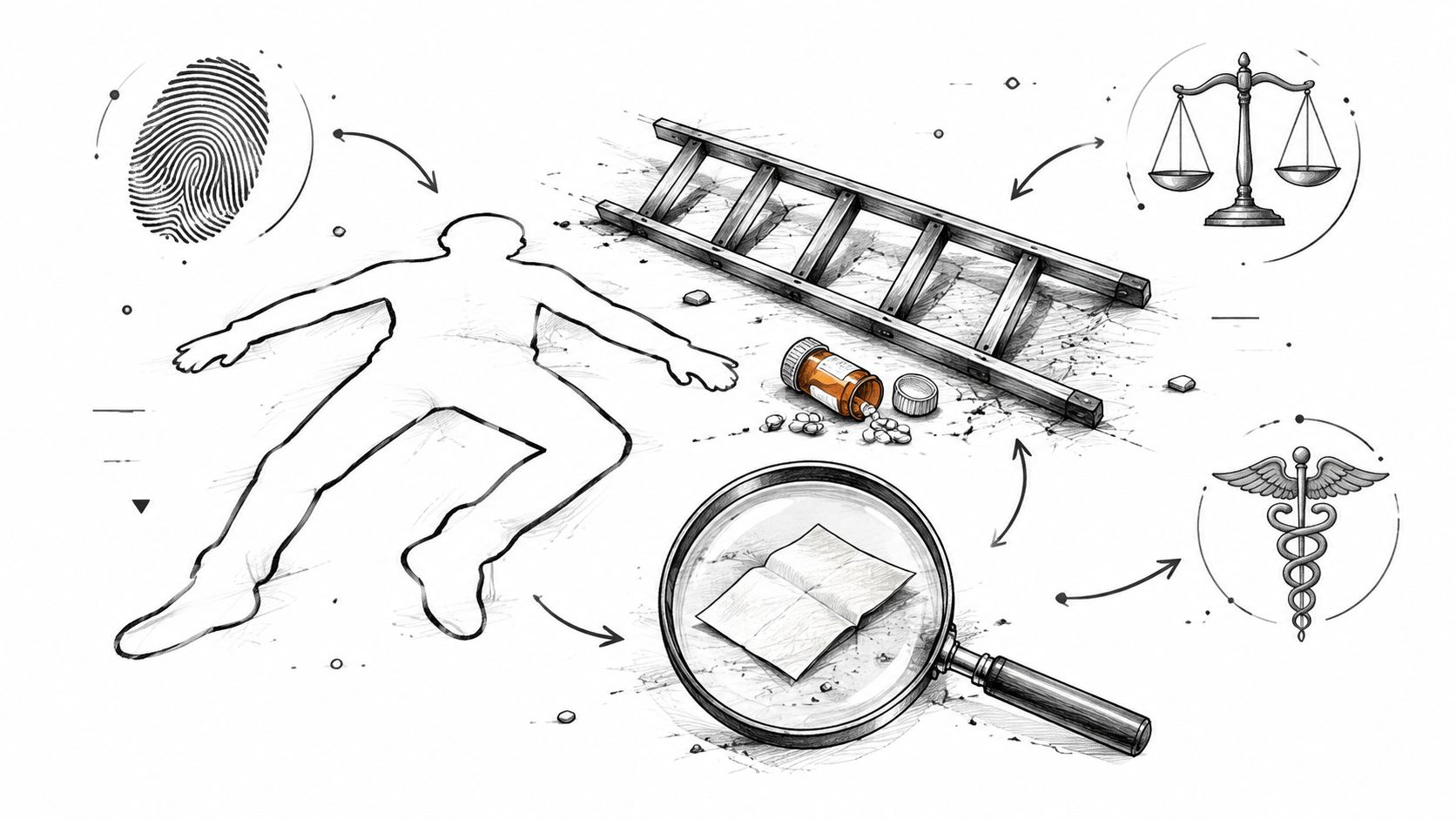
| Accident | Death from an unintended injury or event | Fall from a ladder or a motor vehicle crash |
| Suicide | Death from a self-inflicted act with intent to die | Self-inflicted gunshot wound |
| Homicide | Death caused by another person's act | Fatal assault |
| Undetermined | The evidence does not support a clear manner | Unexplained death with incomplete records |
| Pending | The opinion is not final yet | Toxicology results still outstanding |
What homicide does and doesn't mean
A homicide manner finding describes how the death occurred. It doesn't identify who caused it, doesn't decide intent, and doesn't file charges. Those calls belong to investigators, prosecutors, and courts. Families sometimes read the word and hear an accusation, when the report is only saying that another person's act was the medical cause.
Undetermined and pending get merged in most conversations, and they shouldn't be. Undetermined means the evidence in hand doesn't support a clear manner. Pending means the opinion isn't finished yet, usually because toxicology or another test is still running. One is a conclusion about the evidence. The other is a status.
If a spoken walkthrough helps, this short explainer covers how the two terms are used in practice.
Three questions worth asking
- What is the cause based on? Ask which findings support it, and whether those findings appear in the body of the report or only in the summary.
- What would change the opinion? A pathologist can usually name the result or record that would shift the conclusion.
- Is anything still outstanding? A test that is still running at signature time is worth knowing about.
Our guide to how cause and manner of death are classified goes deeper into how each category is assigned and why the same injury can land in more than one manner.
Reading Toxicology, Histology and Lab Results
Laboratory work is usually the slowest part of a case and the part readers skip. That's a mistake, because the lab pages explain what the final opinion rests on and which questions were still open when the report was signed.
Three kinds of testing, three different jobs
Toxicology looks for drugs, alcohol, and other substances in blood, urine, or tissue. It isn't an optional extra in a forensic case. The National Academies materials on forensic autopsy performance standards identify evaluation for common illicit and therapeutic drugs as testing that should be performed in all cases unless hospitalization has made the results less useful.
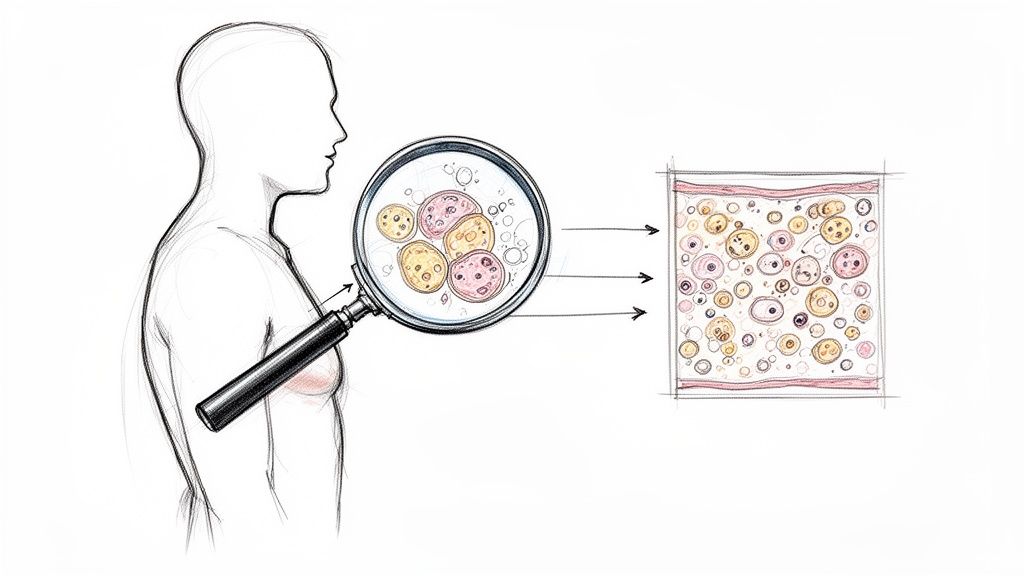
Histology puts small tissue samples under a microscope. It catches changes the eye can't see during the examination, such as early infection, inflammation, or disease in the heart muscle, and it often explains a death that looked unremarkable on the table.
Imaging covers X-rays, CT, and other studies of the body, which may be described in detail or mentioned only in passing. Molecular and other specialized tests appear when a specific question called for them. Retained specimens are the samples kept after the examination so later testing stays valid.
A result on its own isn't a conclusion. The sentence you're looking for is the one where the pathologist says what that number meant for this death.
Lab results in an autopsy report PDF
| Test | What it examines | What to check |
|---|---|---|
| Toxicology | Drugs, alcohol, and other substances in blood, urine, or tissue | Collection date, test date, and whether the result is pending or final |
| Histology | Tissue under a microscope for changes not visible by eye | Which organs were sampled and how the finding is used in the opinion |
| Imaging | X-ray, CT, or other images of the body | Whether the images are described or only mentioned |
| Other laboratory testing | Molecular or specialized tests when ordered | Which question the test was meant to answer |
| Retained specimens | Samples kept so later testing stays valid | Labels and a cross-reference in the final report |
Reading the lab section in a few minutes
- Dates. Check when each sample was collected and when it was tested. A long gap between the two explains part of the wait.
- Pending notes. Look for a line saying which results were still out when the report was signed. That line tells you whether you're holding a final opinion.
- Cross-references. A well-built report names the result it relies on. If the cause opinion mentions a drug level, the toxicology table should show it.
- Context for a single finding. A substance in the blood isn't automatically the cause of death. Dose, timing, tolerance, and other findings all bear on it, and that reasoning belongs in the interpretation.
The report records findings from an examination of someone who has died. It isn't a guide to a living person's health or care, and questions about treatment belong with a licensed clinician. Our explanation of autopsy toxicology reports covers how results are reported and what a family can reasonably ask about them.
Preliminary and Final Reports and Why Timing Varies
A report may arrive before every finding is settled. Start with the status on the cover, then use it to interpret the rest of the PDF. A preliminary report is an early account, while a final report records the completed findings and signed opinion. The distinction is like a draft compared with a finished document: later results can change an early interpretation.
Report status and what to ask the issuing office
| Report status | What it means | What to ask |
|---|---|---|
| Preliminary | Early findings before all lab work is complete; opinions may change | Which results are still pending? |
| Final | All findings and tests are in and the report is signed | Is this the complete signed version? |
| Amended or supplemental | A later revision after new information | What changed, and on what date? |
| On hold | Release paused while an investigation or review is active | Is the hold still in place, and for what reason? |
Why the wait runs long
The examination may be complete while testing continues. Toxicology and histology can take longer, and some cases require additional testing on retained specimens. A case may also go through peer review before signature. Staffing shortages can push completion past an office's usual timeline, and an active criminal investigation may pause release.
The Massachusetts Office of the Chief Medical Examiner annual report states that 92.9% of autopsy reports were completed within 90 days during fiscal year 2025, leaving roughly 7 in 100 outside that window. A wait of several months does not, by itself, show that something is wrong with the case. The status and any pending results offer more useful clues.
A five-step sequence while you wait
- Write down two facts. Keep the date of death and case number together so each call starts with the same information.
- Ask for an expected date. Explain that you are seeking the office's current estimate, not a guarantee.
- Ask which tests are still pending. This helps clarify whether the delay is tied to unfinished analysis.
- Ask for notice when the final version is signed. The office may be able to note your request on the file.
- Keep a dated log. Record who you spoke with, what you asked, and what you were told.
An estimate is not a fixed schedule, and no office can promise a completion date for every case. Keep track of the explanation you receive and whether any results remain outstanding. When a later version arrives, compare its status and revision details with the earlier copy so you can tell whether it is final or amended.
Who Can Request a Copy and How to Ask
A family requesting an autopsy report may first need to identify who has the record and what that office is allowed to release. Access rules differ by state and county, and eligibility can depend on the requester's relationship to the person who died, the report's status, and whether an investigation is ongoing. The issuing office can explain its own process.
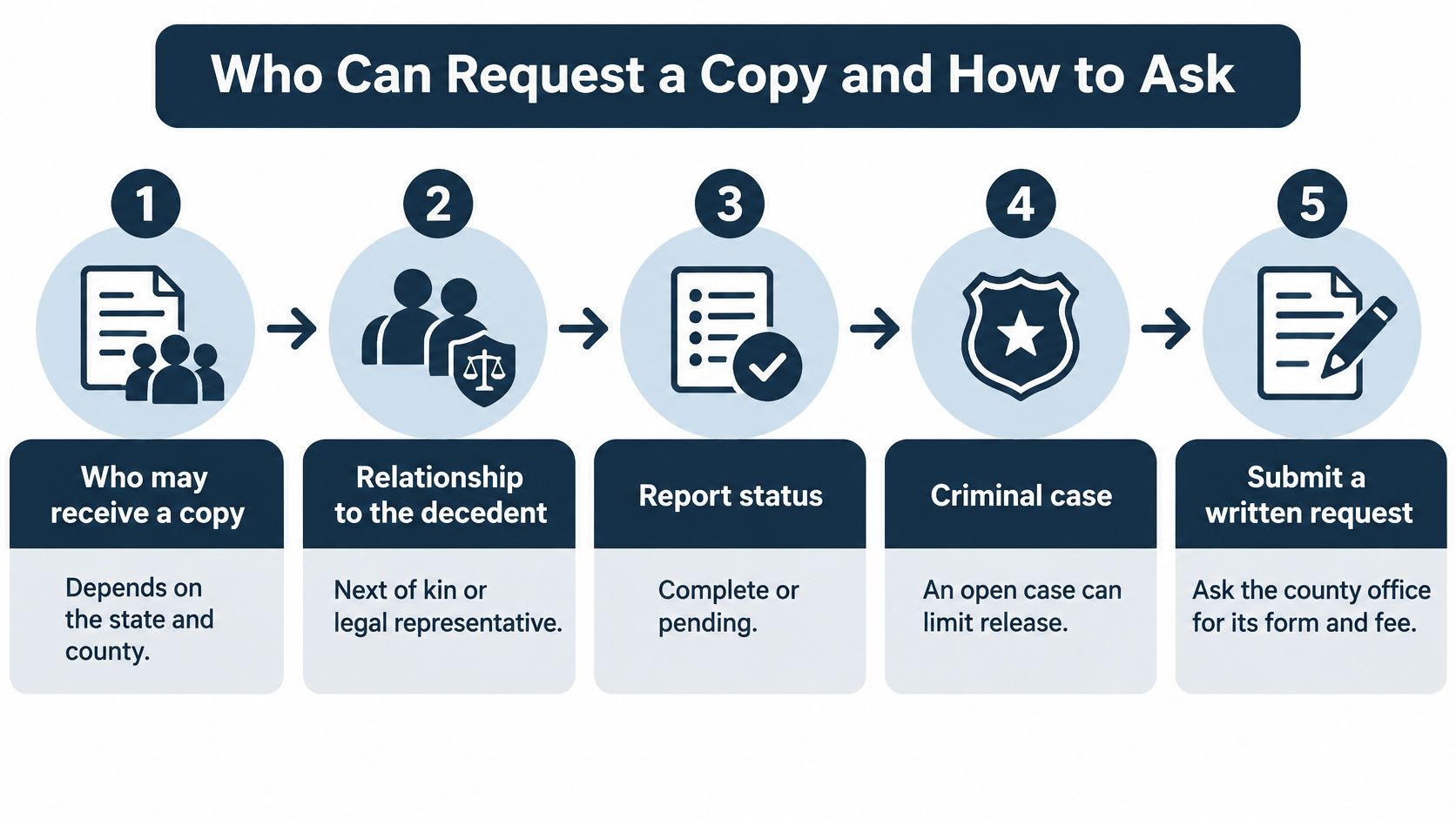
Where the rules actually come from
The office that handled the death is the best starting point. A medical examiner, justice of the peace, or county office may hold the report, depending on the case. Ask which office has the record and what it can release. Rules may treat the written report, photographs, and other materials differently, so ask about each item separately.
For example, Massachusetts gives surviving spouses and specified next of kin priority when requesting an autopsy report, and its guide explains how families can request a copy: Massachusetts guide to requesting an autopsy report. That guidance applies to Massachusetts. It does not establish the rules in another state or county.
Before you file anything: ask whether the office can release the written report, photographs, or both, and whether any part is restricted.
Six steps to request the existing report
- Identify the office that handled the death. Start with the medical examiner, justice of the peace, or county office connected to the case. If you are unsure, ask which office maintains the report.
- Explain who you are. Be ready to describe your relationship to the person who died or your role as a representative. Ask what identification or documents the office requires.
- Clarify what you are requesting. Specify the written report, photographs, or both. Ask whether the available copy is preliminary or final, since those versions may differ.
- Ask about the process. Confirm whether the office requires a form, written request, fee, or particular delivery method. Request details before submitting payment.
- Ask whether release is delayed or limited. If the office cannot provide the record, ask what it can share about the reason and whether you should follow up later.
- Submit the request in writing and keep a copy. Save the request and any response. If the office refuses or redirects you, ask for its reason in writing so you can identify the next appropriate contact.
Estate records are a separate matter from an autopsy report, even when both are needed after a death. Probate documents are handled through the probate process, so obtaining Texas probate document copies involves a different request from asking the office that holds the autopsy report.
A private examination follows a separate authorization and release process. The legal next of kin or their designated representative authorizes it. The report belongs to the family who requested the examination and is kept confidential. Texas Autopsy Services delivers the complete written report directly to that family, which decides who else may see it. For an overview of how information may be released, see this guide to HIPAA-compliant release of information.
Protecting Privacy When You Share a Report
A PDF is easy to change. One edit, one dropped page, one re-saved file, and the copy in your hands is no longer provably the copy that was issued. The National Institute of Standards and Technology publication on digital evidence makes the point plainly: digital files are easy to change, which is why chain-of-custody and data-integrity controls matter to anyone handling evidence. Chain of custody means the documented record of who held the file, when, and what they did with it.
The fingerprint that travels with the file
A cryptographic hash is a string of characters generated from a file's contents. Change a single byte and the recalculated hash comes out different. Ask the issuing office whether they can provide the hash of the released PDF, then have someone calculate the hash of the copy you hold and compare the two. If they match, you're looking at the same file that was authorized and released.
That check costs nothing and answers the question a court will eventually ask. Is this the record that was issued, or a version of it?
Sharing it without losing control
- Keep the original untouched. Save it in a read-only folder and work from copies.
- Log where it came from. Note who sent the file, the date, and the method used.
- Send it through encrypted channels. Avoid forwarding to recipients you can't name, and password-protect any file that leaves your control.
- Watch the labels. An amended or supplemental report is part of the record, not a replacement for it. Check the cover date and any revision note before relying on a page.
- Ask for a certified copy for court. The issuing office can provide one, and a certified copy carries weight that a forwarded attachment doesn't.
The same discipline that goes into protecting source documents from leaks in any professional setting applies to a death record that may end up in front of a judge.
Keep four things with the file. Your written request, the office's reply, any fee receipt, and every notice of a change. Together they answer the first question a reviewer asks, which is how this document got from the issuing office into your hands.
How Texas Law Separates Private and Official Autopsies
Texas draws a line between an autopsy a family consents to and one a public official requires. The line matters to anyone weighing an independent examination, because a private process can't override an active medicolegal investigation.
Under Texas Code of Criminal Procedure Article 49.32, a physician generally may not perform or assist with a postmortem examination or autopsy without written informed consent from an authorized person, given on the statutory form. The Texas Code of Criminal Procedure Chapter 49 sets out that consent rule and then carves out the exception: the requirement doesn't apply when a justice of the peace or a medical examiner determines that an autopsy is required under Chapter 49 or another law.
When no relative can be reached
The same chapter covers a narrow situation. If authorized relatives can't be identified or contacted after due diligence, an autopsy may proceed with authorization from the medical examiner, justice of the peace, or county judge. The window is specific: no earlier than 24 hours and no later than 48 hours after death or after the physician or other person took possession of the body.
Notification comes first
Article 49.01 requires a physician or other person who possesses the body of someone whose death requires an inquest to notify the justice of the peace serving the precinct where the body was found, and to do it immediately. The Texas statute on inquest notification also shows how counties differ. A commissioners court may establish and maintain a medical examiner's office, and counties with populations above 2.5 million are required to do so under Article 49.25.
Disposition is a separate permission
Consent to examine isn't the same as authority to release, transport, or cremate. Health and Safety Code Chapter 716 defines an authorizing agent by reference to the person authorized to dispose of remains under Section 711.002, and Texas Health and Safety Code Chapter 716 also authorizes rules consistent with Chapter 651 of the Occupations Code on cremation. Chapter 711 adds that a person regulated under Chapter 651 who knowingly allows an unauthorized person to control disposition may commit a prohibited practice, which the Texas Funeral Service Commission can address with discipline or an administrative penalty.
Order of operations: settle who holds authority over the body, and notify that office, before anything is scheduled. The statutes are checkable, and the county office or an attorney can confirm which one governs your case.
Choose the Next Step After the Report Arrives
Once the report is in hand, the useful question isn't how to request it again. It's what's still unknown, and the answer points to a different next step in each case.
- Final, matched, and sourced. If the PDF is marked final, the case number matches your records, and the cause and manner point back to named findings, file it as it is. The unchanged PDF, the hash value, the written request, the office reply, and any fee receipt belong together.
- Still pending. If the status line says preliminary or pending, don't re-file the request. Ask for the list of outstanding tests and the date of the next update, then wait for the signed final or an amended report.
- A term that doesn't fit. If a word like undetermined is doing the work, ask what evidence would change it and whether any result is still outstanding.
- A partial release. If the office withheld the written report or the photographs, keep the written denial and ask an attorney whether a different authority holds the record.
- Disputed findings. If the official conclusions are disputed and no inquest is still controlling the body, a private examination is a separate consent process under Article 49.32 and can't override the justice of the peace or medical examiner. Our team can talk through that option at (806) 230-1889. A private autopsy request starts with a confidential request, so the first call is a conversation about questions rather than paperwork.
Nothing in a report replaces care for a living person. Questions about someone's health or treatment belong with a licensed clinician.
Three questions that come up after the report arrives
- Can a report be reviewed without a second examination? Yes. A second-opinion review reads the existing report, the medical records, and the laboratory results, then gives an independent view of whether the conclusions follow from the findings.
- What if the report contradicts what the family was told? Note the exact statement and the page it appears on, then ask the issuing office which finding supports it. Specific questions get specific answers.
- What if the death certificate and the report disagree? The office that signed the certificate is the one that can amend it. Send both documents there with the discrepancy described in writing.
Texas Autopsy Services prepares and delivers complete written autopsy reports for families, attorneys, and county officials across all 254 Texas counties, and every examination is performed by a forensic pathologist certified by the American Board of Pathology. If you're holding a report you don't fully understand, or waiting on one that hasn't arrived, our team can walk you through the findings in plain language and explain what a second-opinion review would involve. Visit Texas Autopsy Services or call (806) 230-1889 to start a confidential conversation.