December 31, 2025 · Texas Autopsy Services
Who Performs an Autopsy and Why It Matters
Discover who performs the autopsy and the experts behind it, from forensic pathologists to medical examiners, and why independent reviews matter.
On this page
When you’re facing a loss, the most pressing question is almost always, "Why?" An autopsy is a medical examination designed to answer that question, giving families and legal teams definitive insights into what caused a death.
But who actually performs this examination? It’s not just any doctor. The person responsible is a highly specialized physician, a forensic pathologist, trained to investigate death through a meticulous, evidence-based process.
- A forensic pathologist is a medical doctor with years of specialized training in determining the cause and manner of death.
- The process involves a comprehensive review of medical records, a detailed physical examination, and advanced laboratory testing.
- Families and attorneys often seek independent or Private Autopsies for clarity when official reports are inconclusive or when medical care is in question.
- My role as a board-certified forensic pathologist is to provide objective, medically sound answers with compassion and respect.
The Experts Behind the Examination
I recently worked with a family in Central Texas who questioned the hospital's stated cause of death for their elderly father. The official report said "natural causes," but the speed of his decline didn't sit right with them, leaving a heavy sense of uncertainty.
They called me to perform an independent private autopsy because they needed clear, medically sound answers to find peace. This happens more often than you might think. Families and their attorneys frequently need an unbiased investigation to resolve lingering questions about a loved one's passing.
These examinations happen in highly specialized environments. Understanding the complexities of designing medical labs gives you a sense of the precision required. After performing over 1,000 autopsies myself, I know my core role is to deliver clarity with compassion.
The Role of a Forensic Pathologist
As a forensic pathologist, I'm a physician who has completed years of dedicated training after medical school. My own journey led me to become board-certified by the American Board of Pathology in Anatomic, Clinical, and Forensic Pathology. This specialization is essential for correctly interpreting complex medical evidence.
The work is far more than a simple physical exam; it's a comprehensive investigation that includes:
- Reviewing Medical Records: A person’s full medical history provides the context for our findings.
- External and Internal Examination: This is a systematic, head-to-toe evaluation to document injuries, disease, and any other abnormalities.
- Microscopic Analysis: Looking at tissue samples under a microscope can reveal crucial details at a cellular level.
- Toxicology and Lab Tests: These tests are key for identifying substances like medications or other compounds that might have played a role.
My objective is always the same: to use medical science to uncover the truth. This process honors the deceased by providing their loved ones with factual, unbiased information, which is the first step toward closure.
Every examination is a methodical process. I compile all findings into a detailed report that explains the cause of death in clear, understandable terms. For those curious, I’ve outlined the extensive education requirements for a forensic pathologist in another article, which highlights why this expertise is so vital. This commitment to rigorous training ensures that every family gets the answers they deserve.
Understanding Pathologists, Medical Examiners, and Coroners
When a family is dealing with a sudden loss, the medical-legal world can feel overwhelming. You’ll hear terms like forensic pathologist, medical examiner, and coroner, and it's easy to assume they all mean the same thing. They don't.
Knowing the difference is critical. It ensures that the person providing answers about your loved one’s death is a truly qualified medical expert.
The journey to becoming an expert in this field is long and highly specialized. This chart shows what that path looks like.

A forensic pathologist is at the top of that pyramid for a reason. We are medical doctors who have dedicated years to advanced, specialized training. This deep expertise is what separates a simple observation from a true medical investigation.
Comparing Autopsy Professionals
This table breaks down the three main roles you'll encounter. Each one has a distinct set of qualifications and responsibilities.
| Professional | Medical Degree Required | Specialized Training | Typical Role |
|---|---|---|---|
| Forensic Pathologist | Yes (M.D. or D.O.) | Yes, in pathology and forensic pathology | The medical expert who performs the autopsy and determines the cause of death. |
| Medical Examiner | Yes, usually a forensic pathologist | Yes, same as a forensic pathologist | A government-appointed official responsible for death investigations in a specific jurisdiction. |
| Coroner | No, in most jurisdictions | No, not medically required | An elected or appointed official, often with administrative or legal duties. |
Understanding these distinctions helps you know who is handling your loved one's case and what level of medical expertise they bring.
The Forensic Pathologist: The Medical Expert
At the heart of any credible death investigation is the forensic pathologist. I am a forensic pathologist, and my job is to act as a specialized medical doctor to determine the cause and manner of a person's death.
It takes a minimum of 12-13 years of college, medical school, and intensive training to earn board certification from the American Board of Pathology. My own certifications in Anatomic, Clinical, and Forensic Pathology provide the tools to conduct a thorough investigation. That means I don’t just perform the physical exam; I also interpret microscopic tissue samples and complex lab results to put all the pieces together.
My most important responsibility in every case is to deliver an objective, scientific conclusion built purely on medical evidence. It’s the only way to give families the accurate, unbiased answers they deserve.
Forensic pathologists perform the vast majority of medicolegal autopsies worldwide. We handle cases involving homicide, suicide, accidents, and any sudden, unexplained death. However, there's a shortage of us. In the U.S., there are only about 500 board-certified forensic pathologists for over 330 million people. This shortage is especially acute in rural areas, including many parts of Texas.
The Medical Examiner: The Government Official
A medical examiner is a physician, almost always a forensic pathologist, appointed by the government to oversee death investigations for a jurisdiction like a county. In Texas, major metro areas like Harris, Dallas, and Travis counties operate under a medical examiner system. The main difference is the official government role. While a medical examiner performs the same duties I do, my work at Texas Autopsy Services is independent. I serve families, attorneys, and counties that don't have a full-time forensic pathologist on staff.
The Coroner: The Administrator
The role of a coroner is completely different. In places with a coroner system, this person is often an elected official who is not required to be a medical doctor. Their job is mostly administrative. A coroner might decide if an autopsy is needed, but they must call in a forensic pathologist to perform it. Texas doesn't use a coroner system. Instead, a Justice of the Peace often serves a similar function in counties without a medical examiner, deciding when an autopsy is legally required. I've written more about the difference between a coroner and a medical examiner if you want to dive deeper.
Understanding these roles helps clarify why seeking an independent second opinion from a board-certified forensic pathologist can provide an invaluable layer of expertise.
When an Autopsy Is Performed and Who Can Authorize It
Understanding when an autopsy is required, and who has the authority to approve one, is crucial. The path to an autopsy isn't random; specific laws dictate when a medical examination is needed. Essentially, there are two main tracks: one required by law and one requested by the family.
The most common reason for an autopsy is that the law demands it. This is a medicolegal or forensic autopsy, ordered by a government authority. In Texas, that’s usually a medical examiner or a justice of the peace. These aren't optional for the family; they're a mandatory part of a public investigation.
Government-Ordered Autopsies in Texas
The state of Texas is specific about which deaths trigger an official investigation, as laid out in the Texas Code of Criminal Procedure, Article 49.04. This law requires a justice of the peace or medical examiner to be notified when certain deaths occur, and they almost always order an autopsy.
Situations that fall under this rule include:
- Sudden and Unexplained Deaths: When someone who seemed healthy dies without an obvious medical cause.
- Violent or Unnatural Deaths: This covers homicides, suicides, and any kind of accident.
- Suspicious Deaths: Any situation where circumstances suggest foul play.
- Deaths in Custody: If a person dies in jail, prison, or while detained by police.
- When a Doctor Isn't Involved: If the deceased hadn't seen a physician recently, an official cause of death needs to be established.
In these cases, the family doesn't have a say. The goal is to protect the public by determining the precise cause and manner of death. A forensic pathologist performs this critical examination.
Private or Family-Requested Autopsies
The other path is a private autopsy. This examination is requested and paid for by the legal next-of-kin. It happens when a death doesn't legally require a government investigation, but the family still has questions. They might worry about the quality of care, suspect an undiagnosed illness, or want to know if genetic conditions could impact other relatives.
In a private autopsy, the power to seek answers rests entirely with the family. It is your right to authorize an independent examination to gain clarity and peace of mind.
The family's legal right to request an autopsy is firmly established. In Texas, the next-of-kin has the authority to make decisions about the deceased's body, and that includes authorizing a postmortem exam. This empowers families to hire an independent, board-certified forensic pathologist to conduct a thorough investigation. Our guide explaining who can request an autopsy dives deeper into the legal hierarchy.
Why Families and Attorneys Choose a Private Autopsy
When an official investigation into a death is over, or when one wasn't required, families can be left with more questions than answers. The public medical examiner system is vital, but it’s often overworked and focused on narrow legal questions. This is where a private autopsy can make a difference.
A family’s reasons for seeking an independent exam are always deeply personal. It might be a search for closure, a need to know if a hereditary disease was involved, or a feeling that the official cause of death doesn't add up.
Seeking Clarity Beyond the Official Report
For families, it almost always comes down to clarity. When a loved one passes away in a hospital, the cause of death on the certificate might say "cardiopulmonary arrest." While technically accurate, that doesn't explain why their heart and lungs stopped. A private autopsy is designed to answer that specific question.
Common reasons families reach out to me include:
- Confirming or Questioning a Diagnosis: A family may need to know for sure if a suspected illness was truly the cause of death.
- Understanding Genetic Risks: Identifying hereditary conditions, like certain heart diseases, can give surviving relatives life-saving information.
- Finding Peace of Mind: For many, having an unbiased expert review provides a sense of finality.
My role in these cases is to offer a compassionate, thorough investigation that gets to the heart of a family’s specific questions. It’s about delivering medical truth with dignity.
While government systems handle autopsies for about 20% of deaths in the U.S., more families are turning to independent pathologists. This trend is growing as they seek answers beyond what a rushed hospital certification provides. You can learn about the causes of death in 204 countries on healthdata.org.
A Critical Tool for Legal Professionals
For attorneys, a private autopsy is a powerful way to gather objective, scientific evidence. In cases of potential medical malpractice, wrongful death, or workplace accidents, the findings can become the foundation of a legal strategy. A key reason attorneys choose this route is to support a comprehensive medical record review for attorneys. An independent report from a board-certified forensic pathologist provides a credible second opinion that can confirm or challenge official findings.
The Value of an Unbiased Second Opinion
I handle both Private Autopsies for families and County Forensic Autopsies for local jurisdictions. This gives me a unique perspective on the different needs each case brings. A private exam allows for a deep dive into specific concerns that might fall outside the scope of a routine government autopsy. The process I manage at Texas Autopsy Services, in partnership with facilities like the Waterloo Mortuary Partnership, guarantees every examination meets the highest standards.
What to Expect During the Independent Autopsy Process
When a family considers a private autopsy, the path forward often feels hazy. My goal is to provide a clear, straightforward look at what happens. The entire process is built on respect for the deceased and clear communication with you.
The First Call and Getting Started
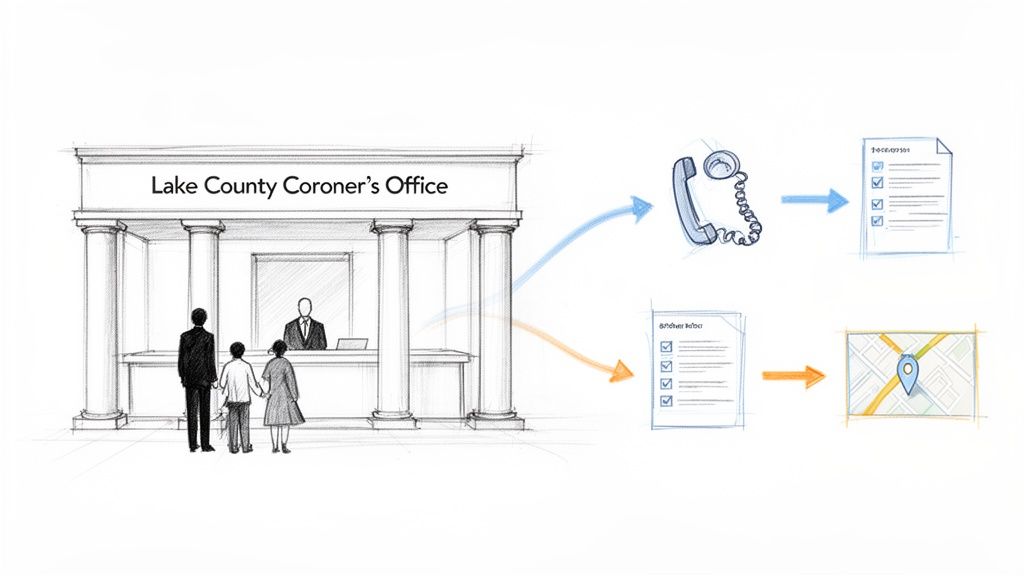
It all begins with a confidential conversation. This is where you tell me your story and what you hope to learn. I'll listen and explain how an autopsy might provide the answers you're looking for. If you decide to move forward, I’ll personally handle the logistics, coordinating directly with the funeral home or hospital. We arrange for the respectful and secure transport of your loved one to our facility, ensuring every legal requirement is met.
The Examination Itself
The autopsy is a detailed and systematic medical examination. Every step is meticulously documented.
The process unfolds in a few key stages:
- External Examination: First, I conduct a thorough visual inspection, documenting physical characteristics and looking for any signs of injury or illness.
- Internal Examination: Next comes a careful, systematic examination of the internal organs. This is often where we find evidence of disease or trauma not visible from the outside.
- Sample Collection: Throughout the exam, I take small tissue and fluid samples for microscopic analysis (histology) and toxicology testing.
At every stage, we maintain a strict chain of custody. This protocol for tracking all samples and evidence guarantees the integrity of our findings, which is vital for your peace of mind and any potential legal matters.
Private autopsies are more necessary than ever. In the 1960s, hospitals performed autopsies in 40-50% of deaths. Today, that number is less than 10%. This has left an information gap, leaving many families without answers. You can explore more about death investigation trends at WorldPopulationReview.com.
The Final Report and Our Follow-Up
After the physical exam, samples are sent for specialized analysis. This part takes the longest, as histology and toxicology typically take several weeks. Once all analyses are complete, I compile a comprehensive final report. I write it in plain, clear language, detailing the findings and the ultimate cause of death. Finally, we’ll schedule a follow-up call to go through the report together. I'll answer every question you have to ensure you have the clarity you came to us for.
Common Questions About the Autopsy Process
After years in this field, I've found that families and attorneys ask the same core questions. My goal here is to give you direct, straightforward answers to help you make an informed decision.
How much does a private autopsy cost in Texas?
The cost depends on the complexity of the case and the specific tests needed. Factors like extensive toxicology screening or specialized microscopic analysis can affect the final cost. At Texas Autopsy Services, we are transparent about pricing. We provide a clear, all-inclusive quote from the start, so there are no surprise fees. Generally, a standard private autopsy runs several thousand dollars. This fee covers the examination by a board-certified forensic pathologist, all lab work, and the final report.
Can an autopsy be performed after embalming?
Ideally, the autopsy is performed before embalming. Embalming fluids can alter tissues and interfere with toxicology testing. That said, a useful examination is often still possible after embalming. A skilled forensic pathologist can still uncover significant information about anatomical issues, injuries, or diseases. However, an autopsy cannot be performed after cremation. The cremation process makes any postmortem examination impossible. I urge families considering an autopsy to make that decision quickly.
What qualifications should a pathologist have?
The single most important qualification is board certification in Forensic Pathology from the American Board of Pathology. This is the gold standard. It means the doctor has completed years of specialized training focused on the medical-legal investigation of death and has passed rigorous exams to prove their expertise. While a pathologist certified in Anatomic Pathology can perform a hospital autopsy, a board-certified forensic pathologist has advanced training in identifying subtle trauma and interpreting complex toxicology. My own triple board certifications in Anatomic, Clinical, and Forensic Pathology ensure a comprehensive approach.
How long does it take to get the final autopsy report?
The physical examination is usually done in a single day. Preparing the final report takes longer, mainly due to detailed lab work like histology and toxicology. These tests can take several weeks. You can typically expect a preliminary report with initial findings within a few days. The complete, final autopsy report is usually ready within 30 to 60 days. If a case is particularly complex, it might take longer, but we are committed to keeping you or your attorney informed every step of the way.
Navigating the loss of a loved one is incredibly difficult, and finding clear answers shouldn't add to that burden. If you have questions about the autopsy process or need guidance, I am here to help. Please contact Texas Autopsy Services directly for a confidential and compassionate consultation. Visit us at https://www.texasautopsyservices.com.