January 3, 2026 · Texas Autopsy Services
What Families Should Know About The Autopsy Process in Texas
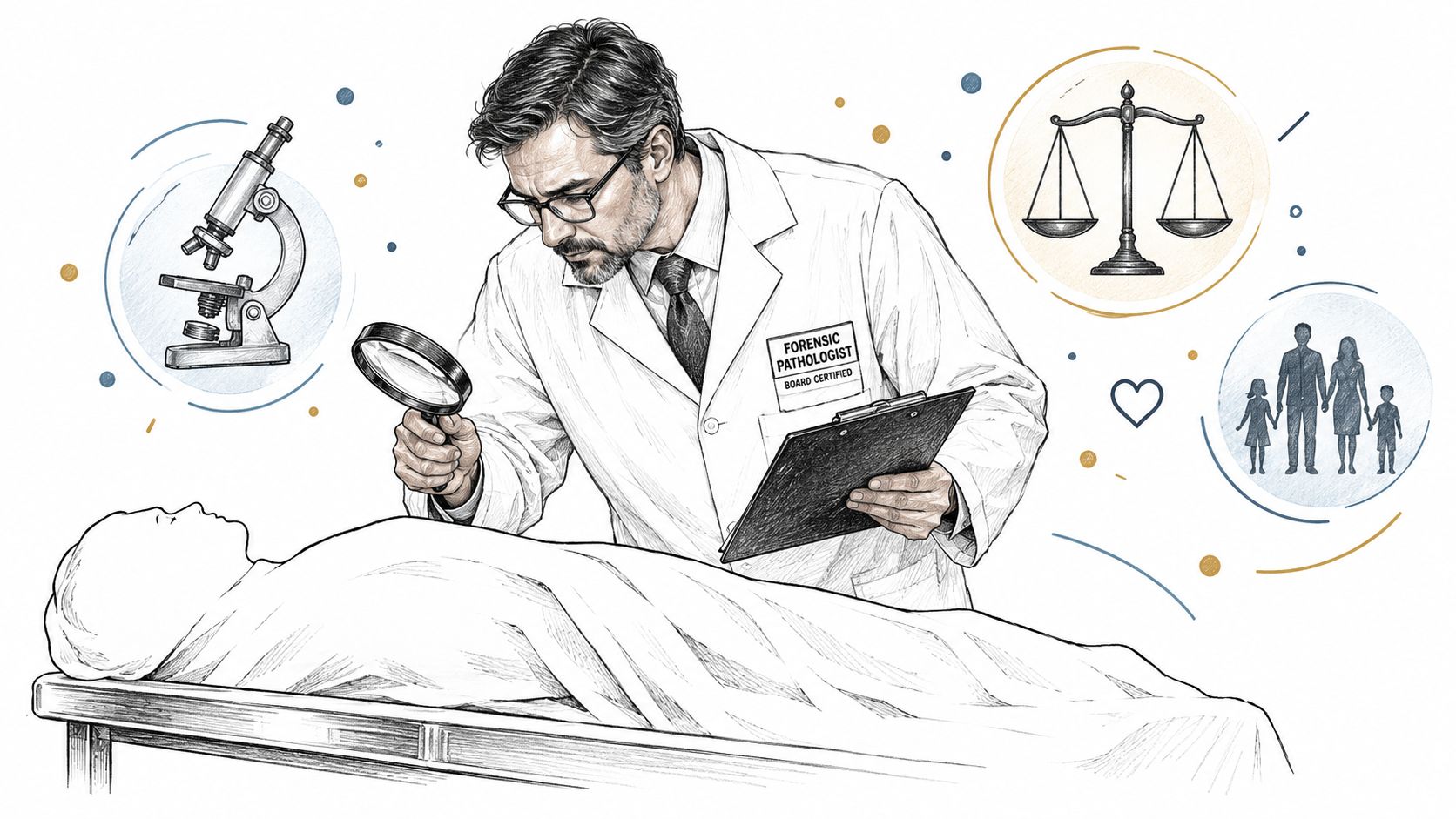
As a forensic pathologist, I'll explain how does an autopsy work, from the initial exam to the final report, helping Texas families find clear answers.
On this page
When a loved one passes away unexpectedly, the question I hear most often from families is a simple but profound one: “Why?” As a forensic pathologist, my work is dedicated to answering that question. An autopsy is a specialized medical examination designed to provide certainty and closure during a difficult time. It’s a methodical, scientific process that reveals the definitive cause of death, helping families find peace and clarity.
Here are the key things to understand about how an autopsy works:
- An autopsy is a respectful medical examination to determine the cause and manner of death.
- The process involves external and internal examinations, along with specialized lab tests like toxicology.
- As a forensic pathologist, I ensure the procedure is done with dignity, allowing for an open-casket funeral.
- A private autopsy provides independent, objective answers when a county or hospital examination isn’t performed.
- Families receive a comprehensive, confidential report detailing all findings, typically within 30 to 60 days.
The Purpose of an Autopsy: Finding Factual Answers
At its core, an autopsy is about finding the truth. It's a methodical process that uncovers definitive answers for grieving families, helps medical professionals improve patient care, and provides crucial evidence for the legal system. The examination can reveal hidden diseases, subtle injuries, or other factors that contributed to the death.
Here in Texas, a private autopsy becomes a vital option when one isn't automatically performed by a hospital or the county. By requesting an independent examination, you ensure that a board-certified forensic pathologist like myself can focus solely on your family's questions, free from outside influence.
Clinical vs. Forensic Autopsies
Not all autopsies are the same. Their purpose depends on the circumstances of the death, which is why they fall into two main categories: clinical and forensic.
Clinical Autopsies: These are performed in a hospital with the family's consent. Their primary purpose is educational. Doctors may want to understand the full extent of a known disease, see how well a treatment worked, or discover if an illness went undiagnosed. It’s a powerful tool for medical quality control.
Forensic (Medico-legal) Autopsies: These are required by law. A Justice of the Peace or Medical Examiner will order one when a death is sudden, suspicious, or unexplained. The focus is on determining the official cause and manner of death for legal purposes.
A private autopsy often fills the space between these two. It combines the scientific rigor of a forensic investigation with a focus on a family's personal search for answers. This is especially important when a death isn't suspicious enough for a legal autopsy, but questions remain. Our guide on when autopsies are done offers a deeper look into these situations.
My role as a forensic pathologist is to be an objective finder of fact. The autopsy gives the deceased a voice, allowing them to tell their final story through science. It provides evidence-based answers that help families and the legal system move forward.
This chart helps clarify the distinctions between the types of autopsies.
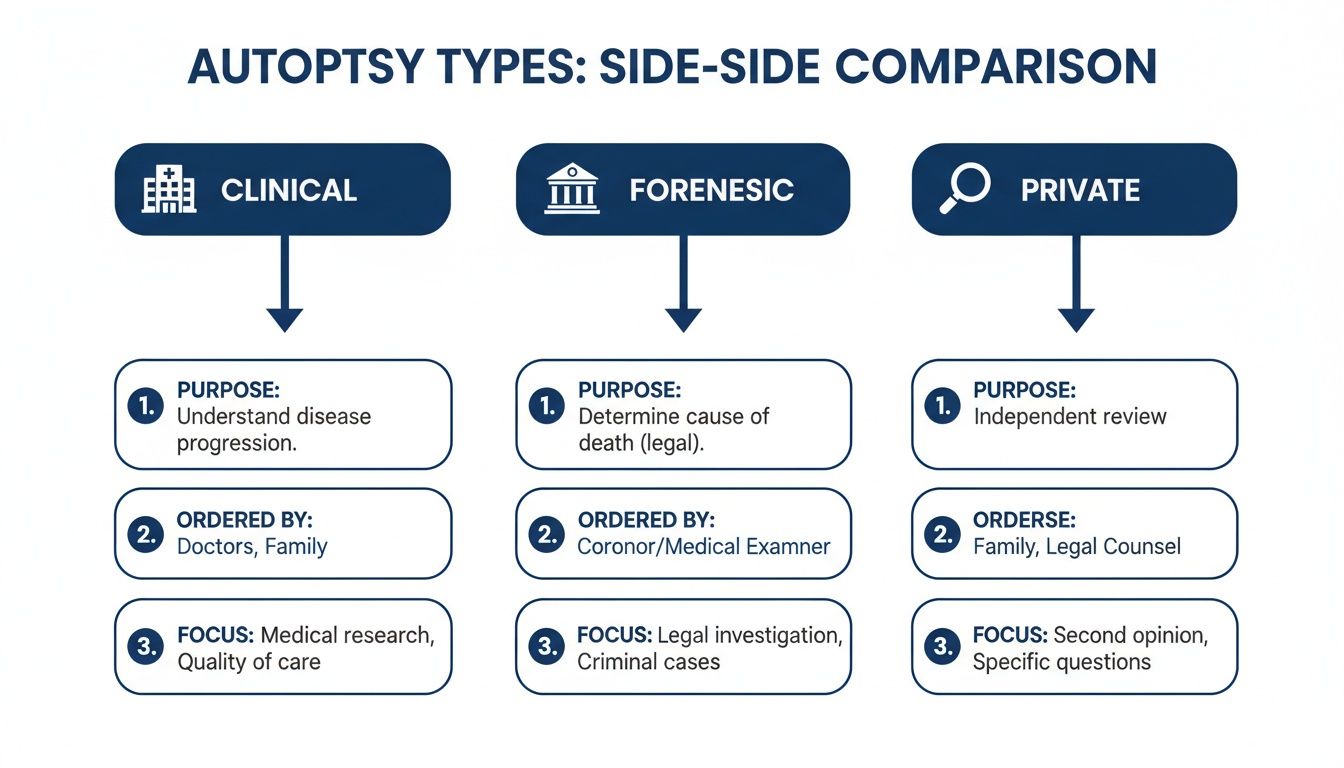
Understanding these differences can empower you to make the right decision during a difficult time, ensuring you get the answers and peace of mind you deserve.
How the Autopsy Process Works Step-by-Step
I find that families are naturally apprehensive about the autopsy process. It's an unknown, and that can be unsettling. Walking you through what actually happens during an examination often helps put some of those worries to rest. My goal is always to find clear answers for you in the most respectful way possible.
Step 1: Review of Records and Circumstances
An autopsy begins long before I enter the examination room. The very first step is to review all available information. I study medical records, read reports from police or first responders, and most importantly, speak with the family. Understanding the person's health history and the circumstances of their death provides essential context for the physical examination. This background work is crucial for interpreting my findings correctly.
Step 2: The External Examination
With that history in mind, I begin a thorough external examination. This is a careful, head-to-toe inspection of the body. I document basic information like height and weight, along with unique features such as scars or tattoos. I also look for any visible signs of injury or illness. Everything I see is meticulously recorded in notes and photographs, creating a complete record of the body's condition upon arrival. To learn more about this initial phase, you can read our article covering the first step in an autopsy.
Step 3: The Internal Examination
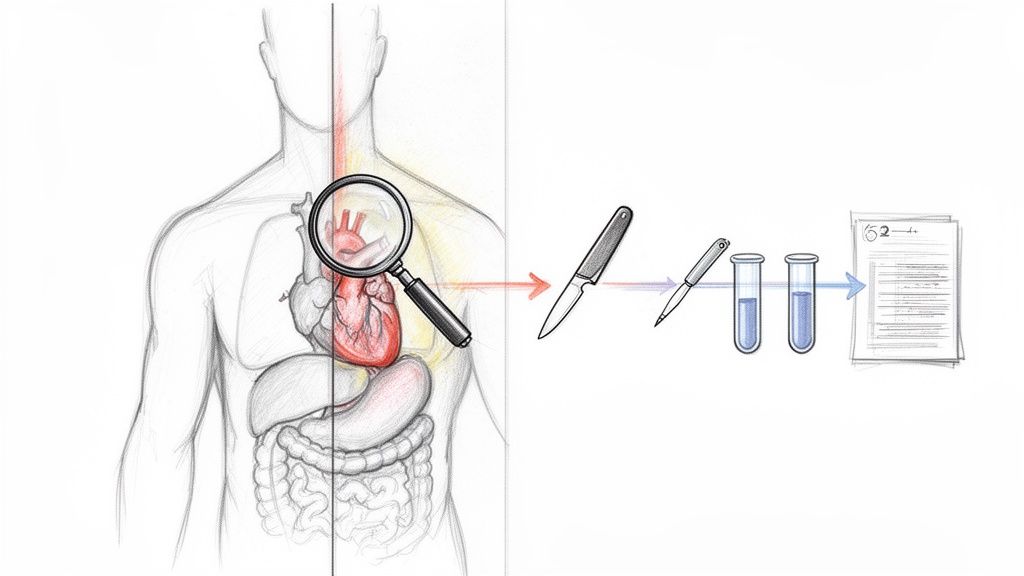
After the external check, I proceed to the internal examination. This is where I can directly inspect the organs for clues. I make a Y-shaped incision on the torso, which gives full access to the organs while being placed so it won't be visible after the body is dressed for a funeral service.
Each organ is gently removed, weighed, and examined for any sign of disease, injury, or other abnormality. I'm searching for evidence like blockages in the heart's arteries, early signs of pneumonia in the lungs, or other subtle damage invisible from the outside. I also take small tissue samples from each major organ. These are preserved for histology, a process where they are viewed under a microscope to see changes at a cellular level.
Step 4: Collecting Samples for Specialized Testing
Beyond tissue samples, I also collect fluids like blood and urine for toxicology testing. This checks for the presence of any medications, alcohol, illegal drugs, or other substances that might have contributed to the death. Every sample is handled with a strict chain of custody protocol, meaning it’s labeled, sealed, and tracked from collection through testing to guarantee the results are secure and accurate.
Step 5: Respectful Closure and Restoration
Once the examination is complete, the final step is to respectfully close the body. All incisions are carefully sutured. I am always keenly aware that the family may want an open-casket viewing, and my work is done with that in mind. My team and I take great care to ensure your loved one is returned to the funeral home in a condition that allows for a dignified, traditional service. This commitment to respect is a cornerstone of my practice at Texas Autopsy Services.
The Role of Toxicology and Specialized Tests
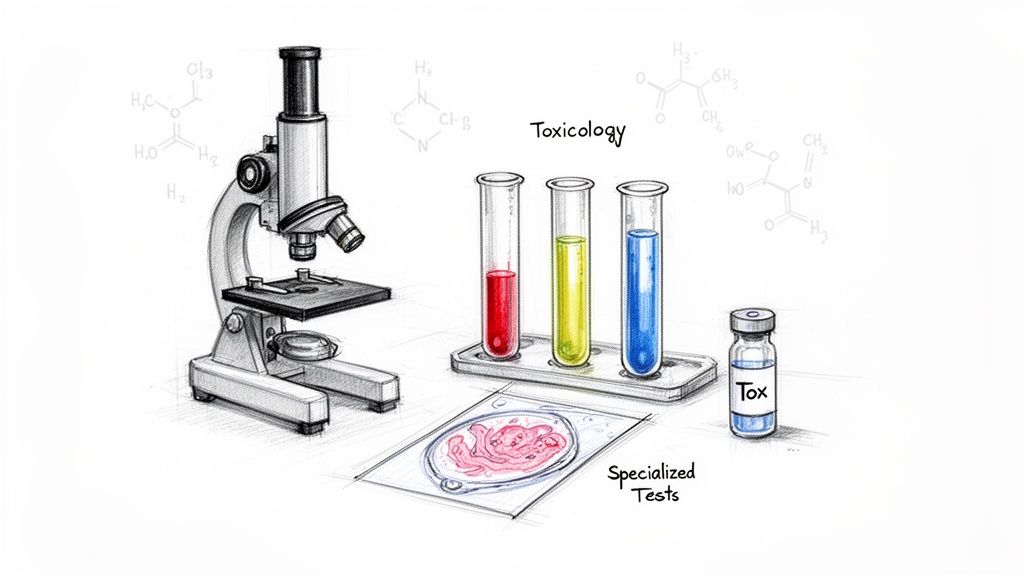
The physical examination tells us a lot, but sometimes the real answers are hidden at a microscopic or chemical level. Specialized lab tests provide objective, scientific data needed to connect the dots and form a sound medical conclusion. They help me see what the examination alone cannot show.
Uncovering the Chemical Story with Toxicology
Toxicology is the science of detecting and interpreting the presence of drugs, alcohol, and other chemicals in the body. The samples I collect are sent to a specialized lab to find any substance that could have contributed to, or directly caused, the death.
This is a critical step in many situations, such as:
- Suspected Overdoses: It confirms what substances were in the system and at what levels.
- Potential Poisonings: It can uncover toxins that would otherwise go unnoticed.
- Impaired Judgment: In accidents, it helps determine if alcohol or drugs played a role.
The results don’t just tell us if a drug was present; they tell us how much. This helps differentiate between a therapeutic dose of a medication and a fatal one. We've written more about this in our guide on what is in a toxicology report.
Beyond Toxicology: Other Critical Tests
Other analyses can be just as important depending on the case.
Histology is where we look at paper-thin slices of tissue under a microscope. This lets us see down to the cellular level to spot things like subtle inflammation in the heart muscle (myocarditis) or microscopic evidence of a stroke.
Microbiology comes into play when we suspect an infection caused the death. We can test tissue or fluid samples to identify specific bacteria, viruses, or fungi, which is key to understanding deaths from sepsis or meningitis.
These scientific analyses aren't just extra steps; they are fundamental. They provide the unbiased, verifiable evidence that supports my final conclusions, ensuring the cause of death is determined by facts, not assumptions.
This data-driven approach is the standard for a reason. Recent statistics from a European forensic department showed that out of more than 2,600 autopsies in one year, 79% had detectable substances. This highlights how often toxicology provides critical information. You can read more about these forensic autopsy findings. Together, these tests build the complete picture necessary to give families accurate answers.
Understanding the Final Autopsy Report
The physical examination is just the first part. The answers come together in the final autopsy report, where all the complex medical data is translated into a clear, factual narrative. This comprehensive document presents the evidence logically, connecting all the dots into a definitive conclusion.
Key Sections of the Autopsy Report
The report is broken down into several sections to give you the full picture.
- Case Summary: A brief overview of the person’s known medical history and the circumstances of their death.
- External Examination: A detailed description of the body, noting height, weight, identifying marks, and any external signs of injury or illness.
- Internal Examination: A meticulous, organ-by-organ account of my findings, documenting the weight, appearance, and any abnormalities.
- Microscopic Findings: Details what I saw when examining tissue samples under the microscope.
- Toxicology and Laboratory Data: All specialized test results, including a full toxicology screen.
Because this information is private and sensitive, we take confidentiality seriously. We ensure any exchange of these documents follows strict protocols for HIPAA compliant document sharing.
The Final Diagnosis: Cause and Manner of Death
The most important part of the report is the final diagnosis, where I formally state the cause and manner of death. It’s crucial to understand the difference between these two terms.
Cause of Death: This is the specific medical reason the person died. It’s the disease or injury that started the chain of events leading to death, like "coronary artery disease." It’s a purely scientific conclusion.
Manner of Death is a legal classification that explains how the death occurred. As a forensic pathologist, I classify the manner into one of five categories:
- Natural: Caused entirely by disease or old age.
- Accident: The result of an unintentional act.
- Suicide: Caused by an intentional, self-inflicted act.
- Homicide: Caused by the intentional act of another person.
- Undetermined: Used when there isn't enough evidence for another category.
This final determination is a synthesis of everything—the physical findings, toxicology results, microscopic analysis, and the known circumstances of the death.
Timeline for Receiving the Report
I know waiting for results is difficult. While I can often give a preliminary summary soon after the examination, the final report takes more time. The main reason is the specialized testing. Toxicology screens and microscopic analysis are painstaking processes that can take several weeks. You can generally expect the final, signed report within 30 to 60 days. That timeframe ensures every piece of scientific data has been received and carefully analyzed.
When a Second Opinion Autopsy Is Needed
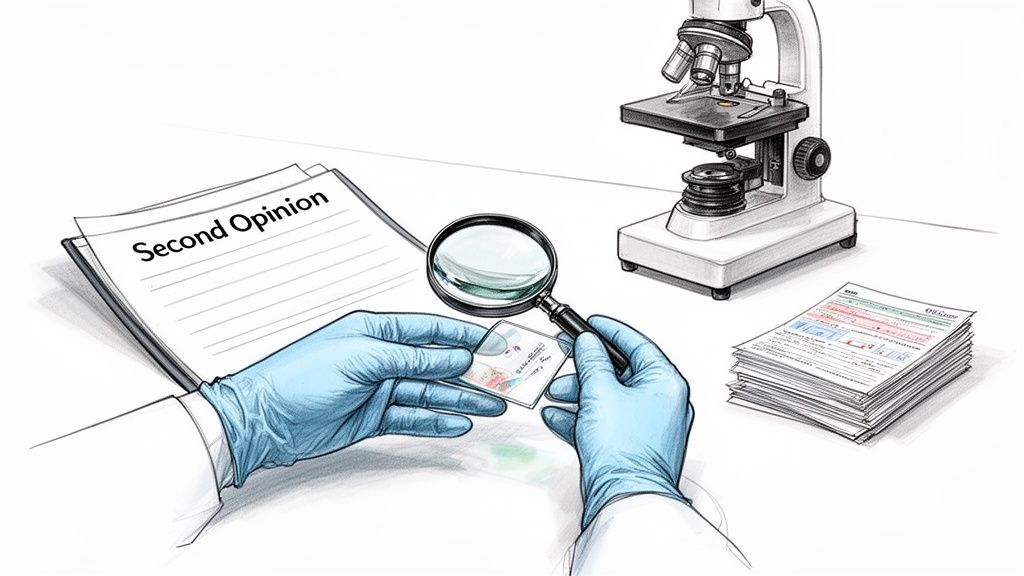
Sometimes, an official autopsy performed by a county or hospital doesn't sit right. It might leave you with more questions than answers. In these situations, a second opinion autopsy can be an important step toward finding the truth. Families often come to me when an initial report is inconclusive, when they suspect medical malpractice, or simply because they need an unbiased expert to confirm the findings.
Why Independence Matters
When I take on a second opinion case, my only goal is to provide a completely objective review of the facts. As a board-certified forensic pathologist, I re-examine every piece of available evidence from the ground up.
The process typically includes:
- A full review of the original autopsy report, photos, and related documents.
- A personal re-examination of microscopic slides and any preserved tissue samples.
- A thorough analysis of toxicology reports and other lab results.
- In some cases, a second physical examination if necessary and possible.
This independent verification is critical. My work either confirms the original findings, which gives a family confidence in the conclusion, or it uncovers details that were missed, providing a more accurate picture of what happened.
The Declining Rate of Autopsies
It's a fact that autopsies have become far less common. In 1972, the autopsy rate in the United States was 19.1%. By 2019, that number had plummeted to just 7.4%. You can see this trend in the CDC's historical data.
This decline means that for the vast majority of deaths, the chance to definitively establish a cause is lost. A second opinion autopsy helps fill that gap, offering a focused, expert investigation when the system falls short.
If you feel you don't have the whole story, seeking a second opinion is a powerful step. At Texas Autopsy Services, my commitment is to conduct these reviews with the highest standard of medical precision, helping you find the certainty your family deserves.
Frequently Asked Questions About the Autopsy Process
Over my years as a forensic pathologist in Texas, I've noticed that families and attorneys often have the same core questions. My goal is to provide clear, straight answers to help you navigate this process.
Will an autopsy prevent an open-casket funeral?
This is the most common and important question families ask. The answer is almost always no. I approach every examination with deep respect for the deceased and the family’s wishes. The incisions are placed so they won't be visible once the body is dressed. We take meticulous care during closure to ensure an open-casket viewing remains an option for a dignified, traditional funeral.
How long does it take to get the final report?
Waiting for answers is difficult. While I can often share a preliminary cause of death soon after the physical examination, the final, detailed report takes more time. Generally, you can expect the full report within 30 to 60 days. This allows the necessary time to complete specialized tests, like toxicology and microscopic tissue analysis. Waiting ensures the report you get is both complete and scientifically certain.
The purpose of an independent autopsy is to find definitive answers. Rushing the science would undermine that goal. My commitment is to deliver a report that is unquestionably accurate.
Who can authorize a private autopsy in Texas?
In Texas, the legal next-of-kin has the authority to authorize a private autopsy. The Texas Health & Safety Code sets out a specific order of priority for who can give that consent:
- The surviving spouse.
- Any surviving adult children.
- The surviving parents.
- Any surviving adult siblings.
Navigating this is a standard part of what we do at Texas Autopsy Services. My team and I will handle the necessary authorization forms with compassion and clarity.
If you have other questions or need to discuss whether a private autopsy is the right step for your family, please do not hesitate to reach out. The team at Texas Autopsy Services is here to provide the information you need. For a confidential consultation, you can contact us through our website or call our office directly at (806) 230-1889.