March 12, 2026 · Texas Autopsy Services
Uncovering the Truth An Autopsy for Lung Cancer
Discover what autopsy lung cancer can reveal about cause of death and disease progression, explained by a forensic pathologist for families.
On this page
When a loved one passes away from lung cancer, their family is often left with nagging questions, even when the diagnosis seemed straightforward. A private autopsy for lung cancer serves as a final, detailed medical examination. Its purpose is to replace those lingering uncertainties with facts, providing the kind of closure that only scientific truth can offer.
As a board-certified forensic pathologist, I’ve sat with many families and attorneys in the days and weeks following a loss. At Texas Autopsy Services, my job isn't just to perform a medical procedure; it's to provide clear, compassionate answers. I've always seen the autopsy as a final act of care—a powerful tool for bringing clarity to a confusing time.
Recently, I assisted a family who was completely blindsided by how quickly their loved one’s health failed. The autopsy provided a clear, step-by-step medical narrative of what happened inside the body, which brought them a real sense of peace.
The Need for Certainty
A diagnosis made during life is a snapshot, built from scans, biopsies, and the symptoms a person is feeling. It's usually on the right track, but it rarely shows the whole story. An autopsy, on the other hand, gives us the complete picture.
Specifically, it can:
- Confirm the primary diagnosis: I can say with certainty that lung cancer was the cause.
- Detail the extent of the disease: It reveals exactly where the cancer had spread (metastasized), something scans don't always catch.
- Identify contributing factors: I can find other issues, like an underlying heart condition or a secondary infection, that may have contributed to the death.
- Provide genetic and familial insights: Understanding the specific cancer subtype can sometimes give living relatives important information about their own potential health risks.
Lung cancer is still one of the most formidable diseases we face. In 2022 alone, there were over 2.4 million new cases recorded across the globe. All too often, autopsy findings show us just how aggressively this cancer can travel to the brain, bones, and liver, sometimes long before symptoms even appear. This aggressive nature is a key reason why the five-year survival rate is still so low. You can find more detail in the latest lung cancer statistics from the World Cancer Research Fund.
An autopsy is fundamentally about replacing uncertainty with facts. For families grappling with loss, this factual clarity can be an essential part of the grieving process, providing a solid foundation of truth to stand on when everything else feels unstable.
My commitment is to deliver these facts with medical precision and genuine compassion. Whether it’s for a family seeking peace of mind or for an attorney building a case that requires private autopsy services in Texas, the goal is always the same: to provide unbiased, definitive answers. It's about honoring the person who has passed by providing the truth for those they left behind.
The Autopsy Process for Lung Cancer Cases Explained
When a family gives me the authorization to perform an autopsy, they’re putting their trust in my hands to find answers. I take that responsibility very seriously. It's natural to feel apprehensive about this process, so I want to walk you through exactly what happens during an autopsy for lung cancer here at Texas Autopsy Services.
First, every examination starts with the proper legal authorization. This is a strict requirement under the Texas Health & Safety Code. From there, the process is methodical, respectful, and laser-focused on one thing: gathering concrete evidence to tell a complete medical story.
The External and Internal Examination
My work begins with a careful, respectful examination of the body's exterior, noting any physical signs that might shed light on the person's final illness.
Once that is complete, I move to the internal examination, with a particular focus on the chest cavity and its organs. This is where the hands-on investigation really begins, offering a level of detail that no CT scan or MRI performed during life can match.
At this stage, I’m looking for what we call gross findings—that is, anything visible to the naked eye. Think of it as creating the first draft of a map showing the cancer’s journey through the body. I meticulously document:
- The primary tumor: Its exact size, where it’s located in the lung, and its appearance.
- Local spread: I check to see if the tumor has invaded nearby structures, like the chest wall, the lining of the heart (pericardium), or major blood vessels.
- Metastasis: I examine the lymph nodes in the chest and other organs where lung cancer often spreads, including the other lung, the liver, adrenal glands, brain, and bones.
This visual inspection gives me a clear overview of the cancer’s physical impact. But what we can see is only half the story. To get the full picture, we have to go deeper—down to the cellular level.
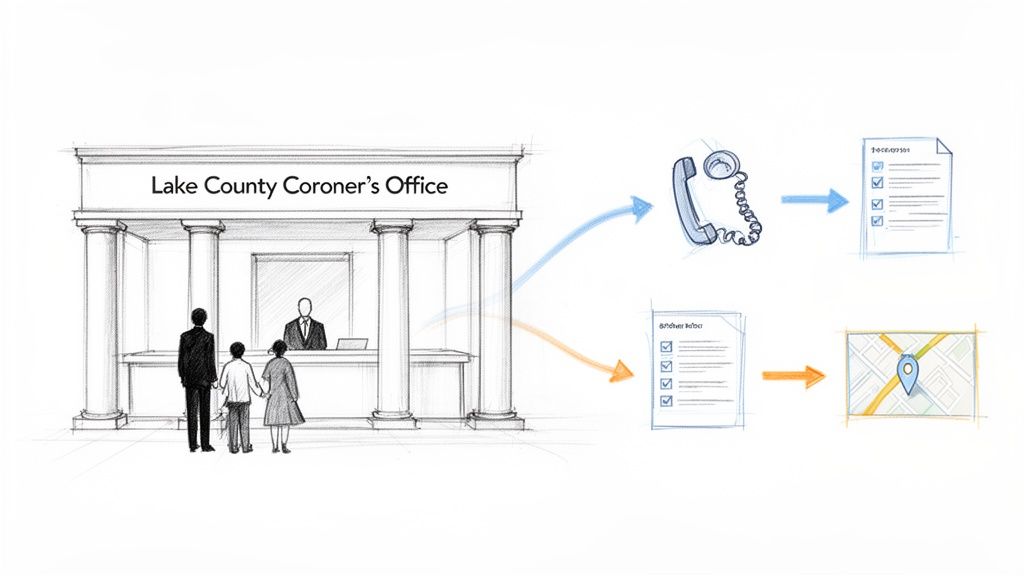
This visual guide shows the path we take: from the initial questions families have, through the methodical autopsy process, to delivering clear, documented answers.
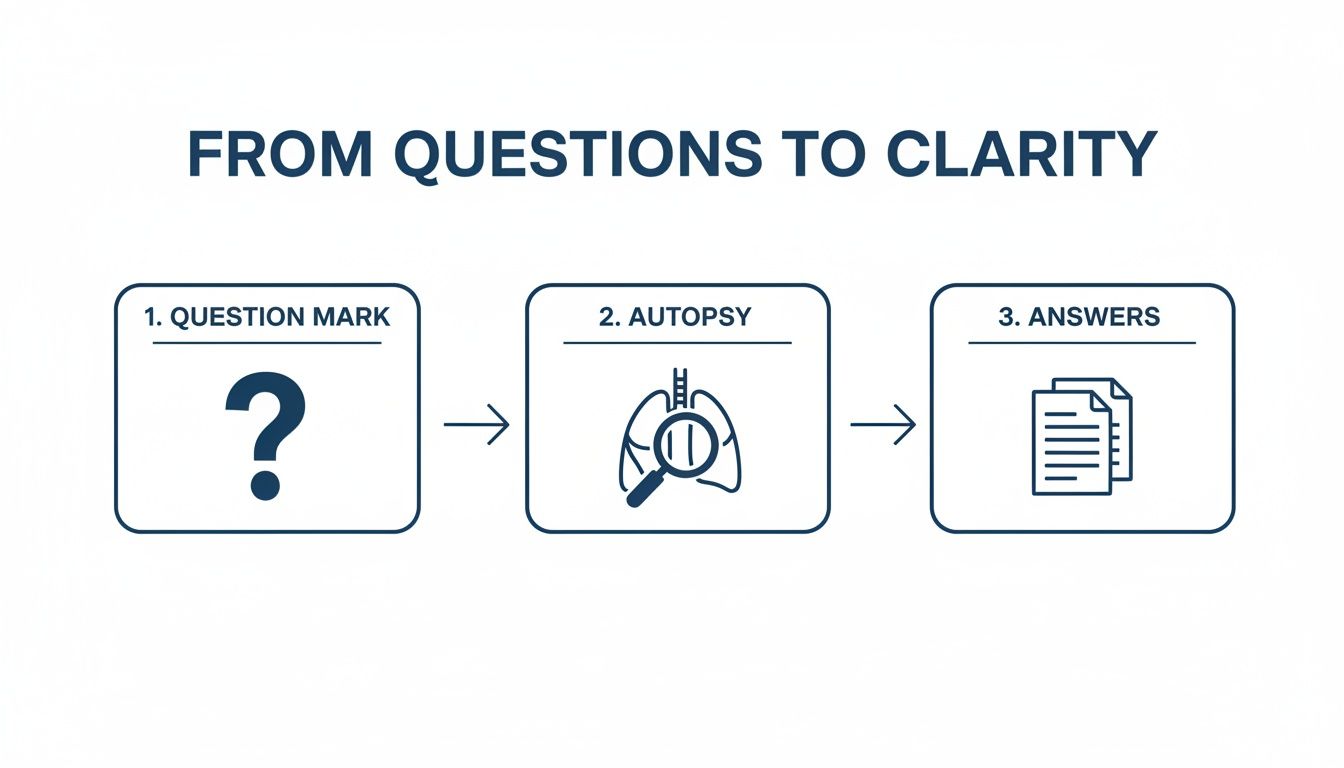
As you can see, the autopsy acts as the critical bridge, turning uncertainty into the clarity that only a final, comprehensive report can provide.
Collecting Samples for a Complete Picture
An absolutely vital part of any autopsy for lung cancer is collecting tissue and fluid samples. These are what allow for ancillary testing—the microscopic work that provides the definitive diagnosis. It’s not enough to just say cancer was present; we need to identify its exact type, origin, and unique characteristics.
The table below outlines the key stages of this methodical process, ensuring every examination is thorough and accurate.
Key Stages of a Lung Cancer Autopsy
This table outlines the methodical steps taken during a postmortem examination for lung cancer to ensure a thorough and accurate investigation.
| Stage | Objective and Key Actions |
|---|---|
| 1. Authorization & Review | Secure legal consent from the next-of-kin and review all available medical records, imaging, and clinical history. |
| 2. External Examination | Document the overall physical condition, noting any external signs of disease or treatment. |
| 3. Internal (Gross) Examination | Open the chest cavity to visually inspect the lungs, heart, and surrounding structures. Locate, measure, and describe the primary tumor and any visible spread (metastasis). |
| 4. Tissue & Fluid Sampling | Systematically collect small tissue samples from the tumor, lymph nodes, and all major organs. Collect body fluids for potential toxicology analysis. |
| 5. Microscopic Analysis (Histology) | Prepare tissue samples for examination under a microscope to confirm the cancer type, grade, and cellular details. |
| 6. Ancillary Testing | If needed, perform advanced tests like immunohistochemistry or molecular studies on tissue samples to identify specific cancer markers. |
| 7. Final Report & Correlation | Synthesize all findings—gross, microscopic, and ancillary—into a comprehensive report that establishes the cause of death and full extent of the disease. |
Each step builds on the last, creating a complete and fact-based medical narrative.
The gross examination tells us where the disease was, but the microscopic examination of the samples tells us exactly what it was. This distinction is fundamental to providing truly complete answers.
I carefully take small tissue sections from the primary tumor, any suspicious spots that could be metastases, and all major organs like the heart, liver, and kidneys. These are preserved in formalin and prepared for analysis under the microscope. In some cases, I also collect body fluids to test for medications or other substances if there are questions.
Every step is performed with the utmost respect for your loved one. If you’d like to learn more about the broader process, you can find a general overview in our guide on the steps to an autopsy.
From Visual Findings to Microscopic Certainty
During an autopsy, the initial visual exam gives me a roadmap. I can see where the cancer is and get a good idea of how far it has spread. But the real story, the definitive answers, are hidden at a level the naked eye can't see. To get there, we have to go from what we can see on the table to the microscopic certainty offered by histology—the study of tissue at the cellular level.
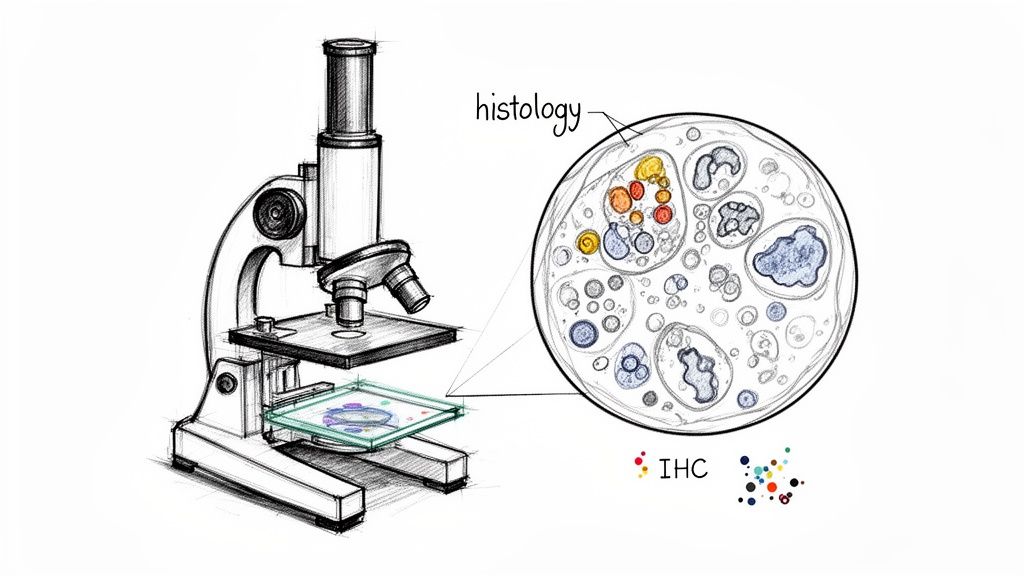
The small tissue samples I collect are the keys to unlocking this detail. These samples are carefully preserved, embedded in wax, and then sliced into sections thinner than a human hair. Once they're on a glass slide, I can put them under a powerful microscope. This is where the cancer truly reveals itself.
Confirming the Cancer Subtype
Looking through the microscope, I'm not just confirming the presence of cancer; I'm identifying its exact type. This is a crucial step. Lung cancers fall into two main buckets:
- Non-Small Cell Lung Cancer (NSCLC): This is the one we see most often, making up about 80-85% of all lung cancers. It includes several subtypes, like adenocarcinoma and squamous cell carcinoma.
- Small Cell Lung Cancer (SCLC): While less common, this type is known for being aggressive, growing and spreading very quickly.
Pinpointing the subtype is vital. An adenocarcinoma has a completely different look and structure from a squamous cell carcinoma under the microscope. Knowing which one we're dealing with completes the diagnostic picture, which can be incredibly meaningful for a family trying to understand what their loved one went through.
Autopsies have been essential in revealing the true scale of lung cancer, which is still the number one cause of cancer-related death in the United States. In fact, projections for 2026 estimate that lung and bronchus cancers will represent 11.1% of all new cancer cases. An estimated 124,730 people are expected to die from the disease, with the numbers split almost evenly between men and women. These sobering figures highlight why a definitive autopsy for lung cancer can bring such vital closure. For more information, you can explore the cancer statistics provided by the National Cancer Institute.
Uncovering Deeper Insights with Immunohistochemistry
Sometimes, a cancer has spread so widely that it's tough to tell where it started just by looking at the cells. When I run into that puzzle, I turn to a powerful technique called immunohistochemistry (IHC).
Think of IHC as a molecular labeling system. Different kinds of cells have unique proteins, or markers, on their surface. We have antibodies designed to hunt for and attach to only one specific type of protein. When the antibody finds its match on a cancer cell, it triggers a reaction that stains the cell, making it visible to me.
If the gross examination tells us where the cancer is, and histology tells us what it is, then immunohistochemistry tells us where it came from. This level of precision is invaluable in complex cases.
Here’s a practical example. Let's say I find a tumor in the liver, but I have a hunch it didn't start there. I can use IHC stains with antibodies that specifically target proteins found on lung cancer cells. If those cells in the liver light up with the stain, it's powerful evidence that the liver tumor is a metastasis from a primary lung cancer.
This technique gives us an incredible degree of diagnostic confidence. For a family, it can clarify the entire timeline of the disease. For attorneys investigating a potential misdiagnosis or a case of occupational exposure, this kind of scientific proof can be the bedrock of their argument. The findings from an autopsy for lung cancer, confirmed with histology and IHC, create an unbiased, factual record that can withstand the toughest scrutiny.
How a Pathologist Determines the Cause of Death
One of the most important things an autopsy does is officially establish the cause of death. After a long fight with something like lung cancer, families often feel the reason for their loved one's passing is obvious. My job as a pathologist, however, is to build a complete, scientifically accurate story that goes much deeper than just the underlying disease. It's about piecing together the precise sequence of events.
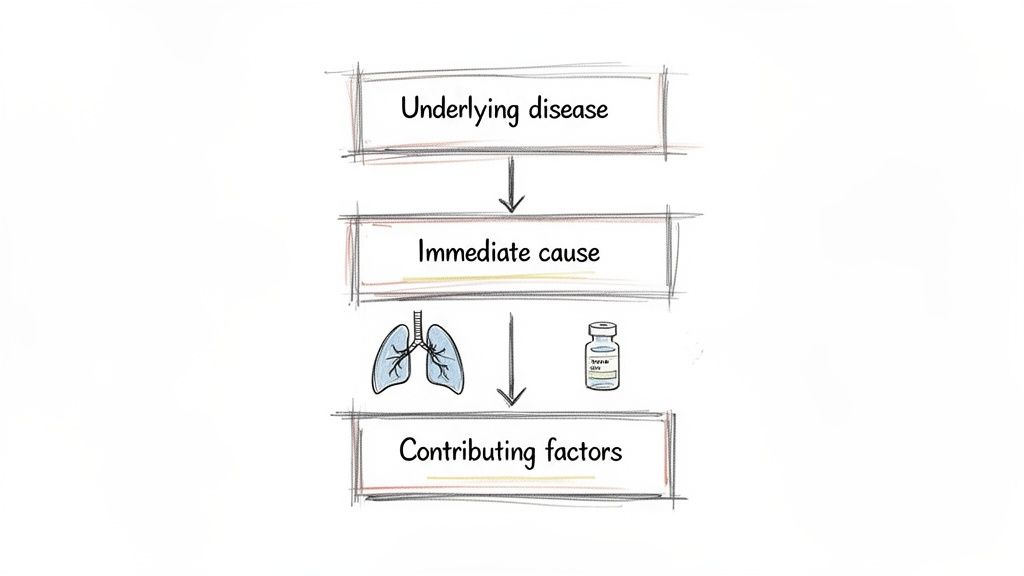
This process isn't just a formality. It involves carefully distinguishing between all the different factors that led to a person’s death, which is a crucial step in creating a final, legally sound autopsy report.
Cause of Death Versus Manner of Death
To get started, it helps to understand two terms that are often used interchangeably but mean very different things: cause of death and manner of death. We cover this topic in more detail in our guide on how a coroner determines cause of death.
- Cause of Death: This is the actual medical reason—the specific disease or injury that started the chain of events leading to death.
- Manner of Death: This is the legal category that explains how the death happened. There are five categories: natural, accident, suicide, homicide, and undetermined.
For a typical autopsy for lung cancer, the manner of death is almost always classified as natural, since it was the result of a disease. My work, then, is to zero in on the exact cause with complete medical certainty.
Connecting the Underlying Disease to the Immediate Cause
When I fill out a death certificate, I’m not just writing down a single phrase; I'm documenting a sequence. While lung cancer is the underlying cause, the immediate cause is the final biological event that actually stopped the body from functioning.
In patients with lung cancer, this immediate cause is usually a direct complication of the tumor's growth or effects. Through my examination, I can pinpoint what finally happened. It's often one of these events:
- Massive Pulmonary Hemorrhage: This is when a tumor grows into a major artery or vein in the lung, causing sudden and catastrophic bleeding.
- Acute Respiratory Failure: The lungs simply can't get enough oxygen to the body anymore. This can happen when tumors take up too much space or when fluid fills the air sacs (a condition called pulmonary edema).
- Pulmonary Embolism: Cancer puts people at a much higher risk for blood clots. If a clot breaks free and travels to the lungs, it can block blood flow and cause a sudden, fatal event.
- Infection: Patients with advanced cancer have weakened immune systems. A severe infection like pneumonia can become overwhelming, and their bodies just don't have the resources to fight it off.
Identifying this exact mechanism provides a clear, complete, and compassionate explanation for the family.
The cause of death statement is not just a single phrase; it is a logical sequence. It starts with the underlying disease (lung cancer) and follows the pathological trail to the final, fatal complication. This provides the ultimate medical clarity.
The Important Role of Toxicology
A thorough autopsy for lung cancer nearly always includes toxicology testing. This isn't usually about looking for illegal drugs. More often, we're trying to understand the role of the person's prescribed medications.
People with advanced cancer are often on a complex cocktail of drugs for pain management and other symptoms. A toxicology screen tells us the levels of these medications in the body at the time of death. This information can be vital, especially if there are questions about the medical care they received. It helps answer whether the drugs were at therapeutic levels or if they might have contributed to the death in some way.
Beyond what we can see with our eyes and a microscope, we sometimes use advanced techniques like forensic DNA analysis to gain more insight. By bringing together all of these findings—gross examination, histology, and toxicology—I construct a precise and legally sound cause-of-death statement. This becomes the foundation of the final report, giving families and attorneys the definitive answers they need.
Why Families and Attorneys Request a Private Autopsy
When I get a call about a private autopsy, the first question I usually hear is, "Why would we need one?" The reasons are deeply personal and can be very different for a grieving family versus a legal team, but they all boil down to one thing: the need for clear, unbiased answers. For a death involving lung cancer, the stakes are often even higher.
A family’s motivation is almost always a search for peace of mind. I’ve worked with many people who watched a loved one’s health decline with shocking speed. They're left grappling with what happened, and they need to understand the full medical story. They want to be sure that the diagnosis given during life was accurate and that no other contributing factors were missed.
Clarifying the Medical Story for Families
Sometimes, a family just needs confirmation. Was it really lung cancer? Did it start in the lungs, or did it spread there from somewhere else? Were there other issues, like an underlying heart condition or a sudden infection, that played a part in the final outcome? These questions don't come from a place of distrust, but from a human need for a complete narrative.
A private autopsy provides that final chapter by:
- Confirming an uncertain diagnosis. In some cases, a diagnosis is made without a biopsy. An autopsy offers the final, concrete proof.
- Explaining a rapid decline. We can often uncover aggressive tumor growth, an unexpected complication like a blood clot, or another acute event that explains why things progressed so quickly.
- Providing closure. Knowing the full extent of the disease helps families process their grief by replacing the haunting "what ifs" with factual understanding.
The statistics surrounding lung cancer paint a grim picture of why these questions are so common. It's projected to kill over 340 people every day in the US in 2026—more than double the death rate of colorectal cancer. Postmortem exams consistently confirm that the overwhelming majority of these deaths trace back to smoking, which globally accounts for 70% of all lung cancer fatalities. This highlights just how crucial an autopsy can be in getting a definitive answer. You can learn more by reading the latest lung cancer statistics and their implications.
Providing Objective Evidence for Attorneys
For attorneys, the motivation for a private autopsy is medico-legal. They need objective, scientific evidence to build a case, and my role as an independent forensic pathologist is to provide just that. I don't take sides; my job is to deliver the facts.
A lung cancer autopsy is often the cornerstone of cases involving:
- Potential medical malpractice. If there's any question of a misdiagnosis, a delayed diagnosis, or improper treatment, the autopsy establishes a baseline of truth about the patient's condition at the time of death.
- Occupational exposure claims. When exposure to substances like asbestos or radon is suspected as the cause, an autopsy can confirm the specific type of lung cancer, which is critical for linking the disease to the workplace.
- Second-opinion autopsies. A family or attorney might have lingering questions after an initial autopsy was performed elsewhere. In these situations, I conduct a thorough review of the original findings, slides, and reports to offer clarification or a second expert perspective.
In legal matters, my findings serve as an impartial foundation. As a board-certified forensic pathologist, my comprehensive report provides the objective medical evidence needed for the legal process to proceed on a basis of fact, not speculation.
Ultimately, whether it's for a family seeking closure or an attorney building a case, a private autopsy is about finding the truth. At Texas Autopsy Services, my commitment is to conduct that search with the highest standards of medical precision and genuine compassion.
Understanding Your Final Autopsy Report
After the physical examination is complete, all the tests and analyses come together in one place: the final autopsy report. This is the document that holds the answers you've been searching for. My commitment at Texas Autopsy Services is to deliver a report that is not only medically precise but also clear enough for you and your family to understand.
This isn't just a list of medical findings. It’s a comprehensive story, pieced together from every observation and test result. My goal is always to provide a report that brings clarity and resolution, not more confusion during an already difficult time.
What to Expect in Your Report
While the details of every report are unique to the person, I follow a consistent structure. The information is organized logically, starting with the main conclusions and then providing the detailed evidence that backs them up.
Your report will generally include these key sections:
- Final Diagnoses: This is a summary list right at the top. It outlines all the major pathological findings in a clear, concise way. For an autopsy for lung cancer case, this would identify the cancer, its spread (metastasis), and any other significant diseases or conditions.
- Clinical Summary: This section gives important context. It’s a brief review of the medical history provided to me before the autopsy, like the original cancer diagnosis and the events that led to the death.
- Gross and Microscopic Findings: This is really the heart of the report. Here, I provide a detailed, organ-by-organ description of everything I observed—first with the naked eye (gross findings) and then under the microscope (microscopic findings).
- Official Cause of Death Statement: This is the formal conclusion. It synthesizes all the evidence into a logical sequence that clearly explains what caused the death, meeting all legal requirements.
The report is more than just data; it is a narrative built on scientific fact. I believe my responsibility extends beyond performing the examination to ensuring you fully understand the story it tells.
My Commitment to Your Understanding
A document full of medical terminology can be incredibly overwhelming, especially when you are grieving. That’s why I always make myself available to personally discuss the findings with you, your family, or your attorney. This conversation is a crucial part of my service.
During this follow-up call, we can walk through the report section by section. I’ll explain complex terms in plain English, answer any questions you have, and make sure the information provides true understanding, not just raw data. For additional background, you can also read our guide on how to interpret a cancer pathology report.
This direct communication helps ensure the autopsy delivers the closure it is meant to. If you believe an independent autopsy can provide the answers your family needs, I encourage you to contact my office. I am here to offer guidance and support with both compassion and professionalism.
Frequently Asked Questions About Lung Cancer Autopsies
When a loved one passes from lung cancer, families and their legal counsel are often left with a lot of questions. It's a difficult time, and the idea of an autopsy can bring even more uncertainty. As a forensic pathologist, I've had countless conversations to help people understand the process. Here are the answers to the questions I hear most often.
Will an Autopsy Disfigure My Loved One?
This is often the very first question families ask, and it’s a completely valid concern. Let me reassure you: the answer is no. An autopsy is a surgical procedure, and we treat it with the same respect and care as any operation on a living person.
All incisions are made discreetly, in places that will be concealed by clothing. This ensures that you can still have an open-casket viewing if you wish. We work closely with excellent facilities like Waterloo Mortuary to ensure your loved one is always treated with the utmost dignity.
How Long Does a Lung Cancer Autopsy Take?
The hands-on examination usually takes a few hours. But the full story isn't revealed until we look deeper. That involves preparing tissue for microscopic analysis and running specialized tests, which takes more time.
I can typically provide the family with preliminary findings within a couple of days. The final, detailed report, however, takes about 60-90 days to complete. This timeline gives us the space to be meticulous and to get the definitive answers the case requires.
What if the Hospital Already Did a Biopsy?
It's a great question, as it seems like the same thing, but a biopsy and an autopsy are designed to answer very different questions. A biopsy is a tiny snapshot, taking just enough tissue to confirm a cancer diagnosis while the person is alive. An autopsy provides the full picture after they have passed.
A biopsy answers the question, "Is it cancer?" An autopsy answers the questions, "Where did the cancer go, what was its full impact, and what was the precise chain of events that led to death?"
With an autopsy for lung cancer, we can map out exactly where the cancer spread (metastasized), see if other conditions played a role, and confirm the cancer's specific subtype. This comprehensive view is something a biopsy simply can't provide, and it's often essential for giving a family closure or for clarifying legal questions.
Can an Autopsy Be Performed if My Loved One Smoked?
Yes, absolutely. A history of smoking doesn't prevent an autopsy—in fact, it often makes the findings even more important.
The examination can document the specific effects of smoking on the lungs, like emphysema, and confirm that the tumor is a type strongly linked to tobacco. This factual evidence can be a critical piece of the puzzle for families and is often central to legal cases involving things like workplace exposure. My job is to report the objective medical facts, and a person's lifestyle history is just one part of that complete story.