March 15, 2026 · Texas Autopsy Services
Can Alzheimer's Be Diagnosed Before Death A Pathologist Explains
Can Alzheimer's be diagnosed before death? A forensic pathologist explains how new tests offer high certainty, but an autopsy provides the definitive answer.
On this page
- A Family's Search for Certainty
- The Difference Between a Clinical and Definitive Diagnosis
- How We Find the Footprints of Alzheimer's in a Living Brain
- The Role of New Blood Tests in Early Detection
- Why a Postmortem Examination Provides the Final Answer
- Common Questions About Alzheimer's Diagnosis and Autopsy
TL;DR: The Bottom Line on Alzheimer's Diagnosis
- Yes, Alzheimer's can be diagnosed with high accuracy (over 90%) in living patients using advanced biomarker tests like PET scans, CSF analysis, and new blood tests.
- However, these are considered "probable" diagnoses. The only way to achieve a 100% definitive diagnosis is through a postmortem brain examination, or autopsy.
- A postmortem examination can also identify "mixed dementia," where other conditions like vascular damage or Lewy bodies contribute to symptoms.
- A definitive autopsy report provides families with complete certainty, which can be critical for understanding genetic risk, resolving legal matters, and finding emotional closure.
As a forensic pathologist, I've spoken with countless families grappling with the loss of a loved one from dementia. For years, many operated under the assumption that the cause was Alzheimer's disease. But without a final, concrete answer, they’re often left with a painful sense of uncertainty.
While doctors today are remarkably good at diagnosing probable Alzheimer’s in a living person, many families are surprised to learn that the only way to be 100% sure has always been through a postmortem examination.
Can Alzheimer's Be Diagnosed Before Death The Short Answer
So, can you get a definitive Alzheimer's diagnosis before death? The short answer is no, but we can get very close. This table breaks down the difference.
| Method | Diagnosis Timing | What It Determines | Certainty Level |
|---|---|---|---|
| Clinical Diagnosis (Symptoms, Imaging, Biomarkers) | Before Death | Probable Alzheimer's or other dementia | High (85-95%), but not 100% |
| Postmortem Autopsy (Brain Tissue Analysis) | After Death | Definitive Alzheimer's, mixed dementia, or other cause | 100% Certainty |
A clinical diagnosis provides a highly educated guess, but only an autopsy can deliver the final, confirmed truth.
A Family's Search for Certainty
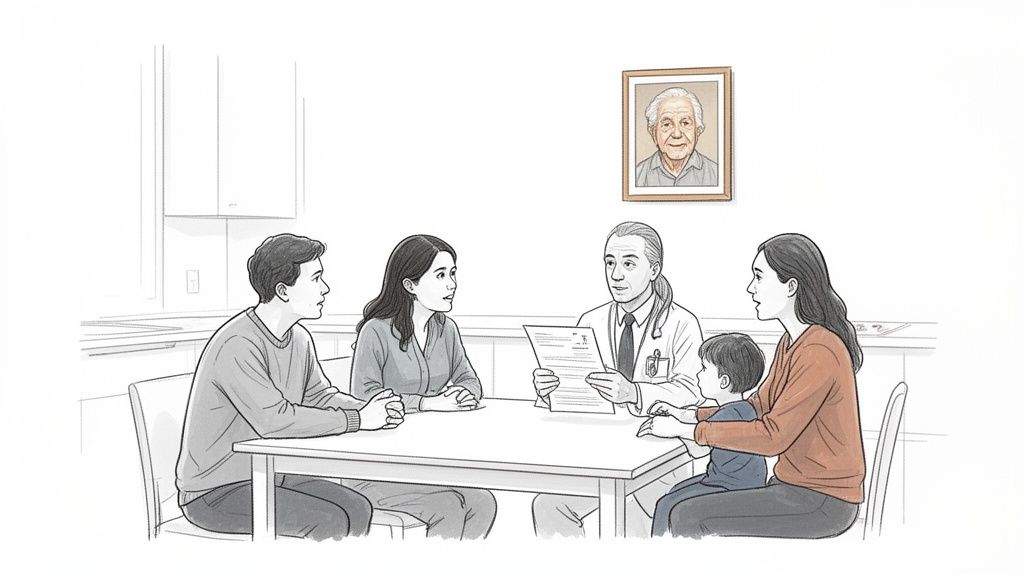
This lingering uncertainty is more than just an unanswered question; it can cast a shadow over a family's grieving process. Here at Texas Autopsy Services, families come to us looking for a truth they couldn't get while their loved one was alive.
They want to know if the years of caregiving, the difficult choices, and the emotional journey were really because of Alzheimer's. This need for confirmation isn't just about finding peace of mind; it has very real, practical implications.
The Impact of an Unconfirmed Diagnosis
A definitive diagnosis helps a family make sense of the past and plan for the future. For younger generations, knowing for certain can help them understand their own genetic risk factors and have more informed conversations with their doctors.
It also provides critical clarity for legal and financial matters. An accurate cause of death can be the key to resolving life insurance claims, settling inheritance disputes, or finalizing an estate. Without that pathological proof, these situations can become complicated.
During their loved one's illness, many families also face the challenge of managing their care and legal affairs. Understanding options like guardianship for persons with Alzheimer’s and dementia becomes an essential part of the journey.
Bridging Clinical Suspicion and Pathological Proof
Modern medicine has made incredible leaps in identifying probable Alzheimer's with advanced imaging and biomarker tests. But the gold standard, the final word, remains a direct look at the brain tissue itself. This is the only way to move from "probable" to "proven."
A Private Autopsies provides answers that no other test can. It can:
- Definitively confirm the presence of amyloid plaques and tau tangles, the classic signs of Alzheimer's.
- Reveal the severity of the disease and how widespread it was in the brain.
- Identify other contributing causes, like vascular damage or Lewy bodies, which often occur in cases of mixed dementia.
This guide will walk you through the differences between a clinical diagnosis and a definitive one. We'll explore how today's diagnostic tools work, and why a postmortem exam is still the only way to give families the complete, conclusive answer they deserve.
The Difference Between a Clinical and Definitive Diagnosis
When families ask me whether Alzheimer's can be diagnosed in a living person, the answer isn't a simple yes or no. It really comes down to understanding the difference between a clinical diagnosis and a definitive diagnosis. They might sound the same, but in my work as a forensic pathologist, that distinction is everything. One gives us a very strong, educated guess while a person is alive; the other provides undeniable proof after they’ve passed.
A clinical diagnosis is the conclusion reached by a neurologist after a deep and comprehensive evaluation. Think of it like a detective building a case. They don't have a smoking gun, but they meticulously gather different lines of evidence that all point toward the same conclusion.
The Clinical Diagnostic Process
A neurologist's first job is to be thorough. They have to rule out dozens of other conditions that can mimic Alzheimer's symptoms, things as simple as a vitamin deficiency, a thyroid issue, or even a reaction to medication. The workup usually involves a few key steps:
- A Detailed Medical and Family History: The doctor will spend a lot of time talking with the patient and their family. They want to know exactly when the symptoms started, how they've changed over time, and what the day-to-day challenges look like.
- Cognitive and Neurological Exams: These are specific tests for memory, language skills, and problem-solving abilities. They help the doctor measure the extent of the cognitive changes and establish a baseline.
- Standard Lab Tests: Simple blood tests are always run to make sure there isn't another medical problem causing the confusion or memory loss.
This initial process helps paint a clear picture of the patient’s overall health and narrows down the list of possible causes.
Advanced Tools for a Highly Probable Diagnosis
Over the last decade, our ability to diagnose Alzheimer's in living patients has improved dramatically. We now have tools that can spot the biological footprints, or biomarkers, of the disease, pushing diagnostic accuracy well above 90% in many cases.
There are two main ways we do this:
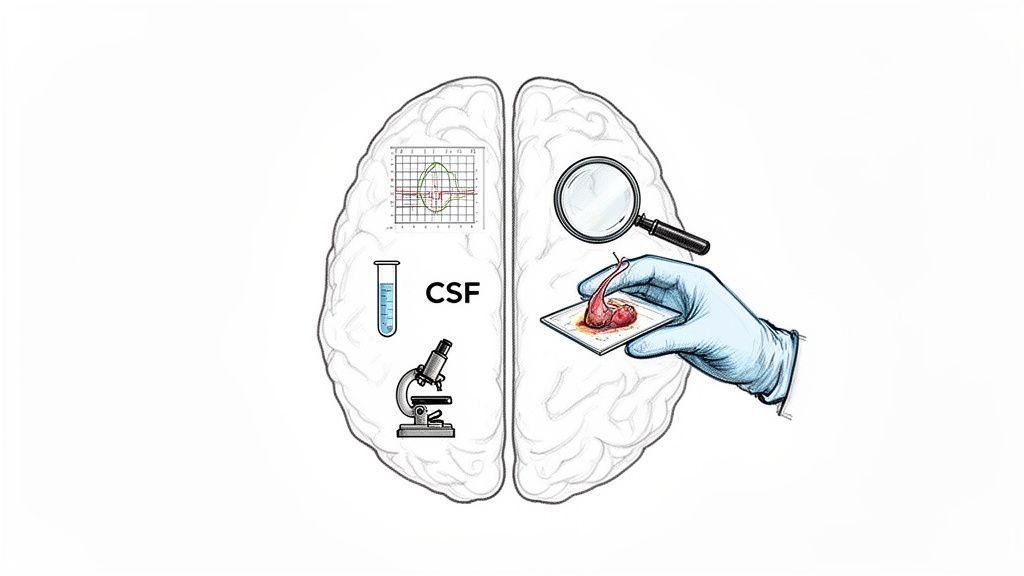
- Cerebrospinal Fluid (CSF) Analysis: This test involves a spinal tap to get a small sample of the fluid surrounding the brain and spinal cord. In that fluid, we can measure the levels of two key proteins: amyloid-beta and tau. When their levels are abnormal, it's a very strong indicator that the Alzheimer's disease process is underway.
- Positron Emission Tomography (PET) Scans: These are specialized brain scans that allow us to actually see the amyloid plaques or tau tangles that are characteristic of Alzheimer's. A positive scan gives us powerful, visual confirmation of what we suspect.
Even with these incredible advances, these tests are still showing us indirect evidence. They confirm the presence of the disease's hallmarks, but they can't give us the microscopic certainty that only a direct examination can provide.
As a pathologist, I often use an analogy. Getting a positive PET scan is like having a perfect satellite image of a suspect's car in the driveway. A definitive diagnosis from an autopsy is like having the suspect's fingerprints from inside the house. One builds an incredibly strong case; the other closes it without a shadow of a doubt.
The Gold Standard: A Definitive, Postmortem Diagnosis
The only way to get a 100% certain diagnosis of Alzheimer's disease is through a neuropathological examination of the brain tissue itself after death. This is the core of what I do. As a board-certified forensic pathologist, I can see the plaques and tangles firsthand, map out where they are, and determine their severity by examining the tissue under a microscope.
This direct look is the ground truth. It not only confirms Alzheimer's but can also identify other issues that may have been contributing to the symptoms, like vascular dementia or Lewy body disease, conditions that often complicate the picture during life. You can learn more about the depth of information we gather in our guide to understanding post-mortem reports.
How We Find the Footprints of Alzheimer's in a Living Brain
For years, an Alzheimer's diagnosis was based almost entirely on symptoms like memory loss, confusion, and changes in behavior. This was always an educated guess. Today, things are different. We can now hunt for the actual physical evidence of the disease, the biomarkers, while a person is still alive.
Think of biomarkers as the biological footprints Alzheimer's leaves behind. They are measurable signs that tell us a specific disease process is underway. This is a massive leap forward from just observing symptoms.
To make sense of these footprints, clinicians use a system called the AT(N) framework. It’s not as complicated as it sounds; it’s just a way to organize the evidence.
- (A) is for Amyloid: Are the sticky amyloid-beta plaques, a core feature of Alzheimer’s, building up in the brain?
- (T) is for Tau: Are there signs of twisted tau proteins, which form the tangles that choke brain cells from the inside?
- (N) is for Neurodegeneration: Is there evidence that brain cells are dying or that the brain is shrinking as a result?
By looking for evidence in these three categories, doctors can piece together a remarkably clear picture of what’s happening inside a patient’s brain.
The Tools That Let Us See the Unseeable
So, how do we find this evidence? Two key methods have changed everything: PET scans and cerebrospinal fluid (CSF) analysis.
An amyloid-PET scan is incredible. A patient is injected with a safe radioactive tracer that is specifically designed to stick to amyloid plaques. When the brain is scanned, those plaques literally light up, giving us a direct visual confirmation that they're there. For the first time, we can truly see one of the main culprits of Alzheimer's in a living person.
The other method is analyzing the cerebrospinal fluid, the clear liquid that bathes the brain and spinal cord. It’s collected with a routine procedure called a lumbar puncture, or spinal tap. This fluid is a goldmine of information. By measuring the levels of amyloid and tau proteins in it, we get a direct biochemical readout of the disease process. You can learn more about the specifics of Tau and ptau biomarkers in Alzheimer's disease to see just how precise this has become.
This chart helps break down the difference between the clinical diagnosis we're talking about and the definitive one I confirm after death.
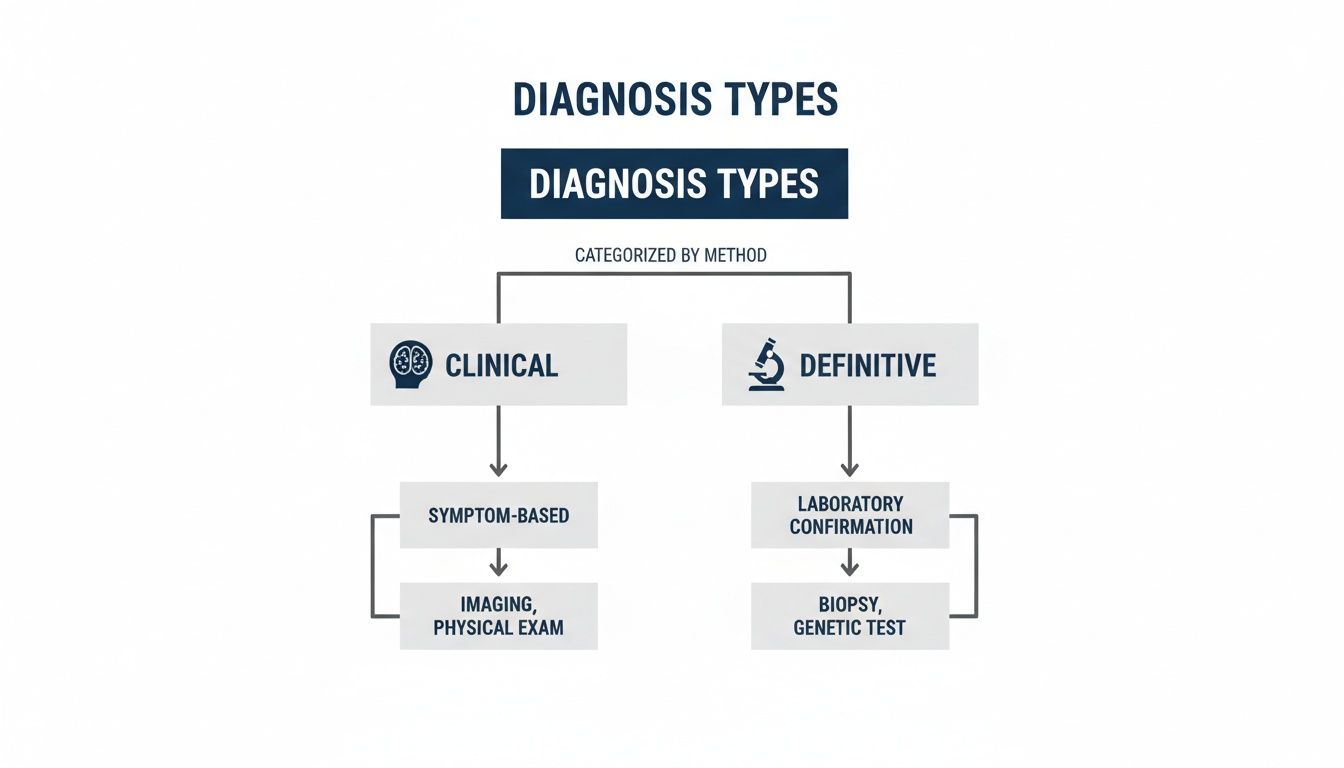
As you can see, one relies on these advanced tests during life, while the other, the definitive one, comes from looking at the brain tissue itself under a microscope.
Detecting the Disease Before It Causes Harm
What’s truly amazing is our ability to spot these biomarkers years, sometimes even decades, before a person notices a single symptom. This is what we call the preclinical stage of Alzheimer's. The science shows that these early biological signals are incredibly reliable predictors.
One major study found that 90.9% of people who tested positive for these preclinical biomarkers were later found to have significant Alzheimer's pathology when an autopsy was performed. In stark contrast, only 8.6% of those who tested negative had the same pathology.
The numbers speak for themselves. The tests have a sensitivity of 87.0% (meaning they correctly identify those with the disease) and a specificity of 94.1% (meaning they correctly rule out those without it).
This is a game-changer. It means we can identify who is on the path toward Alzheimer's long before their memory starts to fail. It gives families invaluable time to plan, to look into clinical trials, and to make informed decisions.
So, can Alzheimer's be diagnosed before death? The answer is a confident yes; we can diagnose it with a very high degree of certainty. But it's important to remember that these are all "probable" diagnoses. For the final, 100% certain confirmation, the kind that provides unshakeable proof, that can only come from a postmortem examination. That is the final truth I uncover.
The Role of New Blood Tests in Early Detection
While PET scans and spinal taps give us a direct look at Alzheimer's biomarkers, they aren't always practical. They can be invasive, expensive, and sometimes hard to access. For years, the medical world has been searching for a simpler first step. Now, that step is finally becoming a reality with new blood tests.
These tests are a significant development, helping us answer the question, "can Alzheimer's be diagnosed before death?" with more confidence than ever. By analyzing a simple blood sample, doctors can spot some of the same biological red flags of the disease found in cerebrospinal fluid or on a PET scan. This makes getting an early read on the disease a much more realistic option for countless families.
How Blood Tests Find Signs of Alzheimer's
So, how does it work? These tests measure specific proteins that have seeped out of the brain and into the bloodstream. The most promising one right now is a version of the tau protein known as p-tau217.
When Alzheimer's is active in the brain, abnormal tau proteins build up. Tiny fragments of this very specific protein, p-tau217, escape into the blood. Thanks to incredibly sensitive technology, we can now detect these minuscule amounts. An elevated level of p-tau217 is a very strong clue that Alzheimer's-related changes are happening in the brain. Think of it like finding a unique type of smoke in the air that could only come from one specific kind of fire.
This is a huge deal because it gives us a peek into what's happening in the brain without needing a spinal tap or a costly scan. It’s an excellent screening tool that helps doctors figure out which patients truly need to move on to more definitive testing.
FDA Approval and Growing Availability
This isn't just theory or lab research; these tests are starting to be used in doctor's offices. The U.S. Food and Drug Administration has begun giving the green light to the first diagnostic tests for early Alzheimer's, which is a major milestone.
For example, one approved test measures amyloid-beta proteins in cerebrospinal fluid, but the science behind it is paving the way for more blood-based options. Study after study has shown that p-tau217 levels in blood plasma are much higher in people with Alzheimer's, even before symptoms appear, compared to those without the disease's biomarkers. As detailed in publications like Neurology Advisor, these tests can provide diagnostic information on par with PET scans but without the radiation exposure.
The shift to blood tests is about more than just convenience. It’s about making early, accurate detection available to far more people, empowering families and doctors to have critical conversations and make plans sooner.
Where Blood Tests Fit in the Diagnostic Journey
It's crucial to see these blood tests for what they are: an incredibly valuable screening tool, but not a standalone diagnosis. They are one piece of a much larger puzzle.
Here's a typical way they might be used in a real-world clinic setting:
- Initial Screening: A family doctor might order a blood test for someone who is just starting to show subtle signs of memory loss or confusion.
- Gauging Risk: If the test comes back positive, it signals a higher probability of Alzheimer's pathology. This helps fast-track that person for a referral to a specialist, like a neurologist.
- Guiding Next Steps: The results help inform the decision of whether to proceed with more involved and expensive tests like a PET scan or a spinal fluid analysis.
Even with these exciting developments, it takes time for new medical tools to become common practice, and many people still aren't aware they exist. But there’s no doubt these blood tests show where the future is headed: toward earlier, more accurate, and more accessible answers for families grappling with the uncertainty of dementia.
Why a Postmortem Examination Provides the Final Answer
Even with all the incredible advances in imaging and blood tests, a clinical diagnosis is still just a highly educated guess. Families often come to us at Texas Autopsy Services because they need something more than a probability; they need certainty.
A postmortem examination is the only way to get that. It’s how we move from “very likely Alzheimer’s” to a definitive, conclusive answer. This is where we learn the absolute truth.
The Power of Looking Directly at the Brain
So, can Alzheimer's be diagnosed before death? We can get very close, but only a Private Autopsies can truly confirm it. The reason is simple: we get to look at the brain tissue itself.
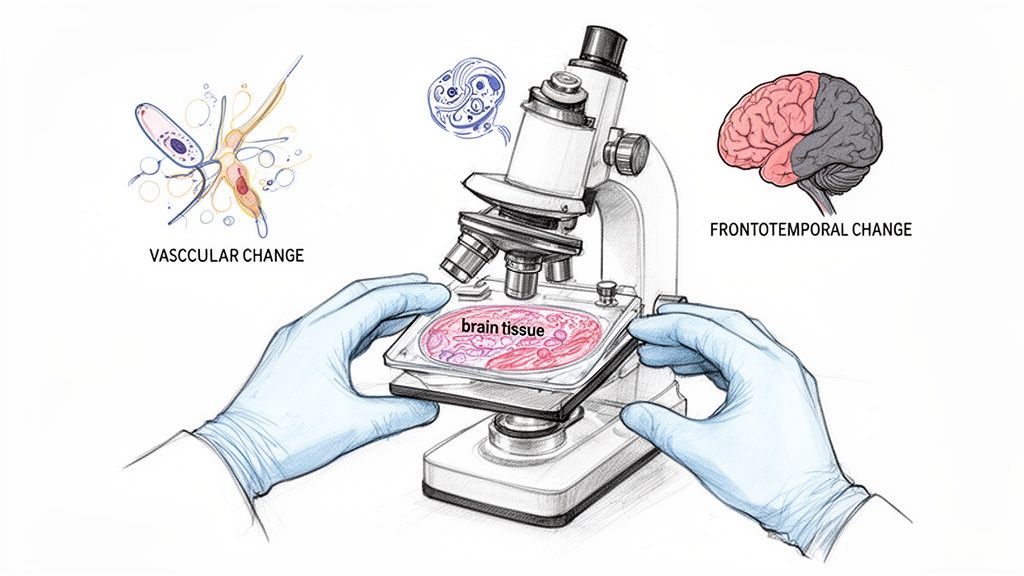
Instead of interpreting shadows on a PET scan or signals in a blood sample, I can examine the tissue directly under a microscope. This allows me to see, count, and map the physical evidence of Alzheimer's disease:
- Amyloid plaques: The dense, sticky protein clumps that build up between nerve cells.
- Neurofibrillary tangles: The twisted strands of tau protein that form inside the cells themselves.
Seeing is believing. I can confirm not just if these markers are present, but also how widespread they are and which parts of the brain they’ve affected. It’s the difference between a meteorologist tracking a hurricane on radar versus an inspector on the ground assessing the actual damage, street by street.
Uncovering the Full Story of Mixed Dementia
One of the most important things an autopsy can reveal is that Alzheimer's wasn't acting alone. It's incredibly common for older adults to have more than one type of dementia-causing pathology in the brain. We call this mixed dementia, and it makes a clinical diagnosis extremely tricky.
A person could have all the signs of Alzheimer's, but their symptoms might have been amplified or altered by other conditions.
An autopsy is the only method that can definitively identify and untangle these overlapping conditions. It provides the ground truth that no other test can offer with absolute certainty, giving families a complete and accurate medical history.
For example, when I examine the brain tissue, I might find evidence of:
- Lewy bodies, which are linked to Parkinson's disease and Lewy body dementia.
- Vascular damage from a series of tiny, unnoticed strokes.
- Frontotemporal degeneration, which explains why personality and behavior changes were so pronounced.
Finding out a loved one had mixed dementia can be a lightbulb moment for a family. It suddenly makes sense of symptoms that never quite fit the textbook description of Alzheimer’s. You can learn more about how we conduct this detailed analysis in our guide to the Alzheimer's brain autopsy.
The Pathologist's Role in Providing Closure
My work isn’t just about looking through a microscope. It’s about providing families and doctors with a clear, final medical report that answers their questions and brings a difficult journey to a close.
This definitive evidence can be crucial for legal matters or for helping family members understand their own genetic risks. But more than anything, it provides the emotional peace that comes from finally knowing the truth. While today’s science offers amazing tools for diagnosis during life, the autopsy is, and will remain, the gold standard for confirmation.
Common Questions About Alzheimer's Diagnosis and Autopsy
As a forensic pathologist, I often get practical, heartfelt questions about this process. My goal is to offer direct, compassionate answers that bring clarity during an incredibly difficult time. Here are a few of the most common questions I hear.
If My Loved One Had a Positive PET Scan, Do We Still Need an Autopsy?
That's a fantastic question. A positive amyloid PET scan is a powerful tool, and it gives doctors a very high degree of confidence that a person had Alzheimer's. But a scan tells you what is likely there, while an autopsy tells you the whole story.
Think of it this way: the PET scan can spot the amyloid plaques, which are a key hallmark of the disease. An autopsy, however, confirms the extent of those plaques and can also identify other troublemakers that were contributing to the dementia. We often find things like Lewy bodies or small strokes (vascular damage) that were also at play. Many older adults have what we call "mixed dementia," where several conditions are causing their symptoms.
A postmortem exam is the only way to definitively identify every single one of those factors. This gives your family a complete understanding and helps build an accurate family medical history for future generations.
How Does the Autopsy Process for Alzheimer's Work?
We conduct every examination with the utmost respect for the deceased. For an Alzheimer's evaluation, our entire focus is on the brain. After the brain is carefully removed, it needs to be preserved for about two weeks. This process firms up the tissue, which is essential for getting a precise look under the microscope.
From there, I take small, systematic samples from the specific brain regions that control memory and thinking. These tiny tissue samples are processed onto microscope slides and treated with special stains that make the Alzheimer's plaques and tangles visible. My final report details all of these findings, providing a definitive neuropathological diagnosis that gives the family the clear answers they’ve been searching for.
A common worry is that the procedure is disfiguring, but that’s simply not the case. Everything is done with surgical precision, which allows for a traditional viewing and funeral service afterward. Understanding who can authorize this is also a key first step, and you can learn more about who can request an autopsy in Texas in our related guide.
Is an Autopsy for Dementia Covered by Insurance?
Unfortunately, Private Autopsies that are requested by a family are generally not covered by Medicare or most private health insurance plans. They are typically considered an elective procedure.
However, many families find that the clarity and closure from a definitive diagnosis are invaluable. It resolves lingering questions about hereditary risk and provides objective, factual information that can be crucial for legal matters or insurance claims related to the cause of death. At Texas Autopsy Services, we provide transparent, all-inclusive pricing so you can make an informed decision without worrying about hidden costs.
If you have lost a loved one and are searching for definitive answers, my team and I at Texas Autopsy Services are here to guide you with compassion and professionalism. Please call our office directly to discuss how we can help your family find the certainty you deserve.