March 27, 2026 · Texas Autopsy Services
Do Pathologists See Patients? The Truth About Their Vital Role
Do pathologists see patients? Uncover their crucial, often unseen, contributions from lab diagnostics to direct patient and family consultations.
On this page
- Why Is Pathology So Often Invisible To The Public?
- The Two Worlds of Pathology: Clinical And Forensic
- When And Why You Might Speak With A Pathologist
- How Direct Communication Improves Medical Outcomes
- How I Serve Families And Attorneys At Texas Autopsy Services
- Answering Your Questions About Pathologist Consultations
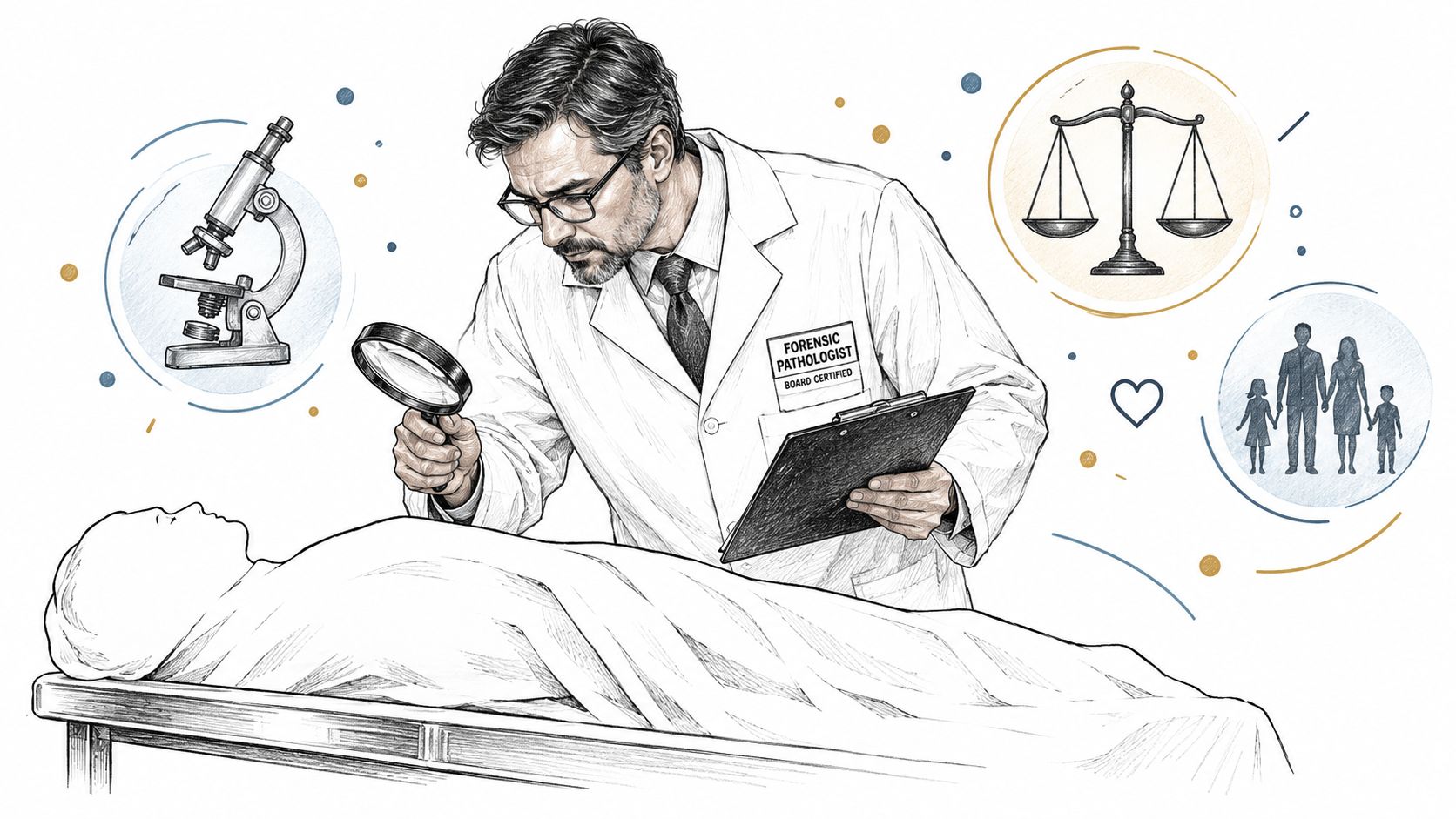
When people find out I’m a forensic pathologist, one of the first questions they ask is, “So, do you actually see patients?”
My short answer is yes, but not in the way most people think. As medical doctors, our work is critical to patient care, but it largely happens behind the scenes. We are the physicians in the laboratory, analyzing tissue and fluids to find the definitive answers that guide your other doctors’ treatment decisions. My role at Texas Autopsy Services, however, involves direct communication with families and legal professionals, a responsibility I take very seriously.
- Pathologists are licensed medical doctors who specialize in diagnosing diseases by examining body tissues and fluids.
- Most clinical pathologists communicate their findings to other doctors, not directly to patients.
- As a forensic pathologist, I regularly communicate directly with families, attorneys, and county officials to explain postmortem examination findings.
- Direct consultation with a pathologist can provide much-needed clarity for families and objective evidence for legal cases.
- My practice, Texas Autopsy Services, is built on providing direct, compassionate, and medically precise answers.
The “Doctor’s Doctor” and the Changing Face of Patient Care
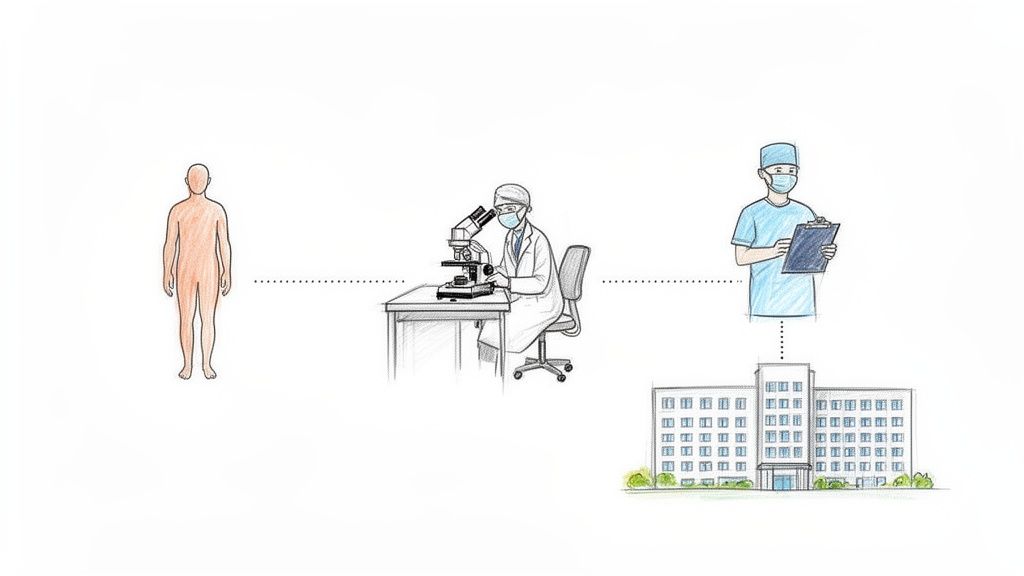
You can think of a pathologist as a "medical detective" or a "doctor's doctor." I provide the crucial diagnosis, the "what" and "why," that allows a primary physician or surgeon to create the best treatment plan.
For a long time, this vital role kept us almost exclusively in the lab, communicating our findings directly to other physicians. This is why many people are surprised to learn that a pathologist is a fully licensed medical doctor with years of specialized training. If you're curious about the journey to becoming one, you can learn more about our extensive training and qualifications.
However, things are starting to change. A growing number of us are stepping out from behind the microscope to meet directly with patients and their families. There's a strong belief in my field that this direct communication is incredibly valuable, offering clarity and comfort during stressful times.
This isn't just a one-way street. We pathologists want this connection, too. A 2021 survey of pathologists found that an overwhelming 86% were highly interested in meeting with patients to go over their pathology reports. We see the benefits firsthand. Patients get a clearer grasp of their diagnosis, and we get the personal satisfaction of seeing how our work directly helps people.
This desire for direct interaction highlights the two main worlds within pathology:
- Clinical & Anatomic Pathologists: These are the doctors who analyze biopsies, Pap smears, and blood work for living patients, usually in a hospital. Traditionally, their "patient" has been the treating physician.
- Forensic Pathologists: This is my specialty at Texas Autopsy Services. In this role, I regularly communicate directly with families, attorneys, and law enforcement who need clear answers about how and why someone died.
Let's take a closer look at these interactions.
Pathologist Interactions With Patients A Quick Overview
The table below breaks down the different ways pathologists might interact with patients or their families, depending on the situation.
| Type of Interaction | Who Is the Patient | Typical Setting | Common Goal |
|---|---|---|---|
| Indirect Consultation | Living Patient | Hospital or Clinic | Provide a diagnosis to the patient's primary doctor. |
| Direct Consultation | Living Patient | Pathology Clinic or Consultation Room | Explain complex biopsy results directly to the patient. |
| Family Consultation | Deceased Individual | Private Office or via Phone | Explain autopsy findings to the next of kin. |
| Legal Consultation | Deceased Individual | Attorney's Office or Courtroom | Provide expert testimony on the cause of death. |
While I may not have a waiting room full of patients every day, my role is deeply connected to patient care and family support. Understanding these different roles is the first step in seeing how a pathologist is an essential, if often unseen, member of your healthcare journey.
Why Is Pathology So Often Invisible To The Public?
Have you ever wondered who really figures out what’s wrong when a doctor takes a biopsy? Most people never think about it, but behind the scenes, there's a pathologist. We're a crucial part of the medical team, yet our specialty often feels like a mystery to the public.
This isn't by accident. The way modern hospitals are set up physically separates pathology labs from patient rooms. Over time, we became known as the "doctor's doctor," the experts other physicians rely on for a definitive diagnosis. Our world became the microscope and the lab bench, and our primary conversations were with surgeons and oncologists, not with the patients themselves.
A Gap In Patient Awareness
This setup has created a huge blind spot in public knowledge. The truth is, many patients whose lives are saved or changed by a diagnosis have no idea a pathologist was even involved. This isn't just a quirky fact; it can get in the way of a person's ability to trust and understand their own health journey.
Just how big is this gap? A 2021 study found that even among patients who had a biopsy, a shockingly low 13.8% knew a pathologist was the doctor who made their diagnosis. That's a massive disconnect. If you're curious, you can dig into the full study to see just how deep this issue runs.
This is exactly why so many people ask, "Do pathologists see patients?" The system was simply built in a way that keeps our work hidden from view, even when our findings are the most important piece of the entire medical puzzle.
Bridging The Divide Through Communication
This is also why it surprises people to learn that I, as a forensic pathologist, regularly speak directly with families. In my practice at Texas Autopsy Services, talking with the next of kin isn't just an afterthought. It’s a core part of what I do.
When I perform a private autopsy for a family, my job doesn't end with the examination. A huge part of my responsibility is to translate complex medical information into clear, straightforward answers. This direct communication provides the clarity and closure that families desperately need during an incredibly difficult time.
My independent practice is structured to bridge the very gap that exists in large hospital systems. It ensures the people who are most affected by a loss get the answers they need, straight from the physician who found them. This personal connection is a small but vital step toward making the field of pathology a little less invisible.
The Two Worlds of Pathology: Clinical And Forensic
People often ask me if pathologists actually see patients. The answer is yes, but it depends entirely on what kind of pathologist you’re talking about. In my career, having become board-certified in anatomic, clinical, and forensic pathology, I’ve had a foot in both worlds, and they couldn’t be more different.
Most pathologists you’ll never meet. They work on the clinical or anatomic side of the field, analyzing biopsies, Pap smears, and blood tests for living patients. Their work is the bedrock of modern medicine. It’s how doctors diagnose cancer, pinpoint infections, and track chronic illnesses.
But here’s the key difference: they almost always communicate directly with other doctors. They act as expert consultants for surgeons, oncologists, and family physicians, providing the definitive diagnosis needed to guide treatment. In that sense, the pathologist's "patient" is really the other doctor who needs their expertise.
The Pathologist's Visibility In Healthcare
This traditional flow of information is why pathologists often feel like the "doctors' doctor," working behind the scenes. This diagram helps visualize it.
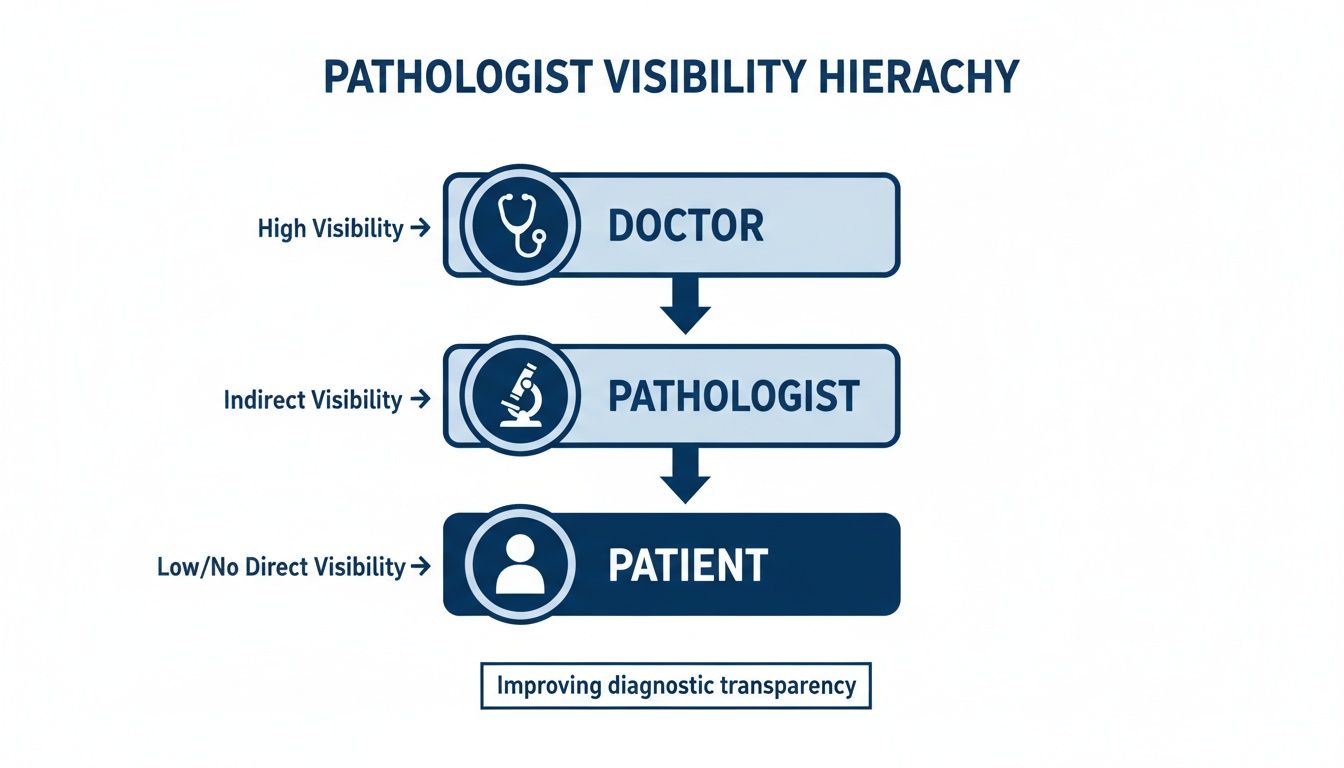
As you can see, the pathologist hands off critical diagnostic information to the primary doctor, who then talks with the patient. It’s an efficient system, but it definitely keeps our work out of the public eye.
The Forensic Pathologist: A Direct Line To Answers
And then there's my world: forensic pathology. My work at Texas Autopsy Services completely flips that communication model around. Here, I interact directly with the very people who need answers the most.
In the forensic field, my "patient" is often a grieving family desperate for closure, an attorney trying to build a solid case, or a Texas county official who needs a formal cause of death investigation. My job is fundamentally communicative. I don't just perform a postmortem exam; I translate my complex medical findings into clear, compassionate, and legally sound answers. You can get a deeper look into this field by reading our guide on what forensic pathology is and the unique role it plays.
When I take on a private autopsy or a second opinion autopsy, my job goes far beyond the examination room. It includes:
- Performing a meticulous examination to establish an objective cause and manner of death.
- Writing a comprehensive report that’s detailed enough for legal scrutiny but clear enough for a family to understand.
- Making myself personally available to discuss the results directly with the family or their legal team.
In my role, seeing the "patient" means sitting down with their loved ones. It's a profound responsibility, and I handle it with the utmost respect, making sure they get the truth with clarity and dignity.
This direct communication isn’t an afterthought; it’s a core part of what I do. It’s rooted in the firm belief that families deserve straight answers from the expert who actually did the work. While a clinical pathologist gives data to a doctor, I provide facts and a path to closure for a family. It’s a different world, but one just as committed to serving people with medical expertise.
When And Why You Might Speak With A Pathologist
So, when would you actually find yourself in a room speaking with a pathologist? It’s a fair question, since we usually work behind the scenes. While it’s not as common as seeing your family doctor, these interactions do happen in a few very specific, very important situations.Most of the time, these conversations fall into one of two main areas: a direct consultation in a hospital, or a discussion in a forensic context, which is the heart of my work. In either case, the goal is to give you direct access to medical expertise and the clearest possible picture of a diagnosis or a cause of death.
Consultations In Clinical And Hospital Settings
There’s a powerful trend growing in medicine where patients meet directly with the clinical pathologist who handled their case. This is becoming more common in specialties like oncology, where understanding the fine details of a diagnosis is absolutely critical.
Think about it. If you were diagnosed with cancer, the hospital might arrange a meeting with the pathologist who examined your biopsy. During that conversation, they could actually show you your own cancer cells under a microscope, explaining exactly what they saw and how it shaped your diagnosis.
This kind of meeting makes the disease real and tangible. It turns an abstract medical term into something you can see and understand, which is incredibly empowering. It’s a profound way to demystify the medical process and build a deeper trust in your care plan.
Conversations In A Forensic Context
The second scenario is where my work at Texas Autopsy Services comes in. Here, the conversations are with families, attorneys, or county officials after someone has passed away. These discussions are focused, professional, and designed to provide definitive answers when they are needed most.
For families, this usually happens in a couple of situations:
- Requesting a private autopsy: A hospital might not perform an autopsy, but the family still has lingering questions about how their loved one died. They’ll contact a forensic pathologist like me to conduct an independent examination.
- Seeking a second opinion: A family may feel uncertain or disagree with the findings of an official autopsy done by a medical examiner. They can hire an independent pathologist to review all the evidence and offer a fresh, unbiased opinion.
In both of these instances, my job is to communicate my findings clearly and compassionately. It’s not just about handing over a report. It's about carefully walking the family through the medical facts to provide the clarity they need to find closure.
For attorneys, bringing in a forensic pathologist is all about establishing medical fact. I’m often retained as a medical-legal expert to provide an objective analysis of a cause of death, which can be crucial for civil or criminal cases. My role is to present the science in a way that is clear, straightforward, and without bias.
Whether it’s in a hospital setting or for a private investigation, speaking with a pathologist boils down to one thing: getting clear, authoritative answers straight from the source.
How Direct Communication Improves Medical Outcomes
So, why should a pathologist step out from behind the microscope and speak directly with patients or their families? For a long time, the answer to "do pathologists see patients?" was a simple 'no.' But that's changing, and for good reason. When we bridge that gap, the benefits for everyone are immense.
For a family, getting to talk to the person who performed an autopsy or analyzed a biopsy can be a powerful experience. It replaces the anxiety of the unknown with real answers. This is especially true after a loss. Understanding why something happened is often the first step toward finding some sense of closure.
A Deeper Connection to Care
This isn't just about the family, though. When clinicians can easily talk with the pathologist, the entire care team gets stronger. It ensures those tiny, but crucial, details we find in the lab don't get lost in a written report. That kind of teamwork makes for better medical care and, in legal cases, stronger strategies.
Speaking from my own experience, these conversations are one of the most rewarding parts of my job. They’re a potent reminder that behind every tissue sample and every examination, there was a person, a life, and a family that loved them. Giving a family the answers they’ve been desperately searching for brings a human connection to the science.
The Data Behind the Dialogue
This isn't just a gut feeling; the data is starting to back it up. While pathologists have traditionally been behind-the-scenes, studies are showing just how much everyone gains from these conversations. For instance, in cancer care, where pathology dictates up to 80% of therapy choices, direct meetings help patients truly grasp their diagnosis and treatment plan.
It helps us, too. This work can be draining, with burnout rates in the specialty hitting 50% in 2022. But connecting with patients gives our work a renewed sense of purpose. If you'd like to read more, this insightful article explores how these interactions are changing our field.
Early programs focused on pathologist-patient meetings have seen incredible results, with patient appreciation rates between 85-95%. This boost in satisfaction and understanding can also head off diagnostic disputes, which play a role in a surprising number of malpractice lawsuits.
At the end of the day, bringing the pathologist into the room is about more than just clear communication. It's about building trust, providing answers, and delivering care with more compassion. It’s how we connect the science directly to the people it matters to most.
How I Serve Families And Attorneys At Texas Autopsy Services
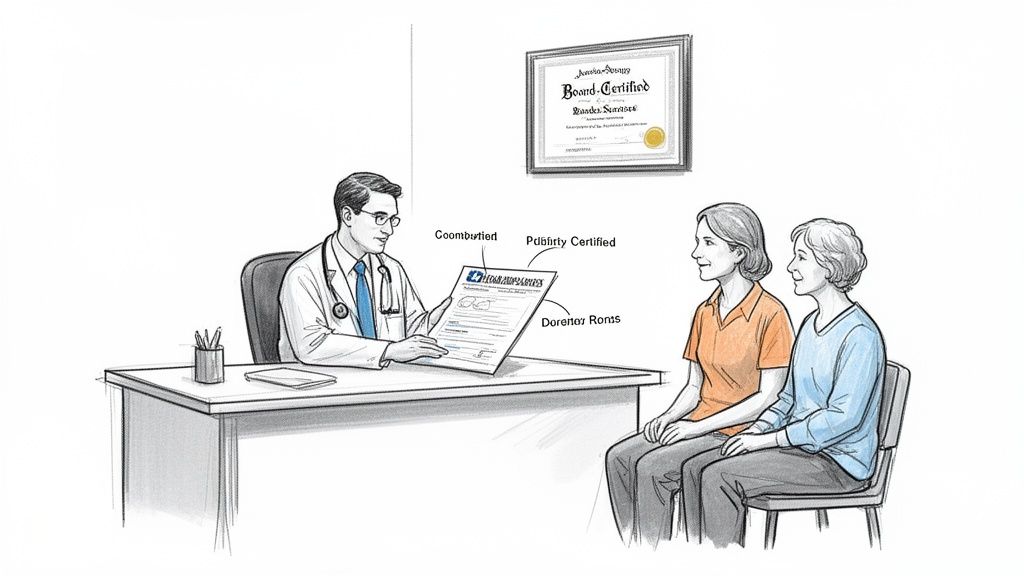
When a family or an attorney reaches out to me for a private autopsy or a second opinion, they don’t get handed off to an assistant. They talk directly to me. I believe clear, compassionate communication is just as important as the science itself, and I make sure you get answers without a middleman.
My work isn’t finished once the examination is done. It’s my job to deliver a detailed, understandable report and to be there to explain my findings in plain English. As a forensic pathologist, I speak directly with the people most affected by a loss. It’s a fundamental part of what I do.
A Process Built on Clarity and Trust
My goal is always to provide definitive answers when they matter most. For a grieving family, that often means finding closure after a sudden or unexplained death. For an attorney, it means building a case on a foundation of clear, objective medical evidence.
As a board-certified forensic pathologist, and after performing over 1,000 autopsies, I have built my practice on a commitment to being both medically precise and deeply respectful. The entire point of a private autopsy is to provide unbiased, objective answers that bring clarity to a difficult situation.
Everything I do is in full compliance with Texas regulations, including the Texas Health & Safety Code, which ensures that every step is handled ethically and professionally. I founded Texas Autopsy Services on a simple principle: families and legal professionals deserve direct access to the expert doing the work.
My approach comes down to two key things:
- Medical Precision: I conduct every examination meticulously, using established scientific methods to find an accurate cause and manner of death.
- Compassionate Communication: I make myself personally available to walk you through the findings. I’ll answer your questions and translate complex medical jargon into something you can actually understand.
This open dialogue isn't an add-on; it’s central to how I work. It ensures you receive not just a report, but the understanding and support you need. If you’d like to learn more about the field in general, you can read more about what a pathologist does and how we fit into both medicine and the legal system.
Answering Your Questions About Pathologist Consultations
When you're dealing with the loss of a loved one or a complex legal case, you're bound to have questions. It’s completely normal. Let’s walk through some of the most common ones I hear from families and attorneys to give you a clearer picture of how I can help.
Can I Speak To The Pathologist Who Handled A Hospital Autopsy?
This is a really common and understandable question, but unfortunately, the answer is usually no. A hospital pathologist’s job is to report their findings directly to the doctor who was in charge of the patient's care, not to the family. They often aren't permitted to speak with you directly.
If you have lingering questions or feel that something was missed in a hospital autopsy, the best path forward is often a second opinion autopsy. This lets an independent pathologist, like myself, take a fresh look at the case and give you direct answers.
What Should I Expect During A Consultation?
Think of our consultation as a straightforward, confidential conversation. My job is to translate complex medical information into plain English for you. We'll go over the report together, I'll explain my findings, and I’ll make sure you have the space to ask every single question that’s on your mind.
It's a focused conversation where I explain the science and you get the answers you need. My reports are comprehensive, but the consultation is where we ensure every detail makes sense to you.
At Texas Autopsy Services, my entire focus is on providing clear, objective, and compassionate answers when you need them most. If you have more questions or believe a private autopsy could help your family find clarity, please reach out to our office for a confidential discussion. You can contact us directly through our website.