April 28, 2026 · Texas Autopsy Services
A Day in the Life of a Pathologist in Texas
Explore a day in the life of a pathologist with our forensic pathology team. Learn about the autopsy process, from case triage to compassionate reporting in Texas.
On this page
- Pathology is quiet, methodical work with serious human consequences. Each case begins with records, context, and a clear question that needs an honest answer.
- A forensic pathologist’s day is structured. Many of us work a 40-hour week with standard 9 a.m. to 5 p.m. hours, with mornings often devoted to 2 to 4 autopsies and afternoons to reports, toxicology review, and court preparation, as described by the American Medical Association’s pathology profile.
- The examination itself is only part of the job. Microscopic review, toxicology, record correlation, and careful report writing often take as much attention as the physical autopsy.
- Private autopsies and second opinion autopsies can answer questions that matter to families, attorneys, physicians, and county officials. The value comes from independence, documentation, and a clear medical-legal process.
- In Texas, logistics and legal safeguards matter. Consent, release procedures, transport, and final disposition all need to be handled carefully and in compliance with applicable state requirements.
A family member once told me, very calmly, “We just need to know what happened.” That sentence captures more of my work than any technical description ever could.
Those who search for a day in the life of a pathologist are really asking something deeper. They want to know how answers are found, how carefully the process is handled, and whether the doctor behind the report understands that a death investigation affects real people for years.
The Weight of an Answer
I begin most days before I enter an examination room by reviewing the name on the case and the reason someone reached out. Sometimes it’s a family trying to understand a sudden death. Sometimes it’s an attorney evaluating whether the medical record and the known facts fit together. Sometimes it’s a physician or county official who needs an independent set of eyes.
At Texas Autopsy Services, every examination is performed by a board-certified forensic pathologist experienced in medicolegal death investigations. Our work centers on one principle: follow the evidence carefully, explain it plainly, and treat the deceased and their family with respect.
What the morning feels like
The work is quiet. It isn’t theatrical, and it shouldn’t be. A postmortem examination is a medical procedure performed for truth-finding, not a dramatic event.
Families are often surprised to learn how much of this work depends on reading, comparison, and disciplined note review. In that sense, pathology has something in common with other professional fields that require documented continuing education and reliable standards. For readers interested in how structured learning supports practice across industries, Cloud Present has a clear explanation of powering B2B marketing with CPE, which is useful as a general example of why credentialed expertise and documentation matter.
Practical rule: The first duty in pathology is not speed. It is accuracy with dignity.
What carries through the whole day
Every case represents a person who deserves respect. That principle affects how the body is handled, how specimens are labeled, how records are reviewed, and how conclusions are written.
It also affects communication. Medical precision matters, but so does language. Families need plain explanations. Attorneys need careful wording that will hold up under scrutiny. Healthcare professionals need findings that are medically sound and clearly supported.
That responsibility is the center of my workday.
The Morning Briefing and Case Triage
My morning starts before the first incision, with a stack of records, a timeline, and a set of questions that may be urgent, disputed, or personal.
In private autopsy work, triage is not a formality. It is the point where the case begins to take shape. I review what is known, identify what is missing, and decide what the examination must be designed to answer. For a family, that may mean clarity after a sudden death. For an attorney, it may mean testing whether the medical record and the physical findings hold together under close review.
What triage means in practice
A useful case review begins with specifics, not assumptions. I want to know the recent medical history, the circumstances of death, the reported symptoms, the medications, and the sequence of events in the final hours or days. In Texas private autopsy practice, those details often arrive from several directions at once. Hospital records, EMS documentation, scene summaries, family interviews, funeral home coordination, and prior pathology material may all matter.
The early questions guide the entire examination:
- What is the central medical issue? Sudden cardiac death, drug toxicity, trauma, infection, surgical complication, stillbirth, or an unexplained infant death each require a different starting point.
- What records can be verified before the examination? Operative notes, imaging, lab results, discharge summaries, and medication lists can change how a finding is interpreted.
- What concerns has the family raised? Inherited disease, delayed diagnosis, possible neglect, overdose, and timing questions all affect the scope of review.
- Will the opinion need to withstand legal scrutiny? If litigation or insurance review is likely, wording, documentation, and specimen handling must be especially disciplined from the outset.
This stage is quiet, but it carries weight.
A body can show me a great deal. It cannot answer a poorly framed question.
The trade-offs that families rarely see
A focused case produces a stronger opinion. A rushed case produces more uncertainty.
If the history suggests a possible arrhythmia, I may prioritize a careful cardiac examination, full heart dissection with attention to conduction-related anatomy, and review of prior cardiac symptoms or testing. If the concern is intoxication, specimen selection and chain of custody become central early decisions. If the death followed a hospitalization or procedure, the timeline matters almost as much as the anatomy. Small differences in timing can change whether a finding reads as expected disease progression, treatment complication, or an unrelated process.
The difficulty is that records are often incomplete at the start. Medication bottles may be missing. Emergency records may arrive after the examination is scheduled. Family members may know a symptom was present but not the exact date it began. None of that prevents good pathology work, but it does require restraint. A careful pathologist does not fill gaps with confidence.
Missing context does not reduce the value of an autopsy. It narrows the range of conclusions that can be stated with confidence.
Why triage matters in private autopsy work
In a hospital or government setting, part of the framework may already be established by institutional procedures. In private practice, I have to build that framework myself, case by case, while preserving independence. That is one reason families and legal professionals seek an outside pathologist. They need an opinion grounded in documented findings, not in the assumptions that may have shaped the case earlier.
By the time the examination begins, the planning should already be clear. What needs to be sampled. What needs photography. Which organs demand closer study. Which questions can be answered grossly, and which will depend on microscopy, toxicology, or records that must still be obtained.
That discipline protects everyone involved. It protects the family from vague answers. It protects attorneys from overstatement. Most of all, it protects the integrity of the final opinion.
The Scope of Examination From Adults to Perinatal Cases
No two autopsies ask exactly the same question. The science is consistent, but the purpose varies.
An adult private autopsy may focus on whether a natural disease process was recognized in time, whether an injury contributed to death, or whether toxic substances played a role. A perinatal examination often asks different questions entirely. There, the goal may be to identify developmental abnormalities, placental findings, evidence of infection, or signs of hypoxic injury that could guide future counseling.
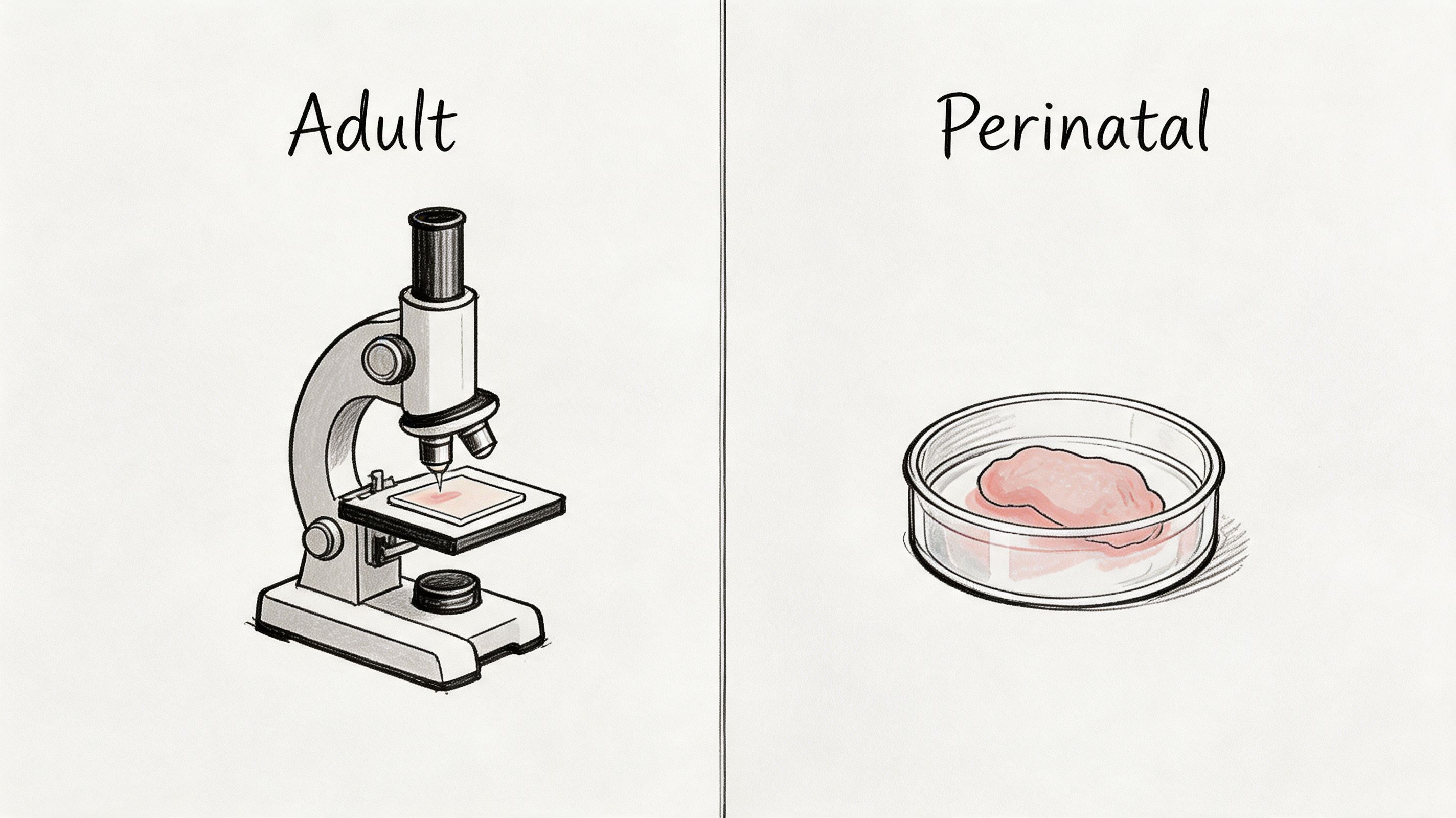
Adult cases and the questions they answer
In adult forensic work, the central issues often include cause of death, contributing conditions, and whether the physical findings match the reported events.
A cause of death is the disease or injury that led to death. A manner of death is the classification of how the death occurred, such as natural, accident, suicide, homicide, or undetermined. Those are separate concepts, and both require evidence.
An independent autopsy can be especially useful when there are unresolved concerns about timing, mechanism, or whether the initial explanation fully accounts for the death. That’s one reason some families and attorneys seek a Private Autopsy after a sudden or disputed loss.
Perinatal and fetal examinations
Perinatal cases require a different posture. The medicine is detailed, but the human setting is often especially painful. In these cases, precision and compassion have to coexist from the first phone call forward.
During on-call work, pathologists may handle urgent cases beyond routine autopsy practice. In perinatal autopsies, pathologists can quantify villous immaturity to guide genetic counseling, and hypoxia is linked to 70% of stillbirths in the referenced discussion from the University of Rochester Medical Center pathology blog. That kind of information can help clinicians and families understand whether a loss may relate to placental function, developmental factors, or another process.
Toxicology and correlation
Toxicology is sometimes the key to the entire case, but it’s never interpreted in isolation. A toxicology result has to be correlated with the scene, the medical history, the autopsy findings, and the known physiology of the decedent.
Here’s the practical difference:
| Case type | Main question | What the examination emphasizes |
|---|---|---|
| Adult natural death review | Was there an identifiable disease process? | Organ findings, heart and vascular pathology, microscopy |
| Possible intoxication | Did a substance contribute to death? | Specimen collection, toxicology correlation, scene history |
| Traumatic death review | Do the injuries match the reported event? | External and internal injury documentation |
| Perinatal or fetal autopsy | Is there an explanation that informs family counseling? | Developmental anatomy, placenta, microscopy, ancillary studies |
A broad practice requires flexibility. The methods are medical. The questions are human.
The Autopsy Process A Commitment to Detail
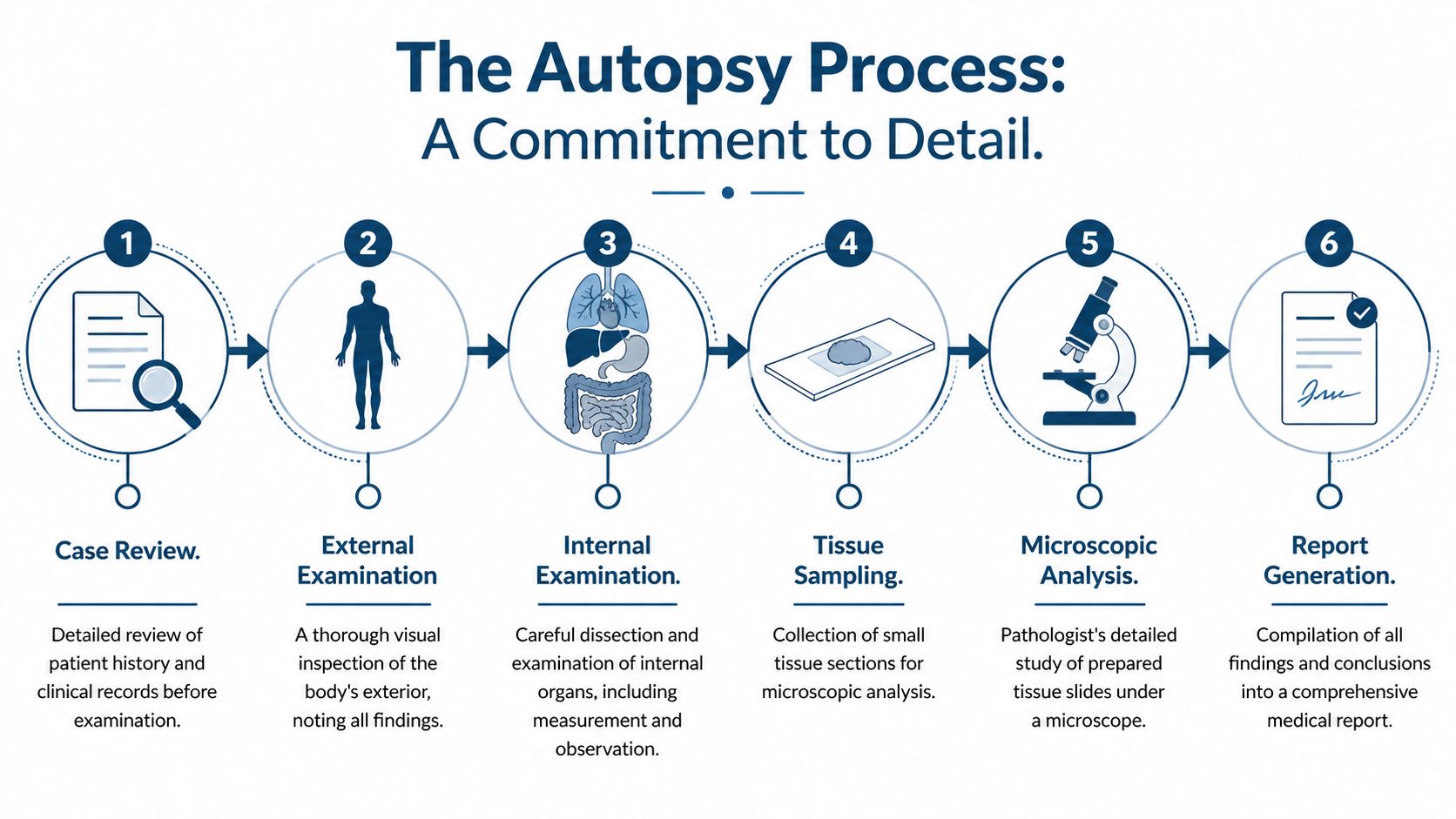
The autopsy process is often misunderstood because the term is commonly heard without knowledge of the method. In practice, it is a structured medical examination performed in ordered stages.
The core sequence
The work usually follows a sequence like this:
Case review
I review records, history, and the stated concerns before the physical examination begins.External examination
This includes identifying features, medical interventions, scars, injuries, and any visible abnormalities.Internal examination
This is the organ-by-organ evaluation, sometimes called gross examination or grossing.Tissue and fluid sampling
Samples are collected for microscopy, toxicology, and other needed studies.Microscopic review
Tissue slides are examined to confirm, refine, or challenge the initial impressions.Final report generation
Findings are integrated into a written medical opinion.
For readers who want a more focused procedural outline, I’ve also discussed the process in this step-by-step autopsy overview.
What gross examination means
The word gross in pathology doesn’t mean unpleasant. It means examination visible to the naked eye. In a typical day, that part of the work includes meticulous dissection and documentation of organs, measurement of organ weights, and collection of samples for toxicology.
The same verified discussion notes that post-grossing work may involve microscopic review of 20 to 50 H&E-stained slides per case, with special stains ordered as needed, and that diagnostic accuracy can exceed 95% when findings are correlated with the full investigation, as described in the referenced video discussion of pathology workflow.
The autopsy is not a single look. It is a series of checks that either support or contradict one another.
A short visual explanation can help place those steps in context:
Respect during the procedure
One of the most common misconceptions is that an autopsy is rough or careless. That isn’t how a proper examination is performed. The procedure is methodical, controlled, and respectful, much more like surgery than the public often imagines.
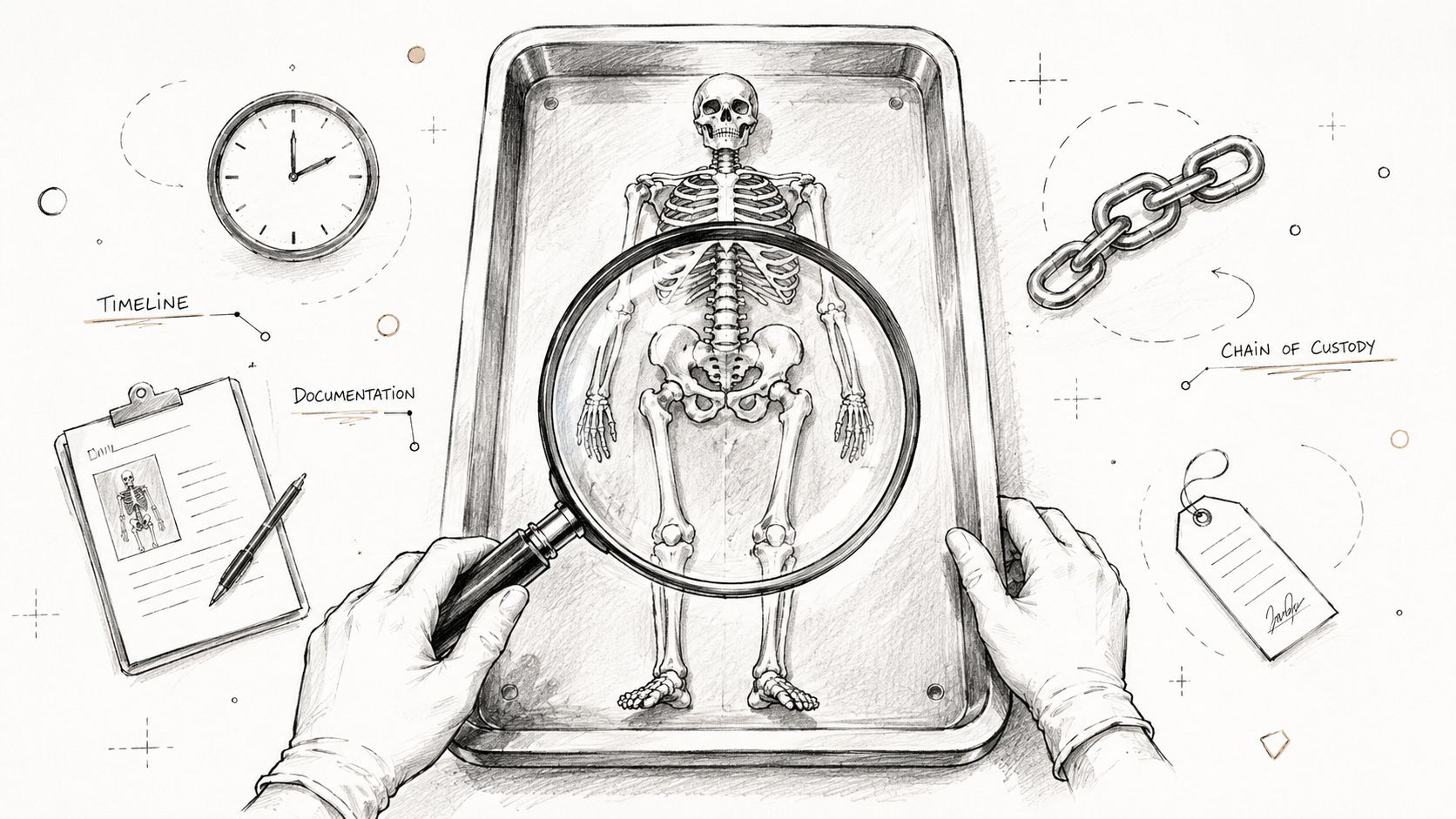
Chain of custody also matters. In plain language, chain of custody means documented control over the body, specimens, and related evidence from one step to the next. When legal review is possible, that documentation becomes essential.
From Microscope to Final Report
The examination room is only part of the workday. A large share of pathology happens afterward, at the microscope and at the desk.
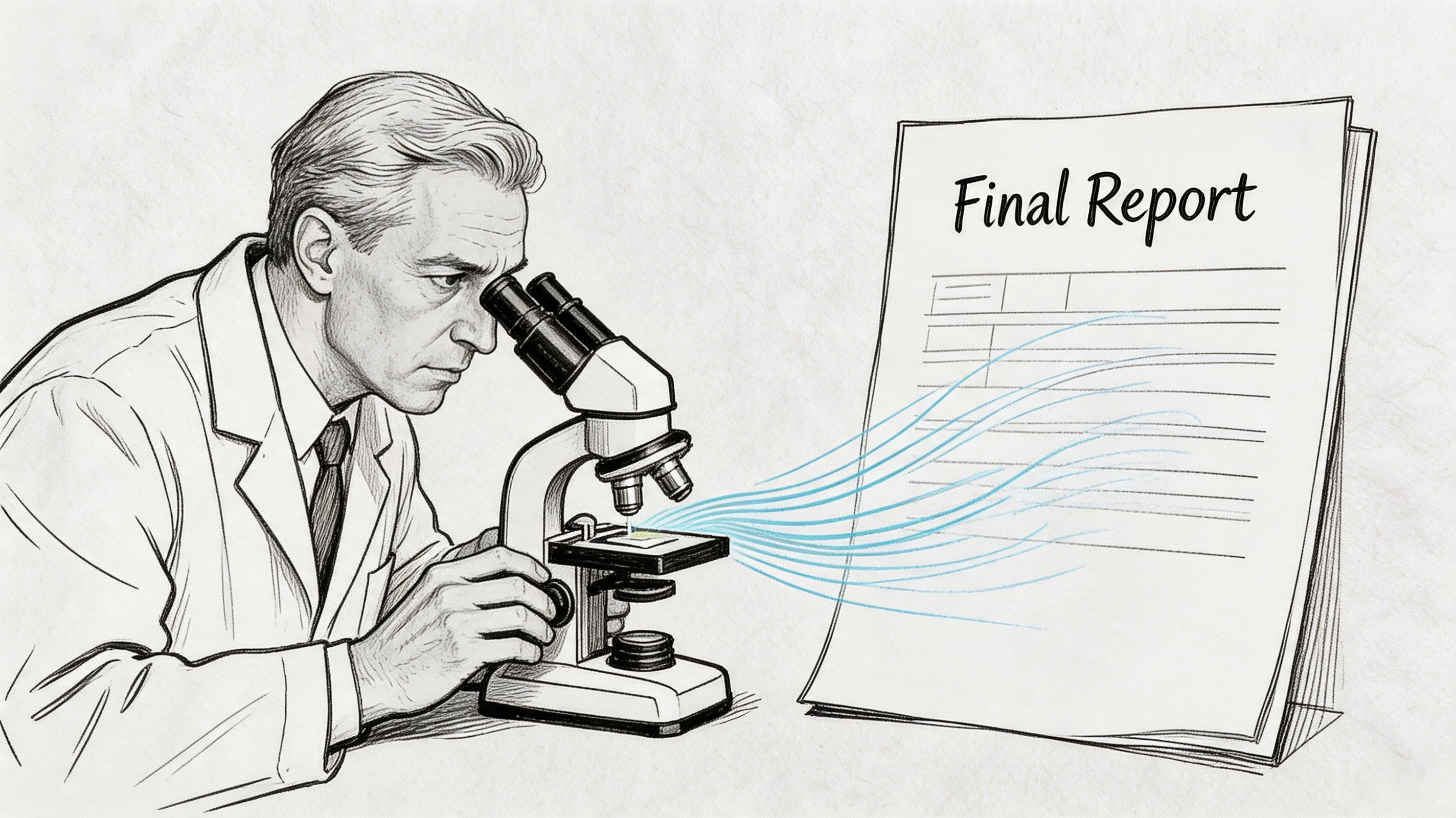
Pathologists often spend 4 to 6 hours of the workday on microscopic examination of biopsies and surgical specimens, and pathologists in the United States review 20 to 50 slides per session on average, with high-volume labs aiming to sign out 90% of cases daily, according to Your Pathologist’s description of the workday. For a forensic pathologist, that same discipline applies after an autopsy. The tissue slides often clarify whether the gross findings tell the full story.
What microscopy adds
Microscopy answers questions that the naked eye cannot. A heart may look enlarged during the internal examination, but histology can show whether there is scarring, inflammation, or another disease pattern. The lungs may appear congested, but the slides help determine whether there is infection, diffuse injury, aspiration, or another process.
Caution is essential. A preliminary impression may be correct, but it still needs support. Good pathology is confirmatory, not impulsive.
How a final opinion is built
The final report isn’t a summary of one observation. It’s a synthesis of several layers of evidence:
- Gross findings: Organ appearance, injury patterns, measurements, and distribution of disease
- Microscopic findings: Cellular-level confirmation or refinement
- Toxicology: Substance identification and interpretation in context
- Clinical and scene correlation: Whether the history aligns with the physical evidence
That synthesis is what gives a report value in both medical and legal settings. If you’ve ever tried to interpret a report on your own, this guide on how to read a pathology report may help explain how pathologists structure their conclusions.
Key point: A useful report doesn’t just state a conclusion. It shows how the evidence supports that conclusion.
Communication after the science
Families and attorneys usually need different kinds of clarity. Families often want direct language and patience. Attorneys often need definitions, limitations, and a clear distinction between observation and inference.
That means I have to translate without oversimplifying. If I state that the cause of death is a disease process, I need to explain what findings support that statement. If the manner of death remains undetermined, I need to say why. Precision includes acknowledging uncertainty where uncertainty remains.
That’s part of the day in the life of a pathologist that people rarely see, but it’s one of the most important parts.
Autopsy Logistics and Timelines in Texas
Some of the hardest conversations in my work happen before the examination begins.
A family has made the decision to seek answers. An attorney is trying to preserve facts without disrupting funeral plans. A funeral home needs clear release instructions. In Texas, those pieces have to come together quickly, but they cannot be rushed carelessly. In private autopsy practice, the quality of the final opinion depends in part on what happens in the first several hours after authorization, transport, and identification are confirmed.
That early coordination matters because a private autopsy is both a medical examination and a regulated postmortem process. Consent must come from the proper legal authority. Transportation has to be arranged. The funeral home must know the timing. Specimens have to be labeled, secured, and tracked correctly from the start.
What affects timing
The external and internal examination may be completed in a relatively short window. The full answer often takes longer.
Several factors commonly affect the timeline:
- Toxicology testing: Laboratory testing and interpretation can extend the schedule, especially when results must be placed in clinical and scene context.
- Microscopic examination: Tissue processing takes time, and slides sometimes clarify or refine what was suspected at the gross level.
- Medical records and investigative materials: Hospital charts, EMS records, imaging, or scene information do not always arrive at once.
- Legal review needs: If litigation is possible, the report has to be written with special care so that findings, opinions, and limitations are clearly separated.
For families looking for private autopsy services in Texas, distance is often part of the problem. A case may begin in Houston, Dallas, Austin, San Antonio, or a much smaller community. The practical question is whether transport, release coordination, and communication can be handled cleanly across those settings. In some situations, coordination with providers such as the Waterloo Mortuary pathology partnership helps families understand how the autopsy fits with final arrangements.
A more detailed explanation of timing appears in this guide to how long it takes to do an autopsy.
Independent review and changing workflow
In second-opinion work, independence matters. A fresh review helps when a family has unanswered questions, and it also matters when counsel needs an objective medical assessment that is separate from earlier assumptions or institutional pressures.
Technology has improved parts of pathology workflow, particularly in digital imaging and case organization. The U.S. Food and Drug Administration has cleared several digital pathology systems for clinical use, including whole slide imaging platforms used for primary diagnosis, as described in the FDA's Digital Pathology page. The American Medical Association has also discussed how pathologists are seeing workflow changes from artificial intelligence and digital tools in practice in its article on specializing in pathology and shadowing Dr. Riddle. These tools can help organize information and support review. They do not replace medical judgment, chain of custody, or careful correlation of findings.
Texas Autopsy Services is one provider offering independent postmortem examinations, second opinions, toxicology coordination, and county forensic work across Texas.
Legal and ethical guardrails
Texas cases require attention to release authority, consent, disposition, and the rules that govern postmortem handling. Families should not have to sort through statutes while they are grieving, but they should be able to trust that the process respects the Texas Funeral Service Commission and applicable provisions of the Texas Health and Safety Code.
I take that part seriously.
A careful process protects the integrity of the findings, preserves evidentiary value when legal questions exist, and treats the person who died with the dignity they deserve.
Common Questions About the Autopsy Process
One of the hardest conversations I have with families happens before the examination begins. They are trying to make careful decisions while grieving, and the questions are usually plainspoken. Will this disfigure my loved one. How long will answers take. Do we need a second opinion. Those questions deserve direct answers, not medical jargon.
Is an autopsy disfiguring
A properly performed autopsy is done with care, restraint, and respect for the person who died. Incisions are closed appropriately, the body is cleaned, and families can usually still proceed with viewing, burial, or cremation after coordination with the funeral home. In private practice, I stay mindful that this is not only a medical examination. It is also part of a family’s last experience caring for someone they love.
What is the difference between cause of death and manner of death
Cause of death is the specific disease or injury that led to death.
Manner of death is the medical-legal classification. Natural, accident, suicide, homicide, or undetermined.
They answer different questions. A heart attack is a cause of death. A drug toxicity may be the cause, while the manner depends on how the exposure occurred.
What is a second opinion autopsy
A second opinion autopsy means an independent pathologist reviews the case to see whether the findings and conclusions hold up. That may involve records, photographs, microscope slides, toxicology, the original report, or a new examination if one is still possible.
Attorneys often ask this question after they see a gap between the reported findings and the clinical history. Families ask it when the official explanation does not fit what they were told before death. In both situations, the goal is the same. Get a medically grounded opinion that is independent of the first review.
How long does it take to get results
Some answers come early. Final answers often take longer.
A careful autopsy may require tissue microscopy, toxicology testing, outside records, or consultation with another specialist. I would rather give a family a supported conclusion than a fast answer that changes once the full evidence is in. In Texas private autopsy work, that trade-off matters, especially if funeral planning, insurance questions, or litigation are already in motion.
What is chain of custody
Chain of custody is the written record showing who handled the body, specimens, slides, and other materials at each step. That documentation matters when legal questions are present because it shows the evidence remained identified, tracked, and protected from mix-ups.
For a grieving family, this can sound technical. For a court, it is basic. If specimens may be reviewed later, every transfer needs to be documented clearly.
How is a private autopsy different from a hospital or government autopsy
The difference starts with authority and purpose. A private autopsy is usually arranged by the legal next of kin or another authorized party to answer specific questions about a death. A hospital autopsy generally focuses on medical clarification and quality review. A government autopsy handles deaths that fall within official legal responsibility.
That difference affects scope, access to records, specimen handling, and how the final opinion may be used. In private autopsy practice, I often work with families and attorneys who need a clear explanation of what can be answered, what cannot be answered, and what additional testing is worth pursuing.
Families often tell me that clear language helps as much as the final conclusion. I agree. People deserve answers they can actually understand.
If you need guidance after a death, whether you’re a family member, attorney, physician, or county representative, contact Texas Autopsy Services. I’ll give you a clear explanation of what the process can and cannot answer, what documentation is needed, and how to proceed in a way that respects both the medical facts and the person at the center of the case.