April 23, 2026 · Texas Autopsy Services
What Happens If You Eat a Fly A Medical Explanation
Wondering what happens if you eat a fly? A forensic pathologist explains the risks from pathogens, symptoms to watch for, and when to seek medical help.
On this page
- The Journey of a Swallowed Fly Through Your Body
- Evaluating the Real Risks Pathogens and Contaminants
- Symptoms That Warrant Medical Attention
- The Critical Difference Swallowing Versus Inhaling a Fly
- A Forensic Pathologist's Perspective on Insect Ingestion
- Frequently Asked Questions for Families and Professionals
What Happens If You Eat a Fly
TL;DR
- Most of the time, swallowing a fly is more unpleasant than dangerous. In many healthy adults, it passes through the digestive tract without causing harm.
- A primary concern is what the fly may have carried on its body. Houseflies can mechanically transfer bacteria such as Salmonella, E. coli, and Shigella to food.
- Watch for ongoing symptoms, not just the moment itself. Persistent vomiting, diarrhea, bloody stool, fever, trouble breathing, or continuing cough deserve medical attention.
- Swallowing and inhaling are not the same event. A swallowed fly goes to the stomach. An inhaled fly can enter the airway and may require urgent evaluation.
- From a forensic standpoint, a swallowed fly is rarely a cause of death. In rare situations, postmortem examination can help determine whether an insect finding was incidental or medically important.
A common version of this happens fast. You're outside at a Texas barbecue, talking while you laugh, and a fly gets in before you can react. The next few seconds are usually a mix of coughing, disgust, and immediate worry.
At Texas Autopsy Services, every examination is performed by a board-certified forensic pathologist experienced in medicolegal death investigations. Our work centers on one principle: follow the evidence carefully, explain it plainly, and treat the deceased and their family with respect.
The Journey of a Swallowed Fly Through Your Body
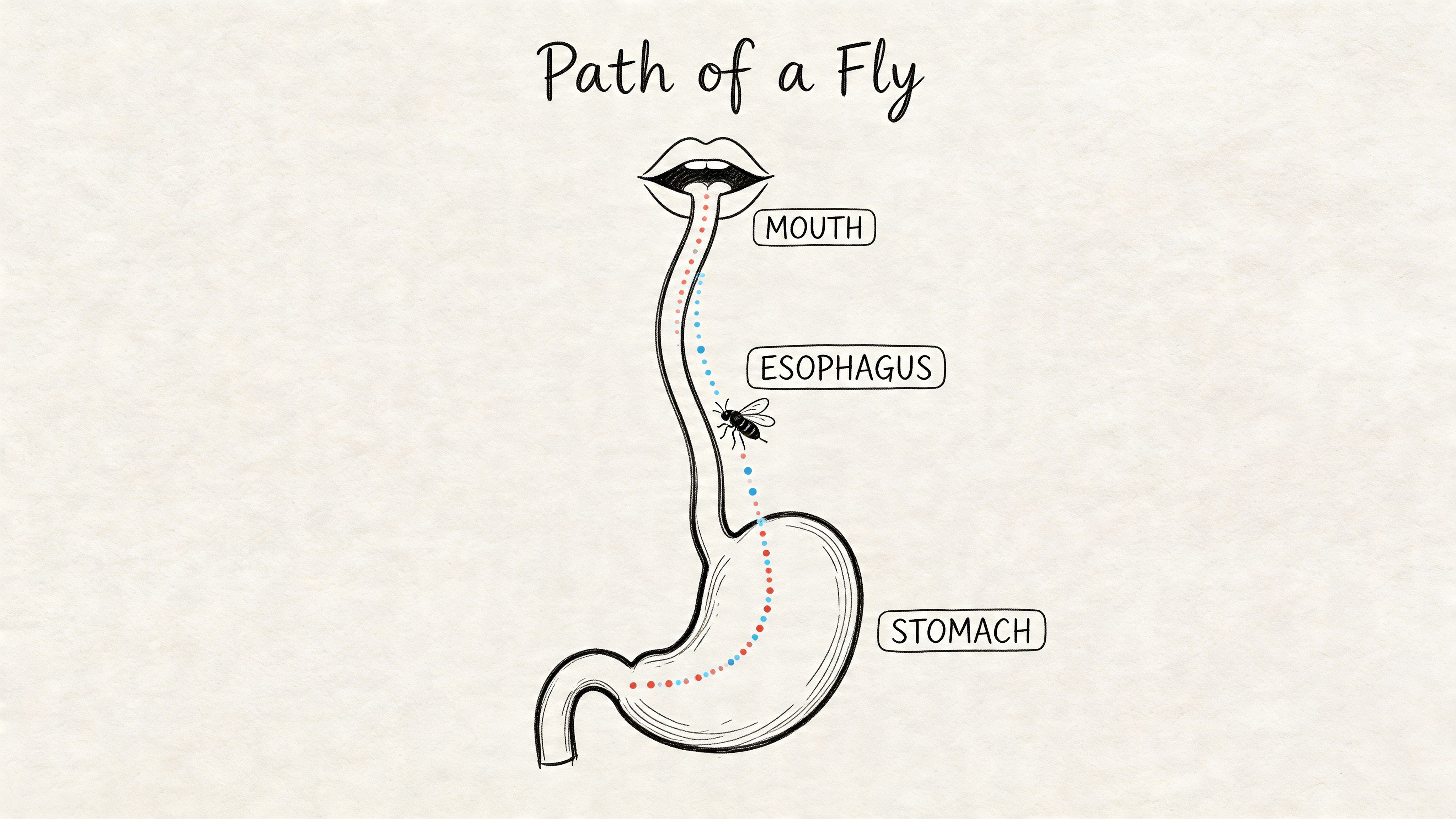
At the moment you swallow, your body treats the fly like any other small piece of organic material. It moves from the mouth into the esophagus, which is the muscular tube that carries food to the stomach. If it goes down that route cleanly, the event is usually brief and self-limited.
What happens first
Saliva starts the process. It moistens whatever was swallowed and helps it move downward. The fly doesn't remain intact for long in any meaningful sense. Chewing, swallowing, and stomach motion break it apart mechanically.
Once it reaches the stomach, acid and digestive enzymes do most of the work. For many people, that's the end of the story.
Practical rule: If you swallowed a fly, feel well, and are breathing normally, the most likely outcome is simple digestion.
Why most swallowed flies don't cause a problem
The body is built to handle accidental ingestion of nonfood material more often than is commonly understood. In the United States, the average person unintentionally consumes about one pound of insects annually through fragments in processed foods permitted under FDA standards, as noted in this discussion of insect fragments in food and forensic context. That doesn't mean insects are desirable in food. It means the digestive tract routinely encounters tiny insect material without consequence.
From a practical medical standpoint, a single swallowed fly usually becomes part of the general digestive stream. It moves through the stomach and intestines, is broken down further, and then passes out of the body with stool.
What does not usually help
People often respond with extreme home remedies after a fly is swallowed. That usually isn't necessary. Large amounts of mouthwash, induced vomiting, or panic-driven eating and drinking don't improve the situation.
A small amount of water is reasonable if your throat feels irritated. Observation is usually more useful than overreaction.
Evaluating the Real Risks Pathogens and Contaminants
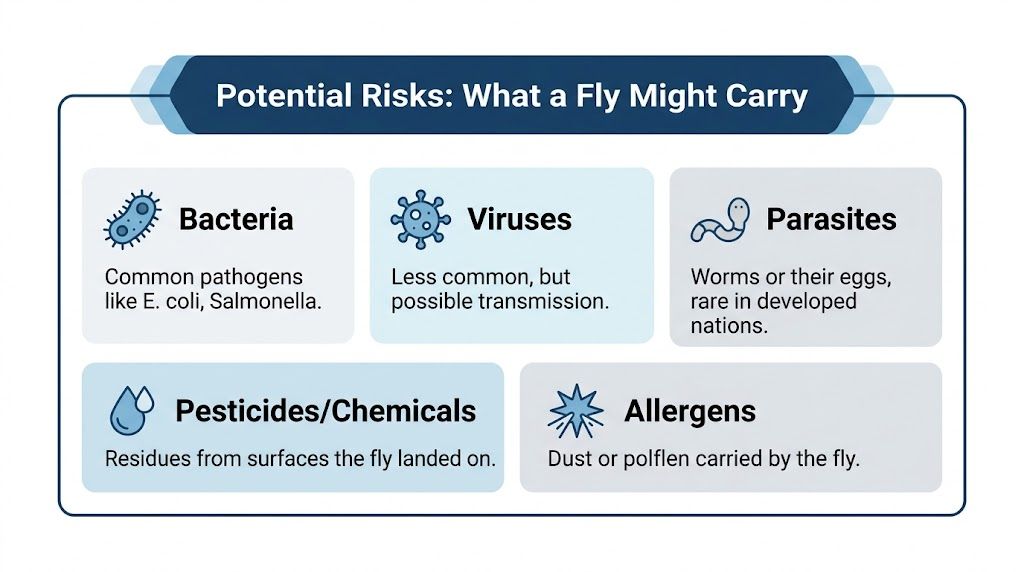
The medically important issue isn't the fly as a piece of tissue. It's the contamination risk from where that fly has been. Houseflies land on garbage, animal waste, decaying material, and food surfaces. They don't need to bite to spread germs. They can transfer organisms mechanically from their legs and body.
The bacteria that matter most
Houseflies act as mechanical vectors for enteric pathogens, depositing Salmonella enterica and Escherichia coli via tarsi and vomitus. In the stomach, about 90% of transferred bacteria die, but acid-tolerant survivors can adhere to the ileal mucosa and trigger gastroenteritis in 20 to 40% of exposed healthy adults within 12 to 72 hours, according to this summary of fly-borne pathogen transfer. The same source notes that the CDC attributes 1.35 million U.S. salmonellosis cases per year to various vectors, including flies.
That explains the balance I give patients and families. The risk from a single fly is low, but it isn't zero. Most swallowed flies won't lead to infection. A contaminated fly can.
What that illness can look like
If infection develops, symptoms usually resemble gastroenteritis. That can include nausea, vomiting, abdominal cramping, diarrhea, and fever. Some people recover quickly. Others have more severe intestinal irritation.
The details depend more on the bacteria than on the insect itself. The fly is the delivery vehicle, not the underlying disease process.
A swallowed fly is usually harmless. A contaminated fly can be the start of a foodborne illness.
What actually works for prevention
The most effective prevention is basic environmental control. Keep food covered outdoors. Remove trash promptly. Clean food preparation surfaces. Use screens and reduce indoor fly access when possible.
Restaurants, event spaces, and home kitchens all benefit from the same principles. If you're looking for a practical public guide on how to prevent foodborne illness, good food handling matters much more than dramatic one-time cleanup after an insect lands on a plate.
For clinicians and attorneys, this is also where laboratory medicine becomes relevant. When gastrointestinal illness follows a suspected contamination event, stool testing and related analyses may become important. I've written separately about how testing fits into death investigation in forensic toxicology, although a swallowed fly by itself rarely creates a forensic case.
Symptoms That Warrant Medical Attention
Typically, reassurance is needed, not emergency care. What matters is whether symptoms develop later and whether they are mild, improving, and short-lived, or whether they are escalating.
Symptoms that deserve prompt evaluation
Accidentally swallowing a fly can transmit Shigella bacteria, leading to shigellosis. While most cases are mild, severe, often bloody diarrhea can occur in approximately 10 to 20% of susceptible individuals, and 450,000 cases occur annually in the United States, as described in this medical explanation of accidental insect ingestion and Shigella risk.
That means you should take the following seriously if they appear after swallowing a fly:
- Bloody diarrhea: This is not a normal response to simple disgust or throat irritation.
- Persistent vomiting: Ongoing vomiting raises concern for significant gastrointestinal illness and dehydration.
- Fever with abdominal pain: Infection becomes more likely when these occur together.
- Symptoms that continue or worsen over time: A brief unpleasant sensation is one thing. Progression is another.
Symptoms that suggest an urgent airway issue
The first question is whether the fly was swallowed or whether it may have gone into the airway. If you have choking, noisy breathing, chest tightness, or a cough that doesn't settle, the airway becomes the priority.
People with asthma, small children, and frail older adults deserve extra caution here. Their reserve is lower, and a minor aspiration event can become clinically significant faster.
A brief visual explanation can help distinguish common reactions from concerning ones:
A simple way to think about next steps
Use the body's timeline as a guide.
| Situation | What it usually means | Reasonable response |
|---|---|---|
| Immediate disgust, brief cough, then normal breathing | Usually irritation only | Observe |
| Mild stomach upset that resolves | Often self-limited | Fluids and monitoring |
| Bloody stool, fever, worsening abdominal symptoms | Possible infection | Seek medical care |
| Trouble breathing or persistent coughing | Possible aspiration | Seek urgent evaluation |
If your concern is in the chest, don't treat it like a stomach problem.
The Critical Difference Swallowing Versus Inhaling a Fly
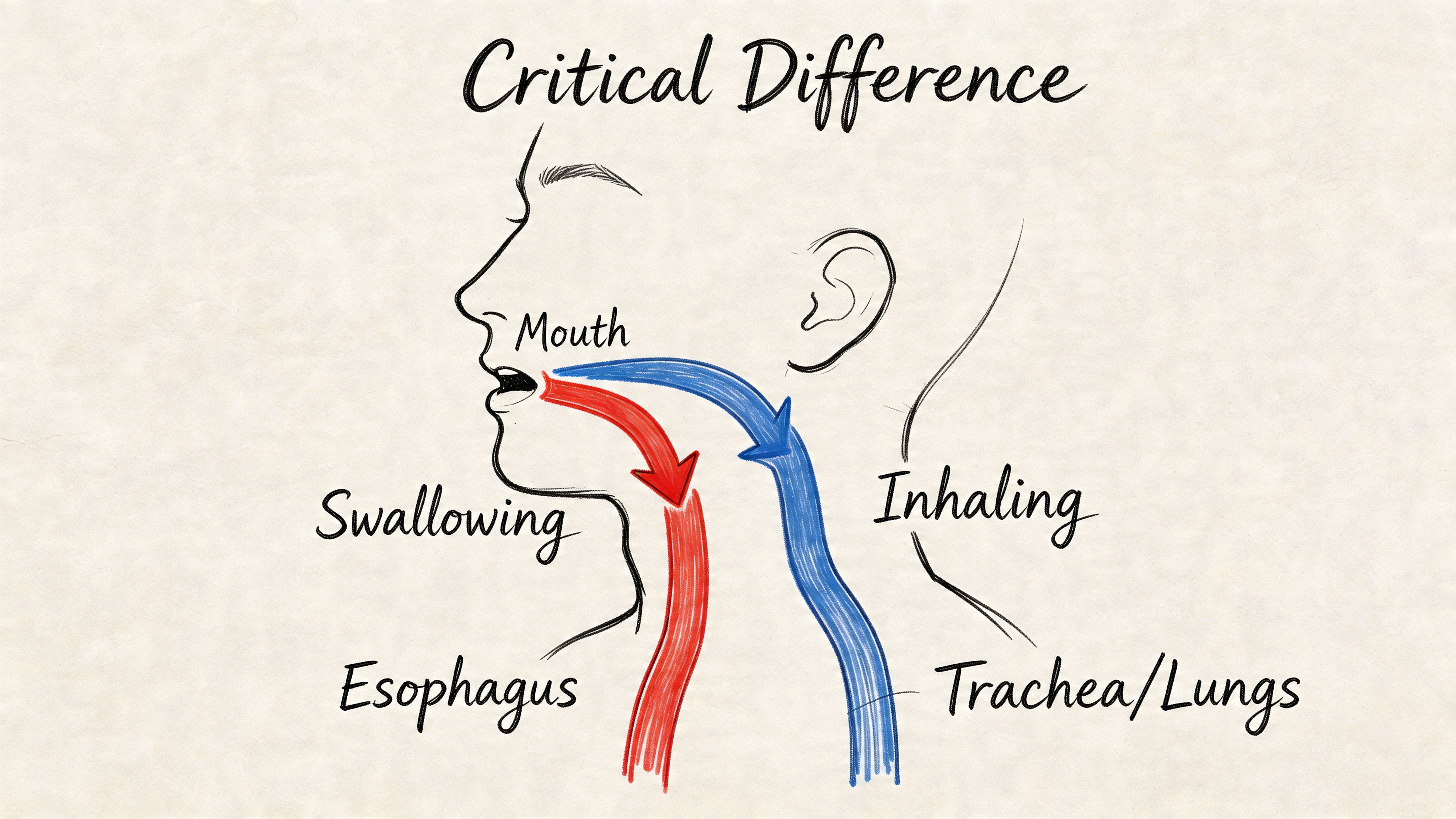
These are two different events with very different implications. Swallowing sends material into the esophagus and then the stomach. Inhaling sends material toward the trachea and lungs.
Why aspiration is more concerning
A frequently unaddressed question is what happens if a fly is inhaled. Persistent coughing after such an event demands medical evaluation to rule out aspiration pneumonia or bronchial obstruction, which may require bronchoscopy, as noted in this discussion of inhaling rather than swallowing a fly.
The body does have a defense. It coughs. A strong cough may expel the material immediately. If that doesn't happen, a fragment can remain in the airway and continue to irritate the lungs.
Who needs lower thresholds for evaluation
Children often can't describe the event clearly. Older adults may have swallowing difficulties. People with asthma may react strongly to airway irritation even when the foreign material is small.
If the concern is aspiration rather than digestion, a same-day medical assessment is sensible. Clinics that handle Foreign Body Removal can help people understand when simple observation is enough and when airway evaluation is needed.
I also discuss unusual insect-related oral and airway concerns in a separate post on bugs in your teeth, because where the insect ends up matters more than the insect itself.
A swallowed fly usually goes away. An inhaled fly may keep announcing its presence through cough, wheeze, or shortness of breath.
A Forensic Pathologist's Perspective on Insect Ingestion
In forensic practice, context is everything. A single swallowed fly almost never becomes the central issue in a death investigation. Most of the time, there is no lasting consequence and nothing to find.
Incidental finding versus meaningful finding
That distinction matters because background insect exposure is common. As noted earlier in public discussions of FDA-permitted insect fragments in food, the average person in the United States unintentionally consumes about one pound of insects annually, and that context can help distinguish normal exposure from a specific health-impacting event.
In an autopsy, I don't assume that the mere presence of insect material means harm. I look at whether the finding fits the medical story, the scene, the symptoms before death, and the pathology. That is part of the discipline of what a forensic pathologist does.
When insect-related findings can matter
There are rare situations in which insect ingestion or aspiration becomes relevant. A vulnerable person with severe infection, a child with an unrecognized airway event, or a neglect concern in a care setting may require a more careful review.
For families and attorneys, two definitions are useful:
- Cause of death: The disease or injury that started the fatal sequence.
- Manner of death: The broader classification, such as natural, accident, suicide, homicide, or undetermined.
- Chain of custody: The documented handling of evidence so that its identity and integrity can be verified.
A careful postmortem examination can help determine whether an insect-related issue contributed to death or was incidental. That distinction can affect family understanding, civil review, and, in some cases, legal accountability.
Frequently Asked Questions for Families and Professionals
Are some flies more dangerous than others
From a practical standpoint, the concern is less about the species name and more about where the insect has been before it landed on food. A fly moving between waste and food presents a contamination concern. A one-time swallowed fly still usually causes no serious problem, but unsanitary environments increase concern.
Could swallowing a fly cause a death that is mistaken for natural causes
Usually, no. In most cases, it would not be a fatal event. The main exceptions involve complications such as severe infection in a vulnerable person or aspiration into the airway rather than simple swallowing. Those are uncommon scenarios, but they are the kinds of details that matter in a careful cause of death investigation.
What should I do if I suspect neglect involving insects at a care facility
Document what you observed, preserve photographs if lawfully obtained, and note dates, times, and who was present. If a death has occurred, an independent autopsy may help assess whether findings are incidental environmental issues or part of a larger pattern of neglect. That review should be objective and medically grounded.
Can an autopsy tell whether an insect was swallowed or inhaled
Sometimes, yes. Airway findings, lung changes, and the location of foreign material can help distinguish aspiration from ingestion. The answer depends on the condition of the body, the timing of the event, and whether there is supporting scene or medical information.
Does swallowing one fly mean I need testing
Not usually. Testing is generally not needed after a single swallowed fly if an individual remains well. Testing becomes more relevant when symptoms develop, especially gastrointestinal symptoms or signs of airway involvement.
If you're dealing with a sudden death, an unusual airway concern, or questions about whether an overlooked event contributed to a loved one's death, careful independent review can provide clarity that routine explanations sometimes miss.
If you need clear answers after an unexpected death, or you want a second opinion grounded in careful forensic analysis, Texas Autopsy Services can help you understand the findings with precision, dignity, and respect.