April 20, 2026 · Texas Autopsy Services
Why Coroners Are Elected in America
Discover why are coroners elected, how they differ from medical examiners, and what it means for families seeking answers about cause of death.
On this page
- The Elected Coroner on Your Texas Ballot
- Coroner Versus Medical Examiner: What's the Difference?
- How Local Politics Shapes Death Investigations
- The Impact on Cause of Death Accuracy
- When a Private Autopsy Provides Critical Answers
- A Compassionate Path to Finding the Truth
- Your Questions About Coroners and Autopsies, Answered
As a board-certified forensic pathologist, I often explain a surprising fact about death investigation in many parts of the country.# Why Are Coroners Elected in Texas
As a forensic pathologist, people are often shocked when I tell them how we handle death investigations in many parts of the country. Here in Texas and across much of the United States, the person in charge of figuring out how and why someone died is often elected by popular vote. It’s a system born from a classic American ideal: local control and accountability.
The Elected Coroner on Your Texas Ballot
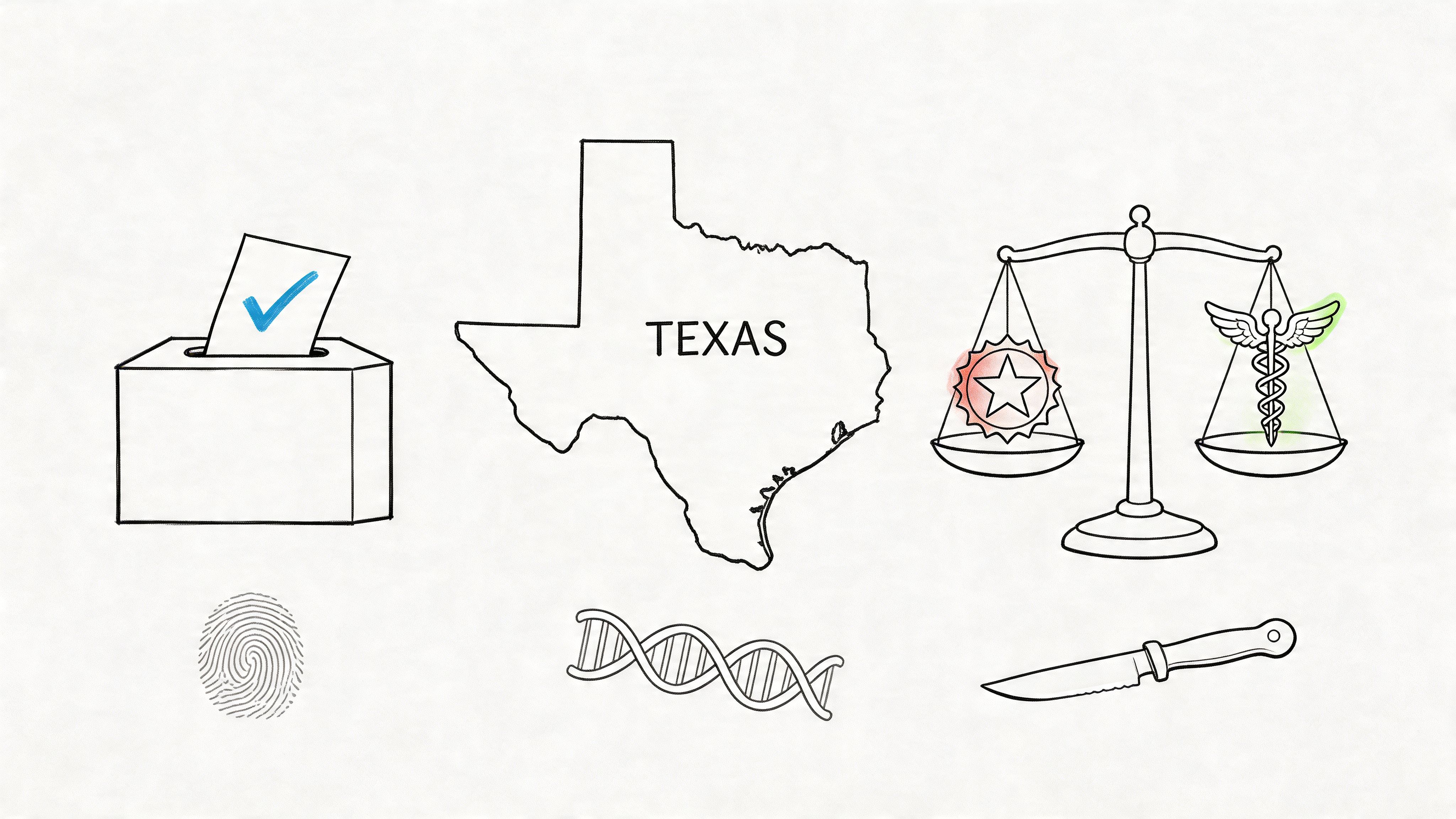
When you step into the voting booth and see a line for "coroner" or "justice of the peace," you're looking at a position with a surprisingly deep and tangled history. The whole idea was to put a local, publicly accountable person in charge of these incredibly sensitive investigations. The community gets to decide who they trust for the job.
A Tradition with Medieval Roots
This system isn't an American invention; we inherited it from old English law, and its origins are, believe it or not, all about money. The practice traces back to 1194, when King Richard the Lionhearted created the office to stop his sheriffs from pocketing death taxes that belonged to the crown.
These officials were called "crowner's representatives," and their job was to investigate sudden deaths to protect the king’s financial interests. When settlers came to the American colonies, they brought this system with them. While the first recorded coroner election in the U.S. was in Plymouth Colony in 1636, most positions were appointed until the 19th century. If you're interested in the messy politics behind it all, you can find more research on coroner elections and death statistics.
Accountability Through the Ballot Box
At its heart, the argument for an elected coroner is all about direct, democratic control. In theory, it forces the officeholder to be responsive to the community they serve. Voters get to hire and fire the person responsible for investigating deaths in their county.
This approach is built on a few core principles:
- Local Control: It keeps a vital government function in the hands of the county and its residents, not some distant state or federal agency.
- Public Accountability: Elected officials have to answer directly to voters. That can be a powerful motivator to do the job right.
- Accessibility: People often feel an elected official is easier to approach and talk to than an appointed bureaucrat buried in a government building.
While the system is steeped in history and a desire for local governance, we need to look at how it works in the real world today. My goal here is to walk you through this historical framework and show you what it actually means for families, attorneys, and the integrity of a cause of death investigation.
Coroner Versus Medical Examiner: What's the Difference?
When a loved one dies unexpectedly, the last thing you want is confusion about who's in charge. But depending on where you live, the official responsible for investigating the death could be an elected coroner or an appointed medical examiner. From my experience as a forensic pathologist, these two roles are worlds apart, and understanding that difference is critical for families navigating the legal and emotional aftermath.
At its core, the distinction is simple. A coroner is typically an elected official. Their main qualification is winning a vote, and in many places including parts of Texas they aren't required to have any medical training. On the other hand, a medical examiner is a physician, usually a board-certified forensic pathologist like me, who is hired based on their scientific expertise.
How They Get the Job and What They Need to Know
The biggest split between these two systems comes down to selection and qualifications. One is a political path, the other a medical one.
This creates a huge gap in the expertise required for the job.
- An elected coroner often just needs to meet basic requirements like age, residency, and a clean record. Their role is primarily administrative they are a public servant first and foremost.
- An appointed medical examiner must be a licensed physician. More than that, they are expected to have years of specialized training in forensic pathology, earning board certification from an organization like the American Board of Pathology. Their role is purely scientific.
This might seem strange, but the coroner's role was never designed to be a medical one. Its roots go back to medieval England, where the "crown-er" was tasked with protecting the king's financial interests in the property of the deceased.
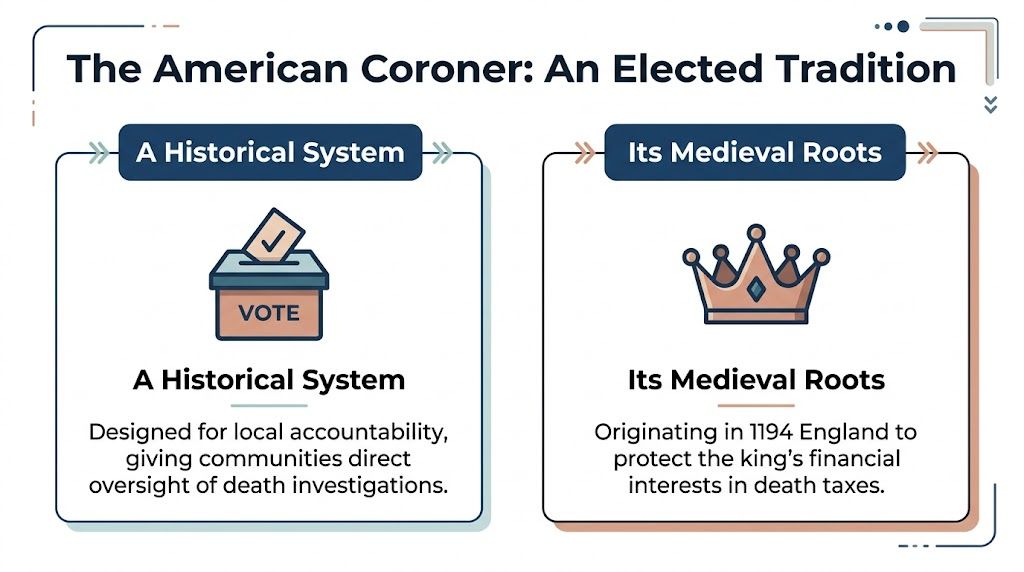
As you can see, the job was about government administration and local accountability, a tradition that carried over to the U.S. The idea of electing a coroner is a holdover from that time. The modern medical examiner system was created much later, specifically to bring medical science into death investigation. You can dig deeper into the difference between a coroner and a medical examiner to learn more about this history.
To put it simply, the coroner system is built on a foundation of political accountability, while the medical examiner system is built on medical and scientific expertise. That's the real reason why coroners are still elected today it's a tradition of democratic oversight.
Coroner vs. Medical Examiner At a Glance
To make the contrast even clearer, here’s a straightforward table breaking down the two systems that manage death investigations across the United States.
| Attribute | Elected Coroner | Appointed Medical Examiner |
|---|---|---|
| Selection | Elected by voters in a county. | Appointed by government officials. |
| Qualifications | Varies by state; medical degree often not required. | Must be a licensed physician, usually a board-certified forensic pathologist. |
| Primary Duty | Administrative oversight; determines if an autopsy is needed. | Performs autopsies and scientifically determines the cause and manner of death. |
| System Type | Found in many rural and mid-sized counties, including in Texas. | Common in major metropolitan areas and statewide systems. |
What this means in practice is that a coroner who isn't a doctor can't perform an autopsy. They have to decide if one is needed and then hire an outside forensic pathologist to do the work. This adds another step and potential for miscommunication.
A medical examiner, however, holds both the administrative authority and the scientific skill. We don't just order the autopsy we are the experts who perform it, ensuring a seamless investigation from start to finish.
How Local Politics Shapes Death Investigations
As a forensic pathologist, my world is one of science and medicine. But to understand why the elected coroner system is still so common, you have to look beyond the lab and into the world of local politics. These coroner elections are what’s known as “down-ballot” races they’re buried so far down the ballot that most voters barely notice them.
This lack of attention often means the person already in office can run unopposed, election after election, keeping the old system in place without much public discussion. The tradition is held up by a mix of habit and a deep-seated belief in local control, a value that runs strong in many communities, especially here in Texas. It boils down to the simple idea that local folks should be in charge of local matters.
The Partisan Nature of a Scientific Role
Here’s where it gets complicated: in many counties, coroner elections are partisan. Candidates run as Republicans, Democrats, or other party affiliates, and their success often just mirrors the county’s general political leaning. A person’s party has absolutely nothing to do with the scientific reality of a death investigation, yet it can be the single biggest factor in who gets the job.
This injects politics into a role that should be purely scientific. A candidate's skill at fundraising, giving speeches, and winning over a political base suddenly becomes more important than their medical background. It’s easy to see how the most qualified person for the job might not be the one who actually wins the election.
Why the System Endures
There’s a reason the elected coroner model holds on so tightly in certain regions. It’s deeply rooted in many areas where local independence is a core value. And because so few voters pay attention to these races, incumbents have a huge advantage. In fact, it's not unusual for coroners to run unopposed 80% of the time.
Election analyst Matthew Isbell pointed out the irony here: a system once created to protect a king’s financial interests now survives because of a local democratic impulse. More than 1,200 counties, mostly in the South and Midwest, still vote for their coroners. As you can read in this analysis of why voters still elect coroners on rockinst.org, many people casting those votes aren't even aware of what they're voting for, particularly in low-turnout, off-year elections.
The core issue is that the skills needed to win an election political campaigning and public appeal are entirely different from the skills needed to conduct a death investigation, which demand scientific rigor, medical knowledge, and impartiality.
This political reality helps explain why a system with obvious scientific blind spots is still so common. It also highlights something critical for families and attorneys: the public system in your area might have built-in limitations. Understanding this is the first step toward knowing when you need an independent, expert-driven investigation.
For a closer look at the medical side of this divide, our guide on the role of a medical examiner in Texas is a great resource. This is precisely why services like private autopsies exist to offer a purely scientific, unbiased alternative when the political nature of a public office leaves critical questions unanswered.
The Impact on Cause of Death Accuracy
This is where the difference between an elected coroner and an appointed medical examiner really hits home. As a board-certified forensic pathologist, my entire profession is built on a foundation of scientific evidence. Determining an accurate cause of death isn't a guessing game; it’s a rigorous process of interpreting complex medical clues.
Frankly, this isn't something you can just learn on the job. Without deep medical training, crucial details get missed. An investigator who isn’t a doctor might overlook the subtle cardiac tissue damage from a silent heart attack or misread a toxicology report. They could easily mistake the signs of a rare disease for something more common, relying more on the circumstances of the death than the hard science. The result is often a conclusion that seems plausible but is ultimately unproven.
The Problem of Incomplete Data
The fallout from these gaps in expertise extends far beyond one family’s search for answers. While the idea behind having elected coroners in 20 U.S. states (covering nearly 1,300 counties) is to ensure local accountability, it creates a dangerous inconsistency in how deaths are investigated.
Consider this: 2021 data from the U.S. Department of Justice shows that offices run by elected coroners perform a full autopsy in only 20% of their cases. In medical examiner systems, that figure jumps to 45%. This discrepancy is explored in-depth in a fantastic article on how politics and death statistics intersect.
When autopsies aren't performed, we’re essentially flying blind.
- Public Health Crises Go Unseen: How can we track new viral outbreaks, identify environmental toxins in a community, or understand the true scope of the opioid epidemic without accurate data from autopsies?
- National Statistics Become Unreliable: Every death certificate feeds into our national health data. If the cause of death is wrong, the entire dataset is flawed.
- Justice Isn't Served: Homicides can be mislabeled as accidents, and natural deaths can be wrongly flagged as suspicious, triggering costly and needless criminal investigations.
Often, the decision to skip an autopsy comes down to money, especially in smaller counties with tight budgets. But the long-term cost of getting the cause of death wrong is always higher. We go into more detail on this in our guide to how a cause of death is determined for a death certificate.
What This Means for Families
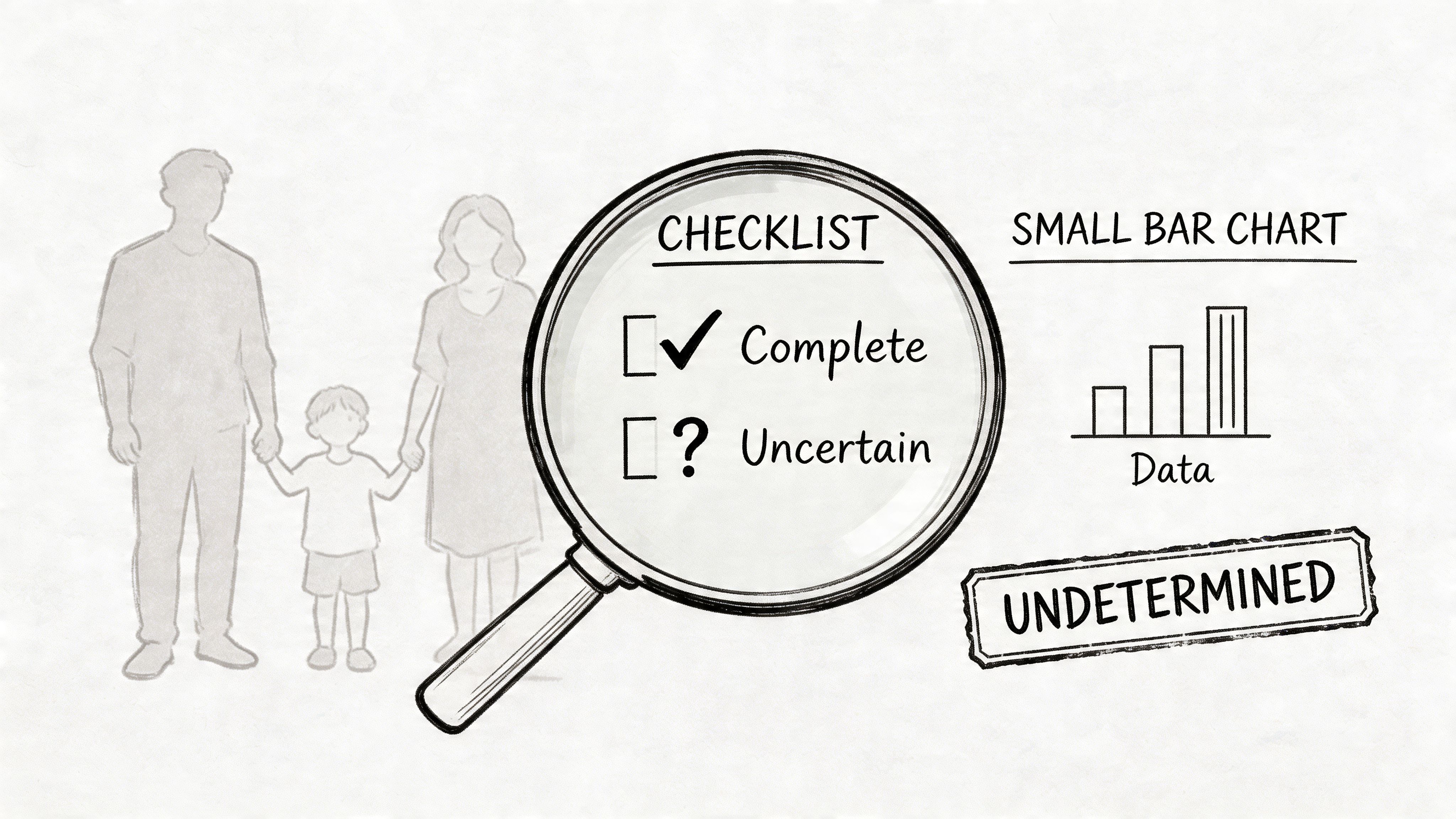
At the end of the day, these systemic problems land squarely on the shoulders of grieving families. When you lose someone, you deserve nothing less than clear, definitive answers. An "undetermined" cause of death, or a ruling that just doesn't make sense, leaves a wound that can't heal.
For a family, an accurate cause of death isn't just a line on a form. It's the final chapter of a life story. It can affect insurance claims, inheritance, and the ability to grieve and move forward with peace of mind.
This is precisely why a second, independent opinion can be so powerful. A private autopsy conducted by a board-certified forensic pathologist provides a path to clarity. It’s a chance to have a medical expert review all the evidence with scientific precision, away from the political and administrative pressures that can cloud a public investigation.
It's about making sure the final answer is based on medicine, not circumstance.
When a Private Autopsy Provides Critical Answers
It’s a terrible feeling when a public death investigation leaves you with more questions than answers. Whether it’s an elected coroner or an appointed medical examiner, sometimes the official conclusion just doesn’t sit right. It might feel incomplete, or worse, it might contradict everything you knew about your loved one.
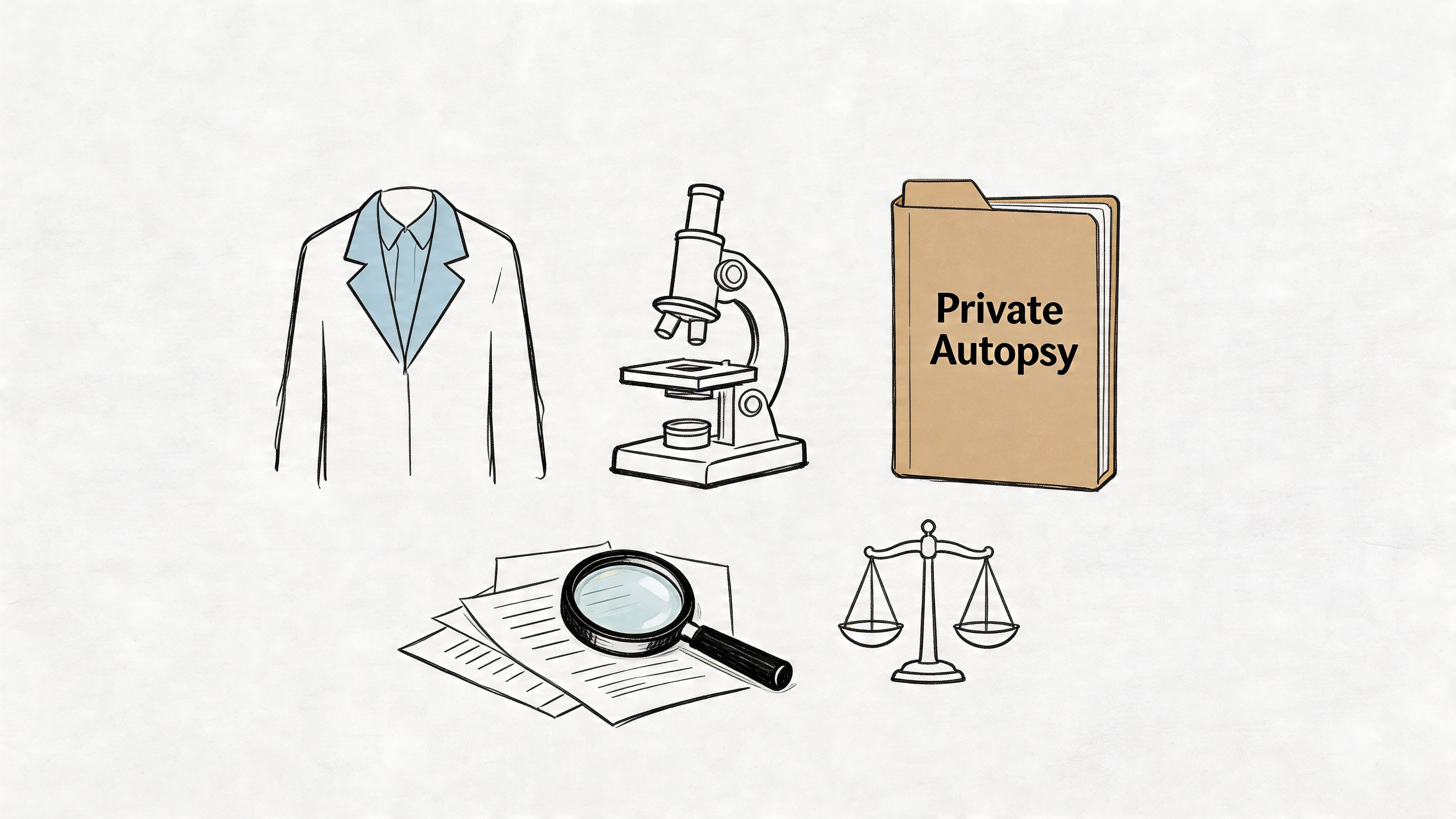
This is the exact moment when an independent, private autopsy can provide the clarity you need. As a forensic pathologist, I’ve met with many families in this exact situation. They come to me holding a death certificate that reads "undetermined," or they just have a gut feeling that the official story is missing a critical piece of the puzzle. A private autopsy gives them a way to find real answers a completely independent, scientific review of the evidence, free from the red tape or potential biases of a government office.
When a Second Look Is Absolutely Necessary
Lingering doubt is more than just unsettling; it can prevent a family from ever truly finding peace. For attorneys, that same doubt can stop a valid legal case in its tracks. Certain situations almost always call for considering a private autopsy.
- An "Undetermined" Cause of Death: This is basically the system saying, "We don't know." A private autopsy conducted by a board-certified forensic pathologist can re-examine everything, often spotting subtle clues that were missed the first time around.
- Suspected Medical Malpractice: If a loved one died during or right after a medical procedure and you're worried about the quality of care, a private autopsy is the only way to get an impartial medical investigation into what truly happened.
- Workplace or Environmental Dangers: Did the death happen after potential exposure to toxins or unsafe conditions on the job? A specialized forensic exam can deliver the hard science needed to prove it and take legal action.
These cases demand a level of detail and expertise that a busy, resource-strapped public office may not be able to provide. Knowing that many coroners are elected officials without medical backgrounds only makes these concerns more urgent.
The Power of an Independent Review
A private autopsy isn't just a "second opinion." It’s a completely fresh investigation with one mission: to find the medical truth. I work for the family or their lawyer, not for a government agency. That independence is everything.
A private autopsy provides an objective, scientific counter-narrative when the official one falls short. It removes doubt by replacing it with verifiable medical facts, ensuring the final record is accurate and complete.
The process is thorough. We re-evaluate every single piece of information medical records, scene reports, witness statements. But the most important part is the physical examination itself, performed with the meticulous care that only a trained forensic pathologist can bring. It’s all about connecting the dots to build a clear and defensible cause of death investigation.
Finding Clarity for Families and Attorneys
For families, the most important outcome is closure. Finally knowing what happened can be the first step toward grieving and healing. It’s also crucial for sorting out practical matters like life insurance policies or survivor benefits, which can be frozen by an ambiguous death certificate.
For attorneys, a private autopsy report from an expert is irrefutable evidence. In cases involving wrongful death, medical malpractice, or personal injury claims, my findings can forge the undeniable link between an action and the death that followed. It can be the one thing that makes all the difference in getting justice for a client. Whether I’m working directly for a family or providing expertise for county forensic autopsies, the goal is always the same: deliver clear, scientifically sound answers.
A Compassionate Path to Finding the Truth
Losing a loved one is hard enough. But when you’re also left with unanswered questions about how they died, the grief can feel impossible. The American system for death investigation, a patchwork of elected coroners and appointed medical examiners, is a product of history and a preference for local control. It’s a system I know well.
As a forensic pathologist, I've seen firsthand how the tradition of an elected coroner rooted in the idea of public accountability can sometimes leave families without the definitive, science-based answers they so desperately need. My goal here isn't to push for political change. It's to give you the information you need to find those answers for yourself. My commitment, as our forensic pathology team, is to uncover the truth through science, always with the utmost respect for the person who has passed and the family they left behind.
When the Official Answer Isn't Enough
The simple truth is that some death investigation systems are more scientifically rigorous than others. An elected official, however well-meaning, might not have the years of specialized medical training needed to identify a subtle or complex cause of death. When that happens, an independent second opinion autopsy isn't just another option it can be a crucial step toward finding peace.
This is especially true in situations where:
- The official cause of death is vague, listed as "undetermined."
- You have suspicions of medical malpractice or negligence.
- Your gut feeling and personal knowledge of your loved one just don't line up with the official report.
Choosing a private examination with a board-certified forensic pathologist like me means the investigation is driven purely by medical evidence, free from any political or administrative pressures. My only focus is to deliver a clear, accurate, and scientifically sound cause of death. Often, this rigorous approach uncovers critical details that were missed the first time around.
The goal is to replace uncertainty with fact. A compassionate, scientifically sound investigation provides families with the final, crucial chapter in their loved one's story, allowing them to grieve with the full and honest truth.
You Don't Have to Search for Answers Alone
If you’re facing a wall of unanswered questions after a loss, please know you aren’t on your own. This is a difficult and painful road to walk, but expert guidance is available to help you find the clarity you deserve.
I founded Texas Autopsy Services on a simple principle: every family deserves closure that is based on scientific certainty and handled with dignity. Your search for the truth is important, and support is here to help you find it.
Your Questions About Coroners and Autopsies, Answered
When a loved one passes away, the investigation process can feel overwhelming and confusing. As a forensic pathologist, I've spoken with countless families and attorneys who just want clear, straightforward answers.
Here are some of the most common questions I'm asked, along with the answers you and your family deserve.
Can We Get a Private Autopsy if a Death Certificate Has Already Been Issued?
Absolutely, yes. It's a common misconception that a death certificate is the final, unchangeable word. The truth is, a death certificate can and should be amended if new, significant information comes to light.
This is especially relevant in counties where an elected coroner or justice of the peace issues a ruling without a full autopsy. A private autopsy conducted by a forensic pathologist often provides the concrete, scientific evidence needed for a more accurate cause of death. If my examination reveals new findings, I prepare a detailed report that you can use to formally petition for an amendment. It’s all about ensuring the official record is as accurate as possible.
How Is a Coroner's Ruling Different From a Medical Examiner's Finding?
This is a crucial distinction. The main difference comes down to medical expertise versus administrative process.
An elected coroner, who often isn't a doctor, typically makes a ruling based on information gathered from the scene and by law enforcement. It's an educated guess based on the available circumstances.
A medical examiner's finding, on the other hand, is a medical diagnosis. As a forensic pathologist, I arrive at my conclusions after a comprehensive physical examination, toxicology tests, and a deep dive into the person's medical history. One is a judgment call; the other is a scientific determination.
A coroner’s ruling often answers "what likely happened," while a medical examiner’s finding answers "what did happen" on a physiological level. This is a critical distinction, especially when legal or insurance matters are involved.
What Is the Difference Between Cause and Manner of Death?
People often use these terms interchangeably, but in my field, they mean very different things.
Cause of Death: This is the specific medical reason a person is no longer alive. Think of it as the direct culprit. Examples include a "gunshot wound to the chest" or an "acute myocardial infarction" (the clinical term for a major heart attack). It's a purely medical fact.
Manner of Death: This is the legal classification of the death based on the circumstances. There are only five options: natural, accident, suicide, homicide, and undetermined. This determination considers the cause of death and the events that led to it.
A forensic pathologist’s job is to establish the medical cause. That information then allows the certifying official to determine the correct manner of death.
What Does a Private Autopsy Cost in Texas?
I know that when you're dealing with a loss, the last thing you need is financial surprises. That's why I believe in being completely transparent about costs.
The price of a private autopsy can change based on how complex the case is, whether extensive testing like toxicology is needed, and transportation logistics. At Texas Autopsy Services, we provide a clear, all-inclusive price. A complete private autopsy, which covers the full examination, standard testing, and the final detailed report, typically costs between $4,000 and $6,000.
For a precise quote tailored to your situation, the best step is to contact our office. We can provide a confidential consultation and answer any questions you have.
If you're looking for clarity or a second opinion on a loved one's death, I am here to help. Please feel free to call Texas Autopsy Services at (806) 230-1889 for a compassionate and confidential discussion. You can also find more information at https://www.texasautopsyservices.com.