June 2, 2026 · Texas Autopsy Services
I Swallowed a Fly: Pathologist Explains Risks
Worried because i swallowed a fly? A pathologist explains immediate risks, aspiration, and infection. Learn when to see a doctor and get the facts for 2026.
On this page
- Most people who swallow a fly are fine. If the insect went down the esophagus, it's usually digested like other food.
- The real concern is aspiration, not swallowing. If the fly enters the trachea below the vocal cords, coughing and airway irritation can follow.
- Watch symptoms, not the story itself. Ongoing coughing, wheezing, breathing difficulty, or a stuck sensation deserve medical evaluation.
- Infection is possible but usually not the main issue. Flies can carry bacteria on their bodies, so diarrhea, fever, or stomach cramps in the following days matter more than the swallowed insect.
- From a forensic standpoint, insects matter in a very different way. In death investigation, insect activity can help pathologists reconstruct timing and circumstances.
A fly hits the back of your throat when you're talking outside, jogging, riding a bike, or mowing the yard. You cough, grimace, swallow, and then the thought lands a second later: I swallowed a fly.
That reaction is common. It feels unpleasant, but in most cases it isn't dangerous.
At Texas Autopsy Services, every examination is performed by a board-certified forensic pathologist experienced in medicolegal death investigations. Our work centers on one principle: follow the evidence carefully, explain it plainly, and treat the deceased and their family with respect.
People usually ask this question because they feel alarmed by the idea of an insect in the body. That's understandable. The reassuring part is that the human body is built to handle many accidental ingestions. The more important task is separating a routine swallow from an airway event.
A Common Accident From a Pathologist's Perspective
I've found that people don't need drama when they ask about swallowing a fly. They need a calm explanation of what likely happened inside the throat and what signs would suggest a real problem.
The first point is simple. A swallowed fly is usually a stomach issue only in theory, not in practice. Most of the time, it becomes no more medically significant than any other small bit of material you accidentally swallowed while eating or breathing through an open mouth outdoors.
That doesn't mean the body ignores it. The throat is sensitive, and the brain reacts quickly to unexpected contact there. A brief gag, cough, or tightening sensation is common. People often interpret that moment as proof the insect is still stuck, when in fact the event may already be over.
Why a pathologist cares about the distinction
Forensic pathology is built on mechanism. We ask what happened, where it happened in the body, and whether the findings fit the history. That same framework applies here.
If a fly enters the digestive tract, the body handles it one way. If it enters the airway, the body reacts very differently. The distinction sounds minor, but medically it matters a great deal.
Clinical perspective: The unpleasantness of swallowing a fly usually exceeds the medical danger.
There is also an interesting cultural layer to this question. The nursery rhyme "There Was an Old Lady Who Swallowed a Fly" became widely recognizable in the modern era, appearing in Dorothy B. King's Happy Recollections in 1946, being formally published in 1947, and recorded by Burl Ives in 1953, a progression outlined in the song's publication history. That helps explain why the phrase remains so familiar in English-speaking households.
What works and what doesn't
A practical response works better than panic.
- What helps: Pause, breathe through the nose, sip water if you're comfortable, and pay attention to whether symptoms are already resolving.
- What doesn't: Repeated forceful swallowing, frantic throat clearing, or assuming that disgust equals danger.
- What matters most: Persistent airway symptoms after the initial event.
Swallowing vs Aspiration The Body's Two Critical Paths
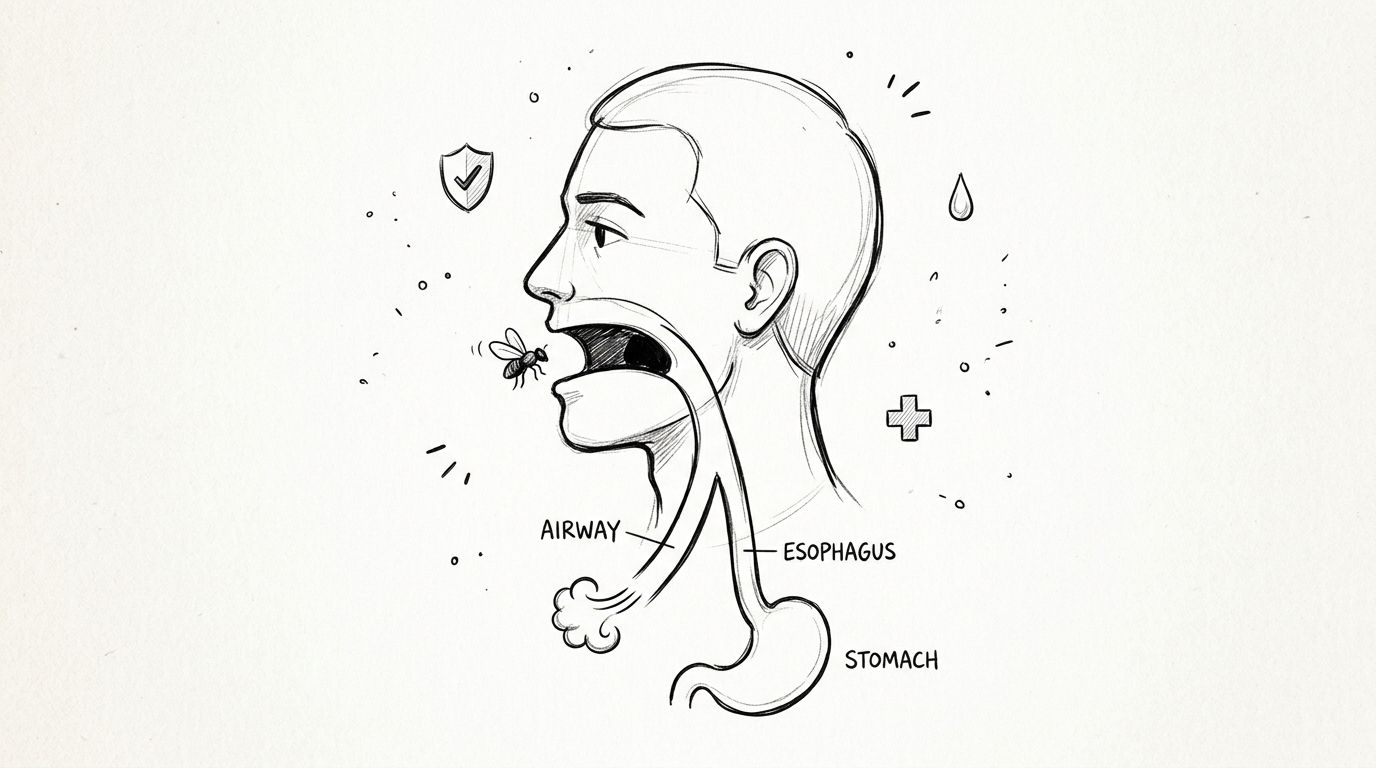
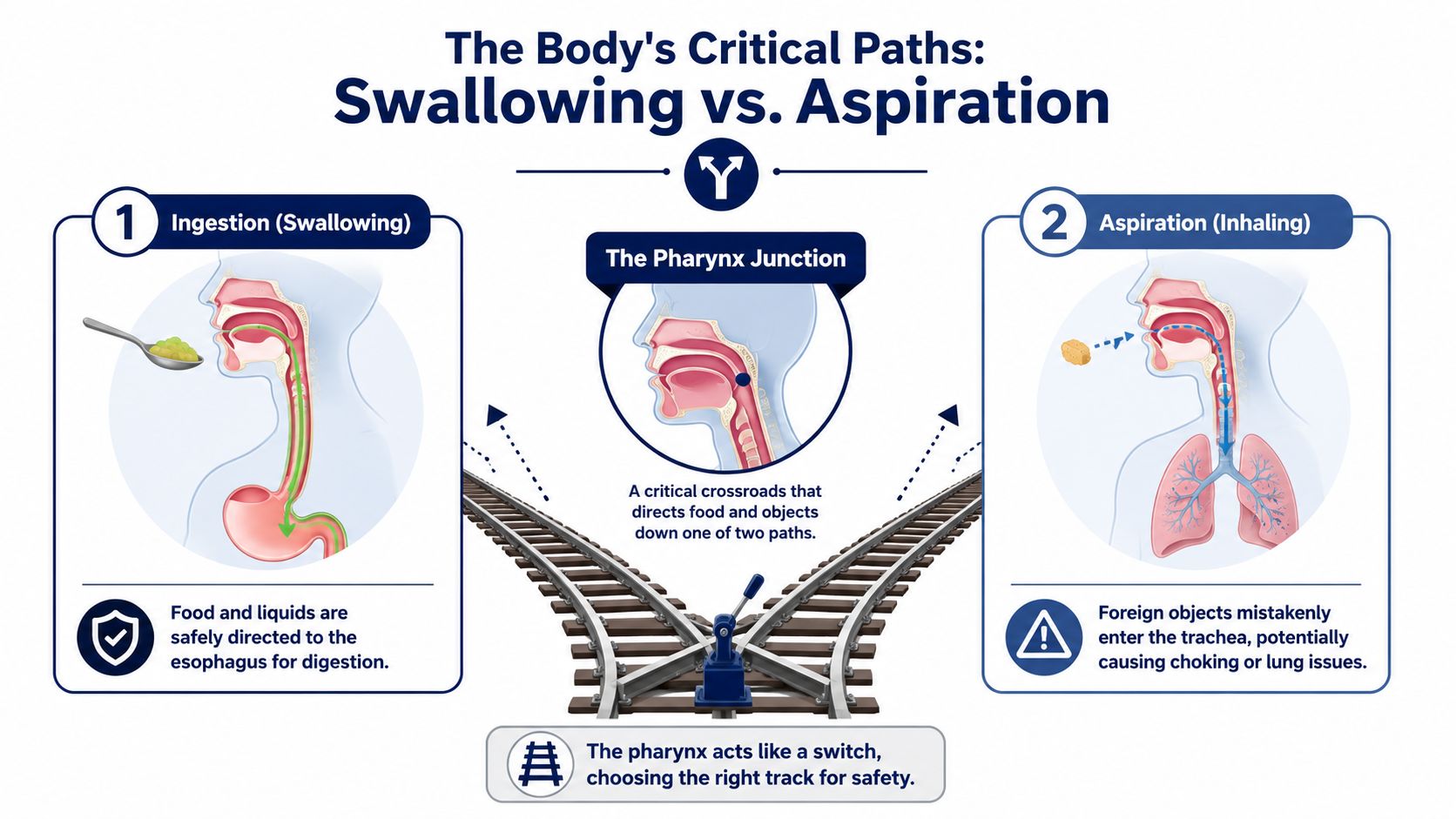
The throat functions like a shared corridor with two paths. One path leads to the esophagus, which carries food and liquid to the stomach. The other leads to the trachea, which carries air to the lungs.
When people say, "I swallowed a fly," they may mean one of two very different things. They either ingested it, or they aspirated it.
When the fly goes down the esophagus
If the insect entered the esophagus, the event is usually low risk. As explained in this overview of what happens when you swallow a fly, the insect most often passes into the esophagus and is digested like other food.
That outcome is the one commonly experienced.
A person may still feel a brief scratchy sensation in the throat afterward. That does not necessarily mean the fly is physically lodged there. It often reflects temporary irritation from the contact, coughing, or dry mucosa.
When the fly enters the trachea
Aspiration means the material went into the airway instead. This is the more important concern. The same source notes that the technical problem is aspiration into the trachea below the vocal cords, where coughing or mucus trapping may occur and persistent airway irritation warrants medical evaluation.
The body has protective systems to prevent that. During swallowing, the structures of the throat coordinate to guide material away from the airway. Usually they do their job. When timing fails, even briefly, the airway reacts immediately.
The body is generally better at protecting the lungs than the stomach. That's why aspiration usually announces itself right away.
A practical comparison
| Path | Where it goes | Usual body response | Typical concern |
|---|---|---|---|
| Swallowing | Esophagus to stomach | Brief discomfort, then resolution | Usually minimal |
| Aspiration | Trachea toward lungs | Coughing, sputtering, airway irritation | Needs closer attention |
People often know which one happened from the first few seconds. A true airway event tends to trigger forceful coughing or a clear sense that breathing became disrupted. A routine swallow is usually followed by disgust, not respiratory distress.
Immediate Symptoms and When to Seek Medical Care
Most readers don't need an elaborate checklist. They need a simple triage approach.
If the event is over and you feel normal, observation is usually enough. If you're still coughing or feel short of breath, the situation deserves more respect.
What a mild event usually looks like
A routine accidental swallow often includes one or more of these short-lived reactions:
- A brief gag reflex: The throat doesn't like surprise contact.
- Momentary coughing: This can happen even when nothing entered the lungs.
- An odd sensation afterward: Many people describe a "tickle" or scratchy feeling for a short time.
If those symptoms settle quickly, that pattern is reassuring.
Red flags that deserve prompt medical attention
The concern rises when symptoms suggest aspiration or significant airway irritation.
- Persistent coughing: Ongoing coughing after the initial event may mean the airway is still irritated.
- Wheezing or noisy breathing: That can signal lower airway involvement.
- Shortness of breath: Breathing difficulty is not something to watch casually at home.
- A stuck sensation in the throat or chest: This matters most when it persists rather than fading.
- Visible distress or reduced alertness: If someone is struggling to breathe or becoming less responsive, severity matters more than the original cause. In emergency settings, clinicians often track responsiveness with tools such as the Glasgow Coma Scale or GCS.
Immediate rule: If breathing is impaired, stop thinking about the fly and seek urgent care.
Children follow the same basic physiology, but adults should watch them more closely because they may describe symptoms poorly. If a child continues coughing, refuses to drink, or seems frightened by breathing, get medical help.
For a broader plain-language explanation of bug ingestion, I've also covered this topic in what happens if you swallow a bug.
Understanding the Risk of Infection and Disease
What unsettles many people isn't just the swallow itself. It's the thought that flies land on contaminated surfaces and then end up in the mouth.
That concern has a real scientific basis, but it needs context.
What flies can carry
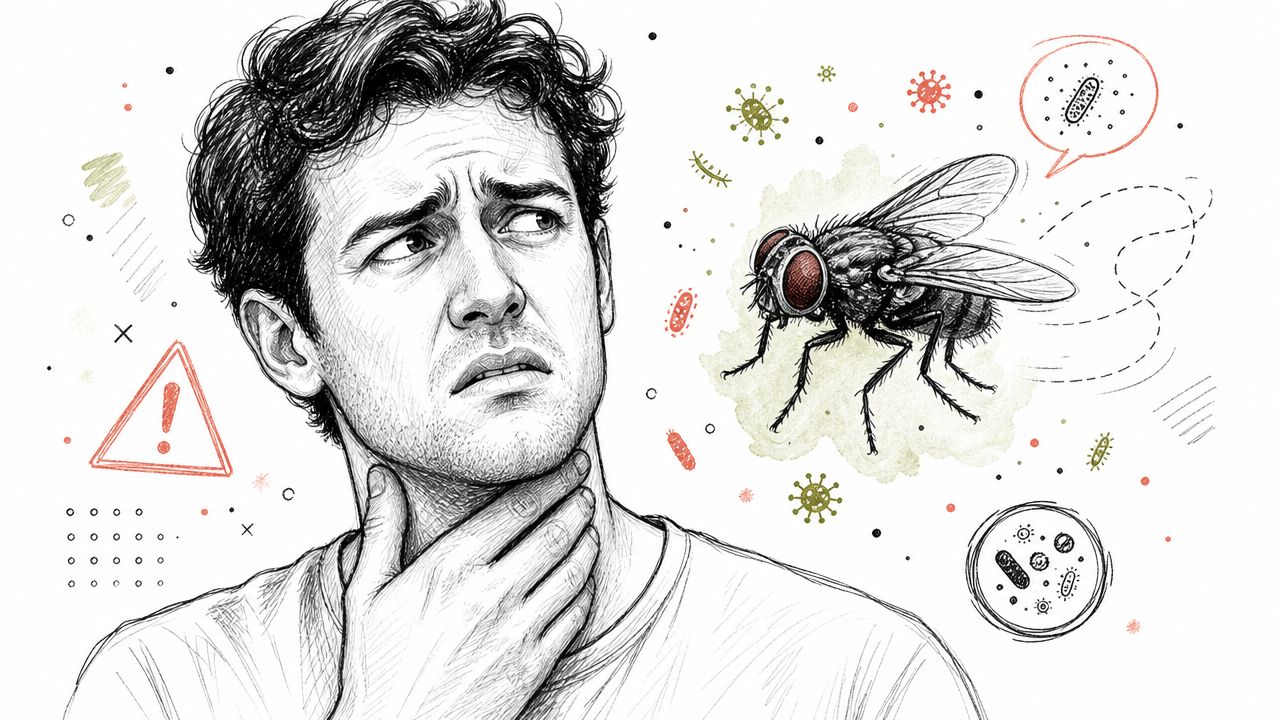
Flies can act as mechanical vectors for enteric pathogens. That means they can carry bacteria on their bodies from one place to another. According to Ohio State's discussion of swallowing a fly, houseflies can mechanically transmit Shigella, and infection can produce diarrhea, fever, and stomach cramps that typically resolve in about 5 to 7 days.
That doesn't mean every swallowed fly causes infection. It means the right way to think about risk is symptom-based, not fear-based.
What to monitor after the event
If someone becomes ill after swallowing a fly, the meaningful signals are gastrointestinal symptoms that develop afterward.
Watch for:
- Diarrhea
- Fever
- Stomach cramps
- A general sense of gastrointestinal illness
If those symptoms appear, a clinician can evaluate whether they fit a routine self-limited illness or something that needs closer attention.
A related question comes up with other insects too. Readers who want that comparison may find this discussion of whether you can eat a stink bug useful.
Why the stomach often limits the problem
The stomach is a harsh environment. In many everyday exposures, it serves as a barrier rather than a passive container. That is one reason a single accidental ingestion usually does not become a major medical event.
This short video offers a simple visual overview of the concern people usually have after the fact.
What doesn't work is assuming that any later upset stomach must have come from the fly. People often develop common gastrointestinal symptoms for unrelated reasons. What does work is paying attention to timing, severity, hydration, and whether symptoms are worsening rather than improving.
The Forensic Perspective When Insects Tell a Story
A living person who swallowed a fly and a decedent examined in a forensic setting are very different situations. Still, the common thread is that insects can carry information.
In my field, that information isn't about whether a fly was unpleasant. It's about whether insect activity helps explain time, environment, neglect, or postmortem change.
Insects in forensic pathology
When remains are examined, the presence and pattern of insect activity can become part of the larger investigative picture. This is the area people often know as forensic entomology.
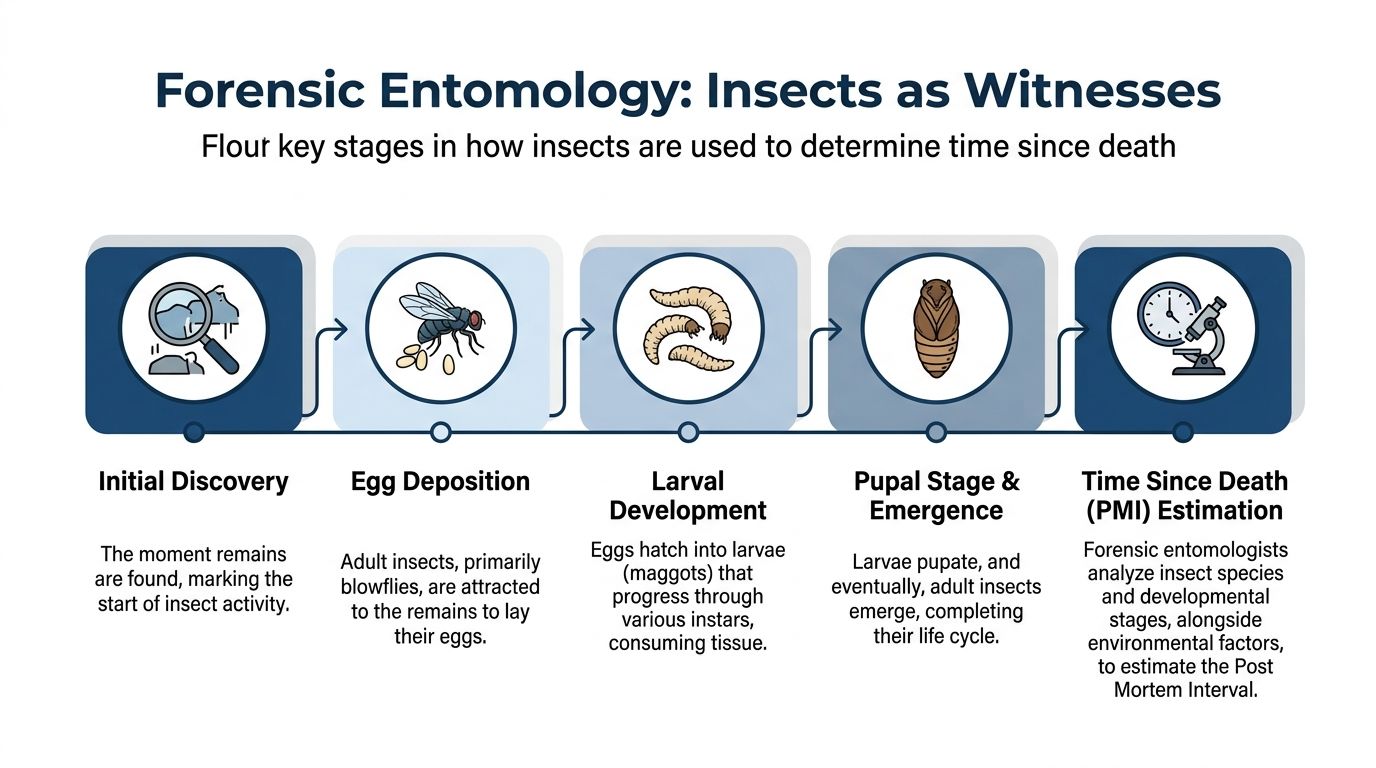
The key point is not that insects solve every case. They don't. The key point is that they can contribute useful observations when interpreted in context with the scene, the body, and the medical history.
At autopsy, context always matters. An insect finding by itself rarely answers the whole question. It may, however, support or challenge a reported timeline.
Why small details matter
Pathology is often a discipline of accumulation. One clue may mean little alone. Several clues together may become persuasive.
Examples include:
- Location of insect activity: Surface findings can differ from findings in protected areas of the body.
- Type of body changes present: These have to fit the reported timeline and environment.
- Condition of clothing and surroundings: The scene influences insect access.
- Associated medical findings: Injury, disease, decomposition, and environmental exposure must be interpreted together.
That same disciplined thinking is central to what a forensic pathologist does to find answers. The public often sees the final conclusion. The harder part is the method behind it.
In forensic work, details that seem minor to others may carry real evidentiary weight.
A related concept in the living
A separate issue is myiasis, which refers to infestation by fly larvae in living tissue. That is not what happens when someone accidentally swallows a fly during an outdoor activity. In clinical and forensic settings, myiasis raises different concerns, including wound care, hygiene, living conditions, and sometimes neglect.
That distinction matters. Casual ingestion is one thing. Evidence of infestation is another.
For families, attorneys, and agencies, this is why objectivity matters so much in a cause of death investigation. We don't force a dramatic interpretation onto every finding. We sort the ordinary from the meaningful.
Frequently Asked Questions
Can a fly survive in the stomach and lay eggs?
No. The common fear is understandable, but that scenario does not fit normal digestive conditions. A swallowed fly is handled as ingested material, not as a living occupant with room to reproduce.
Is this different for a child?
The basic medical issue is the same. The challenge is that children may not describe symptoms clearly, so adults should pay more attention to breathing, coughing, and behavior after the event. Persistent respiratory symptoms deserve medical evaluation.
Does the type of fly matter?
For a single accidental ingestion, the immediate practical question usually doesn't change. The more useful approach is to watch for airway symptoms right away and gastrointestinal symptoms afterward, rather than trying to identify the species.
Why would a forensic pathologist write about something this minor?
Because pathology begins with mechanism and observation. The same careful thinking that explains an everyday event also supports a formal cause of death investigation. In plain terms, cause of death means the disease or injury that produced death. Manner of death describes the category of death, such as natural, accident, suicide, homicide, or undetermined. Chain of custody means the documented handling of evidence so that its identity and integrity remain clear.
How does this kind of detail apply to a private autopsy?
Families and attorneys often need careful explanation more than dramatic language. An independent autopsy examines the body, medical history, and available evidence to reach an unbiased conclusion. For readers seeking that process in Texas, Private Autopsies describe one option for independent postmortem review, and some examinations are coordinated through partners such as the Waterloo Mortuary Partnership. In Texas, that work should remain consistent with applicable legal and professional requirements, including standards relevant to postmortem handling and documentation.
If you're facing unanswered medical or forensic questions after a death, respectful clarity matters. You can contact Texas Autopsy Services for direct guidance about private autopsy services, second-opinion review, or forensic pathology questions in Texas.