June 9, 2026 · Texas Autopsy Services
What Is Your Diagnosis? a Forensic Pathologist's Answer
When asking 'what is your diagnosis' after a loss, a forensic pathologist can provide clear answers. Learn about the private autopsy process in Texas.
On this page
- A private autopsy is a structured medical investigation, not a guess. It can clarify cause of death when records, symptoms, or a death certificate don't seem to fit.
- My diagnosis is built from evidence that includes history, examination, and laboratory studies such as toxicology and histology.
- Independence matters when families or attorneys need an objective second opinion outside a hospital or government system.
- Texas law and proper authorization matter. A lawful, respectful process protects the family, the record, and any later legal use of the findings.
- Good forensic work doesn't promise a preferred answer. It provides the most medically supportable answer the evidence allows.
When families call me, they usually aren't asking for a technical lecture. They want to know why a loved one died, whether the medical record makes sense, and whether anyone can still find a clear answer after death.
Attorneys often call with a related concern. The chart may be thick, the timeline may be messy, and the stated diagnosis may feel incomplete. In both settings, the question is the same in plain language: What is your diagnosis?
The Question Beyond the Clinic
A common situation looks like this. A family receives a death certificate with a broad term such as heart failure, complications of cancer, or natural causes, but what they witnessed felt more complicated. The decline may have been sudden. Symptoms may have shifted. Prior doctors may have disagreed. Sometimes no one ever gave the family a firm diagnosis during life.
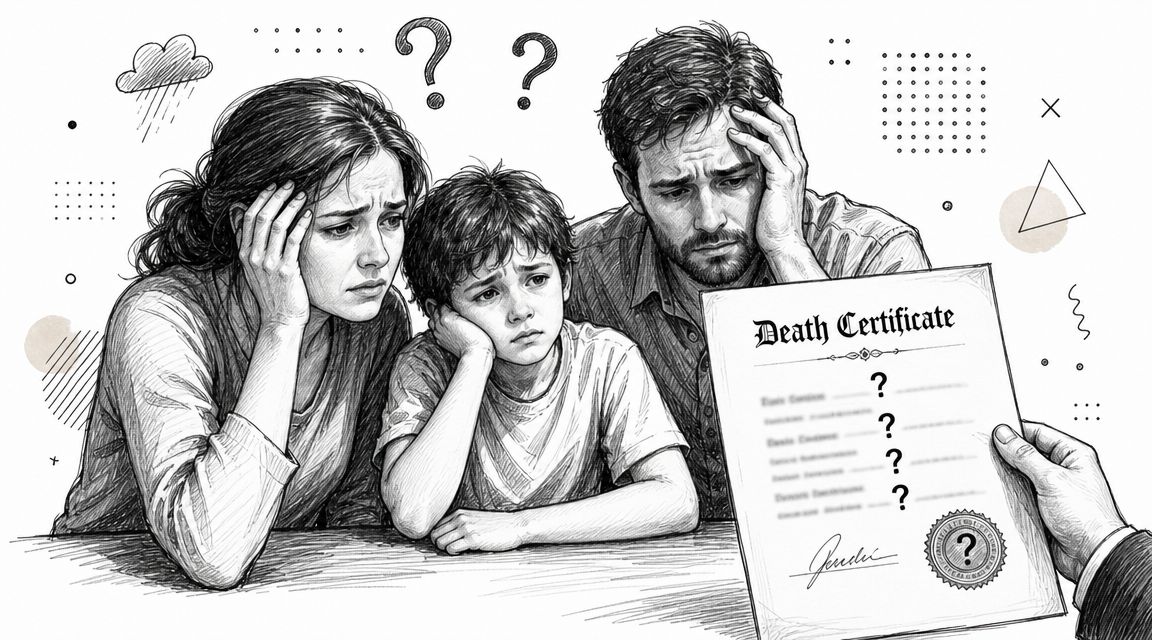
In that setting, the phrase What Is Your Diagnosis takes on a different meaning. It is no longer about choosing treatment. It is about reconstructing what happened and identifying the disease, injury, or complication that best explains the death.
At Texas Autopsy Services, every examination is performed by a board-certified forensic pathologist experienced in medicolegal death investigations. Our work centers on one principle: follow the evidence carefully, explain it plainly, and treat the deceased and their family with respect.
Why this question is reasonable
Families sometimes worry that asking for another review means they are being difficult. It doesn't. Diagnostic uncertainty is a real part of medicine. A review of diagnostic-error statistics reports an estimated 7.4 million misdiagnoses in U.S. emergency departments each year, with about 370,000 resulting in serious harm, and nearly 800,000 Americans dying or being permanently disabled annually due to diagnostic errors according to this summary of misdiagnosis statistics.
That does not mean every unclear death involves negligence or a preventable mistake. It does mean that uncertainty is not rare, and asking for a careful second look is medically reasonable.
Practical rule: If the official explanation feels too broad, doesn't match the timeline, or leaves important questions unanswered, a forensic review may be appropriate.
What a postmortem diagnosis can answer
A postmortem diagnosis may help clarify several kinds of problems:
- Unclear disease process when symptoms never fit neatly into one diagnosis
- Unexpected deterioration when the recorded condition doesn't fully explain the death
- Conflicting medical opinions across hospitals, specialists, or emergency care
- Legal or insurance disputes when an objective record is needed
- Family health concerns when inherited disease is a possibility
The central point is simple. After death, my role is not to defend a prior diagnosis or to challenge one for its own sake. My role is to examine the evidence and state, with medical discipline and respect, what the findings support.
How a Forensic Pathologist Forms a Diagnosis
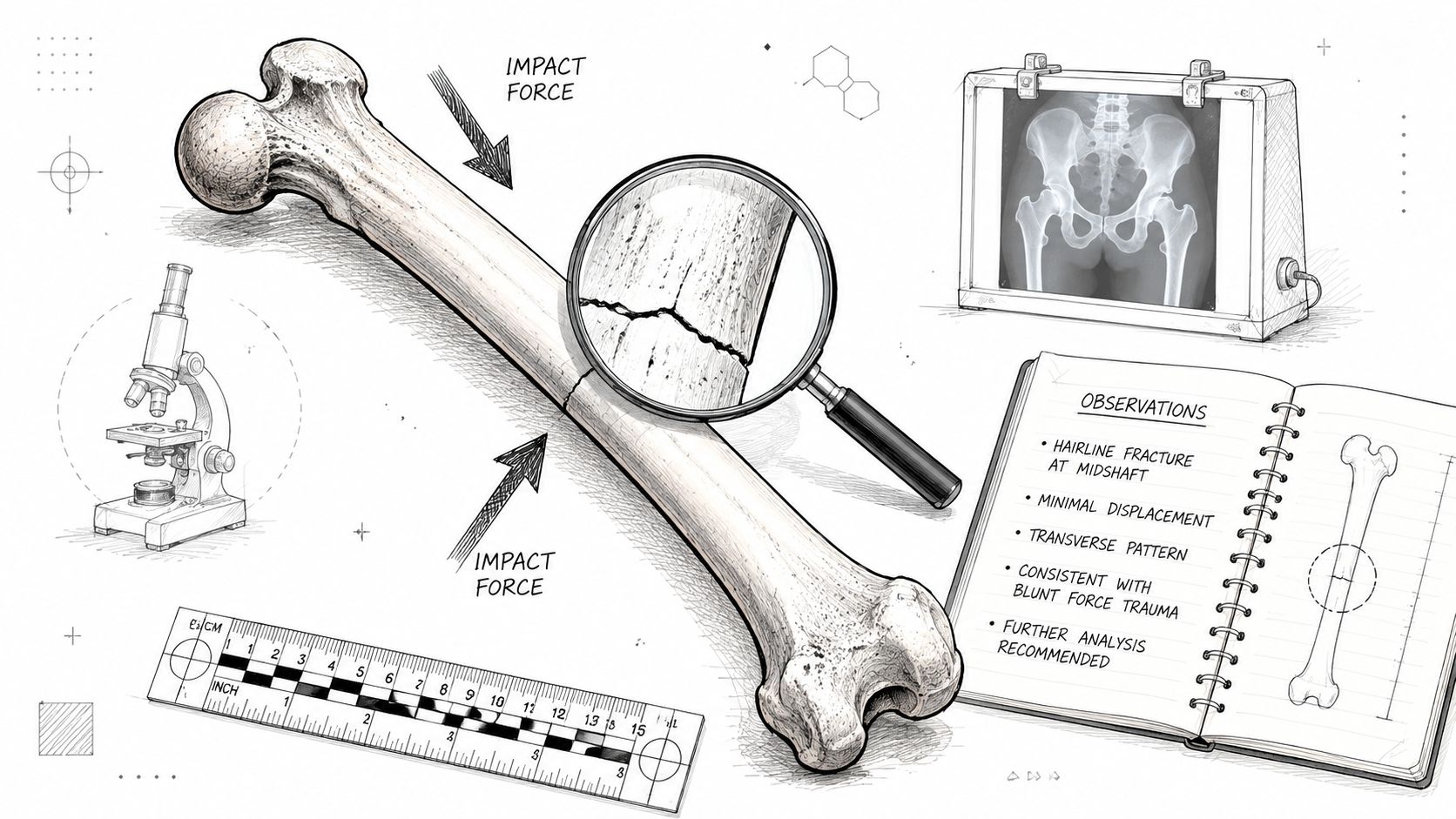
A forensic diagnosis is built step by step. No single finding should be forced to carry the whole case. Good autopsy practice depends on correlation, which means comparing the body, the history, the records, and the laboratory data until they either fit together or expose a contradiction that needs more work.
Early in the process, I gather the non-autopsy evidence first. That includes hospital records, clinic notes, imaging reports, medication history, emergency response information, and the circumstances surrounding death. If the timeline is unclear, that problem has to be recognized at the beginning rather than papered over at the end.
To make the sequence easier to follow, I often explain it visually.
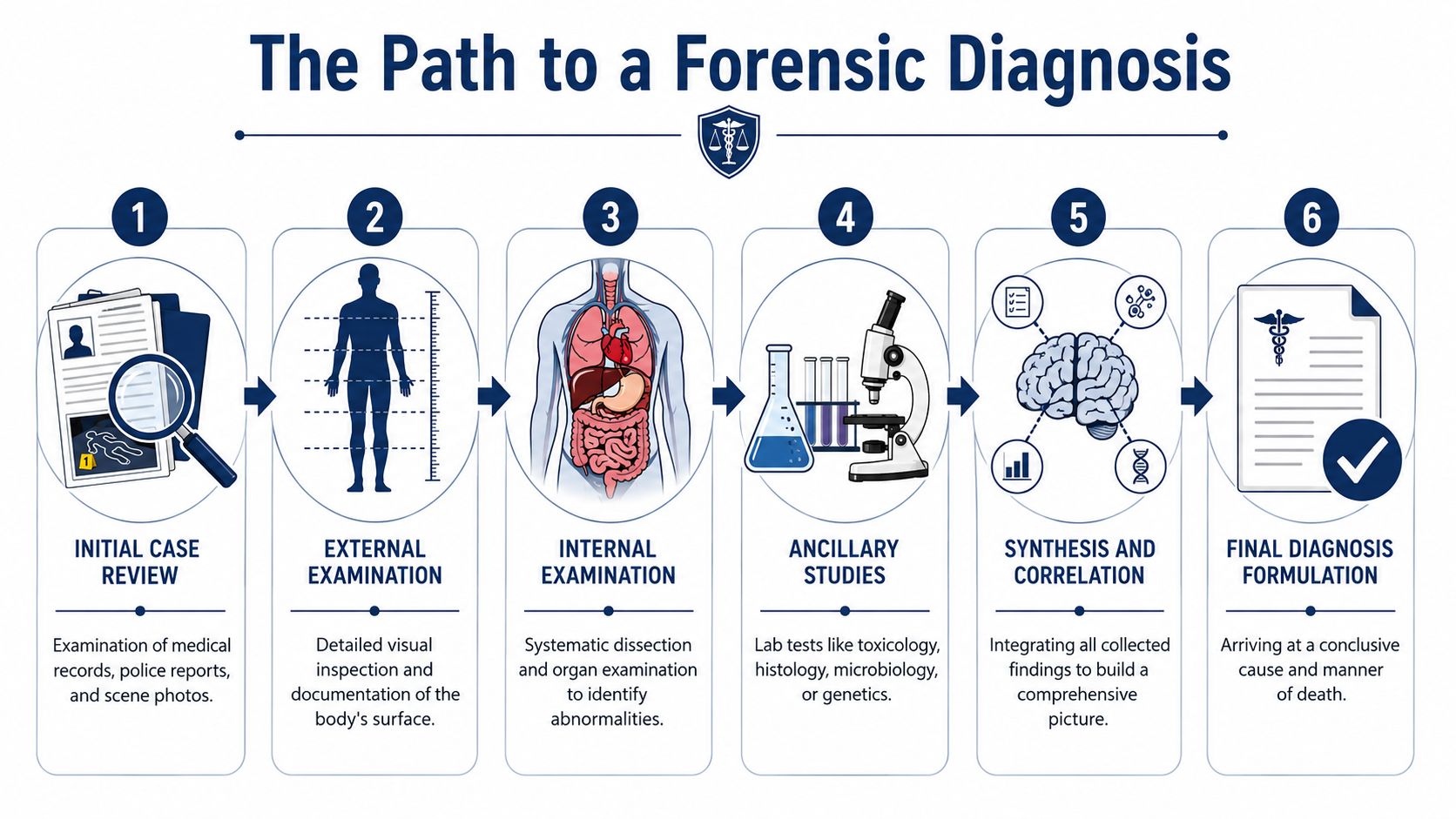
The evidence comes from several layers
The examination itself has distinct parts.
Case review
Medical records matter because symptoms, diagnoses under consideration, recent procedures, and prior pathology findings often frame the most important questions.External examination
I document identifying features, signs of medical intervention, visible injuries, surgical changes, skin findings, and any evidence of disease apparent on the body surface.Internal examination
Each major organ system is examined in an orderly way. I assess anatomy, disease burden, bleeding, infection, clots, tumors, organ enlargement, and treatment effects.Ancillary studies
Histology allows microscopic review of tissue. Toxicology can detect drugs, alcohol, or other substances. Depending on the case, additional studies may include microbiology or genetic testing.
Cause of death and manner of death are not the same
This distinction is often misunderstood, especially in legal cases.
| Term | Plain-language meaning | Example of how it is used |
|---|---|---|
| Cause of death | The disease or injury that led to death | Pneumonia, pulmonary embolism, metastatic cancer, drug toxicity |
| Manner of death | The medical-legal category of how the cause arose | Natural, accident, suicide, homicide, undetermined |
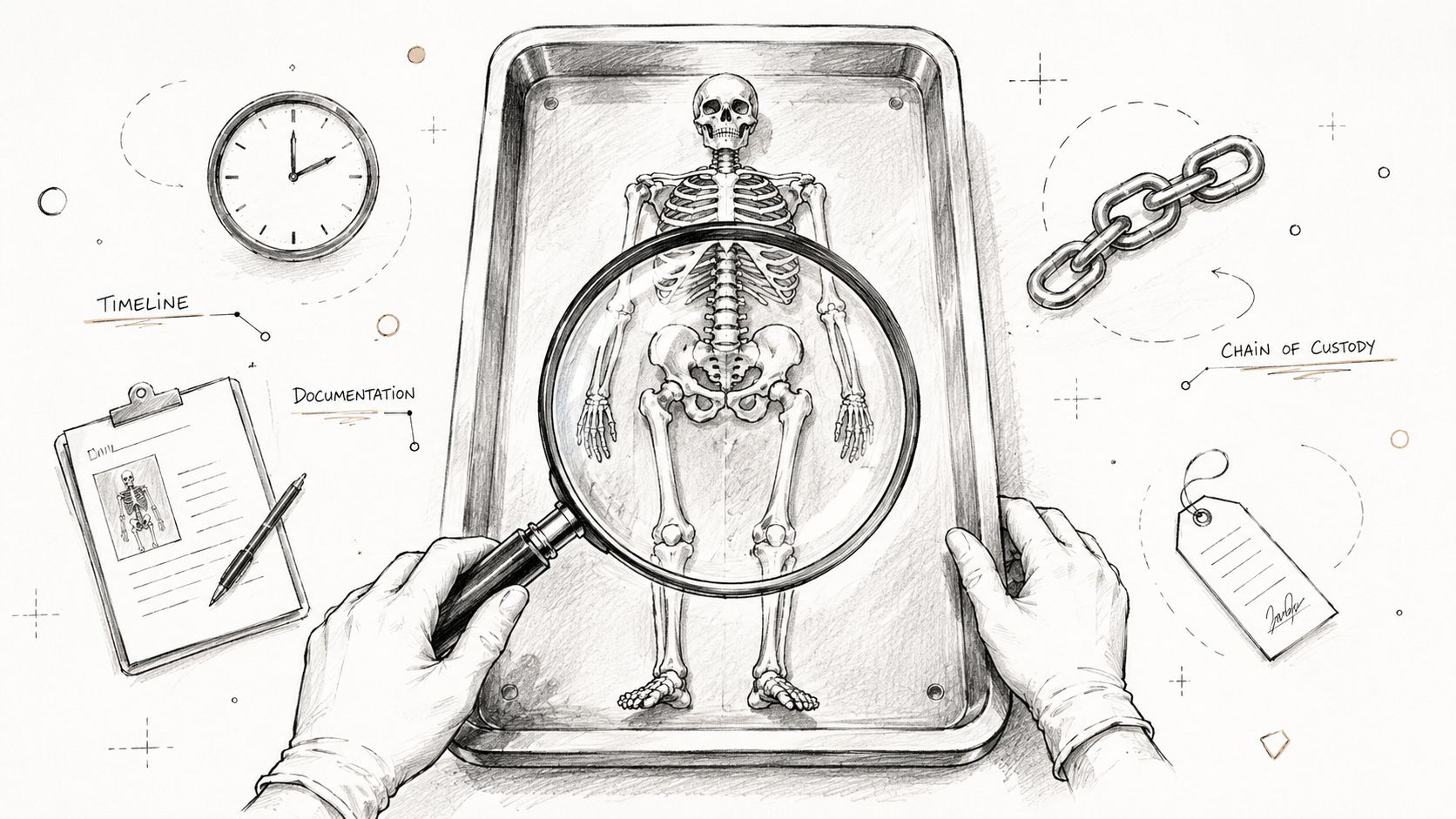
| Chain of custody | A documented record of who handled evidence and when | Important when specimens, clothing, or retained materials may be relevant in court |
A person can die of a drug intoxication, for example. That would describe the cause. Whether it is classified as an accident, suicide, or undetermined is a separate conclusion based on context and evidence.
For readers who want a more detailed explanation of medical-legal determination, I discuss that process in this article on how a coroner determines cause of death.
A brief visual overview can also help:
What works and what does not
What works is methodical correlation. What doesn't work is trying to force an answer before the testing is back, or treating one chart note as if it resolves the entire case.
Published work on diagnostic systems in medicine makes a similar point in another context. Performance varies widely depending on the design and validation of the system. In rheumatology expert systems, the reported proportion of correctly diagnosed cases ranged from 43.1% to 99.9%, with sensitivity from 62% to 100% and specificity from 88% to 98% in this review of diagnostic expert systems. The lesson for autopsy work is straightforward. Broad claims of accuracy are less useful than disease-specific evidence and disciplined review.
A diagnosis should explain the findings. If it leaves major findings unaccounted for, it is incomplete.
The Private Autopsy An Independent Path to Clarity
A private autopsy is an autopsy requested outside the government medical examiner system and outside a hospital quality-review setting. That independence matters. It means the examination is performed for the purpose of answering the medical questions in front of us, with no institutional pressure to fit the case into someone else's administrative process.
Families usually seek a private autopsy when the story feels unfinished. Attorneys usually seek one when the medical record has gaps, contradictions, or consequences that require an objective medical explanation. In both settings, independence improves confidence in the process, not because it guarantees a different answer, but because it reduces concern that the review is constrained by the institution involved in the care.
When independent review is most useful
Some of the most appropriate situations include:
- No clear diagnosis in life when symptoms were real but the final explanation never solidified
- Possible complications of treatment when care, timing, or response to symptoms is under scrutiny
- Unexpected death after a hospital stay when the family wants an outside medical assessment
- Inherited or familial disease concerns when relatives may need clearer information
- Pending litigation or pre-litigation review when causation must be examined carefully
For some people, there was never a settled diagnosis at all. The U.S. Undiagnosed Diseases Network notes that about 3 million people in the U.S. live with undiagnosed conditions despite extensive evaluation, as described by the Hope Center's discussion of undiagnosed disease outreach. In those cases, a private autopsy can become the first definitive medical explanation the family has ever received.
Why attorneys often value independence
An attorney doesn't need speculation. An attorney needs findings, documentation, and reasoning that can be examined line by line. That is especially true in possible medical negligence cases, where understanding the medical sequence is essential before anyone forms legal conclusions. For a non-forensic overview of common error categories, families and counsel may find this guide for medical injury victims useful as background reading.
When families ask how to start, I usually recommend first understanding the practical steps, authorization requirements, and coordination issues involved in an independent case review. This private autopsy guide explains that process in plain language.
The value of a private autopsy is not that it always changes the answer. Its value is that it gives the answer a transparent, independent medical foundation.
What Families and Attorneys Should Expect
The most helpful process is the one that is clear from the beginning. Families should know who has legal authority to authorize the examination, what records are needed, how the decedent will be transported and cared for, and what kinds of findings may require additional testing before a final opinion is issued.

In Texas, lawful authorization is essential. The next of kin or other legally authorized person must approve the private autopsy. Funeral home coordination also matters because timing, transport, refrigeration, and release procedures affect both the quality of the examination and the family's plans for services.
The usual sequence
A private autopsy request often follows this order:
Initial call and case screening
I review the basic facts, the concerns prompting the request, and whether the case is appropriate for private examination.Authorization and records collection
Consent documents are completed, and available medical records are gathered. In some matters, attorneys also provide records chronologies or pleadings for context.Coordination with the funeral home
This step is practical and important. A funeral home such as Waterloo Mortuary Partnership may help coordinate logistics in a respectful and orderly manner.Examination and specimen submission
The autopsy is performed, and tissues or fluids are sent for studies when needed.Reporting and follow-up
Families and attorneys receive findings in an appropriate format, with an opportunity to discuss the conclusions and their limits.
What the report should contain
A useful report does more than announce a final line. It should explain the observations that support the conclusion.
That often includes:
- A factual summary of the records and circumstances reviewed
- External and internal findings documented in medical language
- Ancillary study results when toxicology, histology, or other testing was ordered
- Cause and manner of death opinion stated clearly
- Comments or discussion that connect the findings to the opinion
In complex disease cases, this level of detail matters. The National Cancer Institute notes that people in the United States have about a 38.9% lifetime probability of receiving a cancer diagnosis, and that burden remains substantial, as outlined in the NCI cancer statistics overview. When a charted cancer diagnosis doesn't fully explain a rapid decline, the postmortem examination may clarify disease progression, treatment complications, infection, clotting, or a separate co-existing process.
About timing and expectations
Preliminary impressions may be available before all testing is complete, but a final report often requires patience. Toxicology and microscopic review can change the level of certainty, narrow the diagnosis, or occasionally redirect it. Speed matters, but accuracy matters more.
Attorneys who anticipate litigation sometimes also need later consultation or testimony. When that becomes relevant, it helps to understand how forensic opinions are presented and challenged. I discuss that role further in this article on forensic expert witnesses.
Upholding Objectivity and Texas Legal Standards
I am board certified in Anatomic Pathology, Clinical Pathology, and Forensic Pathology by the American Board of Pathology. Those credentials matter because autopsy work sits at the intersection of medicine, laboratory science, and law. A defensible opinion requires command of all three.
My duty is to the evidence. That sounds simple, but in practice it means resisting pressure from every direction. Families may hope for one answer. Institutions may prefer another. Lawyers on either side may focus on different parts of the record. The forensic pathologist's role is to remain independent and medically disciplined.
What objectivity looks like in practice
Objectivity is not emotional distance from the family. It is disciplined distance from unsupported conclusions.
That requires:
- Complete documentation so every major finding is recorded and reviewable
- Chain of custody when evidence handling may matter in court or agency review
- Clear limits when the available evidence supports only a qualified opinion
- Consistent terminology so the report can be understood by physicians, attorneys, and agencies alike
Texas compliance and lawful procedure
In Texas, autopsy-related work intersects with the Texas Funeral Service Commission and the Texas Health and Safety Code, including Chapters 711, 716, and 651. Those legal standards affect disposition, authorization, and professional responsibilities. They are not paperwork for its own sake. They protect the decedent, the family, and the integrity of the record.
For county agencies and officials, those same principles are important in public work as well. Independent pathology services and County Forensic Autopsies require the same core commitments: lawful handling, accurate documentation, and conclusions that can withstand scrutiny.
Precision is an ethical duty. A cause-of-death opinion may affect grief, probate, insurance, and litigation all at once.
Common Questions About Private Autopsies in Texas
Families and attorneys often need direct answers to practical concerns before they can decide anything. These are some of the questions I hear most often.
Will an autopsy prevent an open-casket funeral
Usually, no. A properly performed autopsy is a surgical medical procedure, and funeral professionals routinely care for decedents after autopsy. Final viewing decisions are made with the funeral home based on the condition of the body, the circumstances of death, and the family's preferences.
The important step is coordination. If a family is planning a viewing, the funeral home should be informed early so transportation and preparation can be arranged appropriately.
Do I need permission from the hospital or treating doctor
In a private autopsy, the key issue is not permission from the treating physician. The key issue is legal authorization from the proper person, usually the next of kin or other legally authorized individual under Texas law.
Hospitals may control release logistics while the decedent remains in their custody, and records access may require standard authorization steps. But a treating doctor does not decide whether the family may lawfully request an independent postmortem examination when the law gives that authority to the appropriate person.
Why was the diagnosis missed before death
Sometimes there is no single reason. Diagnostic delay can reflect patient factors, provider factors, and system factors at the same time. A 2024 review identified barriers that include low health literacy, cultural or language differences, fragmented care, administrative obstacles, distrust, and provider cognitive bias, as discussed in this review of barriers to timely diagnosis in underserved populations.
That doesn't automatically mean someone acted negligently. It does mean the pathway to diagnosis can break down in several places. In my work, that question is approached carefully. I first ask what the records show, what the pathology shows, and whether the final disease process was even knowable at the time symptoms first appeared.
Families deserve an explanation that is honest about uncertainty. Blame and diagnosis are not the same task.
What should families and attorneys gather before calling
The more organized the starting file, the better the review tends to be. Helpful materials often include:
- Medical records from the final hospitalization and relevant prior care
- Medication lists including prescriptions, over-the-counter products, and supplements
- A timeline of symptoms, visits, procedures, and notable changes
- Legal documents identifying the person authorized to consent
- Scene information if death occurred outside a hospital
For attorneys and investigators, documentation habits matter. If your case may involve disputed handling of evidence or media, a structured form can help preserve the record from the beginning. Some readers may find AI Video Detector's evidence template useful as a general organizational tool for chain-of-custody documentation.
How much does a private autopsy cost
The cost varies by case complexity, transport needs, and the scope of testing requested. A limited examination differs from a full forensic autopsy with toxicology, histology, and specialized consultation. Because those variables matter, any responsible answer should come after a case-specific discussion rather than a one-size-fits-all number.
I prefer that families hear clearly what is included, what may generate additional laboratory expense, and what type of report they should expect. Cost discussions are easier when they are direct and specific.
Can a private autopsy still help if an official cause of death was already issued
Yes, sometimes it can. An official death certificate may be accurate, partly accurate, or too general to answer the family's actual concern. A second-opinion autopsy or record review may clarify whether the stated cause is fully supported, whether a more specific diagnosis is possible, or whether important contributing conditions were left out.
That is especially important in matters involving inherited disease concerns, treatment complications, insurance disputes, or civil litigation. The purpose is not to create conflict with an existing record. The purpose is to determine whether the evidence supports a more complete medical explanation.
If you are facing that decision after a recent loss, it is reasonable to ask for guidance before making arrangements that might limit later review. At Texas Autopsy Services, we can explain the private autopsy process, authorization requirements, and coordination steps in plain language so you can decide carefully and without pressure.