August 7, 2026 · Texas Autopsy Services
Carbon Monoxide Testing Explained for Families and Attorneys
Carbon monoxide testing explained for families, attorneys, and county officials. Learn how CO tests work, what results mean, and when to seek expert review.
On this page
- When Carbon Monoxide Testing Becomes a Forensic Question
- What Carbon Monoxide Does Inside the Body
- The Three Main Types of Carbon Monoxide Testing
- How Forensic Toxicology Tests a Blood Sample for CO
- Timing, Storage, and What Can Skew a CO Result
- When an Independent Autopsy Adds Value to CO Findings
- Common Misconceptions About Carbon Monoxide Testing
- Practical Next Steps and How Texas Autopsy Services Can Help
A carbon monoxide problem rarely starts with a dramatic warning. More often, it starts with a family member feeling unwell, a detector that stayed silent, and a later question that's harder than the first one, was there exposure at all, and if so, did it matter medically or legally.
For families, that question can feel urgent and personal. For attorneys and county officials, it becomes a matter of documentation, timing, and whether the available testing can support a cause-of-death investigation. Carbon monoxide testing sits in both worlds at once, and the right method depends on what you're trying to prove.
The public-health need is real. The U.S. EPA says national average carbon monoxide concentrations have declined over time, yet global modeling still estimated 294,173.15 acute poisoning cases in 2021 and 28,946.78 deaths worldwide that year, with a global age-standardized death rate of 0.35 per 100,000 in 2021, down from 0.76 per 100,000 in 1990, an estimated annual percentage change of -2.79% (EPA carbon monoxide trends). That gap between lower average ambient levels and continuing harm is why the test matters in homes, hospitals, and forensic work.
When Carbon Monoxide Testing Becomes a Forensic Question
A family may find themselves in a painful gray zone. There's been a death at home, no alarm sounded, and the scene suggests a possible heating or exhaust issue, but no one can say with confidence what happened without testing that reaches beyond a wall-mounted device. That's when carbon monoxide stops being only a household safety issue and becomes part of a cause-of-death investigation.
Routine testing and forensic testing are not the same thing
In everyday life, carbon monoxide testing usually means checking a detector, confirming an alarm works, or measuring ambient air. In a forensic setting, the question is broader. We may need to know whether there was exposure, how long it likely lasted, whether the person survived long enough to seek help, and whether the available evidence supports carbon monoxide as a cause or contributing factor.
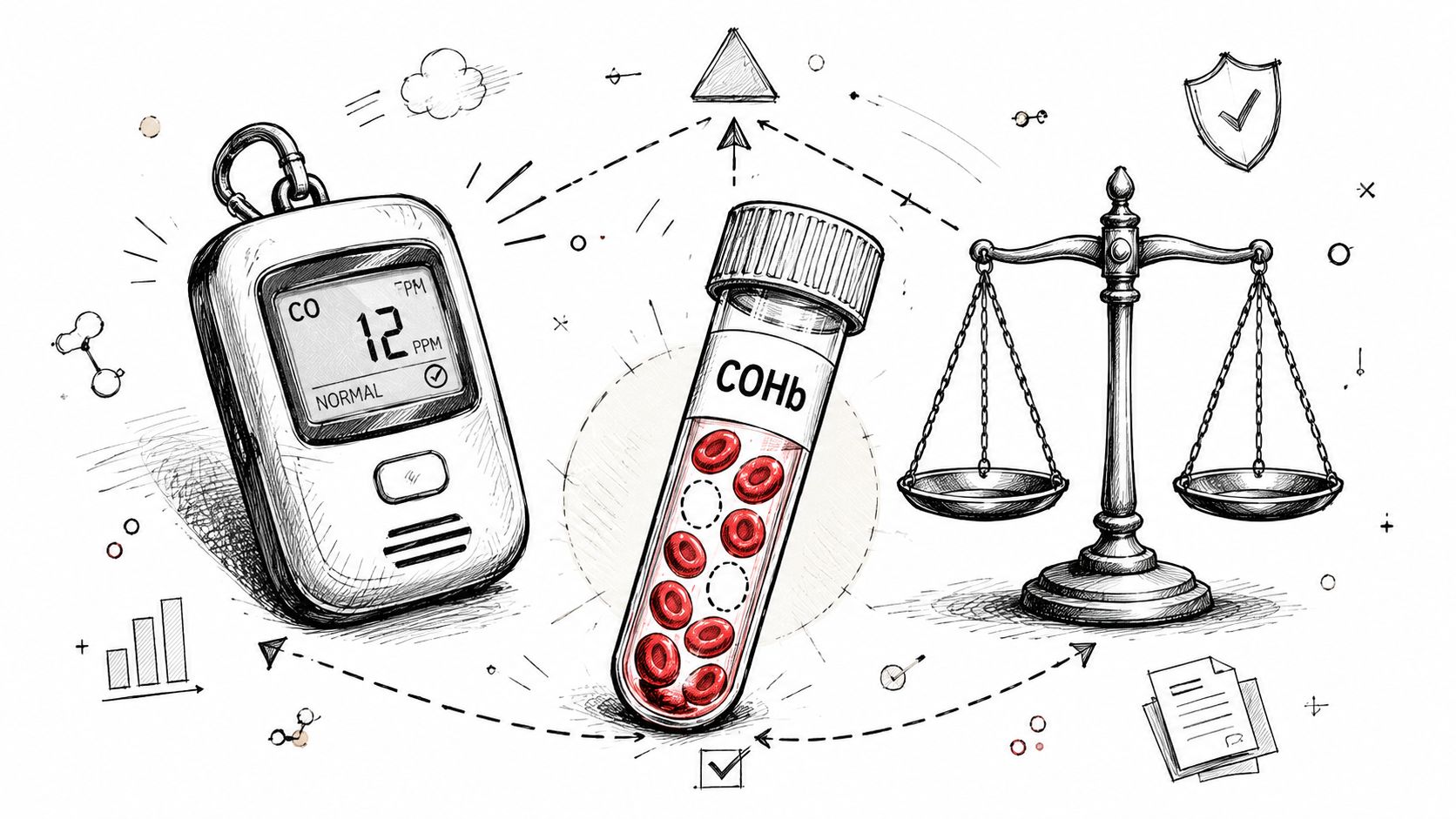
The distinction matters because one test answers one question. A detector test can show that a device functions. An air sample can show that gas is present in a room. A blood test can show that the body absorbed carbon monoxide. None of those, by itself, tells the whole story.
Practical rule: if the question is “Was there a hazard in the room?”, use environmental testing. If the question is “Did this person absorb carbon monoxide?”, the blood sample matters more.
For Texas families and attorneys, this difference often becomes important after the fact. A silent detector doesn't rule out exposure, and a late scene inspection can miss the conditions that were present earlier. In a separate context, the same kind of gap shows up in fire death work, where scene conditions and toxicology must be read together, not in isolation, as discussed in our fire death investigation guide.
Why the forensic setting changes the evidence
A forensic pathologist doesn't just ask whether carbon monoxide was present. We ask whether the measured result fits the scene, the history, the recovery location, and the timing of collection. That's why carbon monoxide testing can support prevention, diagnosis, or death investigation, but only if the right method is matched to the right question.
For families, that can be reassuring even in a hard moment. For attorneys, it sets the standard for what a result can and cannot prove. For county officials, it explains why prompt documentation and proper specimen handling matter from the start.
What Carbon Monoxide Does Inside the Body
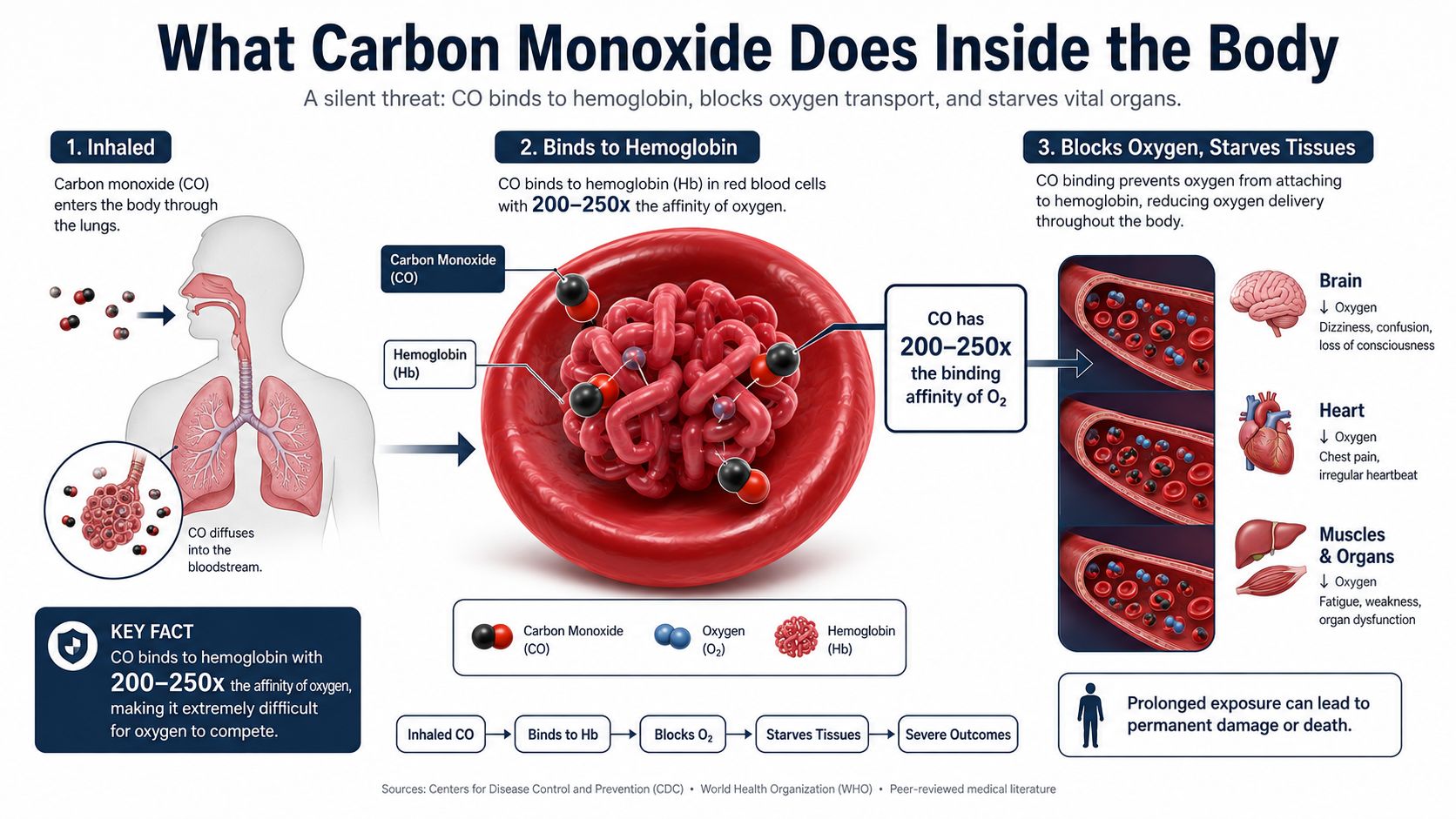
A person can inhale carbon monoxide and feel only vague symptoms at first, while the body is already running short on usable oxygen. The gas enters the bloodstream, attaches to hemoglobin in red blood cells, and blocks oxygen from riding along to the organs that need it. Its binding affinity is roughly 200 to 250 times that of oxygen, so a relatively small exposure can create a serious oxygen delivery problem.
COHb is the number that appears on the report
When carbon monoxide binds to hemoglobin, it forms carboxyhemoglobin, often abbreviated COHb. That percentage on a toxicology report shows how much available hemoglobin was occupied by carbon monoxide instead of oxygen. A blood result is much closer to a record of what the person absorbed than an air reading, because it reflects exposure inside the body.
The oxygen problem is straightforward. Hemoglobin has limited seating, and carbon monoxide takes those seats first, then holds on tightly. The result is not only less oxygen in the blood, but less oxygen reaching the brain, heart, and other organs.
It affects more than hemoglobin
Carbon monoxide also interferes with myoglobin and mitochondrial enzymes, which helps explain why symptoms can continue after the person leaves the source. A person may seem somewhat better in fresh air while still carrying a dangerous poisoning burden. Harvard Health explains the core mechanism clearly, carbon monoxide binds to hemoglobin and reduces the blood's ability to carry enough oxygen for the body's needs (Harvard Health carbon monoxide poisoning).
The number matters, but the body's response matters too. A single lab value never replaces the scene, the history, or the autopsy findings.
For a family member reading a report, COHb is not a verdict by itself. It is one piece of the case. For an attorney, it is a measurement that needs context before it becomes evidence. For a forensic pathologist, it is one of several findings used to decide whether carbon monoxide was incidental, contributory, or central to the death investigation.
The Three Main Types of Carbon Monoxide Testing
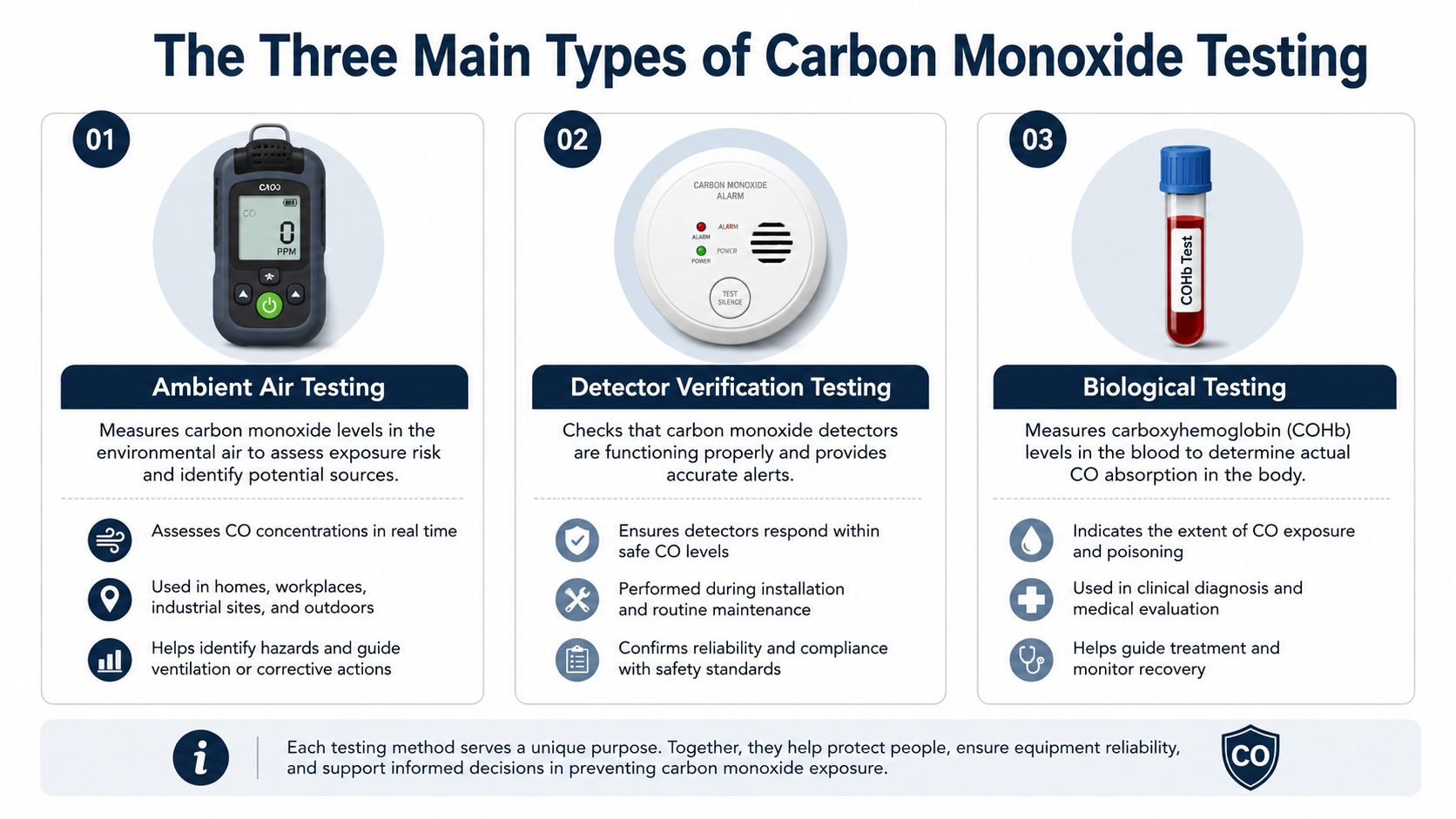
A carbon monoxide case rarely turns on one measurement alone. The right test depends on the question being asked, because a home inspection, a clinical evaluation, and a death investigation each look for something different. In a house, the goal may be warning and prevention. In a clinic, the goal may be diagnosis. In a forensic case, the question is whether the person absorbed enough gas to affect death.
Ambient air testing
Ambient air testing measures carbon monoxide in the environment, usually in parts per million, or ppm. It helps determine whether a room, appliance area, garage, or vehicle space contains carbon monoxide at a level that deserves concern. ASTM D3162 describes infrared-based CO analysis for low-level measurements, which is useful when distinguishing background exposure from a hazardous buildup (ASTM D3162).
The strength of this test is location. It can show whether a source is present in the air people breathed, but it still does not say how long they were exposed or how much entered the body. That distinction matters in a death investigation, because a room reading and a blood result answer different questions.
Detector verification testing
Detector verification is about the device, not the person.
A detector can be mounted in the right place and still fail to help if it is not working correctly or not checked often enough. The CPSC study noted that many households had alarms, but only a small share tested them at the recommended frequency, and some homes had alarms that were present but not working. That pattern explains why a working alarm should never be assumed from the mere fact that one is on the wall (CPSC study).
Detector verification asks whether the alarm responds as expected. It does not tell you whether a person was poisoned, and it does not measure the body's exposure burden. A dead battery, a disconnected unit, or an overlooked replacement date can all leave a family with a false sense of safety.
Biological testing
Biological testing measures the person, usually through blood COHb. In the right timing window, it is the clearest objective marker of exposure. Unlike an air test, it cannot tell you exactly where the exposure happened. Unlike an alarm check, it cannot tell you whether the detector worked. It does tell you whether the body absorbed carbon monoxide.
That is why biological testing sits at the center of forensic toxicology, and it is also why the sample has to be interpreted with care. A blood result is a record of what entered the body, while the scene explains how that exposure may have occurred. For a plain-language overview of the discipline, see what forensic toxicology covers in Texas death investigations.
Practical rule: no single test answers every question. In a real investigation, the result comes from matching the right method to the right fact pattern.
For building and emergency response questions, the measurement method still matters because instruments have different response times and accuracy requirements. EN 50543 specifies t90 response times of ≤50 s for aspirated devices and ≤120 s for diffusion devices, with CO accuracy of ±3 ppm at ≤20 ppm and ±5 ppm above 20 ppm for the 0 to 100 ppm range (EN 50543 summary). That kind of technical detail matters when brief peaks are involved.
A report also has to be traceable. If the case may be reviewed in court, the path from sample to conclusion matters as much as the analyzer reading itself. That is why records, labeling, and handling procedures have to stay clear, and why teams focused on how Verbex supports data integrity are relevant to the broader idea of reliable documentation.
How Forensic Toxicology Tests a Blood Sample for CO
A forensic CO test starts long before the analyzer runs. The blood has to be collected from an appropriate site, preserved correctly, labeled accurately, and tracked through chain of custody. If the result may later be used in court, every handoff matters.
From collection to analysis
In a postmortem case, the sample is typically taken from a sealed or protected site to reduce contamination. The specimen is then preserved and logged. That record matters because chain of custody is the documented path showing who handled the sample, when they handled it, and what happened to it along the way.
At the laboratory, co-oximetry is the standard method used to measure COHb. The result is usually reported as a percentage of carboxyhemoglobin saturation. The number is then interpreted in light of the patient's status, because reference ranges in living patients are not the same as postmortem interpretation.
Why the report format matters
A good report tells you more than a number. It should identify the specimen, the method, and the final interpretation. If the case may be litigated, the integrity of the data trail matters just as much as the analyzer result. That's why teams focused on data handling, such as how Verbex supports data integrity, are relevant to the broader idea of reliable records, even though forensic toxicology has its own rules and safeguards.
For a plain-language reading of the field, our forensic toxicology overview explains how toxicology fits into postmortem work. The key point here is simple. A COHb result is only as useful as the sample handling behind it.
What the number can and can't say
A COHb value can support exposure. It can help a pathologist decide whether carbon monoxide played a role in death. It cannot, on its own, identify the source, the exact duration, or the full timeline of events. That's why laboratory numbers always sit inside a larger medicolegal review.
Timing, Storage, and What Can Skew a CO Result
Carbon monoxide results do not hold still after exposure stops. Once the gas is no longer being inhaled, the body begins clearing it through the lungs, so the measured level depends on how much time has passed and what happened to the body in between. In a forensic case, that means the clock starts running before the laboratory ever sees the sample.
A simple comparison helps. A reading is not a frozen snapshot, it is more like a photograph taken after the scene has already changed. The pathologist has to ask what changed, when it changed, and whether the sample still reflects the person's condition near the time of death.
What can move the number up or down
Several factors can affect interpretation.
- Delay after death. A longer interval before autopsy can change what is measured.
- Storage conditions. Poor preservation can affect specimen reliability, which is why proper handling should follow the guidance in our specimen preservation article.
- Smoking history. Smoking can raise COHb and complicate interpretation.
- Fire exposure. In a structure fire, smoke inhalation can add other gases and make the scene more complex.
- Decomposition. Postmortem gas formation can create interpretive problems in badly decomposed remains.
The same basic rule applies in workplace sampling. Minnesota OSHA carbon monoxide monitoring emphasizes that monitoring has to happen where exposure is most likely, because a reading taken in the wrong place or at the wrong time can mislead the reviewer. In other words, the specimen, the scene, and the moment of collection all shape the final result.
Why context can change the conclusion
A number that looks high in one case may fit the circumstances in another. A lower value may still matter if the person was elderly, medically fragile, or exposed briefly in a confined space. The pathologist has to weigh the scene, the history, and the autopsy findings together, the way a mechanic listens to the whole engine instead of staring at one gauge.
That is also why specimen handling cannot be treated as an afterthought. The condition of the sample, the delay before testing, and the quality of the chain of custody can all affect how confidently the result can be used in a death investigation. For families, that may determine whether the explanation feels complete. For attorneys and county officials, it may determine whether the report can support a later decision.
A CO result is strongest when the sample is preserved well, the timeline is clear, and the surrounding facts fit the laboratory finding. When any one of those pieces is weak, the interpretation has to be narrower.
When an Independent Autopsy Adds Value to CO Findings
A second-opinion review matters when the first report leaves real questions open. Families may want to know whether carbon monoxide was fully evaluated. Attorneys may need to know whether the toxicology, scene information, and report fit together. County officials may need a clearer record before a legal or administrative decision moves ahead.
What an independent review can re-examine
An independent forensic pathologist can review the autopsy report, toxicology, photographs, scene information, and witness history. That review can help sort out whether carbon monoxide was the primary cause of death, a contributing factor, or a finding that has to be read alongside other injuries or medical conditions.
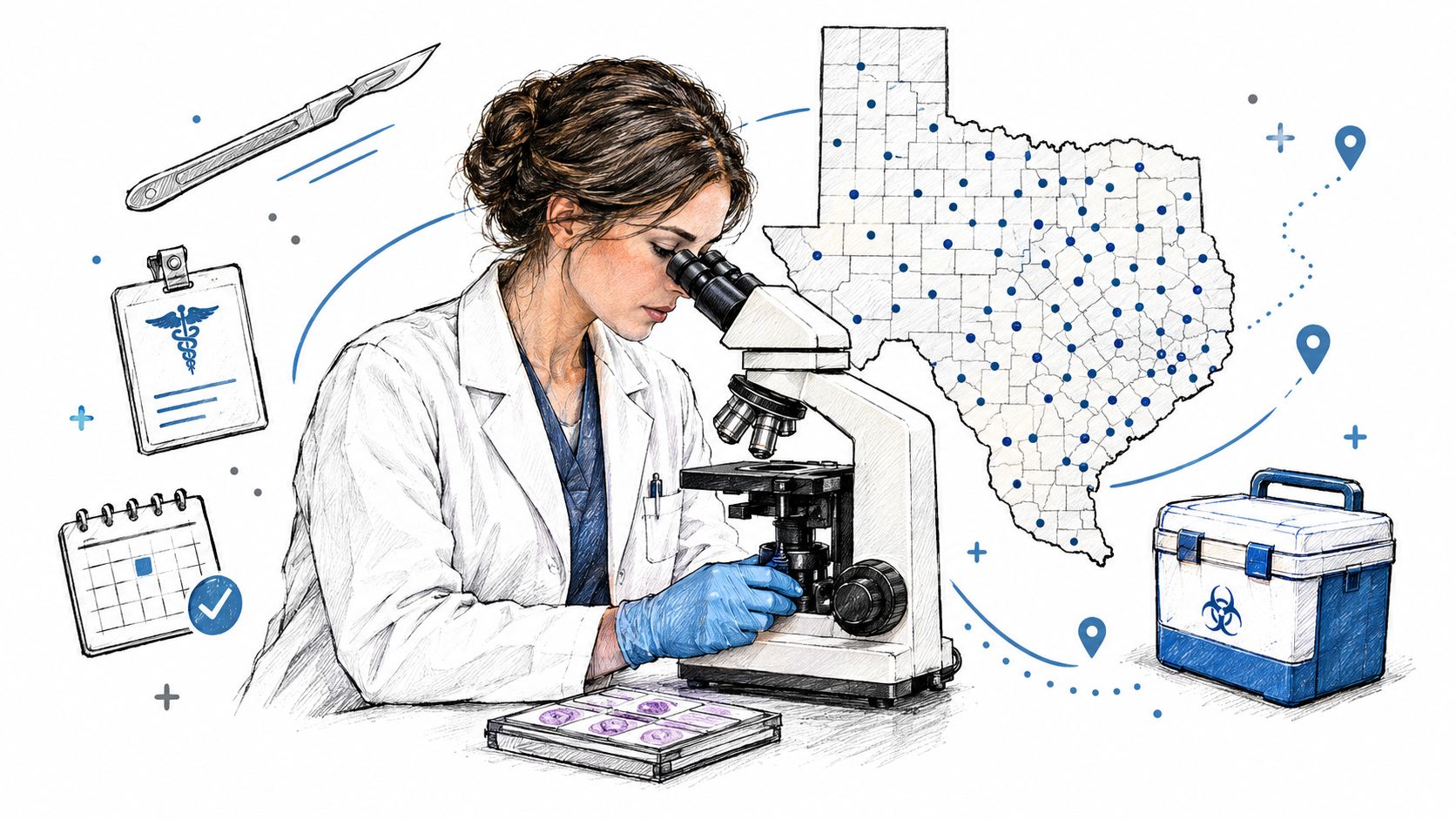
For Texas cases, the practical side matters too. Our practice covers all 254 Texas counties, and we handle in-house licensed transport, secure storage, and full chain-of-custody documentation. We also use flat-rate, all-inclusive pricing so the scope of the work is clear from the start, without hidden charges.
Where a second set of eyes helps most
An independent review is especially useful when the original work was incomplete, the timeline is disputed, or the death involved a possible fire, vehicle exhaust, or faulty heating system. In those cases, the question is whether the existing evidence supports the conclusion already on paper.
Workplace guidance from OSHA uses different thresholds for different exposure windows, including 35 ppm as an 8-hour time-weighted average and 200 ppm as a 5-minute ceiling limit. In a death investigation, the same idea applies, a number only means something when the setting is clear, the sampling is sound, and the timeline makes sense.
A dead battery can still leave a family with questions if the alarm was in the wrong place or the scene was not fully captured. A carbon monoxide case works the same way. The reading, the location, and the surrounding facts have to line up before anyone should place much weight on the result.
If you're a family member, that context can reduce confusion. If you're an attorney, it can shape the evidence review. If you're a county official, it can help you decide whether the record is complete enough to rely on.
Common Misconceptions About Carbon Monoxide Testing
A carbon monoxide case can look simple from the outside. A detector may have sounded, a blood test may show COHb, and yet the meaning of those findings can still be disputed if the scene, timing, or specimen handling is unclear.
A working detector doesn't rule out exposure
A detector can be functioning and still miss the full exposure pattern. It may be mounted too far from the source, placed in a room that was not where the exposure was worst, or affected by airflow from a vent, appliance, or open doorway. As noted earlier, detector testing and placement matter because a device that sounds properly still does not prove the whole home was safe.
A family may hear “the alarm worked” and assume that ends the inquiry. It does not. A detector is one piece of evidence, like a witness who saw only part of the event.
One COHb value isn't the whole case
A single COHb result can support carbon monoxide exposure, but it cannot explain the death by itself. A lower value may reflect delay before sampling, oxygen given before collection, or the natural drop that occurs after exposure ends. A higher value still has to fit the scene and the rest of the autopsy findings.
That is why a number without context can mislead. In a home with a faulty heater, for example, a cracked heat exchanger red tag may point to a combustion problem, but the medical record still has to be read with the scene report and toxicology together.
Timing does matter after death
Postmortem testing does not stop the clock. COHb changes after death, and the way a body is stored, collected, and transported can affect how the result is read. Two reviewers can examine the same report and reach different conclusions if the specimen history is thin or the timeline is uncertain.
A clean conclusion depends on clean facts. Without timing, collection details, and scene context, a carbon monoxide result can be overstated or understated.
The most reliable conclusions come from ambient measurement, biological testing, and a documented chain of custody considered together. Families, attorneys, and county officials should expect that same standard before a carbon monoxide finding is treated as settled.
Practical Next Steps and How Texas Autopsy Services Can Help
If you suspect a carbon monoxide-related death, start with documentation. Preserve the scene information you already have, keep appliance or detector details if they're available, and ask for the toxicology and autopsy records before making assumptions. In Texas, Texas Health & Safety Code Chapter 716 governs autopsy authorization, so the legal path matters as much as the medical one.
What to ask for first
- Request the records. Ask for the autopsy report, toxicology, and any available scene documentation.
- Preserve the timeline. Write down who found the person, when they were last known well, and any known appliance or vehicle exposure.
- Keep the chain intact. If additional testing may be needed, specimen handling and custody records need to stay clear.
If a heating or appliance issue is part of the history, a field safety issue may also be relevant. In those situations, a resource like cracked heat exchanger red tag can help explain why a combustion appliance problem may raise concern, but it doesn't replace a forensic review.
Our team at Texas Autopsy Services supports families, attorneys, and county officials across all 254 Texas counties with in-house licensed transport, secure storage, and reports prepared by a board-certified forensic pathologist. We work with direct communication and full documentation because carbon monoxide cases often turn on details that can't be fixed later.
If you need a second opinion, a cause-of-death review, or help understanding existing toxicology, call us at (806) 230-1889. We'll speak with you directly, explain what the records do and don't show, and help you decide the next step with care and precision.
Texas Autopsy Services provides independent private autopsy and forensic pathology services for families, attorneys, and county officials across Texas. If carbon monoxide testing is part of a death investigation, we can review the records, examine the evidence, and provide a clear, court-admissible report with compassionate communication throughout the process. Visit Texas Autopsy Services or call (806) 230-1889 to speak with our team directly.