August 4, 2026 · Texas Autopsy Services
Communicable Disease Testing After Death in Texas
Learn how communicable disease testing works postmortem in Texas, from HIV and hepatitis to TB and respiratory pathogens. Guide for families and officials.
On this page
- What Communicable Disease Testing Means After Death
- Pathogens Commonly Tested in Postmortem Cases
- Specimen Collection, Biosafety, and Chain of Custody
- Consent, Confidentiality, and Public Health Reporting
- Turnaround Times and What Influences Them
- What Results Mean for Families, Attorneys, and County Officials
- How Texas Autopsy Services Handles Testing and Logistics
- Questions Families and Attorneys Ask Most Often
Communicable disease testing after death often begins with a simple concern. A family may be waiting for answers, an attorney may need a defensible report, or a county official may need to know whether an infection could affect people who had contact with the deceased. In those cases, testing is not routine screening, it's a targeted part of the forensic review, and it has to be handled with care from the first exam room decision to the final report.
At Texas Autopsy Services, we approach these cases with the same discipline we bring to every independent autopsy and second-opinion review. We look for the infection question that fits the death, the exposure, and the legal context, then document each step so the result can support both public health and the record of death.
What Communicable Disease Testing Means After Death
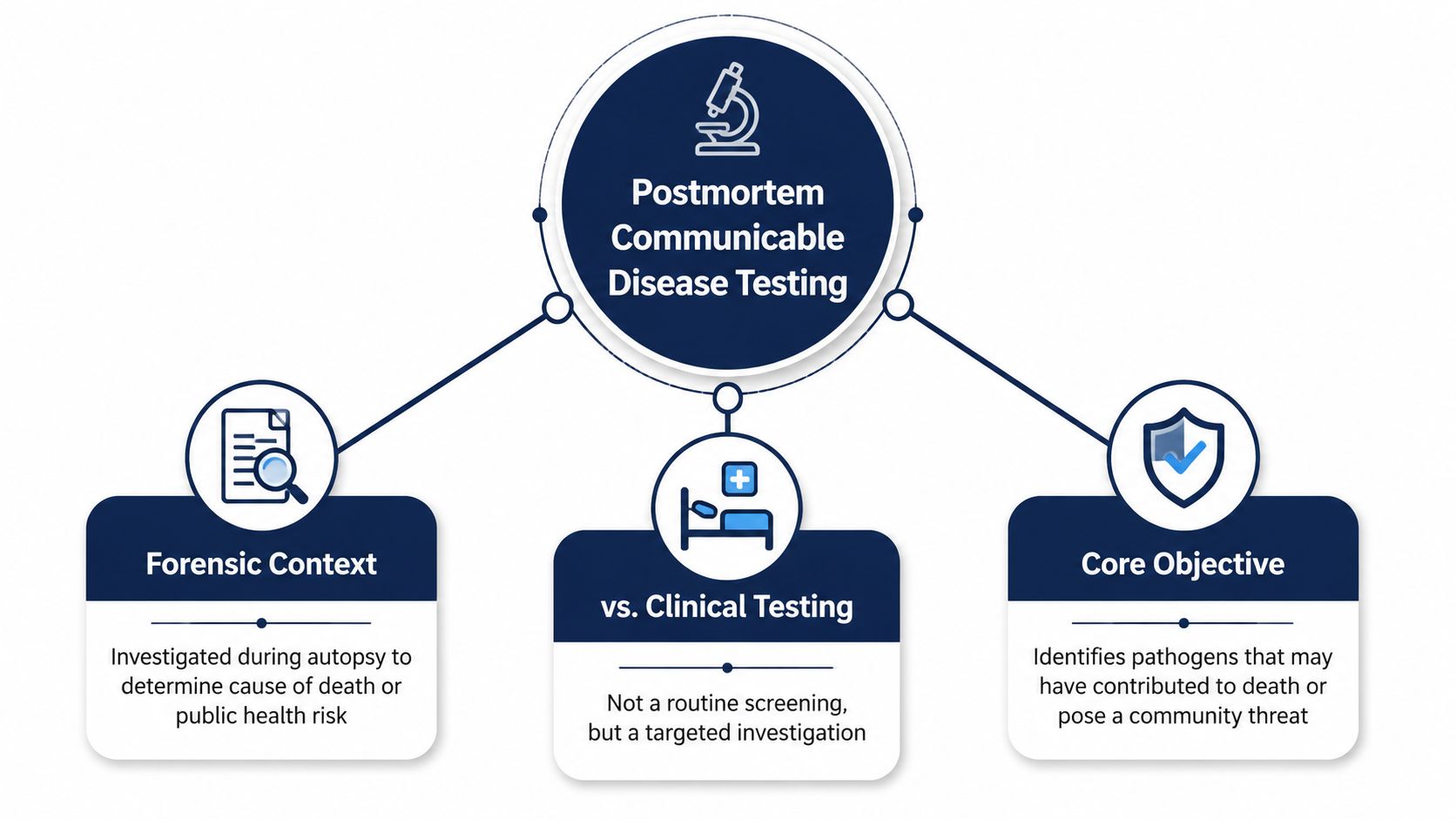
A postmortem infection workup answers a different question than testing in a clinic. In a living patient, the goal is often immediate treatment. After death, the goal is to determine whether an infectious agent contributed to death, created a risk for anyone who handled the body, or needs to be reported for surveillance and contact tracing. That distinction matters because a communicable disease is an illness caused by an infectious agent or its toxic products that can move from one host to another, directly or indirectly through the environment or a vector definition source.
A common situation is a death that appears medical on the surface but has details that raise an infection question. A person may have had fever, cough, weight loss, jaundice, or a recent exposure history, but no confirmed diagnosis before death. In that setting, the forensic pathologist decides which specimens to collect and which organisms to target based on the story, the scene, and the autopsy findings, not on a fixed panel.
Practical rule: postmortem testing starts with the death investigation, not with the laboratory menu.
The purpose is usually threefold. First, it can help determine cause of death, meaning the disease or injury that directly led to death. Second, it can support the manner of death finding, which is the forensic classification of how the death occurred. Third, it can protect workers and inform public health when a contagious condition is possible. For infection-control context in our practice, we also direct families and professionals to our infection control procedures, because handling decisions matter from the moment a case arrives.
Testing is case-specific. A board-certified forensic pathologist may order respiratory testing, blood-based testing, or tissue studies depending on the signs and the clinical history. The point isn't to test everything. The point is to test the right thing, in the right way, for the right reason.
Pathogens Commonly Tested in Postmortem Cases
A body can tell part of the story before the lab ever opens a tube. If the history includes fever, cough, weight loss, jaundice, skin lesions, or a known exposure, postmortem testing often focuses on infections that could explain the death, change the investigation, or affect other people who were around the decedent. HIV, hepatitis B, hepatitis C, tuberculosis, influenza, SARS-CoV-2, and Streptococcus pneumoniae are common examples because each one raises different questions for families, attorneys, county officials, and public health staff.
Matching the pathogen to the question
HIV and hepatitis testing often helps clarify exposure risk for partners, responders, or healthcare workers. A result can shape follow-up steps, especially when a death involved blood exposure or the records before death were incomplete. Tuberculosis testing matters for the same reason, since a contagious case can require contact follow-up after death. Respiratory pathogen panels are useful when the illness looked like pneumonia, when death was sudden, or when more than one infection could explain the course.
The public-health context is broader than one autopsy file. WHO's sexually transmitted infection fact sheet notes that sexually transmitted infections remain a major global health problem, which is one reason infectious disease identification still matters after death. Those figures do not explain a single case, but they show why a forensic team cannot treat infection questions as routine paperwork.
A useful way to sort the testing decision is by how the organism spreads. The guide to airborne and vector spread gives a plain explanation of airborne, droplet, and vector-borne transmission for readers who want the basics without medical jargon. In a forensic setting, that route of spread helps identify who may need to be notified and which specimens are more likely to answer the question.
Plain-language takeaway: a positive result is not just a label. It can change contact tracing, worker exposure review, and death certification.
Our bacterial culture testing resource gives families and attorneys a closer look at how culture fits into the larger postmortem picture. Culture still matters in many cases, but it often works alongside molecular methods rather than replacing them. The choice depends on the question, the tissue, and the condition of the body.
A board-certified forensic pathologist makes that choice case by case. Two deaths that look similar from the outside may call for different tests once the scene, the history, and the autopsy findings are reviewed.
Specimen Collection, Biosafety, and Chain of Custody
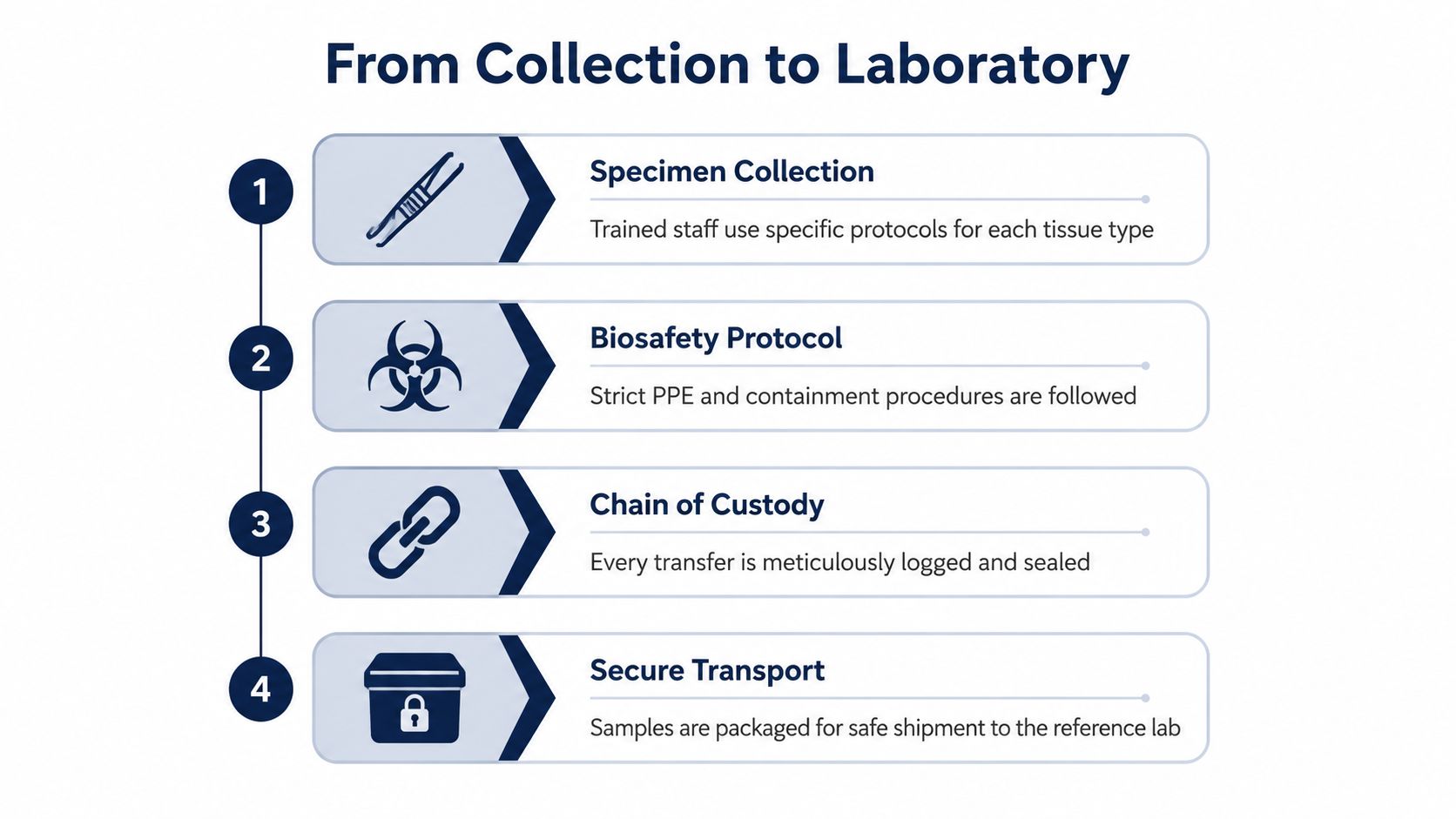
Postmortem testing is only as reliable as the specimen that reaches the lab. During autopsy, our team may collect vitreous fluid, blood from the heart or femoral vessels, tissue from affected organs, a nasopharyngeal swab for respiratory targets, or cerebrospinal fluid when meningitis is part of the concern. The specimen type follows the suspected disease, because the wrong sample can give a weak or misleading result.
How the work stays safe and defensible
Biosafety starts before the specimen is cut. Staff use protective equipment, safe sharps handling, and controlled workspace practices so the team and later handlers are protected from accidental exposure. The basic logic is simple, if a sample is potentially infectious, then every step around it has to be treated as a controlled task.
The handoff record matters just as much as the sample itself. Each specimen is labeled, sealed, documented, and tracked so the result can be defended if a lawyer, county official, or court needs to review it later. That is the practical meaning of chain of custody, the documented path of a specimen from collection to laboratory receipt and final report.
For readers who want the lab-side safety framework, our team recommends the guide to biohazard lab safety, because the same principles guide postmortem handling. The core idea is consistent across settings, containment, documentation, and secure transfer.
A few specimen rules stay constant in our practice:
- Collect the right tissue: the suspected infection determines whether blood, swab, fluid, or organ tissue is most useful.
- Seal immediately: every container is closed and labeled before movement.
- Document transfer: each handoff is recorded so the path of evidence remains visible.
- Transport securely: specimens move under controlled conditions to preserve integrity.
Our specimen collection procedures resource gives additional detail on how we handle that workflow. Good documentation doesn't just support the lab result. It protects the family, the court record, and anyone who may need to rely on the finding later.
Consent, Confidentiality, and Public Health Reporting
A family may be trying to settle a death certificate, an attorney may be reviewing records, and a county official may be asking who can authorize testing. In that setting, postmortem infection testing has to respect Texas law and the family's privacy at the same time. The person who can authorize testing is usually the legally authorized representative under Texas Health & Safety Code Chapters 711 and 716, unless a valid decision made by the deceased already controls the issue. We confirm that authority before testing starts, because a consent problem caught late can slow the case and create avoidable confusion.
Who gets the result
Results go to the legally authorized requester, and confidential information is handled with HIPAA-style privacy expectations in mind. We do not release findings broadly to extended family or other parties unless the requester, the law, or a formal legal process allows it. That careful release process matters because postmortem findings can affect living relatives, insurance questions, and active investigations.
Public-health reporting is a separate duty. Certain positive results, including tuberculosis, HIV, and specific sexually transmitted infections, must be reported to health authorities under Texas law. Our role is to support prompt reporting while preserving the decedent's dignity and sharing only what the law requires.
Practical rule: privacy and reporting can both be handled correctly in the same case.
There is also a public-health reason for the reporting side of the process. WHO estimates show that tuberculosis remains a major global concern, and postmortem findings can still help protect people who were exposed before death. A positive result after death may guide contact tracing, inform living relatives, and give health officials the information they need to act.
Texas families sometimes worry that a positive result will be shared too widely. It should not be. The proper process is narrow, documented disclosure to the person with legal authority, plus any reporting required by law. That is the standard we follow in every communicable disease case.
Turnaround Times and What Influences Them
Families and attorneys usually want a realistic time frame, not a promise. Many molecular tests, including PCR-based assays for respiratory pathogens, HIV, and hepatitis C, return results within 24 to 72 hours once specimens reach the laboratory. Culture-based confirmation, especially for tuberculosis, can take one to three weeks because the organism has to grow before final confirmation is possible.
Those ranges are useful, but they're not fixed. Transport distance from our Elgin facility, the number of samples collected, the need for confirmatory testing, and the complexity of the case all affect timing. A case with one targeted swab moves differently from a case that needs multiple tissues, molecular testing, and culture follow-up.
What usually slows a case
A result may take longer when:
- A specimen needs confirmation: some findings need a second method before they're final.
- More than one target is ordered: broad infectious questions create more laboratory steps.
- Transport is longer: statewide movement takes planning, even with temperature control.
- The case is technically complex: unusual infections or mixed findings require more review.
Our in-house licensed transport helps reduce avoidable delay by keeping custody and temperature control intact while specimens move statewide. That doesn't remove laboratory processing time, but it does cut down on handoff problems that can stall a case.
A family should hear a clear range, not a guaranteed date. The honest answer is that some results are fast, some are not, and the deciding factor is often the type of test rather than the location of the death. That is especially true when the final answer depends on culture, not just molecular screening.
What Results Mean for Families, Attorneys, and County Officials
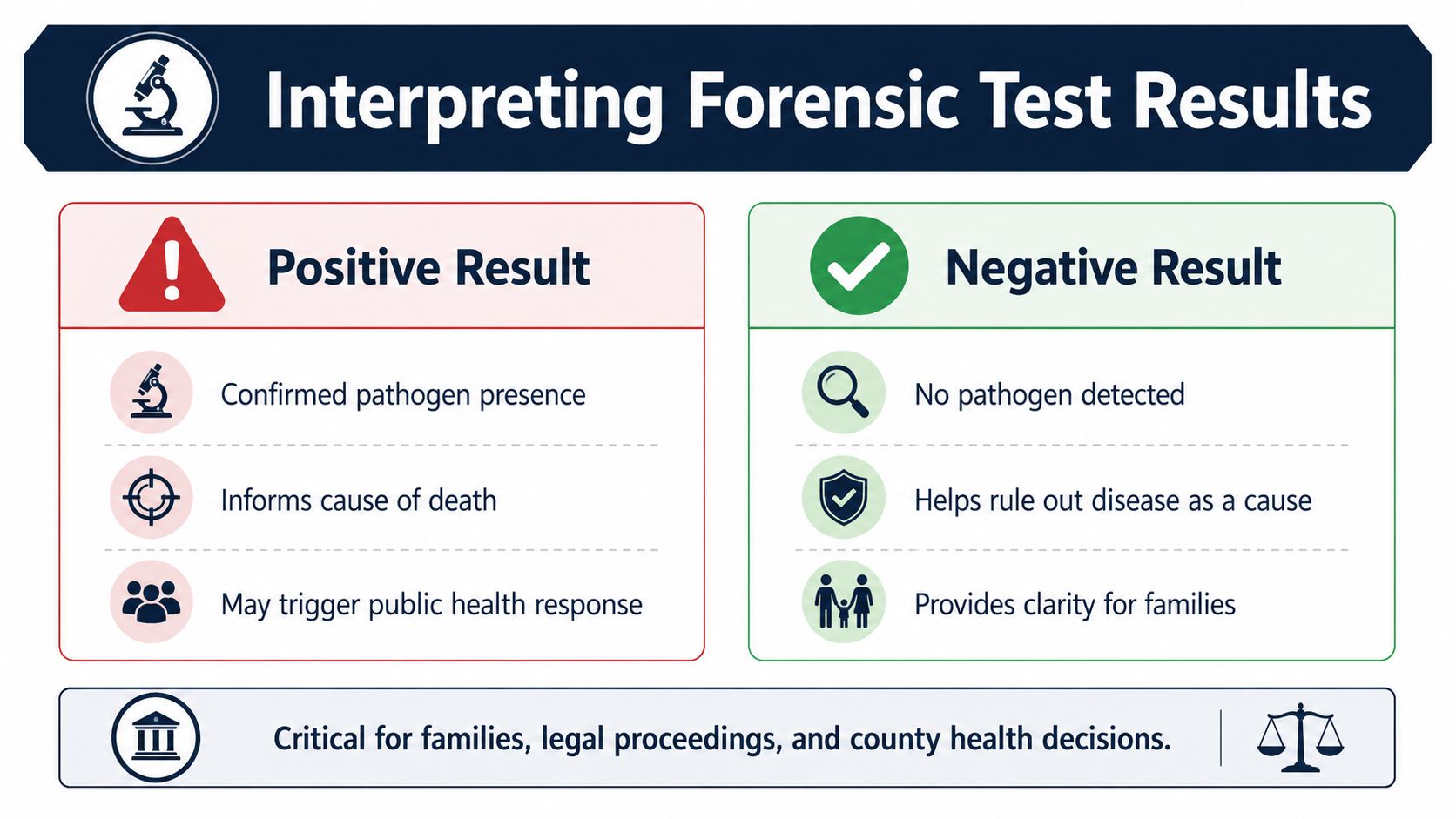
A postmortem infection result is only useful if people know what to do with it. A positive result can support a cause-of-death finding, trigger public-health follow-up, or explain why a death looked sudden or unclear. A negative result can be just as important, because it helps rule out infection and narrows the remaining questions.
Different people use the same result differently
For families, the result can guide future medical screening and shape decisions about funeral handling or burial arrangements. It may also bring clarity when symptoms before death were confusing or when no diagnosis was established during life.
For attorneys, laboratory-confirmed findings can matter in wrongful-death claims, insurance disputes, and other legal proceedings. In those settings, chain of custody and court-admissible reporting aren't technical extras. They're the reason the result can be trusted in a formal record.
For county officials, the result may support death investigation, justice of the peace review, and the reporting obligations that follow an infectious finding. It can also help public-health staff decide whether additional contact tracing is needed.
A negative result doesn't mean “nothing happened.” It means the pathogen tested for wasn't detected in the submitted specimen, which can help the team move away from infection and toward another explanation. In a difficult case, that kind of narrowing can be as valuable as a positive answer.
Communicable disease testing becomes part of the larger forensic story. It doesn't replace the autopsy, and it doesn't stand alone. It gives decision-makers a documented answer they can use with more confidence.
How Texas Autopsy Services Handles Testing and Logistics
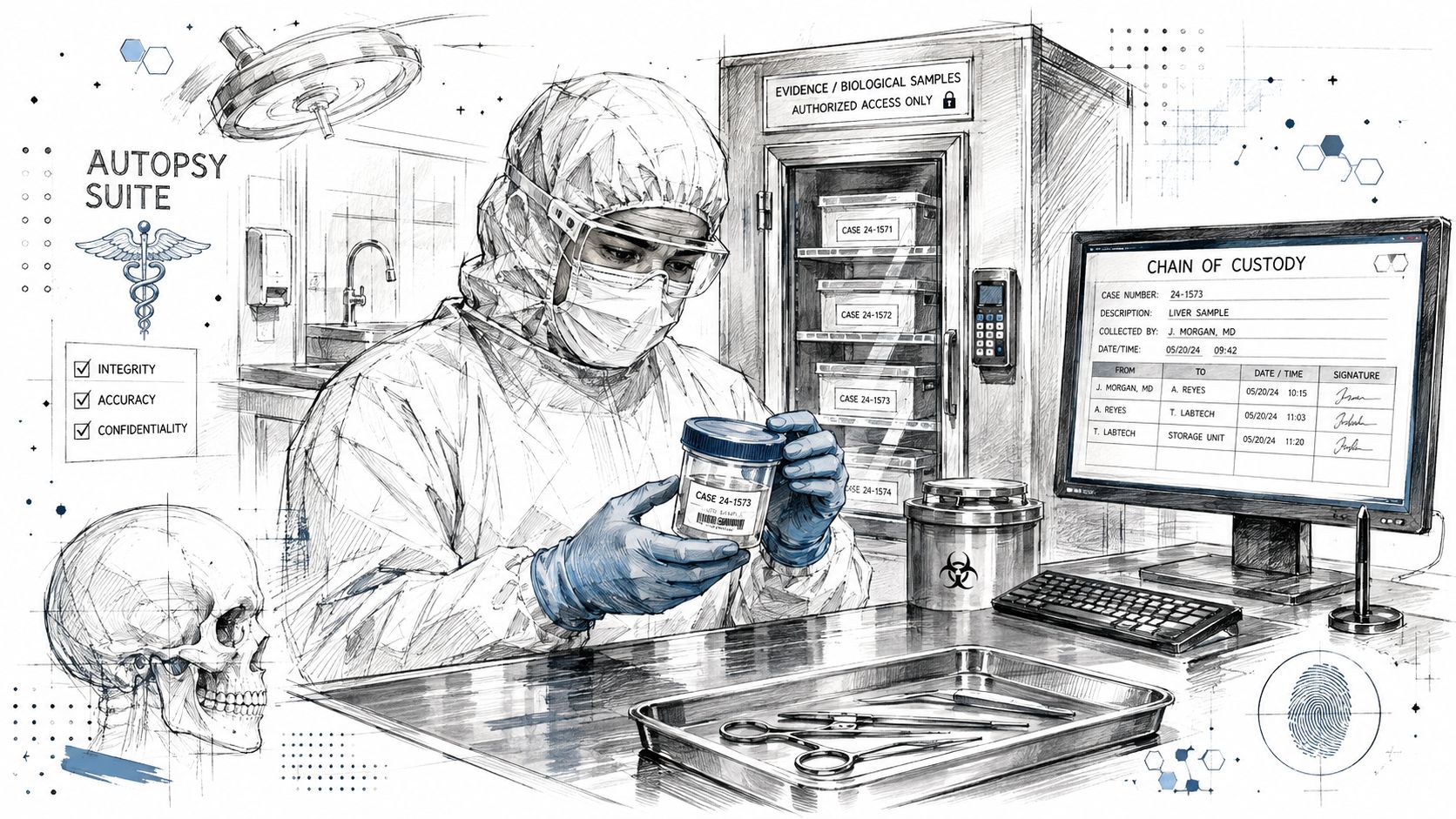
Our practice coordinates communicable disease testing as part of the full autopsy workflow, not as an afterthought. Every examination is performed by a forensic pathologist certified by the American Board of Pathology, and the testing plan is set by the case findings rather than a fixed checklist. That matters because the right specimen, the right test, and the right interpretation all have to fit together.
How the workflow stays organized
We use in-house licensed transport to move decedents and specimens statewide across all 254 Texas counties. That lets us preserve documentation, temperature control, and custody without handing the case off to multiple unknown intermediaries. For specialized molecular and culture-based work, we coordinate with accredited reference laboratories and fold the final findings into secure, HIPAA-compliant reporting.
Our pricing model is flat-rate and all-inclusive, which means transport, examination, testing coordination, and reporting are handled within one defined structure. Families and county officials don't have to guess which line item will appear later. That simplicity is part of good case management, especially when the matter is already stressful.
Texas Autopsy Services also provides direct communication with our team, which helps avoid delays that come from layers of middlemen. In a communicable disease case, timely clarification can matter as much as the test itself.
The practical value of independence is that the testing decision stays tied to the forensic question. We don't push a universal panel. We look at the findings, choose the needed tests, and keep the record clean from intake through final report.
Questions Families and Attorneys Ask Most Often
Who can authorize testing if relatives disagree
The legally authorized requester under Texas law controls the decision, unless a valid prior direction from the deceased says otherwise. When there's disagreement, we verify authority before proceeding.
Will positive results be shared with all family members
No, not automatically. Results go to the authorized requester and to public health only when reporting is required by law.
What if the result is indeterminate or inconclusive
That usually means the specimen, the organism, or the test method didn't give a clean answer. In those cases, the pathologist reviews whether another specimen, another assay, or a different interpretation is appropriate.
What happens when a county case overlaps with a public-health investigation
We coordinate the forensic findings with reporting obligations and keep the chain of custody intact. The county gets the information needed for the death investigation, and the health side gets what the law requires.
Where can I read more about private autopsy support in Texas
Our Private Autopsies page explains our service model, and our County Forensic Autopsies page covers support for justices of the peace and counties without a medical examiner.
If you need a communicable disease testing review as part of a private autopsy, second opinion, or county death investigation, Texas Autopsy Services can help coordinate the forensic, legal, and reporting steps with care. Visit Texas Autopsy Services or call our team at (806) 230-1889 to discuss the case and the next step with a board-certified forensic pathologist.