July 19, 2026 · Texas Autopsy Services
Infection Control Procedures: Texas Autopsy Services
Texas Autopsy Services maintains rigorous infection control procedures, ensuring safety for staff, families, and legal processes during investigations.
On this page
- The Foundation of Safety in Every Examination
- Understanding Risks in the Autopsy Environment
- Personal Protective Equipment Standards
- How Our Facility Design Ensures Containment
- Decontamination and Waste Management Protocols
- Ensuring Safety During Transport and Storage
- Our Commitment to Training and Auditing
- Frequently Asked Questions
Infection control often matters most when a family has the least information. A death may occur at home, in a nursing facility, or during transfer from one care setting to another. Medical history may be incomplete. Infectious risk may be known, suspected, or entirely unclear. In that moment, careful handling is not a technical extra. It is part of dignity, staff safety, and the reliability of the examination itself.
In private autopsy work, infection control procedures begin before a decedent reaches the examination room. They shape transport, storage, documentation, personal protective equipment, room ventilation, instrument reprocessing, spill response, and waste handling. They also protect the chain of custody, which means the documented control of the body, specimens, and evidence from one responsible party to the next.
For families and attorneys, that usually comes down to a simple concern. Was this done carefully, safely, and in a way a court or reviewing physician can trust. That concern is reasonable. It deserves a direct answer.
- Every examination is performed by a forensic pathologist certified by the American Board of Pathology.
- Infection control starts at first contact, not only when the autopsy begins.
- Transport and storage matter in private autopsy practice, especially when cases move across Texas outside a hospital system.
- Engineering controls, PPE, and decontamination protocols work together, not as separate checklists.
- Clear documentation supports both safety and legal integrity, including cause of death, manner of death, and chain of custody.
The Foundation of Safety in Every Examination
A family calls after an unexpected death. The medical history is partial, the hospital records are delayed, and no one can say with confidence whether infection played a role. In private autopsy practice, that uncertainty is routine. The safe response is also routine. We begin every examination as if infectious material may be present until the available facts and the case work narrow that risk.
That starting point protects people, evidence, and the integrity of the examination.
Why every case starts the same way
The formal term is standard precautions, sometimes called universal precautions. In plain English, it means we do not wait for a chart, lab result, or reported diagnosis before using protective measures. Blood, body fluids, non-intact skin, tissues, instruments, and work surfaces are all handled under the same disciplined rules from the outset.
In forensic pathology, the history is often incomplete. A decedent may come from a residence, a nursing facility, a transport vehicle, or another county entirely before arrival at the autopsy suite. That is one reason private autopsy work has its own operational pressures. Infection control has to hold up across transport, intake, secure storage, examination, specimen handling, and release, not only during the time spent at the table.
Protocol keeps those handoffs from becoming weak points.
Practical rule: The safest case is the case handled consistently, especially when the history is uncertain.
What standard precautions mean in plain English
In day-to-day practice, that foundation includes a few fixed habits:
- Clean hands at the right moments: Hand hygiene happens before contact, after glove removal, after contact with potentially contaminated material, and before handling clean supplies, paperwork, or specimens.
- Protection before exposure: Gloves, fluid-resistant outerwear, face and eye protection, and procedure-specific barriers are selected before the case begins, not after a splash, cut, or unexpected finding.
- Attention to transfer points: Stretchers, body pouches, instrument handles, door hardware, specimen containers, keyboards, and documentation areas are treated as possible contamination sites if they are not controlled carefully.
- One chain of custody, one chain of safety: In a private autopsy setting, infection control cannot be separated from case tracking. If a specimen container, transport surface, or personal effect is mishandled, the problem is both a safety failure and a documentation failure.
Families and attorneys who want a practical overview of risk review principles may also find this discussion of Assessing and managing infection risks useful because it explains how structured risk assessment supports routine decision-making outside ideal hospital conditions.
This approach is deliberate. It avoids the common mistake of relaxing standards in cases that look low risk at first glance. In my field, that is how preventable exposures happen. A sound infection control program starts with consistency, then adjusts upward when the case details call for more.
Understanding Risks in the Autopsy Environment
The autopsy environment does not carry one single type of hazard. It involves several. Some are visible, such as blood exposure or sharp instrument injury. Others are less obvious, such as aerosol release during certain procedures or contamination spread from high-touch surfaces and equipment.
The main exposure routes
The first category is bloodborne exposure. This includes risk from contact with blood and certain body fluids, especially through cuts, punctures, or mucous membranes. Sharps safety matters here because one preventable injury can create a serious exposure event.
The second category is aerosol exposure. Some pathogens spread through tiny particles released into the air during tissue handling or the use of powered tools. In autopsy practice, the concern is not theoretical. Certain steps can generate material that travels beyond the immediate work surface if engineering controls and PPE are not in place.
A third category is surface transfer. Handles, saw housings, specimen containers, floors near the table, and transport equipment can all act as secondary contamination points if cleaning discipline slips.
Why autopsy risk differs from bedside care
Autopsy work differs from routine clinical care because the procedure itself can create exposure opportunities. Oscillating saws are a good example. They are useful tools, but they can produce aerosols if they are not paired with containment methods.
The risk profile also changes because the decedent cannot report symptoms, cooperate with isolation steps, or supply a complete recent history. That means the team must build caution into the workflow rather than rely on patient screening.
The safest forensic room is one where airborne, contact, and sharps risks are planned for before the first instrument is opened.
This is also where infection control procedures must be adapted to postmortem work, not borrowed loosely from a general hospital checklist. A hospital hallway, an emergency room, a transport vehicle, and an autopsy suite are connected environments, but they are not interchangeable ones.
Personal Protective Equipment Standards
A private autopsy does not happen in the controlled rhythm of a hospital ward. Staff may receive a decedent after long-distance transport, with limited recent history, variable packaging, and different handoff conditions from one county or facility to the next. That is why PPE selection has to be deliberate before the case is opened. The question is not whether staff will wear protection. The question is whether the protection matches the actual exposure risk of that specific examination.
How PPE is matched to the task
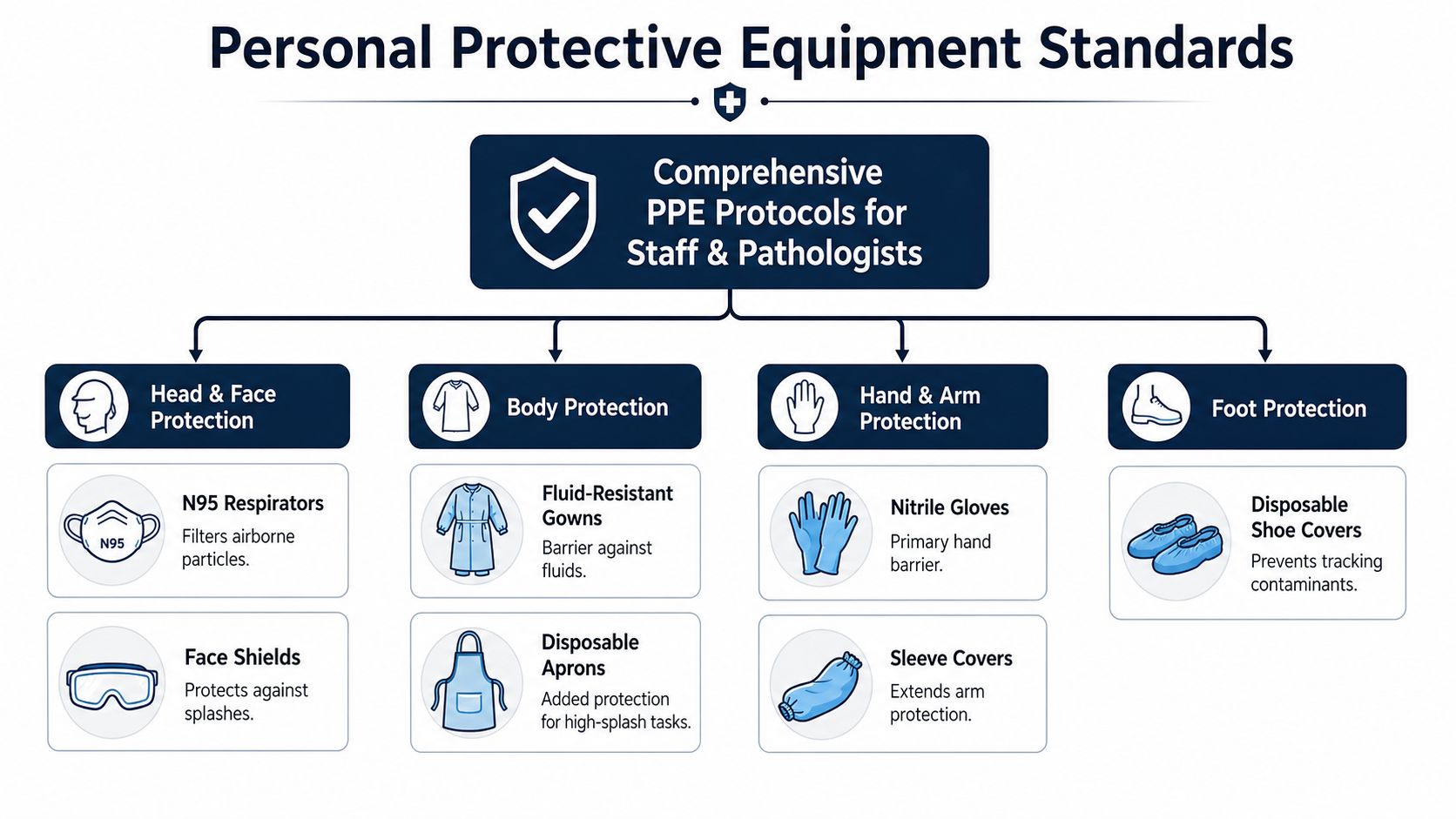
In forensic pathology, the baseline is higher than many families expect. Gloves alone do not address splash to the eyes, contamination of clothing, or the possibility that an outer glove fails during dissection. For higher-risk postmortem work, staff may use water-resistant or waterproof gowns, respiratory protection such as an N95, eye protection, a face shield, double gloves, and controlled footwear or shoe covers, depending on the procedure and suspected infectious risk.
Each piece serves a separate purpose. Respiratory protection reduces inhalation exposure. Goggles and face shields protect mucous membranes from droplets and bone dust. Double gloving gives the examiner a second barrier if the outer glove is cut or heavily contaminated. Fluid-resistant outerwear keeps blood and other body fluids from soaking through to scrubs or skin.
In private autopsy practice, consistency matters as much as the equipment itself. I am less reassured by an impressive cart of supplies than by a team that knows exactly when to change gloves, when to add face protection for an oscillating saw, and when a transport container has to be treated as contaminated on contact. Readers who want more background on occupational exposure can review our guide to bloodborne pathogen precautions.
What full protection includes
The right setup depends on the procedure, but the basic framework is straightforward:
| Protection area | Common purpose in autopsy practice | Typical concern addressed |
|---|---|---|
| Respiratory | N95 respirator when inhalation exposure is possible | Aerosolized particles and bone dust |
| Eyes and face | Goggles or full face shield | Splashes, droplets, and particulate debris |
| Torso and limbs | Fluid-resistant or waterproof gown, with added barriers for heavy exposure cases | Blood and body fluid contact |
| Hands | Double gloves, with glove changes during contaminated steps | Sharps injury, puncture, and outer glove failure |
| Feet | Shoe covers or designated autopsy-room footwear | Tracking contamination beyond the work area |
One avoidable failure point is the sequence. PPE has to be donned before exposure begins, adjusted when the procedure changes, and removed in a way that does not transfer contamination to the face, clothing, or clean surfaces. In a private facility, that discipline has to hold across the entire chain of custody, from receiving and examination to packaging specimens and returning the decedent for release.
PPE works only when it is chosen for the procedure, worn correctly, and removed with the same care used during the examination.
How Our Facility Design Ensures Containment
A family may never see the engineering behind a private autopsy. They should still know it is there, because room design carries part of the infection-control burden before a case even begins.
Airflow is a safety tool
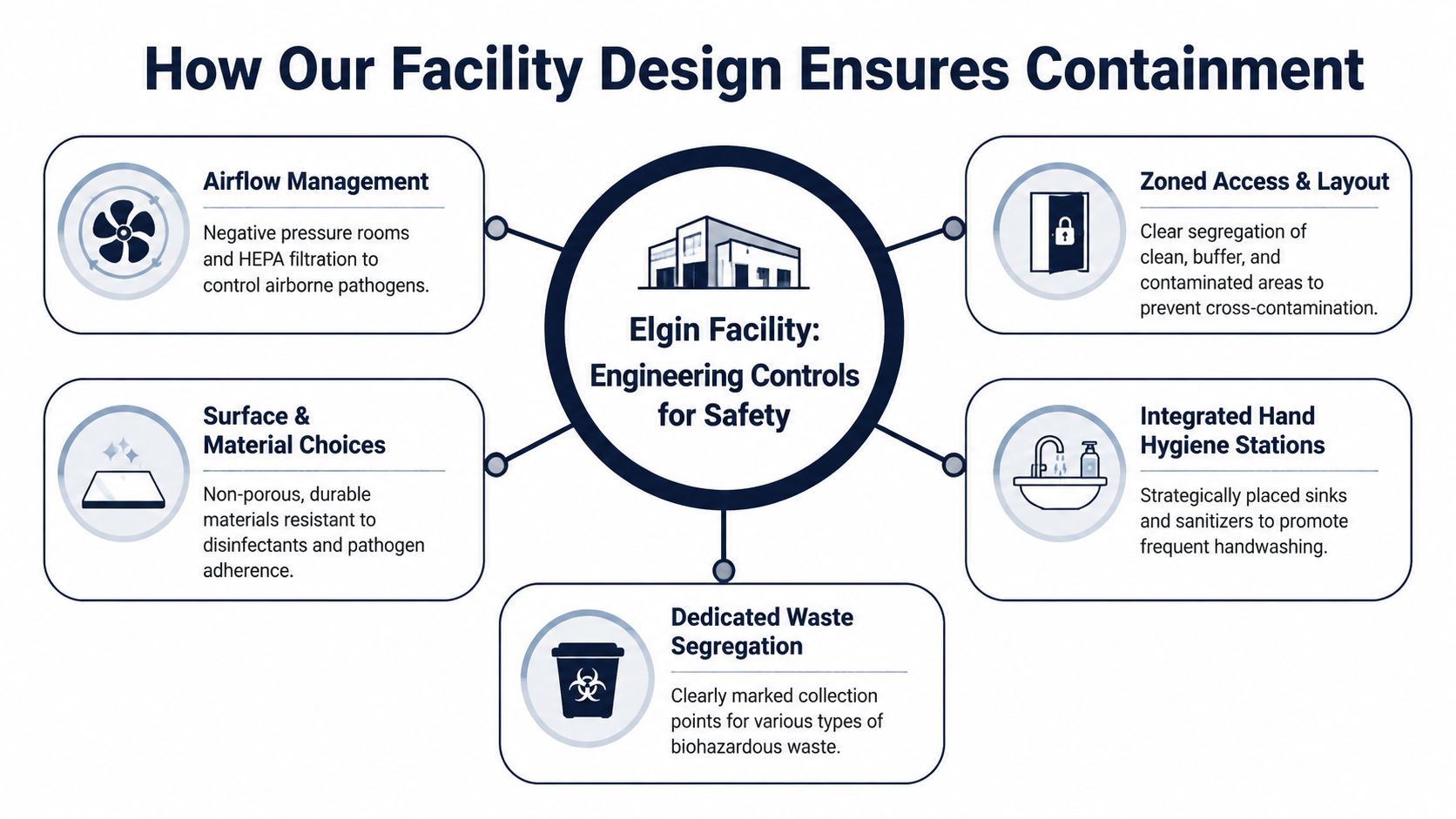
In autopsy practice, airborne risk is handled first by the room. For infective or suspected infective cases, the examination space needs negative pressure relative to adjacent areas so air moves into the room instead of drifting out into hallways, offices, or specimen-handling areas. As noted earlier, accepted autopsy engineering guidance also calls for frequent air exchange and controlled exhaust to reduce aerosol spread during procedures that generate droplets, bone dust, or fine particulate matter.
That matters more in private forensic work than many general articles acknowledge. A hospital may have multiple isolation areas and a large facilities department. A private autopsy service has to build containment into the specific room where the examination occurs, then maintain that performance case after case without relying on the surrounding building to compensate for weak design.
Readers who want a broader view of how these spaces are planned can review our discussion of forensic pathology laboratory design and workflow.
Containment depends on room design and controlled workflow
Containment also depends on how people and materials move through the space. The room has to support a clear path from intake to examination to specimen packaging, with separation between cleaner surfaces, active procedure zones, and waste staging. Sinks and handwashing stations need to be immediately accessible. Finishes on walls, counters, and floors must tolerate repeated chemical disinfection without cracking, absorbing fluids, or trapping debris in seams.
In my field, I pay close attention to small design failures because they become exposure problems under pressure. A poorly placed door, an awkward specimen pass-off point, or a surface that cannot be fully disinfected creates workarounds. Workarounds are where contamination control starts to break down.
The transport piece also changes the design requirements. In a private autopsy practice serving cases across a wide geographic area, decedents may arrive after long-distance vehicle transport, temporary holding, or handoff between agencies. That means the receiving area, cooler access, and exam room cannot be treated as separate safety questions. They are one containment system, and each part has to limit spread to the next.
This short visual overview helps illustrate why airflow and room planning are central to containment.
Good facility design reduces reliance on memory, speed, and improvised judgment. It gives staff a controlled environment for difficult cases and gives families and attorneys a clearer answer when they ask how exposure risks are kept contained.
Decontamination and Waste Management Protocols
The highest-risk moment is often after the examination, when the room looks calmer than it is. Blood droplets may be on a light handle, a scale control, or the outside of a waste container. In private autopsy practice, where a case may arrive after long-distance transport and move through a smaller, tightly controlled facility, decontamination has to clear every touchpoint back to a known safe state before the next person enters.
Instrument reprocessing is a sequence
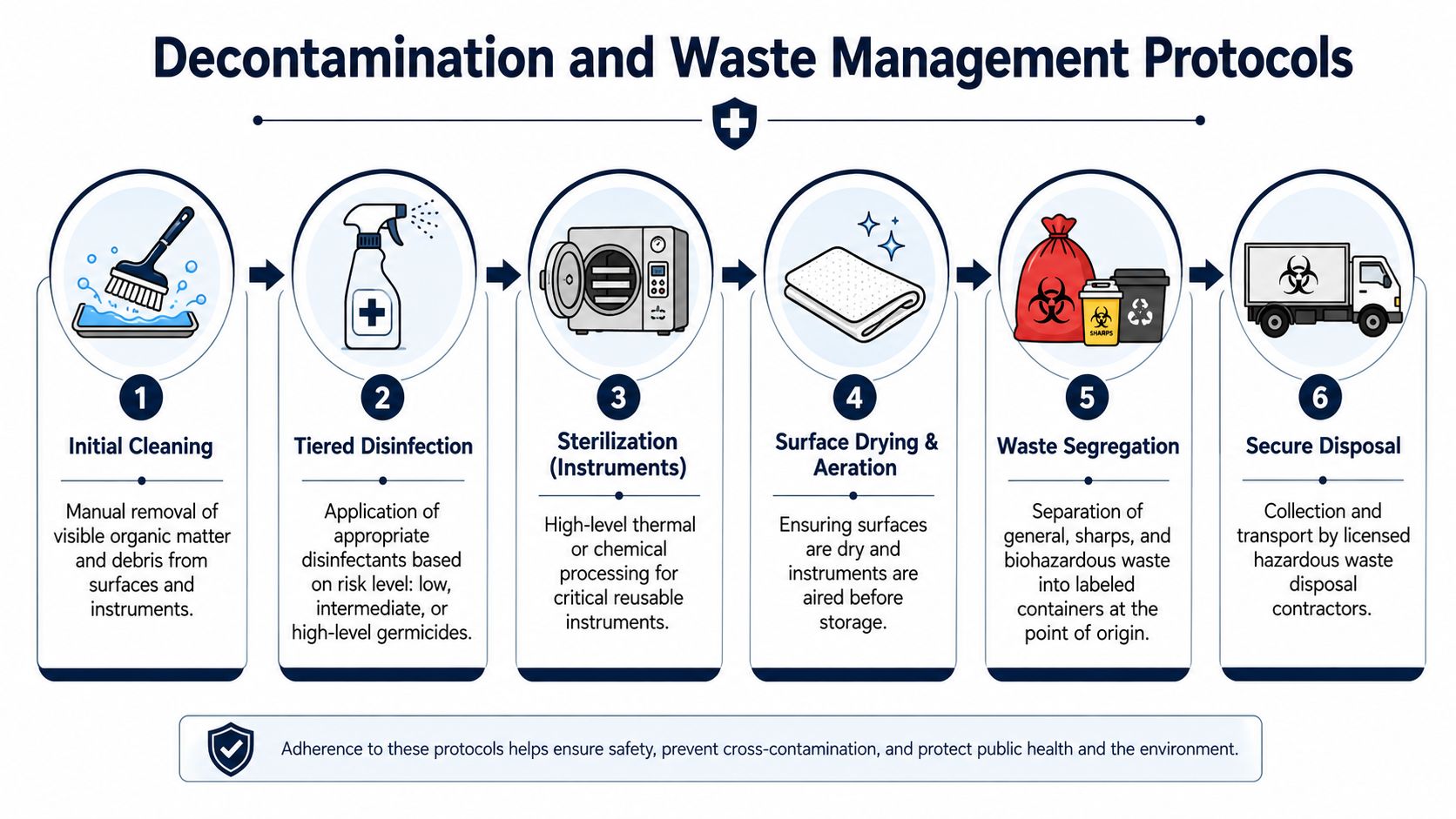
Forensic protocols describe a two-step decontamination process for instruments used in known or suspected infectious cases. Instruments are first immersed in an enzymatic cleaner or detergent for at least 10 minutes, then rinsed and soaked again in 5.25% sodium hypochlorite (a 1:10 bleach solution) or 2% aqueous glutaraldehyde for an additional 10 minutes (forensic infection control protocol review).
Each step has a separate job. The first loosens and removes organic material. The second disinfects the cleaned surface. If visible debris remains on the instrument, the disinfectant has less direct contact with the metal, joints, and serrated edges that matter most.
I do not treat all instruments the same after a case. Hinged tools, saw components, suction attachments, and any item with textured surfaces need closer inspection because debris hides there. In a private facility, that detail matters even more because the same instrument set may support cases from multiple jurisdictions over a short time span. Turnover has to be disciplined, not merely fast.
Surface decontamination also has to match the event. The same forensic guidance describes lower chlorine concentrations for pre-examination preparation, higher concentrations after the case, and a stronger response for visible spills. That graded approach fits real practice better than using one product strength for every surface and every stage of work.
Readers who want a clearer picture of specimen disposal after collection can review our explanation of what happens to blood after testing. It shows how disposal decisions connect to labeling, storage, and documented release.
Spill response must be immediate and structured
A biological spill needs containment, correct disinfectant strength, and enough contact time to work. The affected area should be covered with blotting material, treated with a higher-strength chlorine disinfectant, and held out of routine traffic before final cleaning. The common mistake is impatience. Staff see the liquid removed and assume the hazard is gone.
A practical spill response usually follows this order:
- Control the area so contamination is not tracked onto floors, door hardware, carts, or paperwork.
- Use the disinfectant intended for spill cleanup rather than the nearest bottle at hand.
- Allow full contact time before wiping, rinsing, or reopening the area.
- Discard cleanup materials into the correct biohazard stream with the same attention given to other contaminated disposables.
The most common failure is shortening contact time.
Waste management has to be just as deliberate. Sharps go into puncture-resistant containers at the point of use. Saturated disposables, absorbent materials, and contaminated single-use items are bagged and contained before they leave the room. Reusable bins and carts need cleaning, too. People often focus on the red bag and miss the lid, wheels, or handle that carried it.
In private autopsy operations, waste control also has a facility and logistics component that hospital-based articles often skip. Containers need secure staging areas, a clean route out of the examination space, and documented handoff to licensed disposal services. The planning principles are similar to those used in an expert guide to laboratory moving. High-risk materials stay controlled when movement paths, containment, and handoff points are decided before anyone starts carrying them.
Safety and documentation should support each other. If a family member or attorney asks how a case was handled, the answer should include where contaminated waste was placed, who transferred it, how instruments were reprocessed, and when the room was cleared for reuse.
Ensuring Safety During Transport and Storage
Private autopsy practice has a challenge many general infection control articles overlook. The body may travel a long distance before examination. In Texas, that can mean removal from a home, hospital, nursing facility, funeral establishment, or county location, then transport across a wide geographic area to secure storage and examination.
The first checkpoint happens before arrival
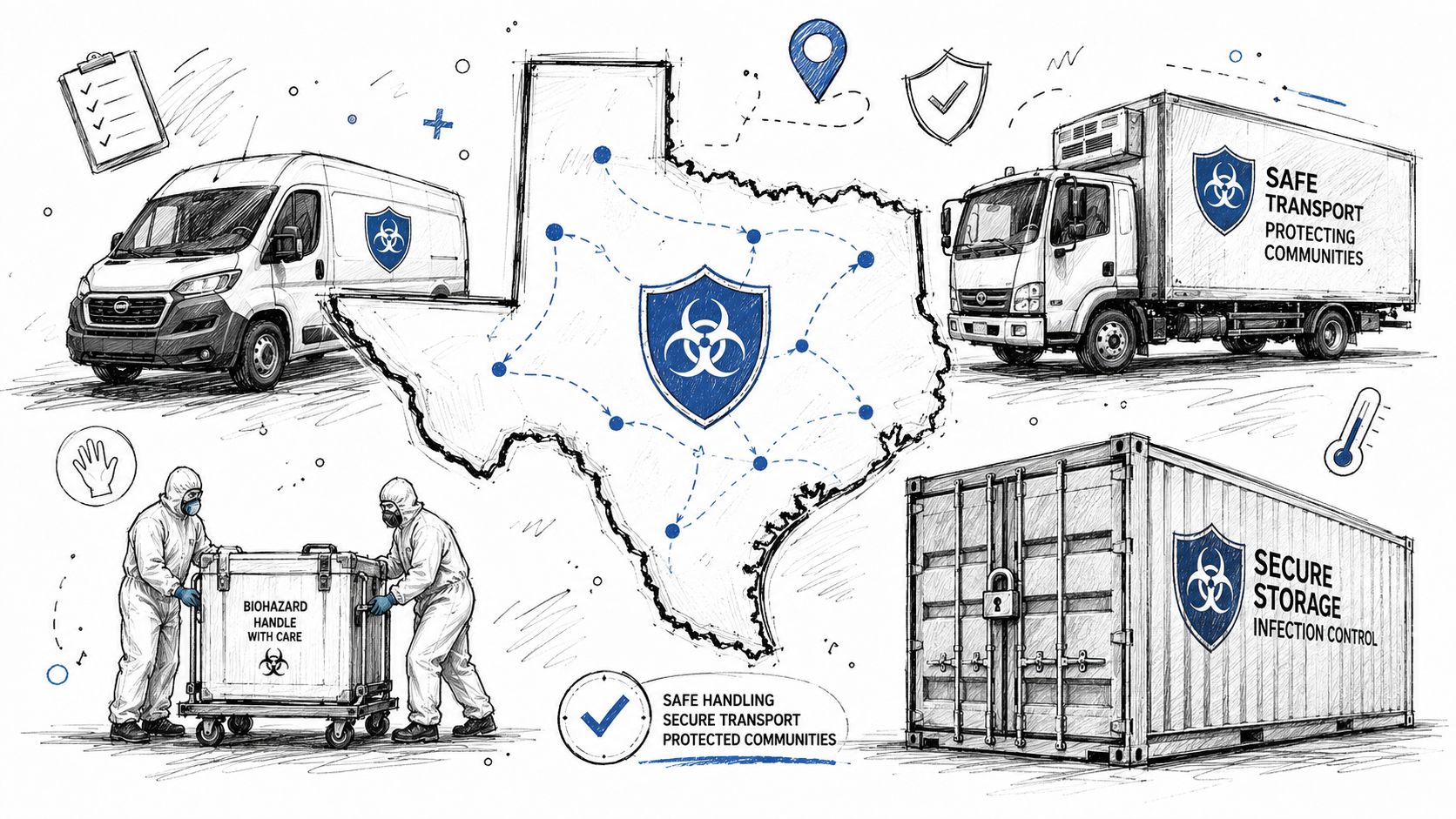
Transport is not just movement. It is an infection control phase. Packaging, transfer surfaces, vehicle touchpoints, and receiving procedures all matter. This is one reason non-hospital handling deserves more attention than it usually gets.
The National Library of Medicine material provided in the background literature notes a gap in guidance for movement and handling outside traditional clinical rooms, including transport-related transmission concerns in non-hospital environments (National Library of Medicine resource). In private autopsy work, that gap is practical, not academic.
The first formal checkpoint after arrival is often the external examination. Standard forensic protocols require documentation of visible injuries, medical interventions, and signs of infection before internal work begins, treating that step as the primary barrier assessment for biohazards (external examination forensic protocol discussion).
Storage must preserve both containment and dignity
Secure storage serves two goals at once. It preserves the decedent respectfully, and it maintains controlled conditions before examination, release, or transfer. In a properly managed setting, containment measures continue during storage rather than restarting only when staff re-enter the case.
This usually includes:
- Controlled intake documentation: Identity, seals, transport records, and receiving condition are logged to preserve chain of custody.
- Protected storage environment: Temperature-controlled holding and limited-access handling reduce unnecessary movement and contamination opportunities.
- Vehicle and equipment cleaning: Stretchers, handles, interior contact points, and reusable transport equipment require routine decontamination before the next case.
Professionals outside medicine sometimes understand this best when they think about specialized logistics. For example, this expert guide to laboratory moving gives a useful parallel. Sensitive material transport is safe only when handling, containment, and documentation are planned together.
In plain language, cause of death means the disease or injury that led to death. Manner of death means the category of how the death occurred, such as natural, accident, suicide, homicide, or undetermined. Infection control does not determine those findings by itself, but it helps preserve the conditions needed to examine the body and any evidence reliably.
Our Commitment to Training and Auditing
A private autopsy is safest when the team performs routine steps correctly even after a long transport, a late-night arrival, or a case that raises concern for an infectious disease. Families and attorneys rarely see that part of the work. I do, and it matters.
Written procedures set the standard, but repetition is what makes them reliable in practice. In our setting, training covers the points where errors occur: putting on and removing PPE without self-contamination, handling sharps during dissection, separating clean and dirty zones, managing spills, processing waste correctly, and reporting an exposure without delay. Those are not abstract hospital rules. They have to work in the realities of private autopsy practice, where cases may arrive from different parts of the state, staff may work across transport and facility roles, and the receiving environment must stay controlled from intake through final release.
Auditing serves a different purpose. It checks whether the protocol being followed on paper is still the protocol being followed at the table, in the prep area, and during room turnover. Small deviations are the ones that concern me most. A glove change happens late. Contact time on a disinfectant is shortened. A specimen container is set down in the wrong area. None of those errors looks dramatic by itself. Repeated over time, each one weakens containment.
Public health guidance has long treated hand hygiene, environmental cleaning, and consistent infection prevention systems as foundational parts of safe practice. The lesson applies here even though private autopsy work differs from hospital care in obvious ways. We do not rely on patient-room workflows or nursing-unit oversight. We rely on trained personnel, controlled facility design, disciplined documentation, and direct review of how the work is performed.
That review has to be specific.
A credible program includes competency checks, documented refreshers, incident review, and correction when a process slips. In a private autopsy facility, auditing also has to examine the points general articles often skip: how transport staff hand off a case after statewide movement, whether packaging and exterior surfaces are handled correctly on receipt, whether airflow and room separation are functioning as intended, and whether cleaning logs match observed practice. If those engineering and workflow controls are not verified, the written protocol gives false reassurance.
Good safety culture is quiet. It shows up in repeatable habits, clean documentation, and a team that does the same careful work on an ordinary case as on the one everyone is worried about.
Frequently Asked Questions
Is it safe to have funeral viewing after an autopsy involving infection
That depends on the infectious concern, the condition of the body, funeral home planning, and applicable public health requirements. There is no single answer for every pathogen. In general, safe decisions require coordination among the pathologist, funeral director, and any governing authority involved. Families should not assume that one infectious diagnosis automatically prevents all viewing, but they also should not rely on general advice from unrelated situations.
How are personal effects protected from contamination
Personal effects should be handled as separate property items, not casually mixed with medical or biohazard waste. If an item is visibly contaminated, it requires controlled handling and clear documentation. The goal is to protect both the family's property and the integrity of the case record.
What do cause of death and manner of death mean
Cause of death is the medical reason a person died, such as a disease or injury. Manner of death is the classification of how the death occurred. In Texas cases, those categories generally include natural, accident, suicide, homicide, or undetermined. A private autopsy may help clarify both, but the final legal certification process can also involve the justice of the peace, medical examiner, or other authorized official depending on the case.
How are highly contagious or unusual cases handled
Higher-risk cases require stricter controls. That may mean increased PPE, tighter room containment, modified instrument handling, stricter waste segregation, and coordination with public health or other authorities when required. No responsible practice should treat unusual infectious risk as routine.
What does chain of custody mean in a private autopsy case
Chain of custody means the documented record of who received, transported, stored, examined, sampled, and released the body and related evidence. For attorneys and courts, this record helps show that the findings are tied to a controlled and traceable process rather than informal handling.
If your family, agency, or legal team needs clear guidance about autopsy safety, transport, or postmortem documentation, contact Texas Autopsy Services. We serve all 254 Texas counties, and every examination is performed by a board-certified forensic pathologist. Our team can explain the process in plain language, including chain of custody, Texas legal considerations, and what to expect in a private or second-opinion autopsy.