July 18, 2026 · Texas Autopsy Services
Bloodborne Pathogen Precautions in Forensic Practice
Learn essential bloodborne pathogen precautions our forensic pathologists use for safety during autopsy and transport, compliant with OSHA standards.
On this page
- Our Unwavering Commitment to Safety
- The Foundation of Safety Universal and Standard Precautions
- Personal Protective Equipment The First Line of Defense
- Engineering and Work Practice Controls in Our Facility
- Decontamination Transport and Waste Handling
- Responding to an Exposure Incident
- Frequently Asked Questions About Autopsy Safety
- We treat every decedent as potentially infectious because forensic work often begins before a full medical history is available.
- Modern bloodborne pathogen precautions in autopsy practice rest on CDC universal precautions and the OSHA Bloodborne Pathogens Standard, not guesswork.
- Protection depends on layers: PPE, engineering controls, work practices, decontamination, transport protocols, and immediate exposure response.
- Forensic transport creates risks that hospital guides often miss, especially when cleaning leather goods, vehicle interiors, and transport equipment after exposure.
- If an exposure occurs, medical assessment and potential PEP initiation may need to occur within 2 hours of the incident, so reporting cannot wait.
A family may be waiting for answers. An attorney may need an independent review for litigation. A county official may need a timely medicolegal examination with full chain of custody. At the same time, the case may arrive with an incomplete history, uncertain infectious status, or no reliable records at all.
That reality shapes how we approach safety. In forensic pathology, bloodborne pathogen precautions are not based on assumptions about the person who has died. They are built on a fixed rule. We use the same high standard in every case because safety, dignity, and evidentiary integrity all depend on consistency.
When people look for a forensic pathologist, private autopsy services Texas, or an independent autopsy, they often focus on cause-of-death answers. That makes sense. But those answers are only trustworthy when the examination is performed inside a disciplined medical-legal system that protects staff, preserves specimens, and maintains a clean chain of custody from transport through reporting.
Our Unwavering Commitment to Safety
A common forensic scenario is straightforward and serious. A decedent arrives for examination, but the available history is limited. The records may be delayed. Family members may still be trying to understand what happened. Legal partners may need answers quickly, but no one can safely rely on assumptions about infection status.
That is why our precautions are absolute. We do not scale protection up or down based on rumor, partial records, or whether an infectious disease is mentioned in a referral. We apply the same disciplined safeguards to every postmortem examination, every specimen, and every transport step.
This protects more than the people in the room. It protects the reliability of the entire autopsy process. A careful safety system reduces avoidable contamination, supports proper handling of tissues and fluids, and helps preserve findings for toxicology, histology, and other ancillary studies. In forensic work, safety and accuracy are tied together.
Practical rule: Consistency is safer than selective caution. The moment a team starts making exceptions based on incomplete history, risk increases.
Our work also carries an ethical obligation. Families deserve a respectful examination. Attorneys deserve objective documentation. County officials deserve procedures that align with Texas legal and regulatory expectations, including chain of custody and proper handling of human remains. Safety protocols are part of that trust.
A few plain-language terms help here:
- Cause of death means the disease or injury that led to death.
- Manner of death means the broader classification used in death investigation, such as natural, accident, suicide, homicide, or undetermined.
- Chain of custody means the documented handling of the decedent, specimens, and evidence so that each transfer is accounted for.
In private and county forensic cases alike, those concepts only hold up when the examination environment is controlled from the start.
The Foundation of Safety Universal and Standard Precautions
A decedent can arrive from a residence, a roadside scene, a nursing facility, or a county morgue several hours away. Records may be incomplete. Infectious history may be unknown. In forensic pathology, the safety decision cannot wait for perfect information. It starts the moment custody begins.
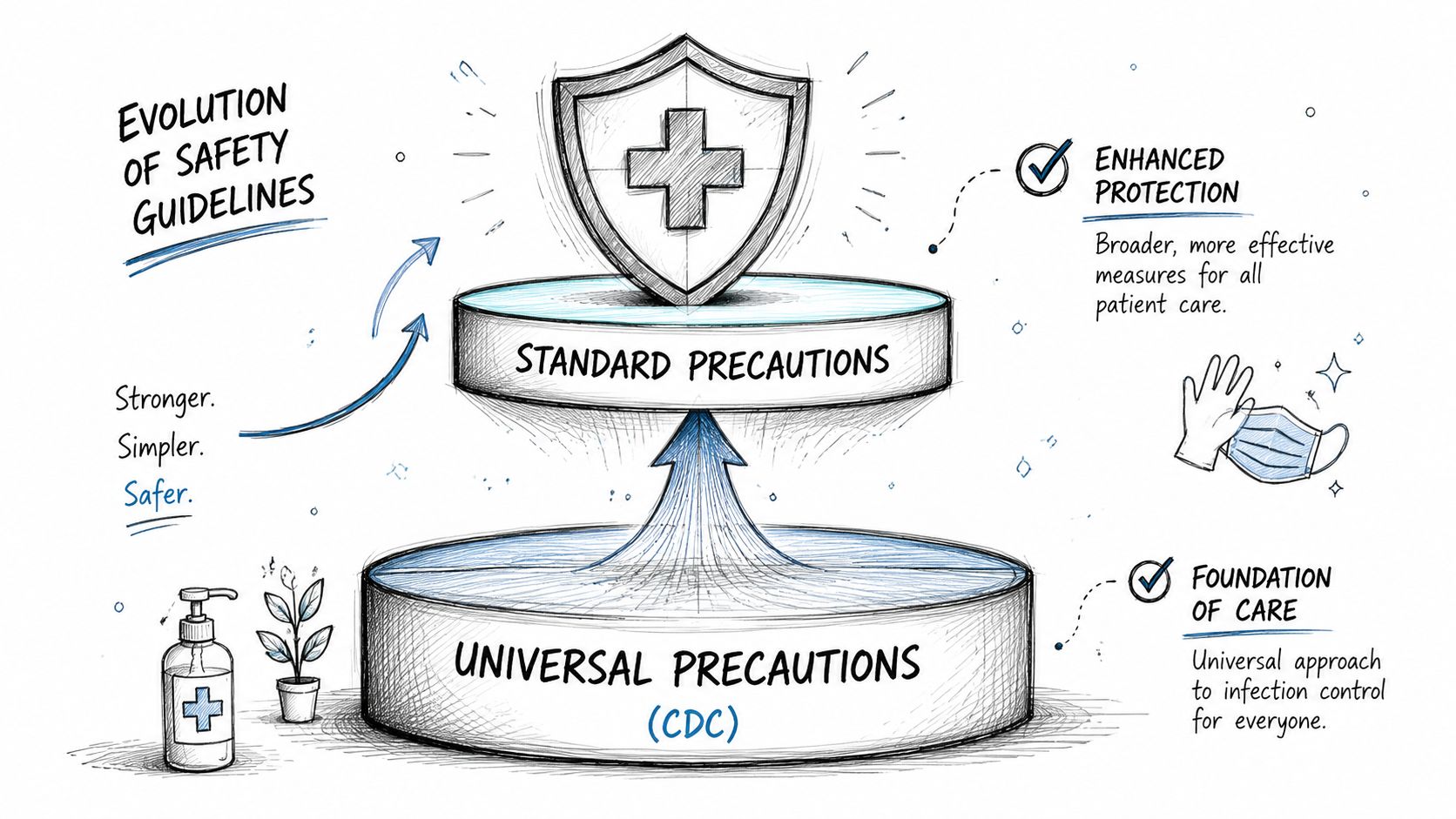
Infection control in this field did not develop as a local preference. It grew out of clear public health and workplace rules. In 1987, the Centers for Disease Control and Prevention established universal precautions, directing healthcare personnel to treat blood and certain body fluids as potentially infectious, as described in this CDC history of universal precautions.
Why every case starts with the same assumption
In our practice, universal and standard precautions mean every case is handled as if blood and other potentially infectious materials can transmit disease. That rule applies in the autopsy suite, during specimen packaging, and during statewide transport, where personnel may be receiving or transferring remains long before laboratory confirmation or medical history is complete.
That consistency protects staff, but it also protects the case.
Forensic work carries a problem that standard hospital guides often leave out. Postmortem procedures can involve decomposition, traumatic injury, prolonged transport, fluid leakage, evidence preservation, and multiple custody transfers between scene personnel, transport teams, funeral professionals, and legal authorities. A selective approach to precautions creates avoidable exposure risk and increases the chance of contamination that can complicate documentation, testing, and later testimony.
We use one standard because the safer rule is also the more reliable forensic rule. Families deserve careful handling. Attorneys and courts need findings that were developed in a controlled environment. The discipline behind precautions supports both.
What required precautions look like in practice
The OSHA Bloodborne Pathogens Standard requires employers to maintain an exposure control plan, offer hepatitis B vaccination to covered employees, provide post-exposure evaluation and follow-up, and train workers who may encounter blood or other potentially infectious materials. OSHA outlines those workplace requirements in its Bloodborne Pathogens Standard and related guidance.
Hand hygiene is part of that system, but in forensic settings it has to be paired with timing and judgment. Soap and water are used after glove removal and whenever contamination is visible. Alcohol-based hand rubs are useful in support areas or during transport transitions when sinks are not immediately available, provided the product meets CDC guidance for alcohol content, as explained in the CDC guidance on hand sanitizer use. For teams that keep a field kit, products such as Living Air sanitizer from EcoQuest can serve as an adjunct, but they do not replace proper washing after direct contamination.
Protective measures must also match the task. The clothing and barrier choices used during intake, transfer, external examination, and autopsy are different in degree, even though the underlying precaution is the same. We outline those task-based choices in our guide to what forensic pathologists wear during examinations and autopsies.
- Universal precautions set the default assumption that blood and specified body fluids may be infectious.
- Standard precautions apply that same discipline to routine handling, hygiene, and exposure prevention across the case workflow.
- OSHA compliance requires those steps to be written, trained, documented, and followed consistently.
In forensic pathology, safety is part of accuracy. A controlled process reduces exposure risk, limits preventable contamination, and helps preserve the integrity of postmortem findings from intake through final reporting.
Personal Protective Equipment The First Line of Defense
The first visible layer of bloodborne pathogen precautions is personal protective equipment. In autopsy work, that layer has to match the actual hazards of the room, including sharp instruments, fluid exposure, splashes, and contamination of clothing or footwear.
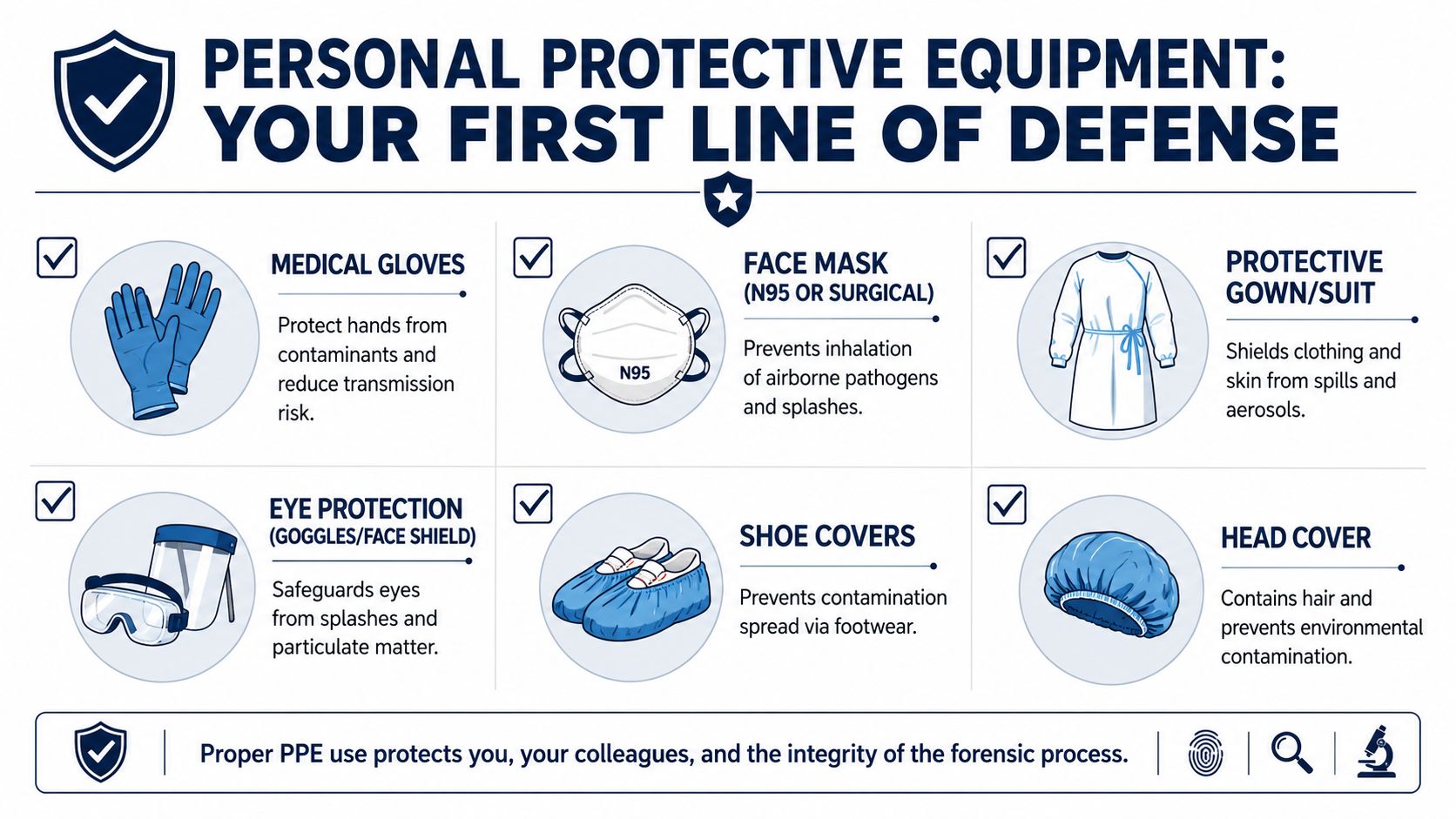
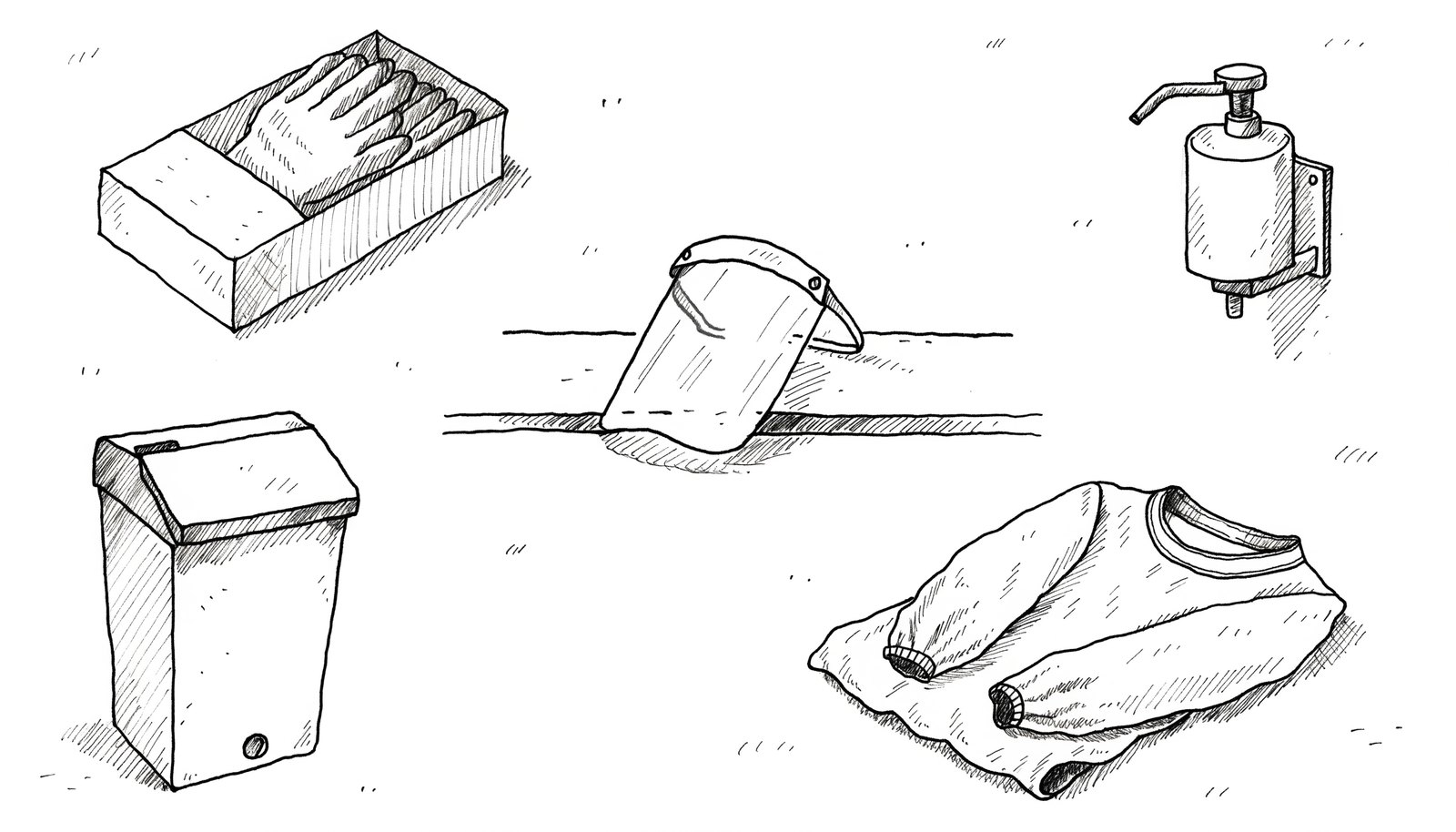
At the forensic autopsy level, complete protective wear includes waterproof gowns, forearm protection, goggles or face shields, caps, and shoe covers. Use of self-contained scalpel-blade removal devices is also critical because sharp injuries are the primary exposure route in this setting, as described in this forensic autopsy infection control review.
What complete protective wear means in forensic work
Each item has a specific function. Waterproof outerwear protects the torso and underlying clothing from fluid penetration. Forearm protection matters because sleeves and glove cuffs are frequent exposure points during dissection and specimen handling. Eye and face protection shield mucous membranes from splashes. Caps and shoe covers reduce environmental contamination and limit what leaves the room with the examiner.
A practical reference on apparel and barriers in this setting appears in our discussion of what forensic pathologists wear. The details matter because “wearing PPE” is not the same as wearing the right PPE for the task.
Gloves alone are not full protection in an autopsy suite. Splash risk, sharp risk, and contaminated surfaces require a complete barrier approach.
This training video gives a useful visual example of PPE principles in practice.
How PPE fails when the process fails
Most PPE failures are process failures. The equipment may be present, but the sequence is wrong. A face shield removed with contaminated gloves, a gown cuff left exposed, or damaged footwear used for convenience can undermine the entire barrier system.
Common failure points include:
- Incomplete coverage: Leaving wrists, lower legs, or facial areas exposed during splash-generating procedures.
- Improper removal: Touching contaminated outer surfaces during doffing and transferring material to skin or scrubs.
- Reuse of damaged gear: Continuing with compromised PPE rather than disposing of it immediately.
- Wrong respiratory protection: For airborne tuberculosis concerns, a surgical mask is not an adequate substitute for an N-95 respirator or HEPA mask.
The same principle applies outside the autopsy suite. Anyone handling blood or body fluid contamination in the field needs task-specific protective measures and disciplined cleanup methods. For readers comparing forensic precautions with scene remediation standards, this guide to proper body fluid spill cleanup helps show why casual household cleaning methods are not enough.
Engineering and Work Practice Controls in Our Facility
A forensic suite is tested long before an incision begins. A decedent may arrive after transport across county lines, after scene release delays, or with personal effects, evidence packaging, and family questions all tied to the same case. Safety controls have to protect staff, preserve specimen integrity, and support a defensible chain of handling at the same time.
That is the standard in our practice.
Engineering controls are the physical safeguards built into the facility and the equipment. Work practice controls are the required methods staff follow so those safeguards operate effectively under case pressure. In forensic pathology, both matter because postmortem work brings splash risk, sharps risk, specimen movement, and evidentiary responsibilities into one environment.
Built-in controls that reduce exposure risk
The room has to be arranged for safe action, not good intentions. Sharps containers are placed at the point of use so a blade is discarded immediately, not carried across the room. Handwashing stations are kept accessible. Clean areas, intake areas, and contaminated work zones are separated and kept that way throughout the case.
We also control storage and movement before and after examination because exposure prevention and case accuracy are linked. A poorly managed transfer or holding process can create leakage risk, surface contamination, and questions about specimen condition. Our discussion of temperature-controlled storage for forensic cases explains why environmental control supports both safety and evidentiary reliability.
Key facility controls include:
- Sharps containment: Blades, needles, and other sharps go directly into puncture-resistant containers located where they are used.
- Safer instrument selection: Devices that reduce hand-to-hand transfer and unnecessary manipulation of exposed sharps are preferred whenever the procedure allows.
- Accessible wash stations: Staff can wash or decontaminate without leaving the work area unsecured or delaying response to contamination.
- Specimen containment: Fluid and tissue samples are placed in secure, lidded containers to reduce leakage during internal movement and later transport.
Daily work practices that keep those controls effective
A well-designed room still fails if staff bypass procedure. For that reason, our work practices are strict, consistent, and documented.
Some rules are absolute:
- No eating or drinking in the autopsy area.
- No recapping, passing, or setting down sharps casually.
- No case handling by personnel with skin conditions or open wounds that compromise the protective barrier.
- No assumption that a dry or visually clean surface is safe.
Hand hygiene remains a required control, not a courtesy step. Staff wash with soap and water when indicated and after glove removal, contact with contaminated material, or any task that could transfer biologic material outside the controlled area. The CDC handwashing guidance gives the specific method and timing.
In forensic work, discipline protects more than staff. It protects the quality of the examination, the reliability of findings, and the confidence families and legal partners place in the case record.
Decontamination Transport and Waste Handling
A case does not become safe once the examination ends. In forensic pathology, the risk often shifts from the table to everything that follows. Instruments must be decontaminated, specimens must stay secure across long transport routes, and waste must leave the facility without exposing staff, couriers, law enforcement personnel, or funeral partners.
Cleaning the autopsy environment after the examination
Postmortem cleanup has two goals at the same time. It reduces exposure risk, and it protects the integrity of the case record. A surface that is only wiped down casually can leave biological material behind. A specimen that is packaged carelessly can leak, degrade, or arrive with its chain of custody in question.
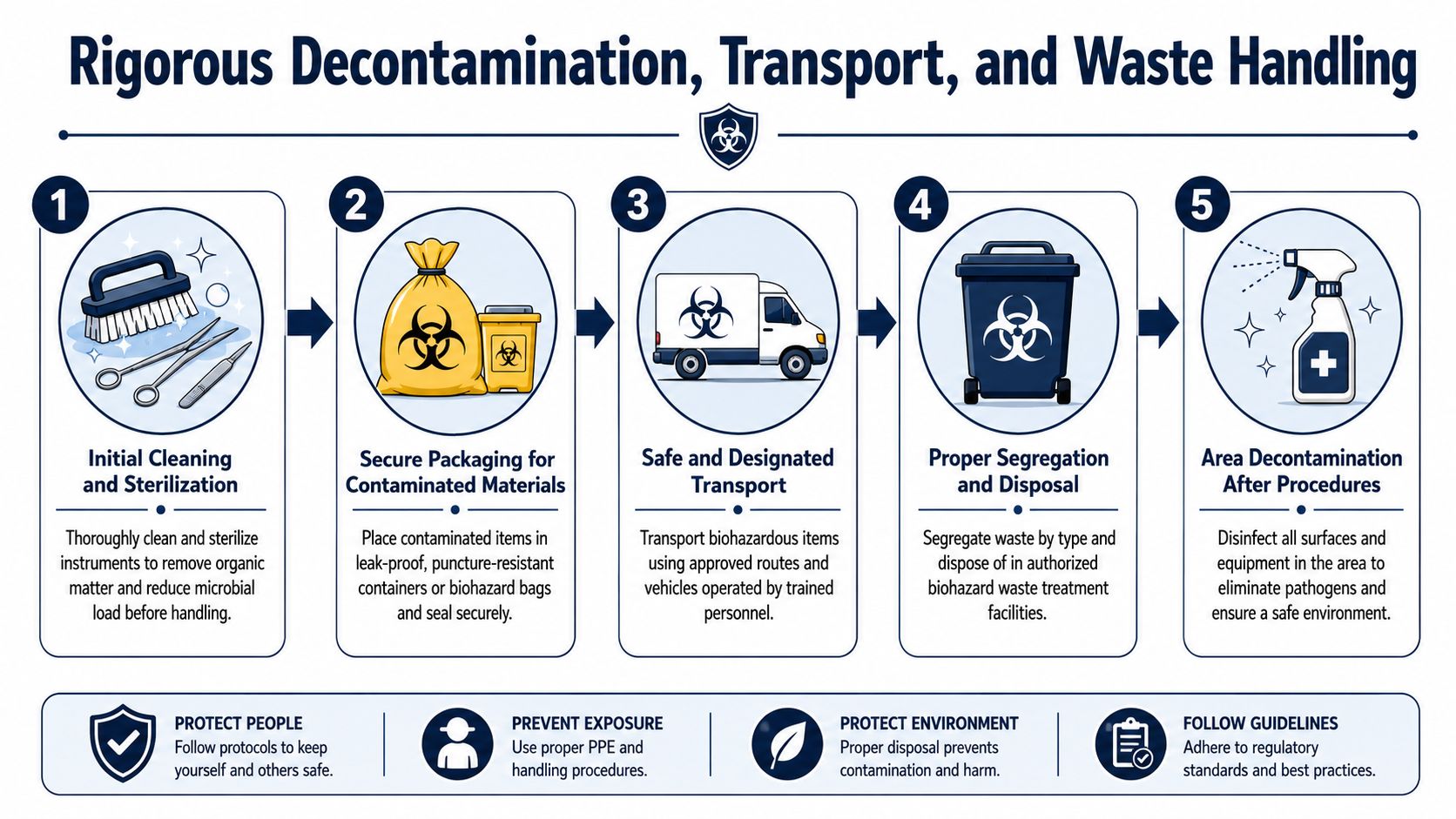
For that reason, decontamination is prompt, methodical, and documented. Instruments are cleaned and disinfected using the agent and contact process specified by protocol for the material involved. Work surfaces, splash zones, reusable equipment, and high-touch contact points are addressed in a defined sequence so nothing is missed because a room merely looks clean.
Specimens require the same discipline. Blood, tissue, and other retained materials go into secure, well-constructed, lidded containers before they leave the controlled area. That protects staff handling the specimen later and preserves material for toxicology, histology, and any later legal review. Families and attorneys often ask what happens after testing is complete. Our overview of what happens to blood after testing explains that process in more detail.
A standard post-case sequence includes:
- Cleaning and disinfecting instruments according to facility protocol.
- Decontaminating exposed work surfaces and equipment that came into contact with blood or tissue.
- Packaging retained specimens in sealed, labeled containers suitable for storage or transport.
- Separating regulated waste from reusable materials and ordinary trash.
- Inspecting the room and equipment before the area is released for the next case.
Transport risks that standard hospital guides often miss
Forensic transport creates problems that hospital guidance often does not address in practical terms. A hospital specimen may move down one hallway. Our cases may travel across counties or across the state, through vehicles, transfer points, refrigeration areas, and receiving facilities. Every handoff creates another chance for leakage, contamination, or a break in documentation.
The transport environment is harder to control than the autopsy suite. Stretchers, cot rails, straps, vehicle flooring, loading handles, and door surfaces can all become contaminated during movement of remains. Staff footwear and utility belts can also pick up biologic material during loading and unloading. If those items are not cleaned correctly before the next transport, contamination follows the route.
Material type matters. The American Red Cross advises that leather goods exposed to blood should be scrubbed with soap, a brush, and hot water, as stated in this Red Cross bloodborne pathogen fact sheet. That guidance applies directly to forensic transport because boots, belts, and certain equipment components do not disinfect the same way as non-porous plastic or metal surfaces.
Our transport cleanup standards account for those differences:
| Surface or item | Required handling approach |
|---|---|
| Non-porous equipment | Clean and disinfect all contaminated contact areas according to protocol |
| Lidded specimen containers | Confirm seal integrity, labeling, and exterior cleanliness before departure and on receipt |
| Leather goods | Scrub with soap, a brush, and hot water after blood exposure |
| Vehicle contact areas | Clean handles, rails, straps, flooring, and other touched surfaces, not only visibly soiled spots |
Waste handling follows the same principle. Regulated medical waste is contained, separated, and removed under biohazard procedures that protect everyone who encounters it after the autopsy team does. In forensic practice, careful decontamination, careful transport, and careful waste control all support the same outcome. Staff safety is protected, specimen quality is preserved, and the findings remain reliable for the families and legal cases that depend on them.
Responding to an Exposure Incident
Even with strict precautions, every forensic practice needs a clear response plan for cuts, needlesticks, or splashes. When an exposure happens, hesitation creates risk.
The first minutes after an exposure
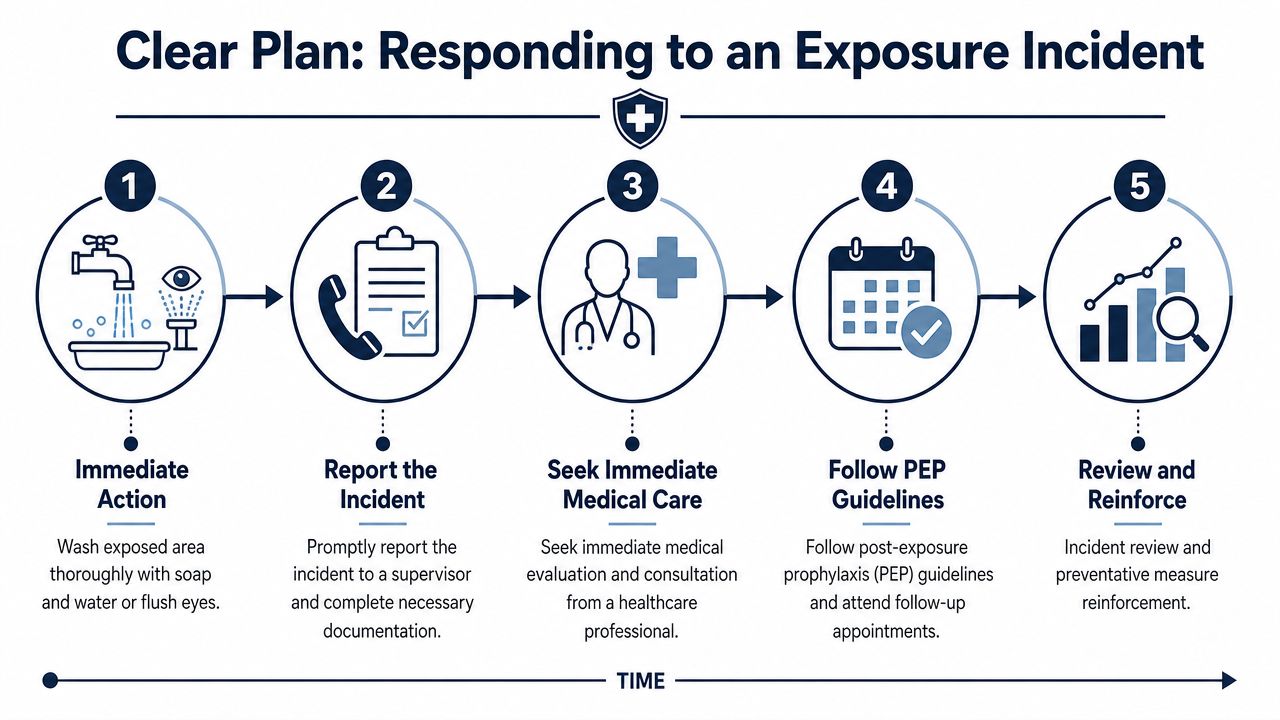
The immediate steps are practical and direct. If skin is exposed through a needlestick or cut, the area should be cleaned with soap and water or skin disinfectant. If mucous membranes are exposed, the area should be flooded with water promptly. The incident then needs to be reported to the employer and appropriate medical services without delay.
The sequence matters:
- Clean first: Flush or wash the exposed area immediately.
- Report promptly: Do not wait until the end of the case or shift.
- Escalate medically: Exposure follow-up is not a paperwork task. It is a medical event.
Report first aid and the incident on the same timeline. Delayed reporting can delay treatment.
What follow-up must happen next
Post-exposure evaluation and follow-up must be available at no cost to the employee under OSHA requirements. The employer also must maintain records and document training. For susceptible workers exposed to hepatitis B risk, post-exposure prophylaxis with hepatitis B vaccine and hepatitis B immunoglobulin is described as highly effective when given promptly in the OSHA-linked medical guidance already cited earlier.
There is one timing point that deserves special emphasis. Medical assessment and potential PEP initiation may need to occur within 2 hours of exposure, a critical window noted in this occupational exposure review. In forensic work, that means no one should treat an exposure as something to address after other duties are completed.
The reason is practical. A calm, immediate response protects the affected worker and preserves clear documentation of what happened, when it happened, and what follow-up was started.
Frequently Asked Questions About Autopsy Safety
Does a private autopsy increase risk to the family
No. Families are not exposed because an autopsy is performed. The risks addressed in bloodborne pathogen precautions concern professional handling of the decedent, instruments, specimens, and contaminated materials within controlled settings.
Why treat every case the same if the infectious status is known
Because forensic records are sometimes incomplete and because selective caution creates avoidable openings for error. A universal process is safer than a variable one.
Who is qualified to perform an autopsy with medicolegal implications
For medical, legal, or evidentiary concerns, the key credential is board certification in forensic pathology through the American Board of Pathology, as noted in this discussion of forensic pathology credentials. That distinction matters in a cause of death investigation and in any second opinion autopsy review.
What does the physical examination include
A full autopsy examination includes an External Examination, an Internal Examination, and Ancillary Studies such as toxicology and histology, as outlined in this explanation of a pathology report example. Those steps require disciplined specimen handling and contamination control throughout.
Who can authorize a private autopsy in Texas
Authorization is limited to the legal next of kin or a designated individual with written authorization, following the priority order described in this overview of who may authorize an autopsy in Texas. Legal authority and safe handling go together. A valid examination depends on both.
For attorneys preparing demonstratives or clarifying medical findings for court, carefully prepared visuals can also help translate technical postmortem issues. This overview of expert medical visuals for litigation is a useful example of how complex forensic findings may later be presented clearly.
If you need clear guidance about a private autopsy, an independent review, or county forensic services, Texas Autopsy Services is available to speak directly with families, attorneys, medical professionals, and officials across Texas. Every examination is performed by a forensic pathologist certified by the American Board of Pathology, and our team approaches each case with medical precision, legal care, and respect for the person who has died.