August 21, 2026 · Texas Autopsy Services
How Can I Find a Lost Relative: Practical Steps That Work
Wondering how can i find a lost relative? Get a step-by-step guide covering public records, DNA, social media, and when to call in professionals.
On this page
- Starting Your Search the Right Way
- Building a Solid Case File Before You Search
- Using Official Databases and Tracing Networks
- Searching Social Media and People-Finder Tools
- DNA, Genealogy, and Forensic Identification Options
- Privacy, Legal Boundaries, and Common Roadblocks
- When to Bring in Professionals and Find Closure
A family search often starts with a name, an old photograph, and a vague memory of where someone once lived. The search becomes difficult when relatives treat it as a single trail and wait for one lead to succeed before taking the next step. That approach loses time and scatters information.
The better answer to how can I find a lost relative is to run several tracks together. Use official records, digital searches, family history, DNA resources, and legal reporting at the same time. If the person may be deceased or connected to unidentified remains, add forensic identification and death-investigation channels early rather than treating them as a last resort.
- Run parallel searches: Combine official databases, online discovery, genealogy, DNA, and legal reporting.
- Build one reliable case file: Preserve names, photographs, dates, addresses, contacts, and every search result.
- Use official systems early: NamUs, law-enforcement databases, vital-records offices, and the Red Cross or Red Crescent tracing network can reach records informal searches cannot.
- Treat online results as leads: People-finder data can be outdated, duplicated, or attached to the wrong person.
- Escalate when the case involves death: Family DNA, unidentified-remains databases, forensic genetic genealogy, and independent forensic review may be necessary.
- Protect privacy and dignity: A living relative may have chosen to end contact, and searching must stay within legal and ethical boundaries.
Starting Your Search the Right Way
The core mistake is treating a lost-relative search as a linear checklist. Families wait for a police response before searching online, wait for a social-media reply before contacting a tracing service, or wait for a DNA result before gathering official records. Start those paths together.
First, establish what kind of case you have. A living relative who voluntarily ended contact requires a different approach from a person reported missing, a long-lost family branch, or a possible unidentified deceased person. Before spending heavily on searches, check recent public posts, obituaries, jail rosters, and available hospital or care-facility channels. These checks can rule out straightforward explanations, but private medical information remains protected and may not be available to family members without proper authorization.
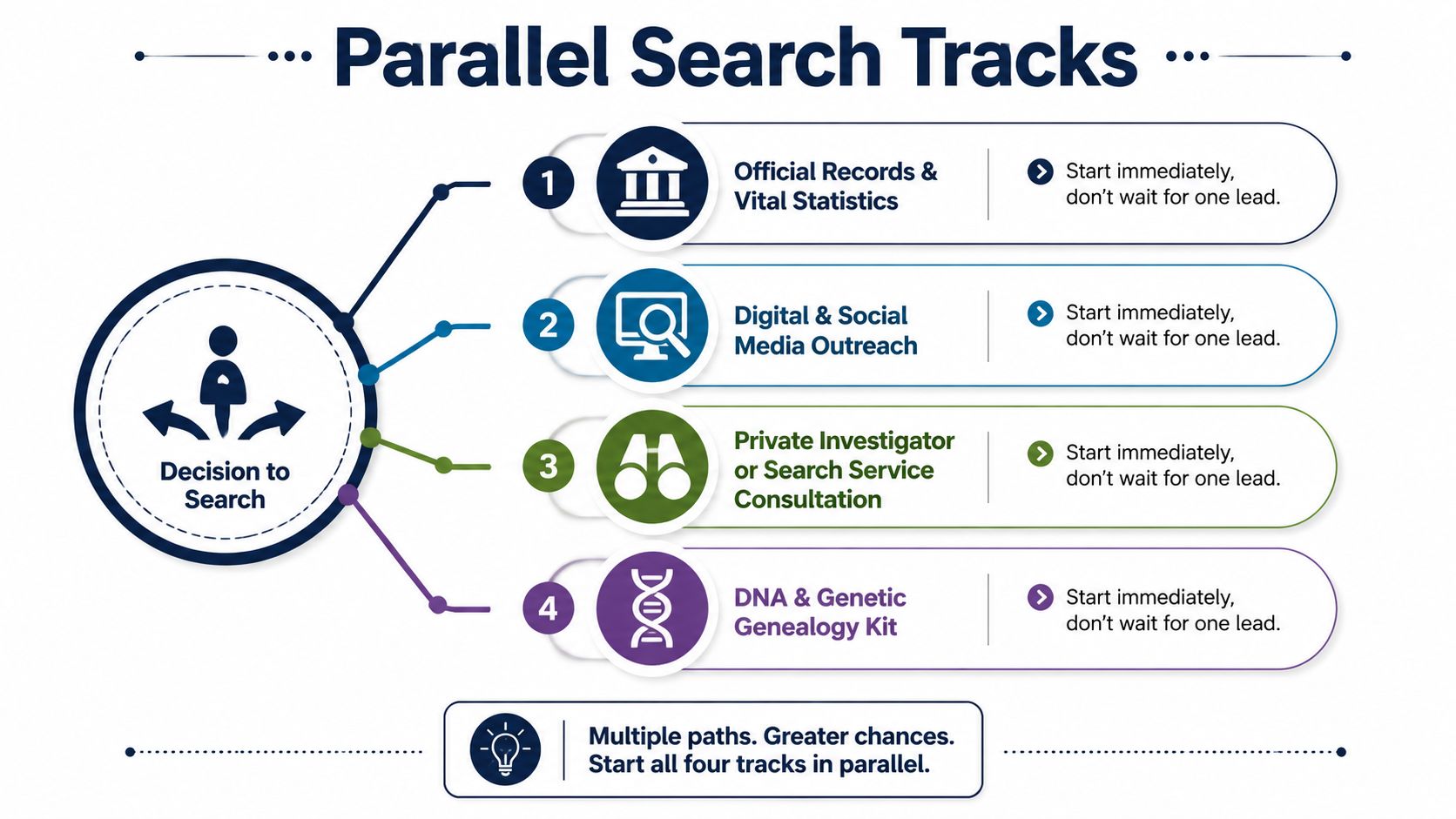
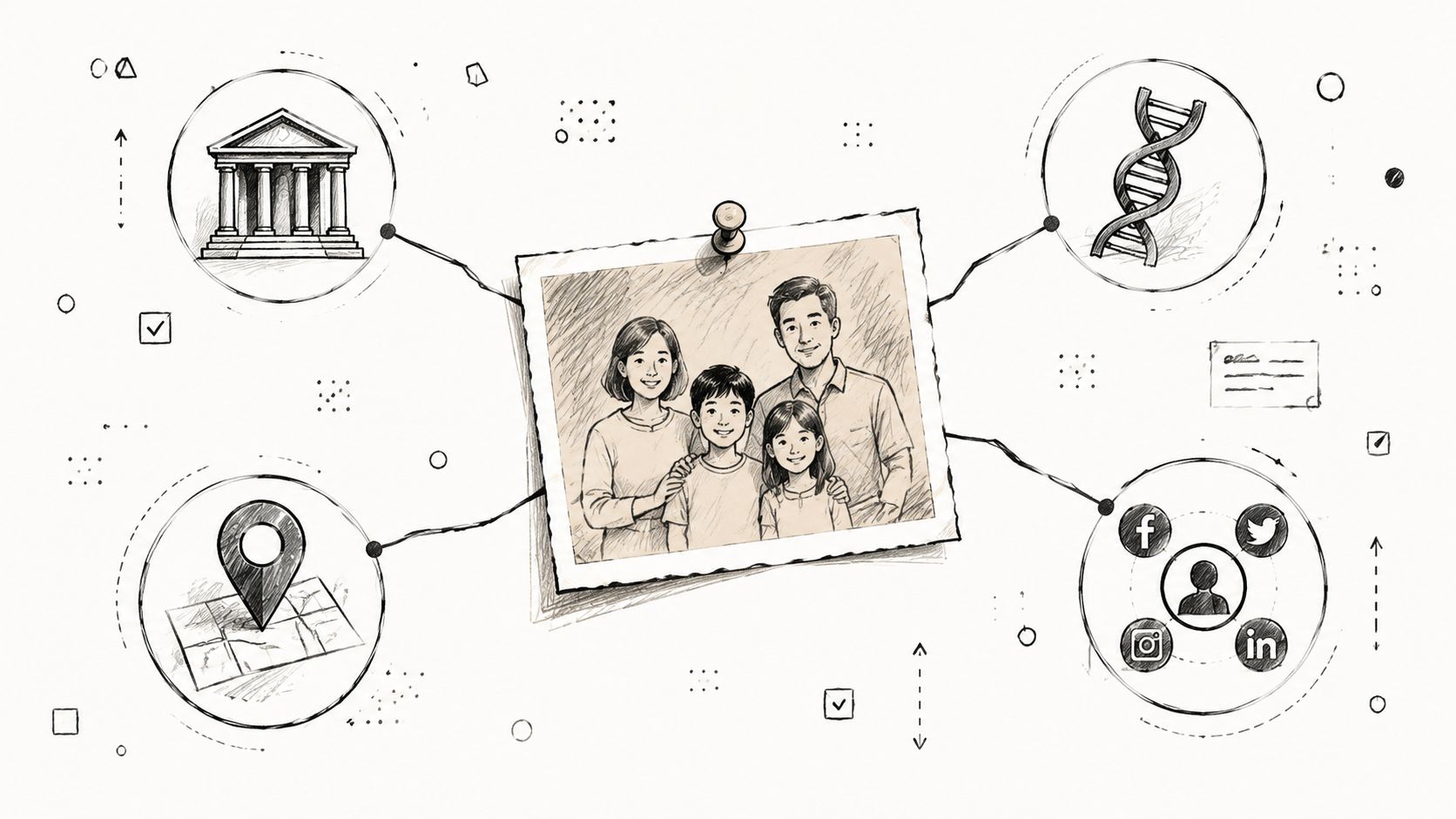
Four tracks to start together
- Official records and reporting: Contact local law enforcement when the person may be missing, ask whether an NCIC record exists, and review NamUs options when appropriate.
- Digital and social discovery: Search Facebook, LinkedIn, Instagram, and other platforms using the person's name with known employers, schools, cities, or associates.
- DNA and genealogy: Review family trees, identify relatives who may already have tested, and consider an appropriate DNA pathway.
- Professional and legal support: Consult a licensed investigator or tracing service when the case crosses jurisdictions, involves restricted records, or stalls.
Set an immediate action window and assign one person to each track. That owner should record sources, dates, usernames, case numbers, and outcomes in one shared file. Families researching reconnecting with family after years can use practical planning guidance, but online advice should support, not replace, formal reporting when safety is involved.
Practical rule: Don't wait for the perfect lead. Submit the first accurate report and keep building the search around it.
Building a Solid Case File Before You Search
A complete case file is the most useful asset in a family search. It prevents relatives from repeating the same calls, paying multiple services for identical work, or giving different versions of the same history to police, investigators, and tracing organizations.
Gather identifiers first
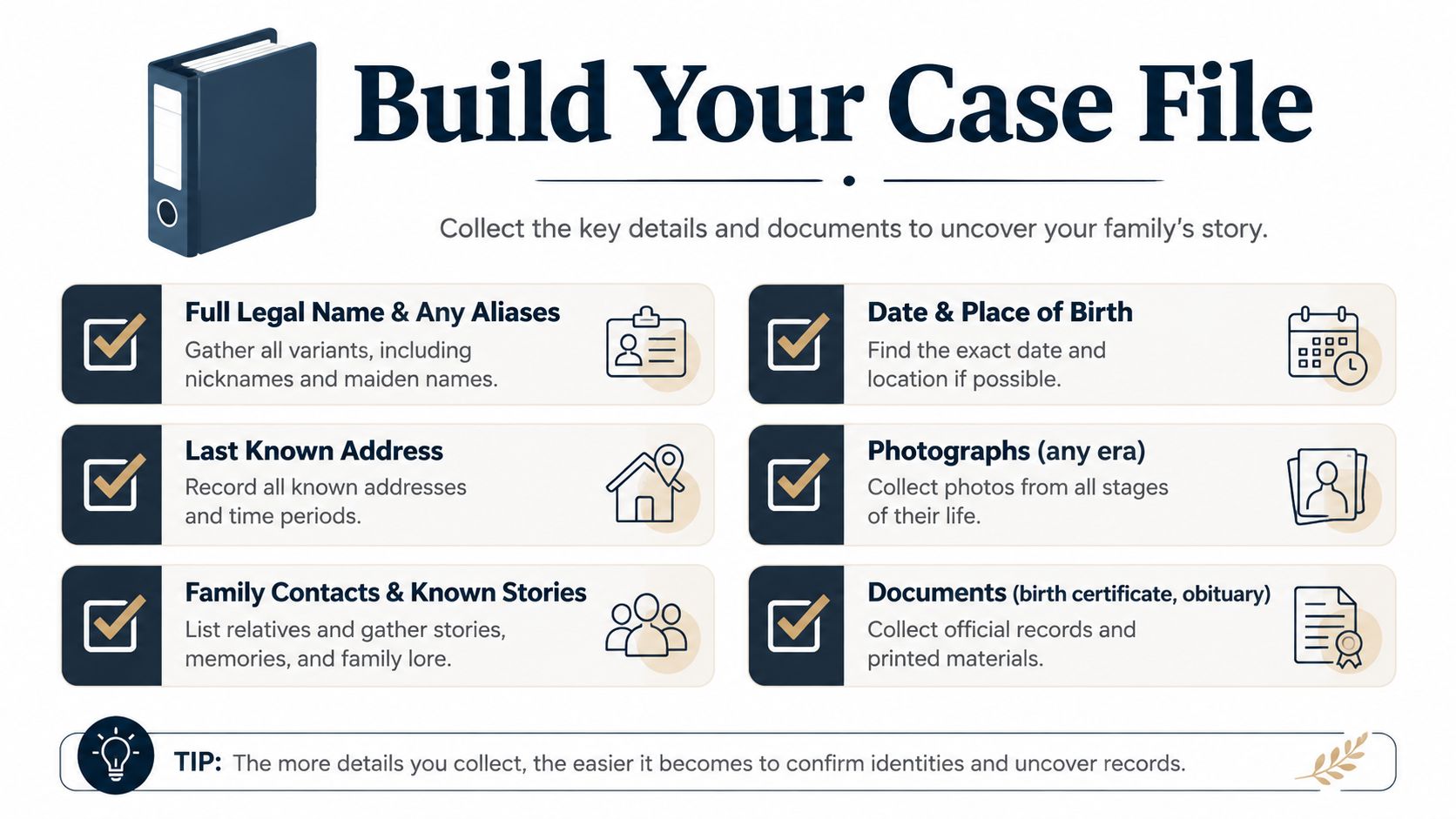
Record the person's full legal name, aliases, former names, nicknames, and possible spelling variations. Add the date and place of birth, last known address, prior addresses, phone numbers, email addresses, employers, schools, vehicles, and known associates. Include photographs from different periods, especially images showing the face clearly and any distinctive features.
Do not discard uncertain information. Mark it as confirmed, reported by a relative, or unverified instead of presenting every detail as fact. A questionable address can still help an investigator identify a geographic connection, but it must be labeled accurately.
Build a reverse chronology
Create a timeline that moves backward from the last confirmed contact. List every known residence, job, hospitalization, arrest, marriage, divorce, military connection, and family relationship. Separate direct knowledge from family stories. This timeline helps investigators identify gaps and gives tracing organizations a structured set of identifiers.
For DNA-related work, document known parents, siblings, children, and other close relatives. Record family relationships carefully, including adoptions, informal kinship care, and possible half-sibling connections. Do not include speculative medical conclusions, but hereditary conditions and known biological relationships may be relevant to later identification work.
Control information and preserve records
Choose who receives the complete file and who receives updates only. If the missing person is alive and intentionally avoiding contact, broad disclosure can create safety or privacy problems. Keep a log of every call, email, database submission, platform report, and agency response, including the date, contact name, reference number, and next action.
The same file can later support a police report, NamUs submission, licensed private investigator, forensic genealogist, or forensic service. A clean record makes every later handoff faster and reduces the risk that important evidence disappears inside separate family conversations.
Using Official Databases and Tracing Networks
Treat official reporting, database checks, international tracing, and professional investigation as parallel tracks. Waiting for one channel to finish before starting another creates avoidable delays. In the United States, NamUs, the National Missing and Unidentified Persons System, provides a free repository for missing, unidentified, and unclaimed-person cases. Families can submit information, while law enforcement handles case verification and investigative access.
NamUs matters when a relative may be among unidentified remains. Its case information can be reviewed alongside family DNA collection and other identification methods. The FBI's National Missing Person DNA Database compares profiles from missing people, their relatives, and unidentified human remains. Family reference samples therefore matter when a direct sample from the missing person is unavailable. The NamUs missing and unidentified persons repository explains the available case pathways.
NCIC serves a different purpose. The FBI reported 93,447 active missing-person records in NCIC as of December 31, 2024, and 533,936 missing-person records were entered during 2024. Juveniles under 18 accounted for 25,493 records, or 27%, while the share reached 37% when juveniles were defined as under 21. These figures appear in the FBI 2024 missing and unidentified person statistics. NCIC is restricted to law enforcement, so contact the investigating agency and ask whether the report was entered, updated, and shared with the appropriate systems.
Compare the main official channels
| Channel | Covers | Who Can Request | Best Entry Point |
|---|---|---|---|
| NamUs | Missing, unidentified, and unclaimed persons in the United States | Families provide information, while agencies support official case work | NamUs official repository |
| NCIC | Law-enforcement missing-person records | Law-enforcement agencies | Local police or the investigating agency |
| Texas vital records | Birth, death, marriage, and divorce records subject to access rules | Eligible applicants under state requirements | Texas Department of State Health Services vital-records office |
| Family Links Network | Cross-border family tracing involving conflict, migration, detention, or disaster | Families through Red Cross or Red Crescent offices | Local Red Cross or Red Crescent office |
| INTERPOL I-Familia | International kinship matching when direct comparison isn't possible | Families through national police and the INTERPOL National Central Bureau | National law-enforcement authorities |
For an international case, contact the Red Cross or Red Crescent office where you live and, when relevant, the office in the country where the relative was last known to be. The ICRC describes roughly 150 years of tracing and family-reunification experience. Families can submit requests through local network offices using the person's full name, date of birth, place of birth, and last known residence. In 2024, the network registered approximately 284,400 missing people, located more than 16,000, and reunited more than 7,000, according to the ICRC newsroom update on missing-person tracing.
Cross-border searches may require a specialist investigator. Use UK tracing agents when the evidence points to the United Kingdom, and ask any investigator how they verify identity, protect personal information, and document searches.
If unidentified remains may be involved, learn how disaster victim identification coordinates agencies, records, DNA, and other evidence. Keep database checks, official reports, international tracing, and professional work active at the same time. Each track can produce information that strengthens the others.
Searching Social Media and People-Finder Tools
Online searches work best when each platform has a defined purpose. Social media can produce a genuine lead when a living relative is active online, but it can also generate false matches based on common names, old photographs, or copied profiles. Search the person's name with a city, employer, school, workplace, family member, or known interest, then compare profile photographs with the case file rather than relying on a name alone.
People-search services such as Spokeo, BeenVerified, Whitepages, and TruePeopleSearch can surface possible addresses, phone numbers, relatives, and public-record connections. Their results should be treated as starting points, not proof. Records may be stale, duplicated, or incorrectly combined, and multiple services may sell information derived from the same underlying public records.
Genealogical platforms, including Ancestry, MyHeritage, FamilySearch, and WikiTree, serve a different purpose. They're strongest when the family already has documented trees, unusual surnames, or relatives who have contributed records. They may not locate a living person directly, but they can identify branches, marriage connections, or family relationships that clarify where to search next.
Online discovery channels compared
| Channel | Best For | Weakness | Typical Cost |
|---|---|---|---|
| Social platforms | Living relatives who use public profiles | False profiles, privacy settings, inactive accounts | Often free, with optional paid features |
| People-search engines | Possible addresses, phone numbers, and associates | Stale or merged records | Free results may be limited, paid access varies |
| Genealogical platforms | Family trees and historical relationships | Incomplete trees and uncertain connections | Free and subscription options |
| Direct outreach | Confirming a carefully supported lead | A person may decline contact | Usually free |
| Licensed investigator | Restricted databases and multistate searches | Requires professional judgment and a defined scope | Quoted by provider |
Avoid mass messaging relatives, employers, or neighbors. One respectful, factual message is safer than repeated contact, public accusations, or pressure through third parties. If the person is alive and has chosen distance, the ethical outcome may be confirming that they're safe without disclosing their location.
DNA, Genealogy, and Forensic Identification Options
DNA searches split into two distinct paths. For a living relative, consumer genealogy tests can reveal biological relationships through shared DNA and family-tree connections. For a possible unidentified deceased person, the family's DNA may serve as a reference sample for law-enforcement or forensic databases. These are not interchangeable processes.
For living relatives
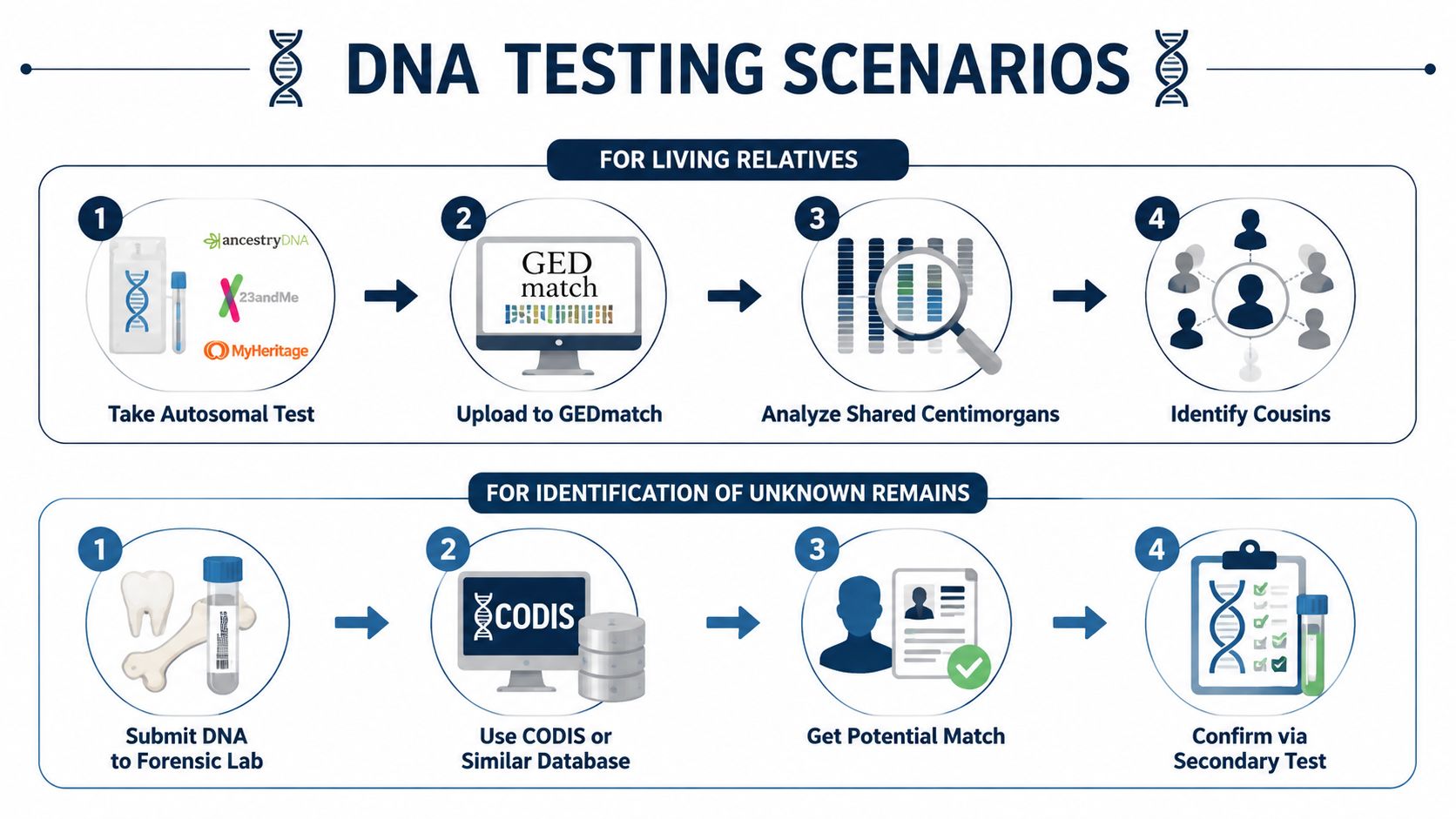
Autosomal testing is generally the broadest consumer genealogy route because it can identify relatives across maternal and paternal lines. AncestryDNA, 23andMe, and MyHeritage may provide cousin matches when a relative or connected branch has tested. Shared centimorgan analysis can help estimate the likely relationship, but a match still requires careful interpretation and confirmation through documents and additional relatives.
Y-DNA can help trace a direct paternal line, while mitochondrial DNA can help trace a direct maternal line. Those tests are narrower and won't replace an autosomal search when the relationship is more distant or unknown. Review each company's privacy terms before testing or uploading data elsewhere.
For unidentified-remains cases
If a relative may have died without identification, contact law enforcement, a medical examiner or coroner, and NamUs. The FBI DNA program can compare relatives' profiles with unidentified human remains. INTERPOL's I-Familia provides an international kinship-matching route when direct comparison isn't possible, but families must work through national police and the country's INTERPOL National Central Bureau, as described by INTERPOL's I-Familia guidance.
Forensic genetic genealogy uses SNP profiles with genealogical research to develop an identification lead. Access is generally controlled through law enforcement, medical examiners, or vetted laboratories. A consumer upload alone may not place a case into every forensic system, so ask the responsible agency what sample type, consent, and database pathway apply.
DNA is an investigative lead, not an automatic identity determination. A proposed match normally requires confirmation through an appropriate secondary test and documented case review.
The National Missing and Unidentified Persons System reports that 61,492 missing, unidentified, and unclaimed cases have been resolved since its inception, with more than 11,300 identifications made through DNA, fingerprints, dental comparison, anthropology, radiographs, or forensic genetic genealogy. Those results are summarized in the ICRC overview of global missing-person response and identification systems. Families seeking postmortem genetic context can also review this guide to genetic testing after death.
Privacy, Legal Boundaries, and Common Roadblocks
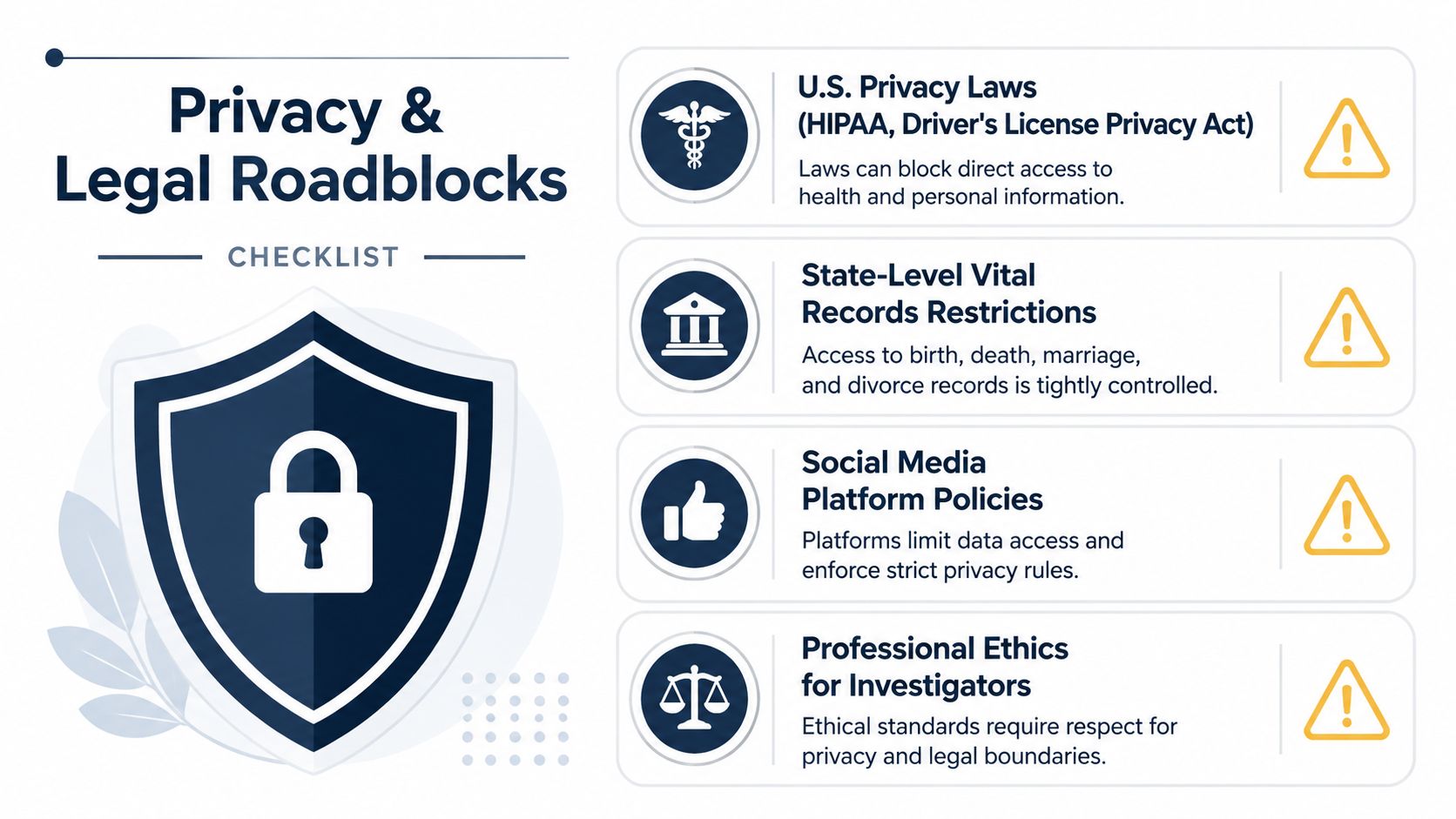
More searching doesn't always produce faster results. The main obstacle is often access, not effort. Driver's-license information, voter records, Social Security data, juvenile records, medical information, sealed court files, adoption records, and restricted vital records may be unavailable to the public or available only to an eligible person or authorized professional.
A private investigator may have lawful access to databases and investigative tools that a consumer cannot use, but that access doesn't eliminate privacy rules. Consumer reports also carry restrictions under the Fair Credit Reporting Act when used for regulated purposes such as employment, housing, credit, or insurance. A search designed to locate a relative must not become a pretext for an unlawful background check.
Work around restrictions lawfully
- Restricted vital records: Ask the relevant state office about eligibility, certified copies, and whether a noncertified search or review is available.
- Sealed or adoption records: Consult an attorney about court petitions, consent procedures, or authorized intermediary services.
- Informal kinship care: Search using every known surname, guardian, residence, and school connection instead of assuming the person kept a biological family name.
- Cross-border barriers: Use the Red Cross or Red Crescent network, national police, or a licensed investigator familiar with the destination country.
- Possible harassment: Send limited, respectful contact and stop if the person asks for no further communication.
Do not impersonate an official, bypass account security, buy leaked records, or pressure employers and relatives to disclose private information. A well-intentioned search can create legal exposure when it turns into stalking, harassment, unauthorized access, or public disclosure of sensitive details.
In Texas, official death-investigation responsibilities also depend on the county structure and circumstances. In counties without a medical examiner, a justice of the peace has broad responsibility in death investigations, including an inquest in circumstances such as a jail or prison death, a death without a physician, suicide, or a suspicious death, as summarized by the CDC overview of Texas coroner authority. Families should ask the responsible agency which records and identification steps apply rather than assuming a private search can replace the official process.
When to Bring in Professionals and Find Closure
Professional help becomes sensible when the search crosses state or national borders, restricted databases are involved, the family has conflicting information, or the DIY tracks have stopped producing reliable leads. It's especially important when death or unidentified remains may be part of the case. At that point, a licensed private investigator and a forensic service solve different problems.
A private investigator may handle living-person location work, skip tracing, address verification, interviews, and records that aren't available to ordinary consumers. A forensic pathologist evaluates human remains, postmortem findings, medical records, toxicology, and the documented cause and manner of death. A forensic anthropologist may assist with skeletal identification, while forensic odontologists may compare dental evidence.
Match the professional to the problem
| Scenario | Professional Type | Typical Cost | Realistic Timeline |
|---|---|---|---|
| Living relative, limited public information | Licensed private investigator | Provider quote | Depends on records, jurisdiction, and available leads |
| Search across countries | International tracing service or investigator | Provider quote | Depends on agency cooperation and local law |
| Possible unidentified remains | Law enforcement, medical examiner, forensic pathologist | Agency or private-service terms | Depends on evidence and case status |
| Complex DNA identification | Forensic laboratory or forensic genetic genealogy provider | Consent and provider terms | Often longer than an ordinary online search |
| Disputed death findings | Independent forensic pathologist | Provider quote | Depends on records, examination access, and testing |
Forensic genetic genealogy organizations may work with law enforcement on unidentified-person cases, but families should ask who controls the case, what consent is required, what data will be uploaded, and how a potential match will be confirmed. Don't assume a consumer DNA result alone can establish identity or cause of death.
If a death is involved, request the complete official case information available to the family, preserve photographs and records, and document every transfer of evidence. Texas Health and Safety Code section 691.031 requires rules for proper transport and labeling of bodies or anatomical specimens and requires each person controlling the remains to complete, retain, and transfer chain-of-custody forms. The law also requires sender and receiver records that the commission, district attorney, or county attorney may inspect, as shown in the Texas Health and Safety Code provision on transport and chain of custody.
A cause of death is the disease, injury, or condition that produced death. The manner of death classifies the circumstances, such as natural, accident, suicide, homicide, or undetermined, when the responsible authority makes that determination. A chain of custody is the documented history of who collected, transported, stored, examined, and transferred evidence or remains.
Our resource on closure after death explains why families may need both factual documentation and compassionate support after an identification or death investigation. Preserve the final reports, agency contacts, DNA documentation, photographs, and family communications so another relative can continue the work if necessary. Grief counseling, victim-assistance programs, and support organizations for families of missing people can provide help even when the investigation remains unresolved.
Texas Autopsy Services provides independent autopsy and forensic pathology services across all 254 Texas counties, including licensed transport, second-opinion review, identification support, and clear cause-of-death reporting. If your family's search may involve unidentified remains or unresolved death findings, visit Texas Autopsy Services to contact our team directly and discuss the next appropriate step with compassion and discretion.