July 30, 2026 · Texas Autopsy Services
Disaster Victim Identification Explained Step by Step
Learn how disaster victim identification works, from scene recovery to DNA matching. A clear guide for families, officials, and legal teams.
On this page
- What Disaster Victim Identification Means
- The Four Phases of a DVI Operation
- Primary and Secondary Identification Methods Compared
- How Ante-Mortem and Post-Mortem Data Are Reconciled
- Who Is in the Room and How the Evidence Stays Clean
- The Hardest Problem in DVI Missing Ante-Mortem Records
- How Texas Autopsy Services Supports DVI Operations
A family is waiting for answers after a violent storm, a transport crash, or a fire that changed a scene beyond recognition. At that point, disaster victim identification is not a single test or a quick visual check, it's a disciplined process for recovering remains, documenting evidence, comparing it with known information, and returning a legally defensible identity to the family. The work sits at the intersection of science, law, and human dignity, and the standards matter because the wrong match can compound an already severe loss.
Families and agencies often expect the process to begin with a face or a name they already recognize. In reality, the first question is whether there is enough ante-mortem information to compare with post-mortem findings, and whether the remains still preserve the features needed for a primary match. INTERPOL's framework and the FBIIC-hosted U.S. guide both treat identification as a structured comparison problem, not a matter of guesswork.
What Disaster Victim Identification Means
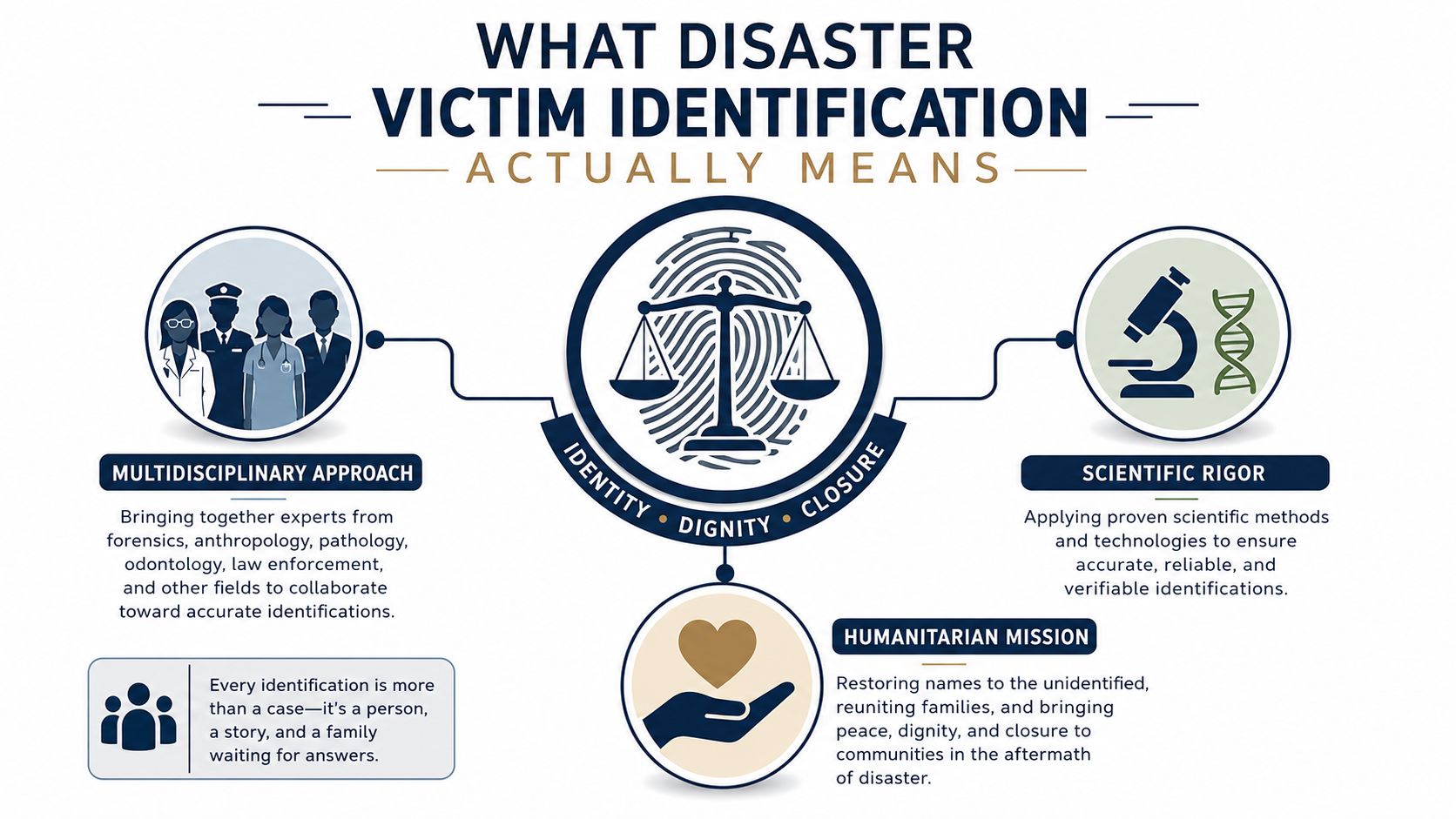
A mass-fatality event changes the order of work. The team has to recover the dead, protect evidence, identify each person, and do it in a way that can stand up in court and in the records of public agencies. That is why disaster victim identification, or DVI, exists as its own discipline.
The practical purpose is simple to say and hard to do well. Teams compare post-mortem data from the remains with ante-mortem data from missing persons, then confirm identity only when the evidence meets the required standard. INTERPOL guidance states that identity requires a 100% match between ante-mortem and post-mortem data for one or more primary methods, namely fingerprints, dental comparison, or DNA.
DVI is triggered when ordinary casework is no longer enough. Transport crashes, explosions, fires, floods, and large natural disasters can leave multiple victims with damaged remains, incomplete records, and overlapping jurisdictions. In those settings, the goal is legal certainty, so families, courts, and public agencies can rely on the result.
The emotional side matters too. Identification does more than label remains. It helps close the loop for families who are waiting for confirmation, and it gives investigators a lawful basis to release, repatriate, or further examine the body. For readers who are also trying to understand the grief response around sudden loss, a plain-language Kübler-Ross model overview can help frame why families often move between shock, uncertainty, and the need for facts.
A real DVI operation also depends on people who can hold the process together under pressure. A disaster mortuary response team brings the mortuary, documentation, and evidence-handling functions into one coordinated effort.
Practical rule: if the evidence does not support a primary match, the case is not ready for identification, even if the scene pressure is intense.
The Four Phases of a DVI Operation
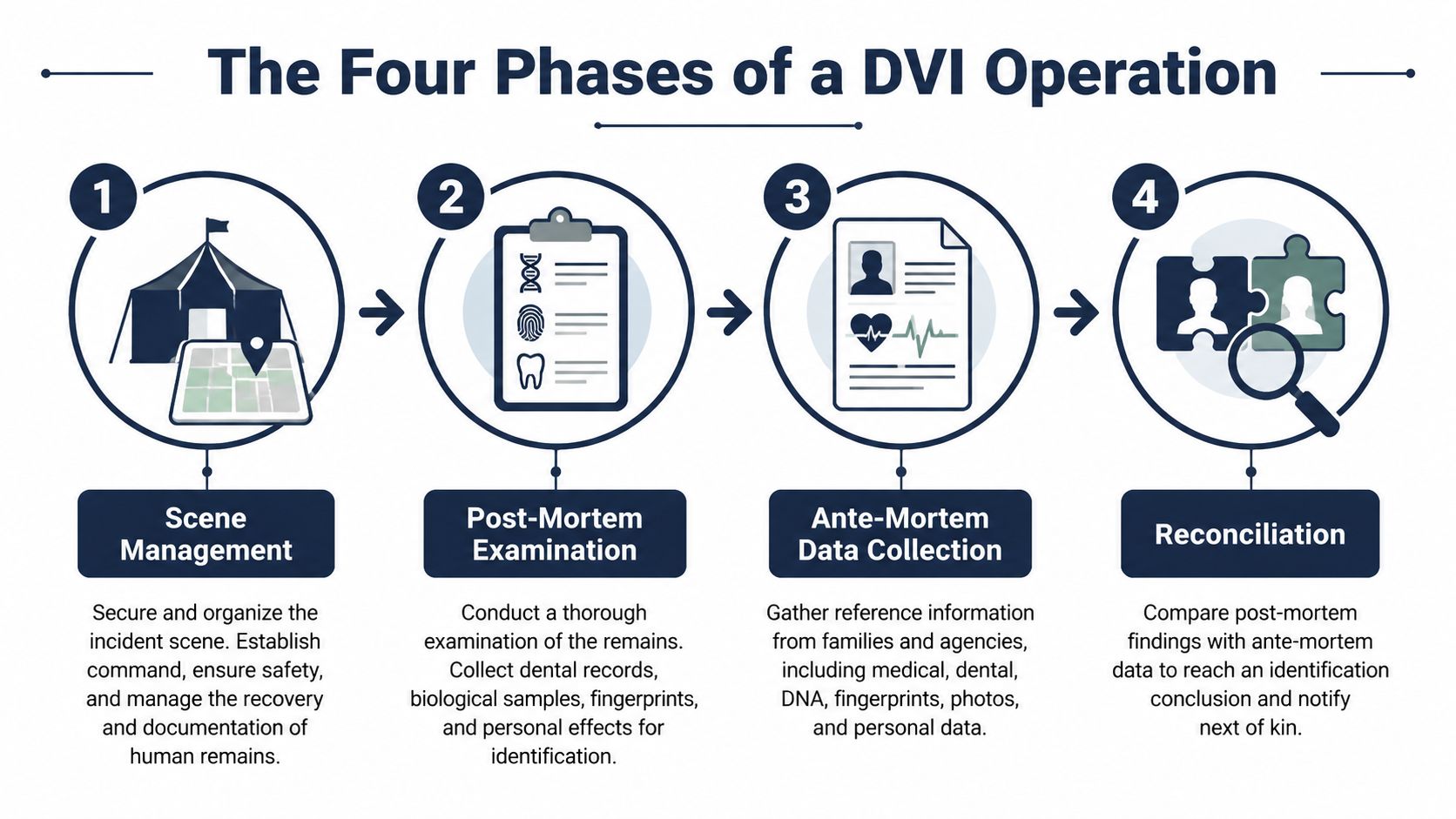
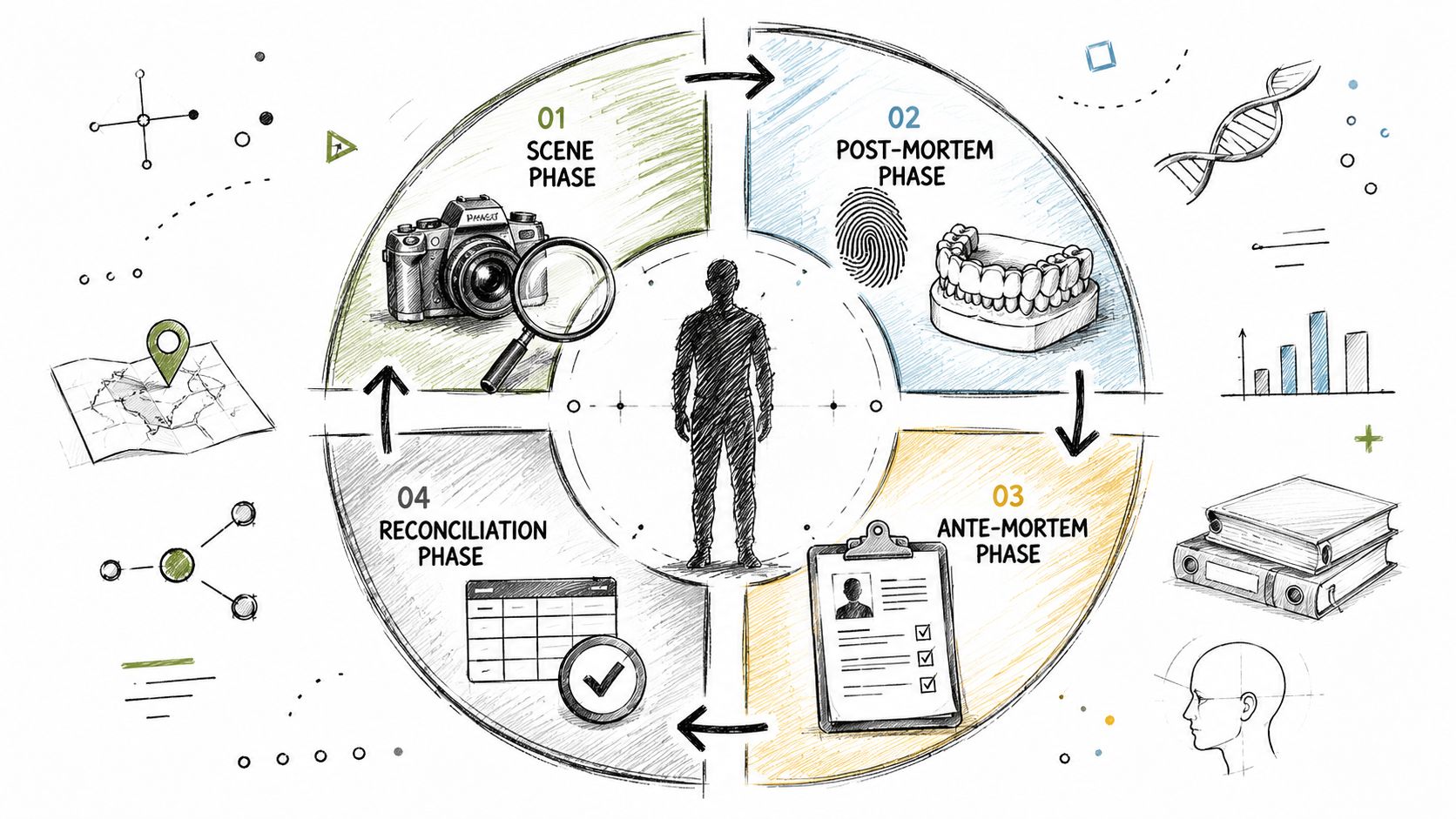
A fire-ground may still be hot, a flood scene may still be unstable, and the paperwork may already be drifting out of control. That is why a DVI operation starts by naming the missing, separating confirmed survivors, and building a working victim list before the team gets lost in the debris. The U.S. guide treats that first accounting step as the foundation for everything that follows, because every later comparison depends on who is being searched for in the first place (FBIIC disaster victim identification guide).
Scene management
The scene is handled as a crime scene until that status can be ruled out, because the body, the surrounding debris, and even small personal items may carry identity evidence (Forensic Sciences Research review). Photographs, notes, labels, and controlled movement of remains come first. If a boot, wallet, fragment of clothing, or trace material is shifted too soon, the link between the person and the place can be weakened before the mortuary team ever sees the body.
A scene like this is often divided into zones, with recovery crews, evidence staff, and documentation personnel each keeping their own lane. That is the kind of coordination described in the disaster mortuary response team model, where body handling and evidence handling have to stay aligned from the start.
Post-mortem examination
Once the remains reach the mortuary side, the team documents the body, orders radiographs or other imaging when needed, and looks for primary identifiers first. The literature keeps returning to the same three, fingerprints, dental comparison, and DNA (Forensic Sciences Research review). This stage creates the record that later gets compared against the missing-person file, so labeling, packaging, and chain of custody are part of the evidence, not clerical extras.
The practical difficulty is that disaster remains are often degraded. Heat can destroy fingerprints, trauma can fragment the face and jaw, and water or decomposition can make visual clues unreliable. In those cases, the mortuary examination has to be disciplined enough to separate what is observed from what can be proven.
Ante-mortem data collection
The other side of the case comes from the missing-person file. Families, dentists, hospitals, employers, and law enforcement may each hold a piece of the record, and the team has to assemble those pieces into a format that can be compared against the post-mortem findings. The FBIIC guide places that work alongside recovery itself, because a body without a usable reference file cannot be identified with any confidence.
Missing records become more than an inconvenience. A dental chart may be incomplete, a fingerprint record may never have been collected, or a family may have only partial medical history to offer. In those settings, the team is not comparing two full pictures. It is comparing an incomplete post-mortem record against an ante-mortem file with gaps, and those gaps are often the reason a case stalls.
Reconciliation
Reconciliation is the point where the two files are placed side by side. Analysts compare the post-mortem findings with the ante-mortem information, then a qualified review group decides whether the evidence supports identification. The standard is strict because the legal and ethical weight of the conclusion is high, and a weak fit does not become a valid identification because the scene is under pressure.
This is also where the process breaks down in real events. A body may be too degraded for a clean comparison, the ante-mortem file may be thin, or the chain of custody may be too mixed to support a conclusion. When that happens, the correct answer is to keep the case open until the record is strong enough, not to force a name onto remains that have not met the standard.
Primary and Secondary Identification Methods Compared
A DVI team does not treat every clue the same way. Some findings can support an identification, while others can establish it, but only if the evidence meets the primary standard. INTERPOL's position is direct, primary identifiers are fingerprints, dental comparison, and DNA, and identification requires a complete match between ante-mortem and post-mortem data for one or more of those methods (INTERPOL DVI guidance).
The table below keeps the distinction plain.
| Method | Category | What It Requires | Where It Fails | Best Use Case |
|---|---|---|---|---|
| Fingerprints | Primary | Recoverable ridge detail and a matching record | Severe burning, decomposition, skin slippage, missing prints | Fast comparison when records exist |
| Dental comparison | Primary | Ante-mortem dental charts or radiographs and post-mortem dental findings | No records, severe jaw trauma, extreme loss of dentition | Degraded remains with accessible dental history |
| DNA | Primary | Reference sample and a viable post-mortem sample | No family reference, heavily degraded sample, contamination risk | Cases with limited visible or fingerprint evidence |
| Visual recognition | Secondary | A witness or family member believes they recognize the body | Trauma, decomposition, emotional error | Initial clue only, never enough alone |
| Clothing and personal effects | Secondary | Items associated with the remains | Mixed belongings, scene movement, shared possessions | Helpful context, not proof |
| Tattoos, scars, implants | Secondary | Visible or documented distinguishing traits | Destruction of tissue or missing records | Narrowing candidates |
| Anthropological profile | Secondary | Bone-based estimation and scene context | Incomplete remains and ambiguity | Supporting analysis, not final identity |
A key point gets lost in casual discussions. Secondary methods can narrow a case, but they do not establish identity on their own unless they are corroborated by primary evidence. That is why visual recognition is best treated as a lead, not a conclusion.
Dental comparison remains statistically significant in the disaster setting because it keeps working when other methods don't. A systematic review covering 22,345 victims reported an overall identification rate of 86.21%, with 15.21% of identifications achieved solely through forensic odontology and 6.21% more through dental methods combined with other techniques (systematic review). In a separate analysis of 20,569 victims, 14.7% were identified using dental records alone (same review).
How Ante-Mortem and Post-Mortem Data Are Reconciled
A body arrives. A family arrives with memories, forms, and whatever records survived the disaster. Reconciliation is the stage where those two streams of information are brought into the same frame and tested against each other until the identification either holds or fails.
That process is slower and less tidy than many public explanations suggest. Teams do not just look at a face and name a person. They standardize the ante-mortem and post-mortem files, place the observations into comparable fields, and then compare item by item. If the records are incomplete, the work becomes more like fitting broken pieces from two different boxes, with missing parts on both sides.
The 2004 Indian Ocean tsunami remains the clearest large-scale benchmark. INTERPOL's coordinated effort identified an estimated 3,272 of 3,680 officially registered victims by November 2006, an identification rate of about 88.9%, and 1,956 of those identified victims were foreigners (tsunami DVI thesis). That case showed what reconciliation can achieve when records are pooled across borders and when teams use multiple primary methods together.
What gets matched
The comparison stage looks for agreement across two sets of data that were collected at different times, by different people, and often under very different conditions. Dental charts, fingerprints, DNA profiles, scars, medical implants, and personal descriptors all matter in the file, but only the primary methods can complete the identity decision. If the remains are commingled, fragmented, or degraded, every additional record matters more, because one missing item can change the confidence of the whole comparison.
Family records can be just as difficult. Ante-mortem information is often incomplete, written in different formats, or stored where responders cannot access it quickly. Some cases move forward with strong dental or fingerprint evidence. Others depend on genetic comparison, which can be much more useful when the body is damaged or the usual markers are absent. For a closer explanation of that step, see molecular genetic testing in disaster victim identification.
Rapid DNA can shorten part of this timeline. One recent DVI study reported that a buccal swab processed on the RapidHIT ID system completed lysis, purification, extraction, PCR, electrophoretic separation, detection, and analysis in exactly 95 minutes (ICMP DVI technology page). That speed helps with throughput, but it does not remove the need for a full reconciliation review.
Why it still takes time
The delay is not always in the laboratory. It can be the missing family reference, the absence of dental records, or the need to sort two possible matches that look similar on paper. It can also be the legal and ethical burden of getting the identification right before a body is released or a death certificate is issued. In DVI, a fast result is useful only when the underlying comparison can stand up to scrutiny.
When records are thin, the standard does not change. The team still has to ask whether the ante-mortem and post-mortem information really point to the same person, and whether the evidence is strong enough to support that conclusion without forcing it.
Who Is in the Room and How the Evidence Stays Clean
A DVI operation brings together people who each guard a different part of the identification chain. The room may include the incident commander, medical examiner or forensic pathologist, forensic odontologist, fingerprint examiner, DNA analyst, anthropologist, ante-mortem interviewer, family liaison, law enforcement, and legal counsel. One person may describe the body, another may compare teeth, another may process DNA, but none of them can work outside the same custody rules.
Those rules are what keep the evidence defensible. Every item needs a label, a log entry, and a documented transfer so the team can show who had it, when it moved, and why it moved. Scene handling also has to stay disciplined, with exhibits photographed, recorded, and labeled before later reconciliation through the database system.
What the team has to protect
- Identity evidence: fingerprints, dental data, and DNA must stay linked to the correct body or reference sample.
- Confidential information: medical and family records need controlled handling, especially when multiple jurisdictions are involved.
- Court value: reports need to be written so they can be explained later in sworn testimony if the identification is challenged.
The same discipline applies to the handoff points, because that is where errors usually enter. If a sample is mislabeled, or if a transfer is not documented, the comparison may still look neat on paper while the underlying evidence has already been weakened. A clear chain of custody procedure gives the team a way to trace each item from recovery to review without guessing about who touched it.
Texas agencies also work within state law and oversight structures. Texas Health & Safety Code Chapters 711, 716, and 651, along with Texas Funeral Service Commission oversight, shape how bodies are handled, how reporting is shared, and what authority governs the process. In a real case, that legal frame is not background noise, it decides who can see what and when.
For readers comparing disaster work with broader compliance systems, a practical health tech compliance partner can help clarify how regulated records, evidence handling, and reporting discipline fit together across sectors.
The Hardest Problem in DVI Missing Ante-Mortem Records
The most overlooked failure point is not the body, it's the record. Many public explanations assume that dental charts, fingerprints, medical records, or family reference samples already exist, but that assumption breaks down fast after a disaster, especially in low-resource settings or among people who never had formal records in the first place.
A peer-reviewed review of tsunami response found that only 18.1% of missing Thais had dental charts and just 0.8% had dental X-rays, while many victims from neighboring countries had similarly limited records (INTERPOL DVI guide PDF). The same material also notes that entire families may be missing, which leaves no close relatives for DNA comparison (same guide).
That is the bottleneck in many operations. The post-mortem side can be well executed, but if the ante-mortem file is empty or partial, the comparison board has less to work with. Families often feel this as delay, but the delay usually reflects missing source material, not lack of effort.
Practical ways teams reduce the gap
Teams may reach out to foreign consulates, search hospital records, use pharmacy histories as supporting context, or send mobile dental and fingerprint units into the field. Anthropological assessment and DNA can still help when conventional records are absent, but they work best when someone can build a reference picture first. The hard lesson is that DVI is only as strong as the records that survive the disaster.
How Texas Autopsy Services Supports DVI Operations
When a county, court, or outside agency needs extra capacity, DVI principles still apply. We support the same evidence discipline through independent autopsy and forensic pathology services, with statewide coverage across all 254 Texas counties and in-house licensed transport that helps preserve chain of custody from the first transfer onward. Every examination is performed by a forensic pathologist certified by the American Board of Pathology.
That matters most when a case needs more than routine handling. A county without a medical examiner may still need a scientifically grounded cause-of-death investigation, a second-opinion autopsy, or a court-admissible report that can be explained clearly in later proceedings. Our team also works with secure temperature-controlled storage, digital imaging, toxicology, and molecular testing, which keeps the evidence side orderly when the case crosses agencies or timeframes.
What officials and families should expect
- Direct communication: no call centers, just clear contact with our team.
- Chain-of-custody documentation: evidence handling is tracked from pickup through reporting.
- Court-ready reporting: findings are written for medical, legal, and investigative use.
- Compassionate clarity: families get plain language, not medical jargon without explanation.
For agencies that want to compare compliant workflow support across regulated settings, an external health tech compliance partner can illustrate the same basic principle, documentation has to survive review. In our work, that principle is not abstract, it is what makes an identification or autopsy result defensible when the case is questioned later.
If you need a second-opinion autopsy, help with a cause of death investigation, or guidance on a forensic case that depends on clean evidence handling, Texas Autopsy Services is here to help. Visit Texas Autopsy Services to speak with our team about independent autopsy services, county forensic support, and court-admissible reporting across Texas.