October 1, 2026 · Texas Autopsy Services
Temperature Controlled Storage Pods for Forensic Use
Compare temperature controlled storage pods for forensic and mortuary use. Explore temperature ranges, capacity, monitoring, and transport compatibility.
On this page
- Importance of Temperature Control in Forensic Logistics
- Overview of Temperature Controlled Storage Pods
- Key Features to Compare in Storage Pods
- Transport Compatibility and Chain of Custody Integration
- Regulatory and HIPAA Considerations for Storage Pods
- Use Cases and Selection Criteria for Statewide Transport
- Recommendations for Specifying Temperature Controlled Storage Pods
A county official receives a request to move human remains overnight for an independent examination. The receiving facility has refrigeration, the transport vehicle is licensed, and the paperwork is ready. The unresolved question is whether the storage unit will maintain a documented, stable environment from pickup through delivery, while preserving privacy, evidence integrity, and legal authority.
That question separates a temperature controlled storage pod from an ordinary insulated container. Refrigeration supports preservation, but forensic logistics also require controlled access, reliable monitoring, documented handoffs, and mortuary practices that respect Texas law. For families, attorneys, healthcare professionals, and county officials, the pod is only one part of a larger chain.
- Temperature stability protects examination quality. Chilled, frozen, and ambient-controlled systems serve different forensic purposes.
- A thermostat reading isn't enough. Decision makers should evaluate sensor placement, alarms, power continuity, humidity, and records.
- Chain of custody includes the pod. Seals, access logs, transport records, and delivery verification must connect the storage unit to the case file.
- Texas authority matters. A justice of the peace, medical examiner, prosecutor, or county attorney may have defined powers concerning an autopsy.
- Selection should follow the case. Rural transport, laboratory staging, and temporary mortuary storage create different requirements.
- Independent review depends on objectivity. Every examination by Texas Autopsy Services is performed by a forensic pathologist certified by the American Board of Pathology.
A family may be searching for an autopsy near me while an attorney is asking a different question: whether the evidence can withstand scrutiny later. Both concerns point to the same operational need, a storage and transport process that protects the remains and preserves a trustworthy record.
Importance of Temperature Control in Forensic Logistics
An overnight transfer can appear routine until a refrigeration unit cycles outside its intended range. Remains may be held in a vehicle, moved into temporary storage, and delivered to an examination facility the next morning. If personnel cannot show what happened to the temperature during that period, questions can arise about tissue condition, toxicology handling, and the reliability of the evidence record.
A passive insulated box slows environmental change. It doesn't actively correct it. A refrigerated pod, by contrast, uses insulation and active cooling to maintain a defined internal condition, provided it has suitable power, functioning controls, and adequate monitoring.
Cold-chain logistics provide the engineering background. After the shipping container was invented in 1956, refrigerated intermodal units helped move perishable goods across long distances. Published industry histories describe refrigerated containers operating from -30°C to +30°C, supporting stable movement of food and other sensitive goods at scale (Cabinet Magazine's history of refrigeration and shipping).
Forensic rule: Temperature control should be treated as an evidence-preservation function, not merely a comfort feature for a storage facility.
A county or private practice should therefore assess the entire route, not only the destination. That includes loading conditions, vehicle power, dwell time, access control, alarm response, and the record produced when the pod arrives. Guidance on secure evidence environments, including the storage guide by Material Handling USA, is useful when evaluating the relationship between physical storage and documentation.
Our team also considers how secure storage connects with facility access, transport authorization, and mortuary coordination. Texas Autopsy Services describes these operational considerations in its discussion of a secure storage facility. The practical conclusion is direct: active temperature control is necessary, but it isn't sufficient without custody controls and a defensible record.
Overview of Temperature Controlled Storage Pods
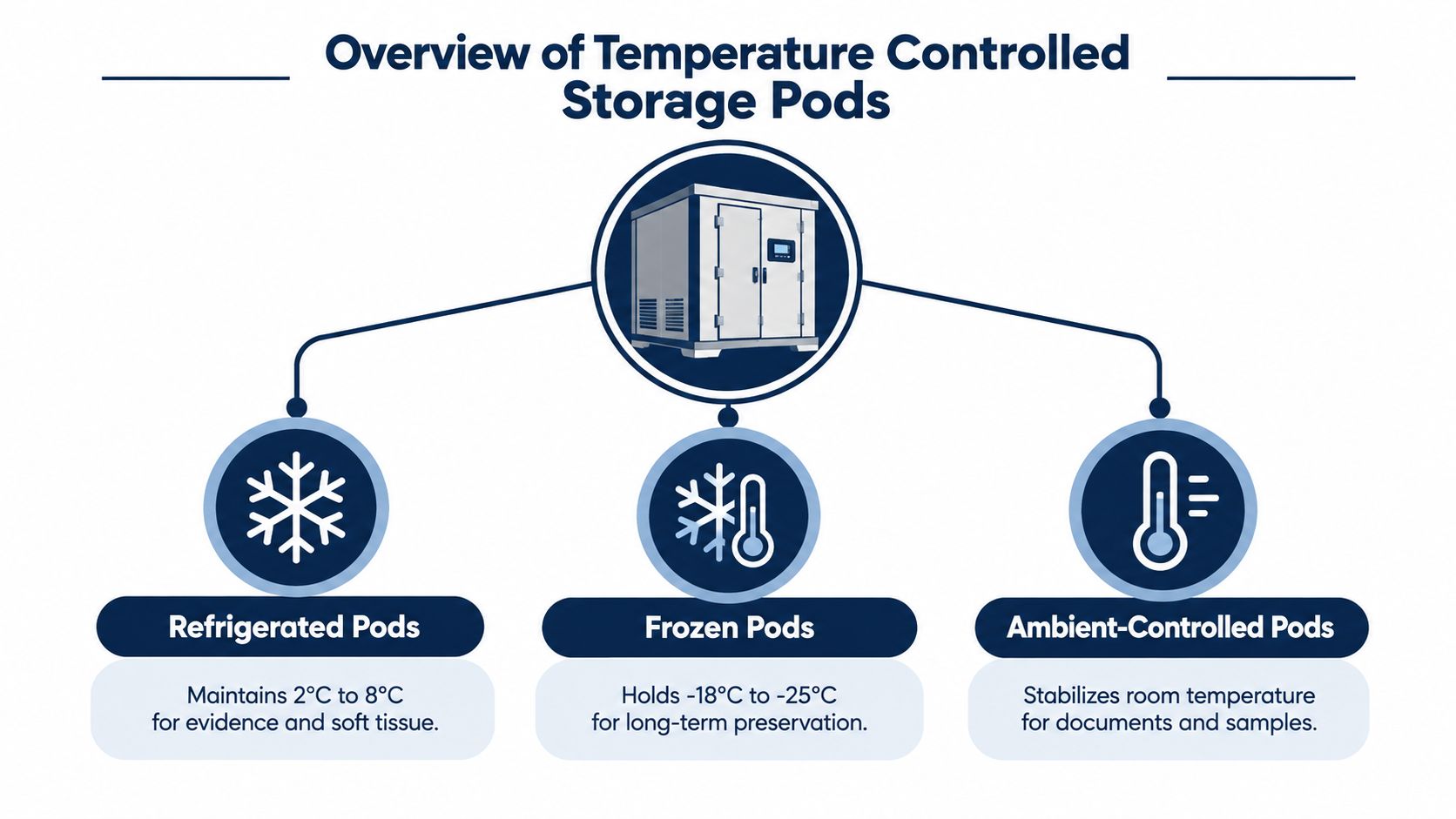
Temperature controlled storage pods serve different operating conditions. Selection should account for the required temperature, expected dwell time, materials involved, and whether the unit will remain stationary or travel with a load. For forensic logistics, the pod must also support segregation, inspection, and custody documentation rather than temperature control alone.
Refrigerated pods
Refrigerated systems commonly target 2°C to 8°C for chilled storage in regulated cold-chain applications (technical specifications for temperature-controlled pods). This range may suit chilled containment for remains, specimens, or other temperature-sensitive materials. The responsible authority, examination protocol, and laboratory requirements still determine whether that range is appropriate for a particular case.
Frozen and dual-zone systems
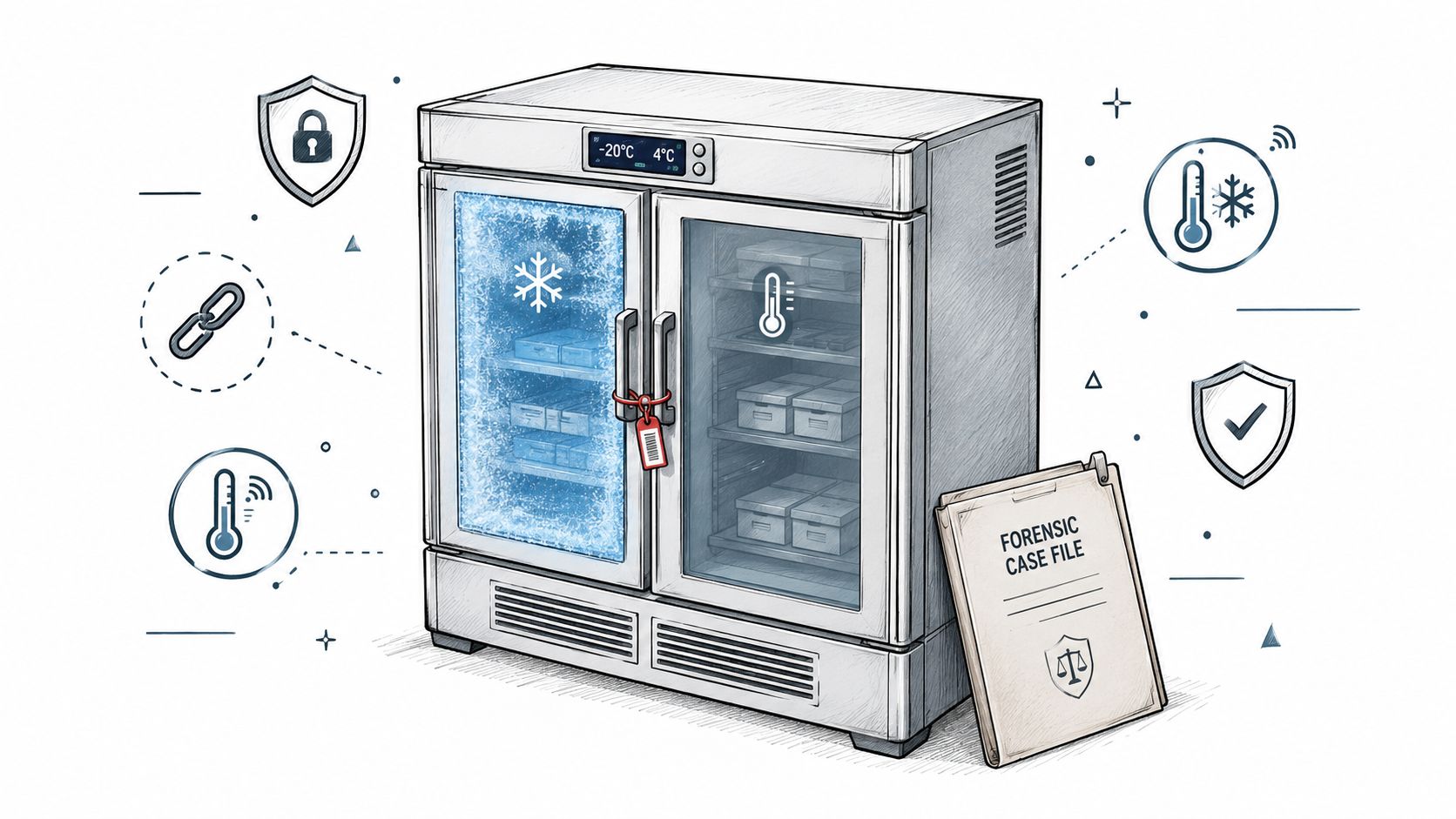
Frozen compartments commonly target -18°C to -25°C. Dual-zone platforms can combine a chilled compartment at 2°C to 8°C with a frozen compartment at -18°C to -25°C, allowing different materials to remain segregated within one unit. That configuration is suitable only when the compartments operate independently and their temperature controls, alarms, and records can be reviewed separately.
Ambient-controlled pods address a different need. They stabilize room-like conditions for documents, supplies, and materials that do not require refrigeration. They cannot substitute for active chilled storage where the case requires it.
Modern pods combine insulated walls, active cooling, controls, and transport compatibility. Plant-level design principles can be compared with technical guidance on industrial refrigeration systems, although portable equipment has different power, ventilation, and service constraints.
Matching construction to forensic work
A procurement review should examine insulation, door seals, floor loading, drainage, interior surfaces, and cleaning procedures. Usable capacity may be lower than the external dimensions suggest because shelving, airflow clearances, partitions, packaging, and separation requirements consume space.
Chain-of-custody integration belongs in the same review. The specification should identify access controls, seal or tamper checks, temperature records, alarm escalation, and the person responsible for reviewing exceptions. Texas Autopsy Services discusses related requirements for a secure storage facility. A pod that maintains conditions but cannot produce a defensible custody record creates a documentation gap during transfer or examination.
Power requirements also vary by setting. A fixed facility connection differs from a transport vehicle or temporary generator. Before acceptance, confirm the intended power source, restart behavior, alarm response, maintenance responsibility, and the procedure for documenting a power interruption.
Key Features to Compare in Storage Pods
A pod for sensitive remains should be assessed as both a cooling system and a record-producing control. The relevant question is whether it maintains the required environment and generates evidence that staff can review during examination, transfer, or an incident investigation.
| Feature | Standard Pods | Premium Pods |
|---|---|---|
| Temperature range | Fixed chilled or ambient setting, with basic display | Chilled, frozen, or dual-zone configuration with documented performance |
| Temperature stability | One or more local readings | Multiple sensors, mapped locations, and calibrated monitoring |
| Alarms | Local audible or visual alert | Local and remote alerts with escalation records |
| Power protection | Basic connection to facility or vehicle supply | Backup planning, restart controls, and documented failure response |
| Humidity | Often not actively controlled | Separate humidity measurement or control where required |
| Access control | Mechanical lock or basic key system | Restricted access, tamper evidence, and access logging |
| Reporting | Manual notes or downloaded readings | Time-stamped export suitable for case and quality records |
Temperature accuracy and stability
The specification should define the target range, permitted variation, sensor locations, testing conditions, and calibration process. One sensor positioned near a cooling outlet may not represent conditions at the floor, rear door, or center of the load. Published reefer specifications can state tight control ranges and broad operating limits, but those figures have limited value without test methods, calibration records, and the conditions under which performance was measured.
Temperature-controlled storage is commonly described as maintaining about 55°F to 70°F, while climate-controlled storage generally covers a wider range and also addresses humidity (PODS explanation of temperature-controlled and climate-controlled storage). For forensic work, that distinction prevents a frequent specification error: temperature control alone does not establish moisture control.
Capacity, loading, and airflow
Measure usable internal space after shelves, partitions, and protective fixtures are installed. Remains, specimen containers, documentation, and packaging must not block return-air paths or press against walls. A unit may fit the load by volume yet perform unevenly when loading restricts circulation.
The review should also record floor loading, door clearance, drainage, interior materials, and cleaning access. These details affect whether the pod can be prepared between cases and whether its stated capacity remains practical under mortuary operating procedures.
Monitoring and alarm response
Monitoring records should identify the sensor location, sampling method, time source, calibration status, and retention period. Remote visibility can shorten response time, but an alert without an assigned responder leaves the case exposed. Written procedures should name the notification recipient, the person authorized to access the pod, the escalation threshold, and the method for recording corrective action.
Humidity and sealing
Verify humidity separately where condensation, moisture exposure, or surface contamination could affect remains, specimens, or packaging. Door gaskets and latches require inspection, while tamper-evident seals connect environmental control with custody documentation. A damaged seal should produce an exception record, an assessment, and an authorized replacement, not an undocumented change.
Practical distinction: A stable reading shows an environmental condition. A complete log shows who controlled that condition and what happened when it changed.
Premium features should correspond to a defined operational risk, such as long-distance transport, repeated handoffs, mixed temperature requirements, or records likely to face legal review. The strongest specification links each feature to a mortuary procedure, a responsible role, and a retrievable record.
Transport Compatibility and Chain of Custody Integration
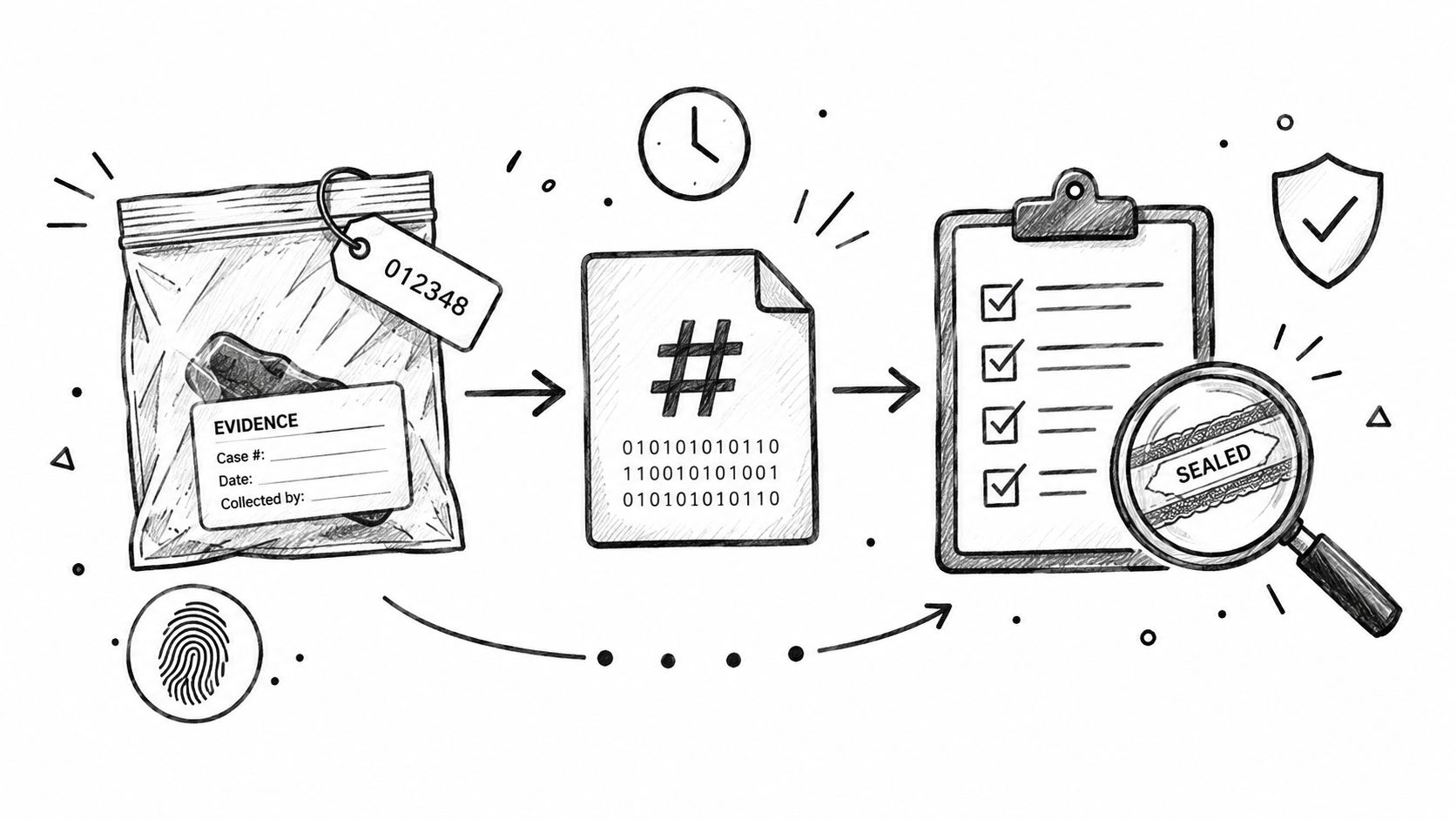
A pod becomes part of the chain of custody as soon as remains or specimens enter it. The process should connect the physical container, the case identifier, the responsible personnel, and the environmental record.
Secure the unit before movement
Before loading, personnel should inspect the pod, confirm its operating condition, record the starting temperature, and identify the case. The door should be secured with a tamper-evident seal or another approved control. Seal numbers belong in the case record, along with the identity of the person who applied them.
Record every handoff
Each transfer should identify the date and time, releasing person, receiving person, location, seal condition, and any observed deviation. A digital log can reduce gaps, but it must be protected against unauthorized editing and linked to the correct case. Visibility systems can provide useful background on monitoring and supply-chain oversight, including this Evright Industrial visibility guide.
Match the pod to the vehicle
The vehicle must support the pod's dimensions, weight, mounting points, ventilation, and power needs. A refrigerated unit that works reliably at a facility may not maintain conditions in transit if the vehicle cannot supply the required power or if the pod shifts during movement.
Verify delivery
At arrival, the receiving person should inspect the seal before opening the unit, compare the number with the dispatch record, note the temperature history, and sign the transfer. Any discrepancy should be preserved in the record and escalated according to the agency or facility procedure.
Our statewide transport work follows the same principle described in temperature-controlled transport procedures. The pod doesn't replace licensed transport, legal authorization, or mortuary coordination. It supports those functions when its controls are integrated into them.
Regulatory and HIPAA Considerations for Storage Pods
A storage pod doesn't independently authorize an autopsy, release, transfer, or examination. In Texas, the responsible government authority and applicable law determine what may occur. The equipment must support that process rather than create an informal substitute for it.
Texas authority and county practice
Texas doesn't use coroners in the traditional sense. In many counties, justice of the peace duties include death investigation, while counties that adopt a medical-examiner system transfer those duties to the medical examiner's office (Texas forensic medicine overview).
Texas law gives a justice of the peace discretion to direct a physician to perform an autopsy for a body subject to an inquest. It also identifies circumstances in which an autopsy is required or barred, as summarized by the CDC's Texas medicolegal death investigation resource. A private request can't override that authority.
County responsibility can also include transport costs when a body is moved for an autopsy ordered during an inquest. County reimbursement and authorization rules therefore affect the movement record, the receiving facility, and the documentation attached to the pod.
Privacy and mortuary compliance
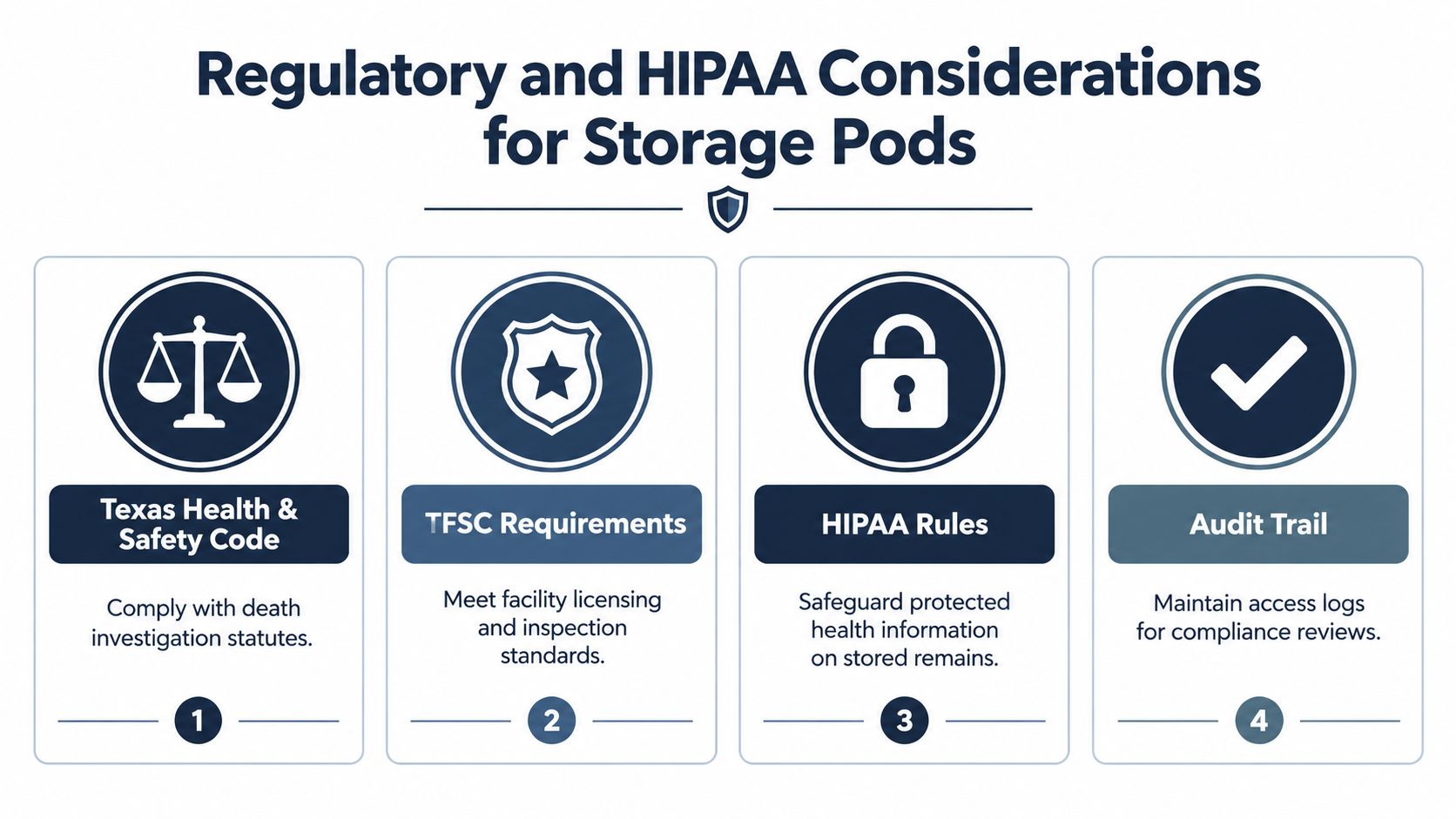
Texas Health & Safety Code Chapters 711, 716, and 651, together with Texas Funeral Service Commission requirements, form part of the compliance environment for funeral and mortuary operations. The exact duty depends on the activity and the responsible licensee, so facilities should obtain legal or regulatory guidance for their circumstances.
HIPAA safeguards may apply to protected health information associated with a decedent, family, provider, or investigation. The pod itself shouldn't expose identifiers through an unsecured display, open access panel, shared account, or unprotected monitoring platform. Access permissions, audit logs, password controls, and secure transmission should be evaluated alongside temperature performance.
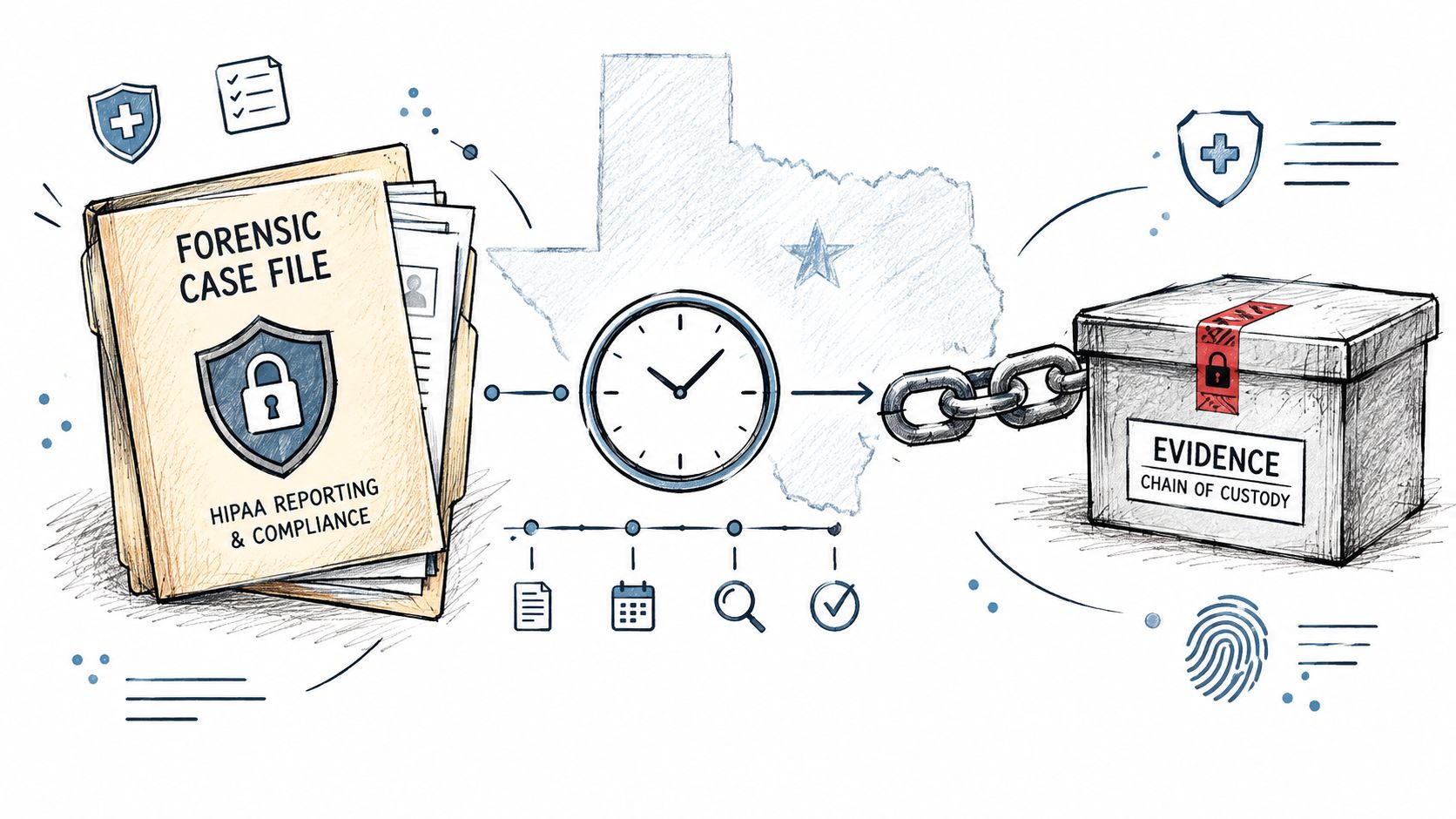
The chain-of-custody form process should align the pod's environmental history with the broader case record. Equipment selection becomes a legal-quality decision. A facility needs to show not only that remains were stored, but also who controlled access, who authorized movement, and whether the recorded conditions remained acceptable.
Use Cases and Selection Criteria for Statewide Transport
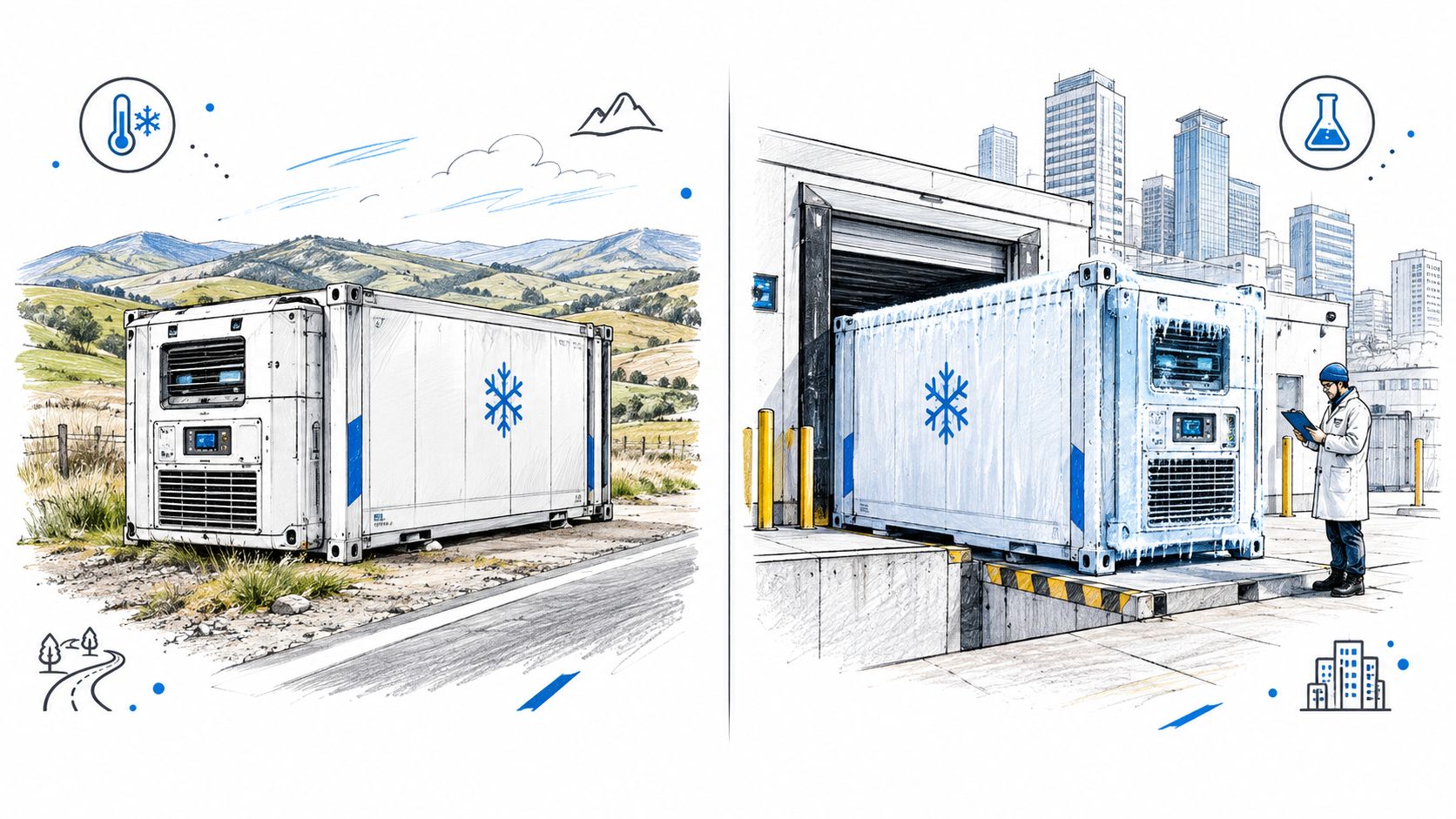
A rural county sending remains to a central facility must solve a different logistics problem than an urban laboratory staging specimens for a short transfer. Route length, infrastructure, material type, and custody controls should determine the pod configuration. One standard unit can create avoidable expense on simple routes or inadequate control on demanding ones.
Rural and long-distance movement
A remote county may require a refrigerated pod that remains stable during extended vehicle travel and periods without fixed infrastructure. Selection should focus on dependable vehicle power, visible alarms, secure mounting, and a documented handoff process. The transport record should connect the pod, vehicle, case identification, and receiving facility. A dual-zone system adds complexity without clear value when the route carries chilled remains only and no frozen specimens.
Urban staging and laboratory coordination
A central facility handling remains, toxicology specimens, and other materials with different requirements may need separate temperature zones. Segregation can reduce loading errors, provided each compartment has independent monitoring, access control, and records. The pod should support the facility's existing release and receiving procedures rather than create a parallel record that staff must reconcile later.
Temporary mortuary capacity
A temporary pod can add controlled space during a sudden increase in demand. Its temporary status does not change requirements for identification, authorization, access, cleaning, loading, or release. Staff should define who accepts custody, who checks conditions, and who records each movement before the unit is placed into service.
Seasonal conditions affect planning. Industry reporting says climate-controlled storage demand can rise by 15% during summer months, when heat and humidity place more pressure on stored goods (portable storage industry data). The figure concerns the broader storage market, not forensic remains. It still supports testing refrigeration capacity and response procedures under summer operating conditions.
The same source estimates portable storage container rental revenue at $8.3 billion in 2025 and identifies refrigerated containers as the fastest-growing container type at 8.5% annual growth. Market growth does not establish forensic suitability. It does signal variation in equipment, service models, monitoring records, and vendor support, so buyers should assess documentation as closely as hardware.
For statewide transport, the appropriate choice follows the route and case requirements. Long-distance use prioritizes transport continuity and custody integration. Laboratory staging requires segregation and reliable records. Temporary mortuary use requires controlled access, cleaning procedures, and clear staff accountability.
Recommendations for Specifying Temperature Controlled Storage Pods
Procurement documents should translate forensic risks into measurable requirements. A vendor proposal should answer these questions without relying on general terms such as “climate controlled” or “secure.”
- Define the operating band. State whether the requirement is chilled, frozen, ambient-controlled, or dual-zone.
- Require performance evidence. Ask for calibration records, sensor locations, mapping results, alarm tests, and the conditions under which published accuracy was measured.
- Specify monitoring. Require local alerts, remote notifications where appropriate, time-stamped records, data export, and a named response procedure.
- Protect continuity. Identify facility power, vehicle power, restart behavior, backup arrangements, maintenance intervals, and service escalation.
- Control access. Require case identification, restricted entry, tamper-evident seals, access logs, and a process for documenting damaged or replaced seals.
- Address humidity separately. Don't treat a temperature display as proof of moisture control.
- Evaluate the whole lifecycle. Compare installation, transport integration, calibration, cleaning, repairs, software access, and end-of-service costs.
A specification should also state who owns the data, how long records remain available, and whether the vendor can alter or delete entries. Those details matter when counsel later needs to authenticate an environmental record.
Texas Autopsy Services operates from Elgin, Texas, provides in-house licensed transport across all 254 Texas counties, and maintains secure temperature-controlled storage as part of its forensic process. Every examination is performed by a forensic pathologist certified by the American Board of Pathology, with reporting and custody procedures designed for families, attorneys, healthcare providers, and county officials.
Texas Autopsy Services can coordinate independent autopsy services, licensed transport, secure temperature-controlled storage, and documented chain-of-custody handling for cases across Texas. If you need a private autopsy, a second opinion, or county forensic pathology support, please visit Texas Autopsy Services to contact our team directly.