November 17, 2026 · Texas Autopsy Services
Expert Witness Fees in 2026 and What They Cover
Expert witness fees explained: typical hourly rates, minimums, case costs like depositions and travel, plus the questions to ask before you retain an expert.

On this page
- What Expert Witnesses Charge in 2026
- What Drives Forensic Expert Fees Up or Down
- What an Expert Invoice Covers and What It Costs
- Who Pays Expert Witness Fees and When Courts Shift Them
- How Texas Counties and Medical Examiners Set Their Fees
- Questions to Ask About Price and Scope Upfront
- Common Questions About Expert Witness Fees
- Get the Fee Scope in Writing Before You Commit
Expert witness fees in 2026 most often land between $300 and $500 per hour, with an average of about $451 per hour and roughly 75% of experts requiring a minimum fee near $2,500 before they will take an assignment. About 88% of experts bill primarily by the hour, which means the rate you agree to is a starting point, never the total.
A firm sets aside money for one day of courtroom testimony. The invoice arrives and the testimony is one line among many. The rest is records review, a written report, two conference calls, a deposition, and the hours an expert spent reading several hundred pages of medical records before forming an opinion about a death.
That gap between the expected bill and the actual bill is where most fee disputes begin. The work is legitimate. What's usually missing is a written scope that names each phase, its rate, and what happens if the case settles before trial.
Legal teams and families both benefit from understanding how the money moves, because the price of specialized testimony shapes strategy long before anyone reaches a courtroom.
What Expert Witnesses Charge in 2026
Say a law firm budgets for one day of testimony at a specialist's hourly rate. The invoice arrives covering months of records review, two written reports and a dozen short calls. Nothing on it is improper, and the total is far above what the firm reserved.
The 2024 ExpertPages survey report puts hard numbers on that pattern. Of the experts who responded, 88% billed primarily by the hour, and the remaining respondents combined hourly rates with flat fees. Reported general rates ranged from $100 to more than $1,000 per hour, a spread that reflects specialty and experience more than geography.
Broken into bands, 24% of respondents charged less than $300 per hour, 45% charged between $300 and $500, and 31% charged more than $500. A summary of the same survey placed the average hourly rate at $451 in 2024, against $408 in 2022 and $200 in 2006. Specialized testimony has more than doubled in cost since 2006.
Then there's the minimum. Roughly 75% of experts required a minimum fee, generally around $2,500, before accepting a new assignment. That minimum often applies whether or not the case ever reaches a deposition.
The engagement total matters more than the rate
More than half of respondents expected to earn at least $10,000 per engagement. About 20% reported fees below $5,000, and a small minority reported assignments above $50,000. A single rate quote tells you very little about which of those totals your case will resemble.
| Fee benchmark | 2024 planning figure | What it means for your budget |
|---|---|---|
| Billing method | 88% bill primarily by the hour | Expect hourly invoices for review, reports and testimony |
| Below $300 per hour | 24% of experts | Lower band, often tied to less specialized or earlier-career experts |
| $300 to $500 per hour | 45% of experts | The most common band for experienced forensic experts |
| Above $500 per hour | 31% of experts | Higher band, typically senior or complex-case experts |
| Average hourly rate | $451 in 2024 (2006: $200) | Rates have more than doubled since 2006 |
| Minimum fee | About $2,500, required by 75% of experts | Plan for it as an upfront charge |
| Engagement total | Over half reach $10,000 or more | About 20% stay under $5,000, and a small number exceed $50,000 |
Planning rule: treat published rate ranges as a budget line, never as a quote. Your case's posture, the record volume and the number of testimony events decide the total.
A forensic pathology opinion ordered for a wrongful death claim and a two-page record review for a coverage dispute can come from equally qualified specialists and produce very different invoices.
What Drives Forensic Expert Fees Up or Down
Two quotes for the same case can differ by thousands of dollars and both can be legitimate. The useful exercise is to sort the drivers by who controls them, because only one group is yours to negotiate.
What the expert brings
Board certification, specialty training and years in the field set the rate floor. A pathologist who has testified in hundreds of medicolegal cases prices differently from someone entering expert work after a clinical career. Compare quotes from experts with similar credentials, or you're comparing two different products.
What the case demands
Complexity drives hours. A pediatric death with an unclear mechanism, a body found after significant decomposition, or a suspected poisoning can require additional histology, toxicology and literature review before an opinion is defensible. Record volume does the same thing. A hospital chart of several hundred pages bills by the hour at every reread, and attorneys sometimes request the reread.
When toxicology is central to the case, the laboratory and the testifying pathologist often bill separately, and our own discussion of forensic toxicology expert witness work shows how that split appears on a case budget.
What the client decides
- Timeline: a rush opinion usually carries a premium, because it displaces other work and compresses review.
- Travel: distance from the expert's base adds transport, lodging and travel-day charges, which is why a local expert often costs less overall than a cheaper expert three states away.
- Role: a consulting expert who never appears costs less than a testifying expert, whose exposure to deposition and cross-examination adds preparation hours.
- Number of experts: each additional specialist adds a full fee stack, not a fraction of one.
That last point includes a subtler cost. An expert retained early to shape the case can spare you a much larger invoice later, because the questions you never ask are the ones nobody has to answer under oath.
Ask which of these factors apply to your matter before you agree to a rate. A provider who can't name them is guessing at your total.
What an Expert Invoice Covers and What It Costs
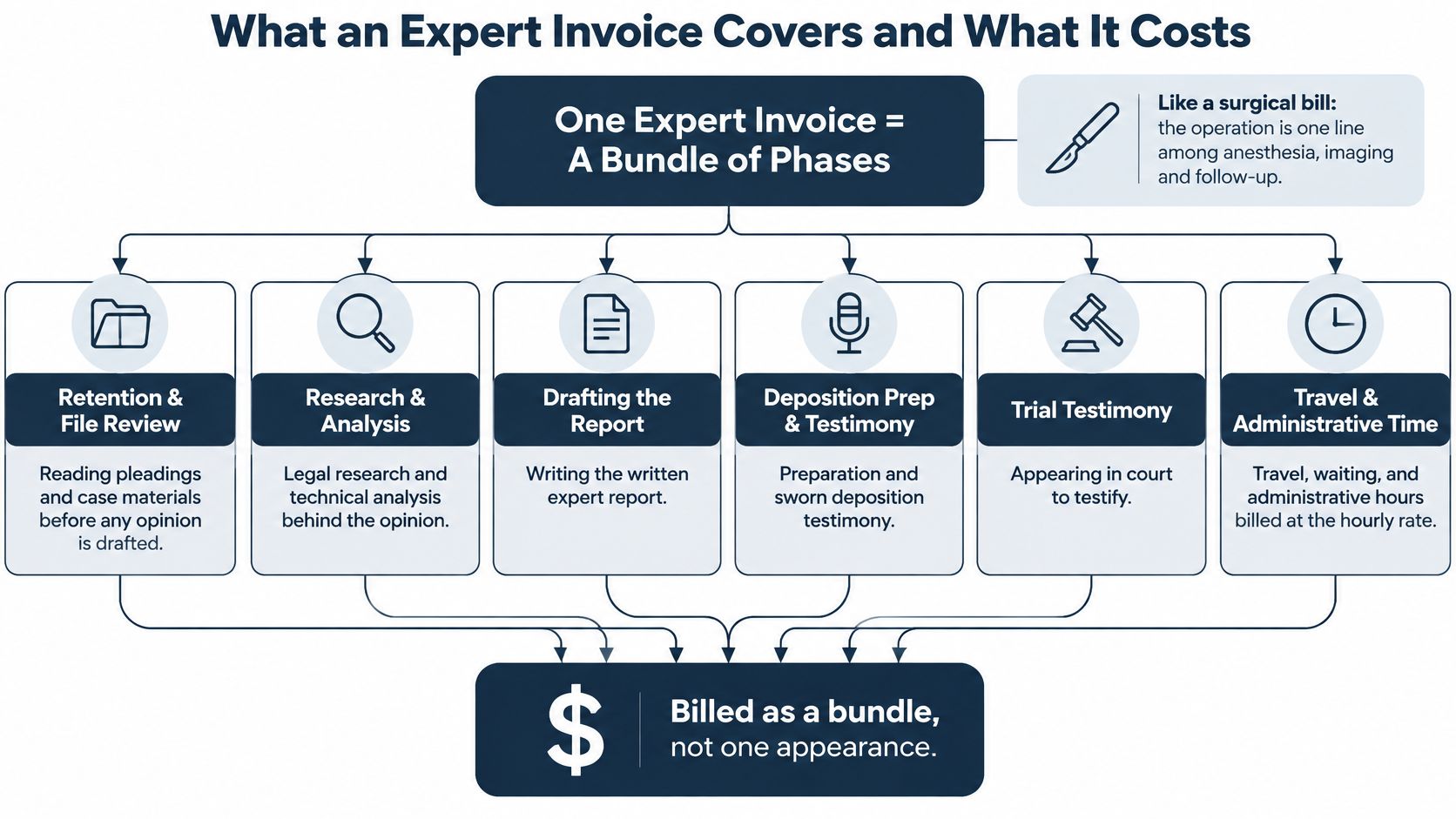
A surgical bill is a useful comparison. The operation is one line among anesthesia, imaging, pathology and follow-up visits. Nobody expects the surgeon's fee to cover the hospital. An expert invoice works the same way, and the appearance in court is the operation.
Here's how the phases stack up at an hourly rate of $300 to $500. This is planning arithmetic, not a quote from any provider, and it shows why the total surprises people who budgeted for testimony alone.
A short walkthrough of the billing sequence is worth two minutes before the numbers.
The phases in the order they bill
1. Initial consultation. Usually $300 to $1,000 for the first substantive conversation and conflict check. Some practices credit it against the engagement if the case proceeds.
2. Records review. Typically 6 to 10 hours on a contested matter, which is $1,800 to $5,000. Medical records, imaging, investigative reports and prior autopsy materials all count.
3. Research and analysis. The reading an expert does to reach an opinion, including guidelines and published literature, runs a few hours on a straightforward case and considerably more where the mechanism of death is disputed.
4. Written report or affidavit. Four to 8 hours, or $1,200 to $4,000, depending on whether the report must satisfy a discovery deadline or a specific pleading requirement.
Add phases one through four and you're at roughly $4,200 to $13,000 before anyone is deposed. These four appear in nearly every engagement, which is why a minimum fee of about $2,500 exists in the first place.
5. Deposition preparation and testimony. Combined, $1,800 to $6,000, and it includes reviewing exhibits, preparing with counsel and the post-deposition record review that many jurisdictions treat as billable time.
6. Trial preparation and testimony. $2,400 to $8,000, covering pretrial conferences, exhibit work, travel days and waiting time at the courthouse.
7. Travel and administrative time. Billed at cost, as a per diem, or as a day rate. Ask which before you authorize anything.
Phases five and six depend entirely on how far the dispute travels. A case that resolves after the report never generates them. A case that goes to verdict generates both, and the same expert who cost $6,000 in the first month can cost $20,000 by the second year.
At a glance, the phase-by-phase range looks like this.
| Phase of work | Cost range at $300 to $500 per hour |
|---|---|
| Initial consultation | $300 to $1,000, sometimes flat or credited |
| Records review | $1,800 to $5,000 for 6 to 10 hours |
| Written report | $1,200 to $4,000 for 4 to 8 hours |
| Deposition preparation and testimony | $1,800 to $6,000 for 6 to 12 hours |
| Trial preparation and testimony | $2,400 to $8,000 for 8 to 16 hours |
| Travel and expenses | Billed at cost, per diem or a day rate |
Why the total matters before trial
Cost influences strategy, not just budgets. The ABA Section of Litigation survey found that more than 81% of lawyers considered expert-witness costs at least somewhat important to the decision to settle a civil case. That figure was 85.1% among plaintiffs' lawyers and 79.9% among defense lawyers.
How many experts a case needs matters too. National Center for State Courts materials on automobile tort cases describe one expert per side at the 25th and 50th percentiles and two at the 75th percentile, at an estimated $2,500 to $7,500 per expert. That's one civil-case category, not a national price schedule, but the multiplication is real.
One more detail belongs in your planning. Opposing counsel can seek discovery of the compensation paid for an expert's study and testimony, so the fee arrangement becomes part of the case record. Courts also expect itemized invoices, which is one reason a clear engagement letter protects everyone.
Before you compare two prices, confirm which phases each quote covers. A lower rate that excludes report writing and deposition preparation isn't cheaper. Learn more about how expert witness services are scoped in forensic pathology matters.
Who Pays Expert Witness Fees and When Courts Shift Them
The default rule is simple and unforgiving. The party who retains the expert pays the invoice, win or lose. Cost-shifting is the exception, and it's narrower than most clients expect.
In federal court, 28 U.S.C. § 1920 allows courts to tax certain witness-related costs, but the statute specifically identifies compensation for court-appointed experts. Guidance from the federal courts on taxation of costs states that privately retained experts are ordinarily limited to the statutory witness attendance amount, currently $40 per appearance, plus allowable transportation, unless a statute provides otherwise or the court approves additional recovery in advance.
What to budget for. Plan as if you will carry the full cost. Any recovery later is a reimbursement, not a funding source.
Court-appointed experts are treated differently, and the Supreme Court has held that fees above the ordinary witness limit are taxable in that situation. If your case turns on a court-appointed neutral, the economics change.
Federal discovery practice adds another wrinkle. The party who deposes an opposing expert generally pays that expert's reasonable fee for the discovery time, so the deponent's budget carries the cost of questioning.
Texas family law goes further and states the rule plainly. Under the Texas family-law statutes, when a party deposes an expert retained by the opposing party, the retaining party must pay all reasonable fees for time spent preparing for, giving, reviewing and correcting the deposition. On-record hours are only part of it.
Three numbers to keep apart
A litigation budget should separate the expert's contractual invoice, the amount potentially recoverable as taxable costs, and any fee-shifting available under a specific statute, contract or advance court order. Blending them produces a forecast nobody can defend.
Cash flow is the practical problem even when shifting applies. The retaining party fronts money at the consultation, again at the report, and again at deposition, sometimes years before any recovery. In forensic pathology matters, clear engagement terms matter because review, examination, laboratory testing, report writing and testimony are distinct services that should be priced and approved separately.
Ask counsel which rules apply to your specific case before you sign anything.
How Texas Counties and Medical Examiners Set Their Fees
Public forensic work in Texas runs on a different set of rules from private engagements, and attorneys who budget for one channel sometimes assume the other.
Under Article 49.32 of the Texas Code of Criminal Procedure, a medical examiner may charge reasonable fees for services connected with death investigations, including court testimony, consultations and depositions. The fee isn't whatever the office decides to set. The commissioners court must approve it before it may be assessed, and it may not exceed the amount necessary to provide the service.
The inquest channel is separate. A justice of the peace may consult a physician about whether an autopsy is necessary, and if a complete autopsy is unnecessary, may order removal of body fluids, tissues or organs for testing. The commissioners court must pay a reasonable fee to a physician performing an autopsy ordered by the justice of the peace and for any requested chemical analysis, as set out in Article 49A.063.
Public and private payment channels
County-ordered examinations are public expenses, authorized within a statutory framework that includes approval by the commissioners court. Private autopsies are different. They're arranged and paid for by the family or the party requesting them, not by the government.
Counties without a medical examiner still need court-ready death investigation. We provide county forensic autopsy services for justices of the peace, commissioners, medical examiner offices and sheriff offices.
Before you budget, confirm which channel the fee flows through. Approval requirements, who writes the check and whether the expense is recoverable all differ between a county-ordered examination and a privately retained expert.
Questions to Ask About Price and Scope Upfront
Rate-setting isn't the only financial risk in this work. In a 2025 expert-witness survey, 27% of respondents had filed a court money claim for unpaid expert fees within the previous five years. Collection problems are common enough to belong in your planning.
The legal stakes reinforce it. Federal Rule of Civil Procedure 26 requires disclosure of the compensation paid for an expert's study and testimony, which means every figure in your engagement letter may be read aloud in a proceeding. It needs to be accurate and defensible.
The questions that surface hidden cost
- Hourly rate and minimum: get the number and the conditions attached to it, including when the minimum applies.
- Scope inclusions: have the provider name records review, testing, report writing, deposition and trial separately, not as "expert services".
- Exclusions: supplemental opinions, additional testing, transport, specimen storage and administrative time are the usual gaps.
- Testimony rates: ask whether deposition and trial bill at the same rate as review, or at a higher day rate.
- Travel and cancellation: confirm mileage or per diem, and what happens if a deposition is postponed the week of the appearance.
- Who performs the work: the person who signs the report should be the person who appears in court, and you should know who that is before you commit.
- Payment milestones: retainer amount, progress billing and the timing of final payment.
- Invoice detail: itemized hours and expenses support any later cost submission, and courts may reject unsupported categories.
| Ask before you sign | What the answer should cover |
|---|---|
| Hourly rate and minimum fee | The rate, the minimum charge and when the minimum applies |
| What the quote includes | Records review, testing, report, deposition and trial named separately |
| What is excluded | Supplemental opinions, added testing, transport, storage and administrative time |
| Deposition and trial rates | Whether testimony phases bill differently from preparation |
| Travel and cancellation | Mileage or day rates, postponement and cancellation fees |
| Who performs the work | The pathologist who signs the report and appears in court |
| Payment milestones | Retainer amount, progress billing and final payment timing |
| Invoice detail | Itemized hours and expenses that support any later cost request |
A flat-rate or capped arrangement in writing is usually the cleaner answer, provided the document names the deliverables, the exclusions, testimony limits, payment milestones and cancellation rules. All-inclusive pricing only helps when the inclusions are written down. If qualifications are your deciding factor, our overview of expert witness qualifications covers what to verify.
Common Questions About Expert Witness Fees
Does a minimum fee still apply if the case settles early?
It depends on what the engagement letter says. Many practices treat the minimum as earned once work begins, while others apply it only if the matter reaches a defined milestone. Confirm the settlement terms in writing before you sign, not after the case resolves.
Can a family or attorney get a fee estimate before committing?
Yes, and you should ask for one in writing before any work starts. The estimate should name what it covers, from records review through testimony, so you can tell whether you're comparing equivalent proposals. A verbal range isn't a scope document.
Does a higher hourly rate mean a better report?
Not by itself. Rate reflects specialty, experience, case complexity and urgency. Compare credentials and the written scope of work, then decide whether the difference in price buys work you need for your matter.
Get the Fee Scope in Writing Before You Commit
Expert witness fees become manageable once the scope is written down, and most of the surprises come from work nobody defined at the start. That's the whole lesson, and it holds for a $2,500 record review and a $40,000 trial engagement alike.
Many readers arrive here after a death in the family, looking for a straight answer about cost at a difficult moment. That deserves a plain response rather than a rate sheet full of ambiguity. Before retaining any forensic expert, request a written quote that names included services, exclusions, rates or flat fees, minimums and cancellation terms.
Our approach at Texas Autopsy Services is a written flat-rate, all-inclusive quote before work begins. A complete private autopsy is $5,795 for the service itself, with no hourly billing and no hidden fees, covering the examination by a forensic pathologist certified by the American Board of Pathology, histology and laboratory analysis by Clinical Pathology Laboratories, a complete written report, a personal consultation, coordination with the funeral home and transportation within 40 miles of Elgin. You can review the scope in detail on our page for private autopsies, and payment plans are available.
Call (806) 230-1889 to discuss an independent autopsy, a second-opinion review or county forensic services anywhere in Texas.
Texas Autopsy Services performs independent postmortem examinations for families, attorneys and county officials across all 254 Texas counties, and every examination is performed by a board-certified forensic pathologist certified by the American Board of Pathology. When a death investigation turns into a legal matter, that same work produces the records, written report and testimony an expert engagement requires. Visit Texas Autopsy Services to talk through your case and get the fee scope in writing before anything begins.