November 16, 2026 · Texas Autopsy Services
Expert Witness Services in Forensic Pathology Explained
Learn what expert witness services in forensic pathology cover, from case review and reports to testimony, and how attorneys can engage a practice.
On this page
- Core Expert Witness Services at a Glance
- How a Forensic Case Review Moves From Records to Opinion
- How Court Admissibility Rules Shape Every Engagement
- What a Defensible Report Must Hold Up Under Testing
- Credentials and Records to Verify Before You Hire
- What Drives the Cost of Expert Witness Services
- Confirm Scope and Authority Before You Engage
You have an autopsy report, medical records, and a question that still hasn't been answered. Perhaps your family needs a clearer explanation of a death, or your legal team needs to know whether the medical findings support a disputed conclusion. Expert witness services should begin with that question, not with a promise to support a particular outcome.
At Texas Autopsy Services, our role is to explain what the evidence supports, what remains uncertain, and what additional work could reasonably help. We recognize that families may be making these decisions while grieving, and that clear explanations matter as much as technical detail.
- Match the service to the question. Reviewing an existing autopsy isn't the same as performing a new examination.
- Evaluate the reasoning. Credentials matter, but courts also examine methods, supporting records, and case-specific application.
- Expect a testable report. Findings, interpretations, alternatives, and limitations should be distinguishable.
- Confirm the full scope. Authority, transport, laboratory testing, reporting, and testimony affect both cost and feasibility.
Core Expert Witness Services at a Glance
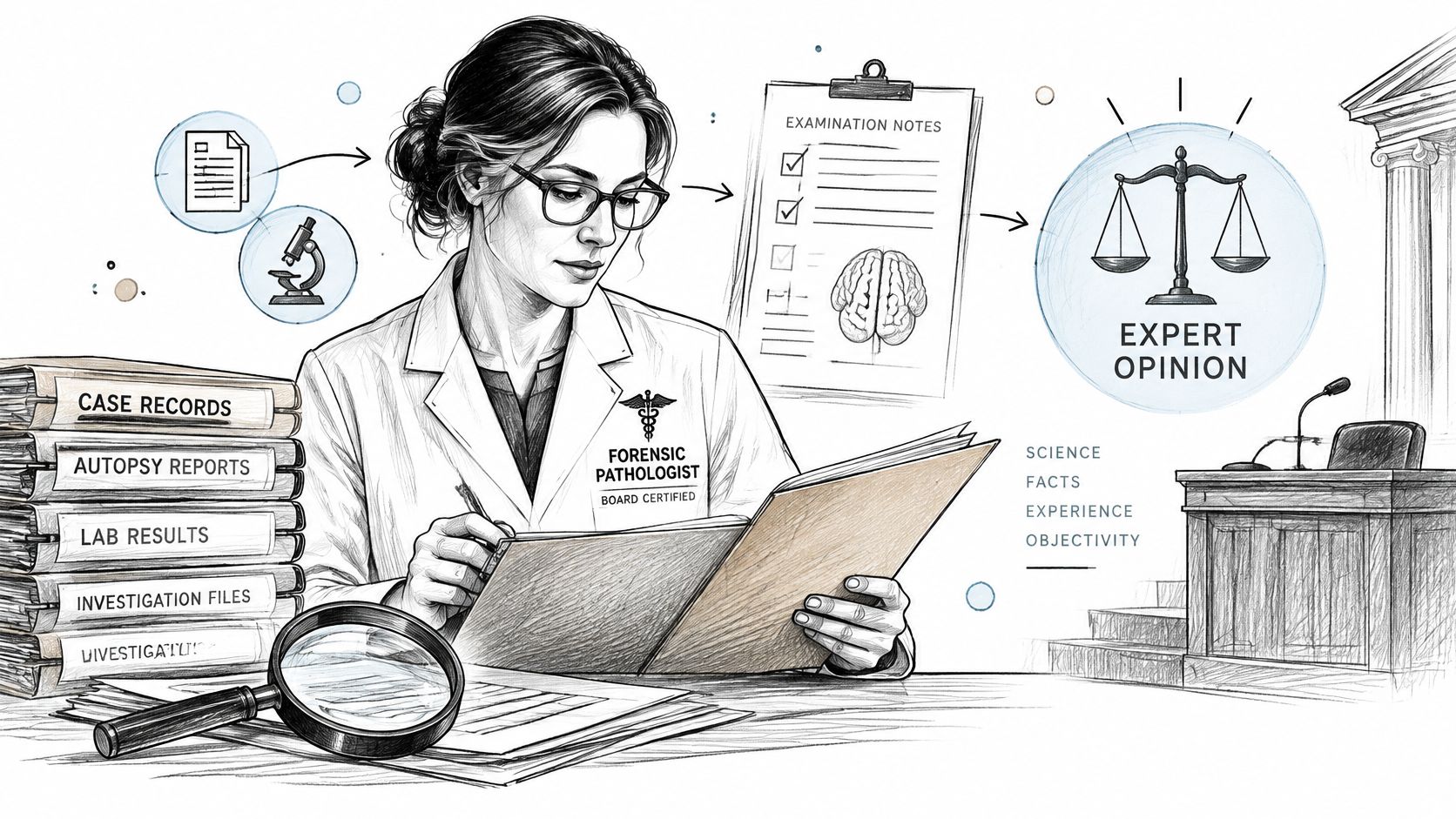
Expert witness services provide an independent medical opinion on a question an attorney, family, insurer, court, or agency needs answered. In forensic pathology, that question usually concerns how and why someone died.
The American Board of Medical Specialties describes forensic pathology as the investigation and evaluation of sudden, unexpected, suspicious, and violent deaths, along with other legally defined categories. The work isn't limited to visible injuries. Medical records, scene circumstances, toxicology, and examination findings may all contribute to the opinion.
Expert witness services by type
| Service | What the Attorney or Family Receives | Typical Situation |
|---|---|---|
| Case review | Written review of records, images, and prior findings | Early check of case strength and issues to test |
| Report preparation | Written report with methods, observations, and conclusions | Expert disclosure and deposition preparation |
| Testimony | Deposition and courtroom testimony | Explaining findings to a judge or jury |
| Second-opinion review | Independent review of an existing autopsy report and records | A prior cause of death is disputed or unclear |
| Private autopsy | New independent postmortem examination | Body available and the medical examiner declined the case |
| Exhumation autopsy | Examination after burial, subject to lawful authorization | Cause of death must be checked after burial |
A case review evaluates available evidence without necessarily requiring another examination. Report preparation turns that analysis into a documented opinion, while testimony allows the expert to explain and defend it under questioning.
A second-opinion autopsy review specifically tests an earlier examination and its conclusions. A private autopsy generates new examination findings. An exhumation autopsy involves additional authorization and practical limits, including the condition of the remains.
Choosing the service: Start with the unanswered question, rather than assuming that a new examination is always necessary.
One engagement may include several services. We also provide court-ready forensic autopsies for Justices of the Peace, commissioners, medical examiner offices, and sheriff offices through our County Forensic Autopsies work. Court-ready means prepared for legal scrutiny, not guaranteed admission by a judge.
How a Forensic Case Review Moves From Records to Opinion
Define the legal or medical question. Identify whether the issue concerns cause of death, manner of death, or the support for a prior finding.
A focused question helps prevent an expensive review that never addresses the actual dispute.Confirm authority and scope. Establish who can authorize an examination, who is requesting the work, and which services are included.
This separates permission to examine from permission to obtain or disclose records.Gather and inventory the records. Collect the death certificate, medical records, prior autopsy report, imaging, scene reports, and toxicology results.
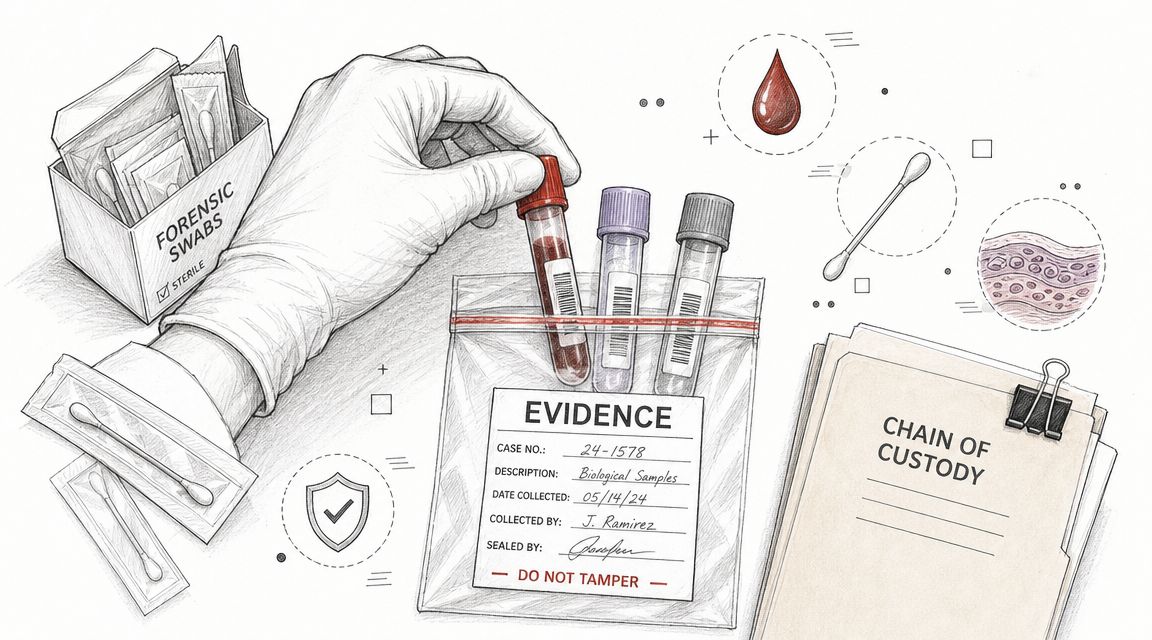
An inventory shows what the expert received and exposes gaps before conclusions are formed.Secure specimens and original images. Document collection, identification, transfers, storage, and testing.
Chain of custody is the record of who handled evidence, when they handled it, and what happened to it.Examine or review the evidence. The forensic pathologist evaluates the body or record set while keeping observations separate from interpretation.
A finding must be documented before its significance can be assessed.Develop the opinion. Explain the causal reasoning, consider alternatives, and identify limitations.
A conclusion should be no stronger than the evidence supporting it.Deliver the report and prepare for questions. Communicate the findings in writing and clarify what may require explanation at deposition.
Both families and attorneys need to understand the reasoning, not just receive a technical conclusion.
Making the record set usable
Cause of death means the disease or injury responsible for death. Manner of death describes the circumstances surrounding it, such as natural, accidental, suicidal, homicidal, or undetermined. A medical finding may help establish the cause without resolving the manner.
The following flowchart summarizes the analytical work within the broader engagement.
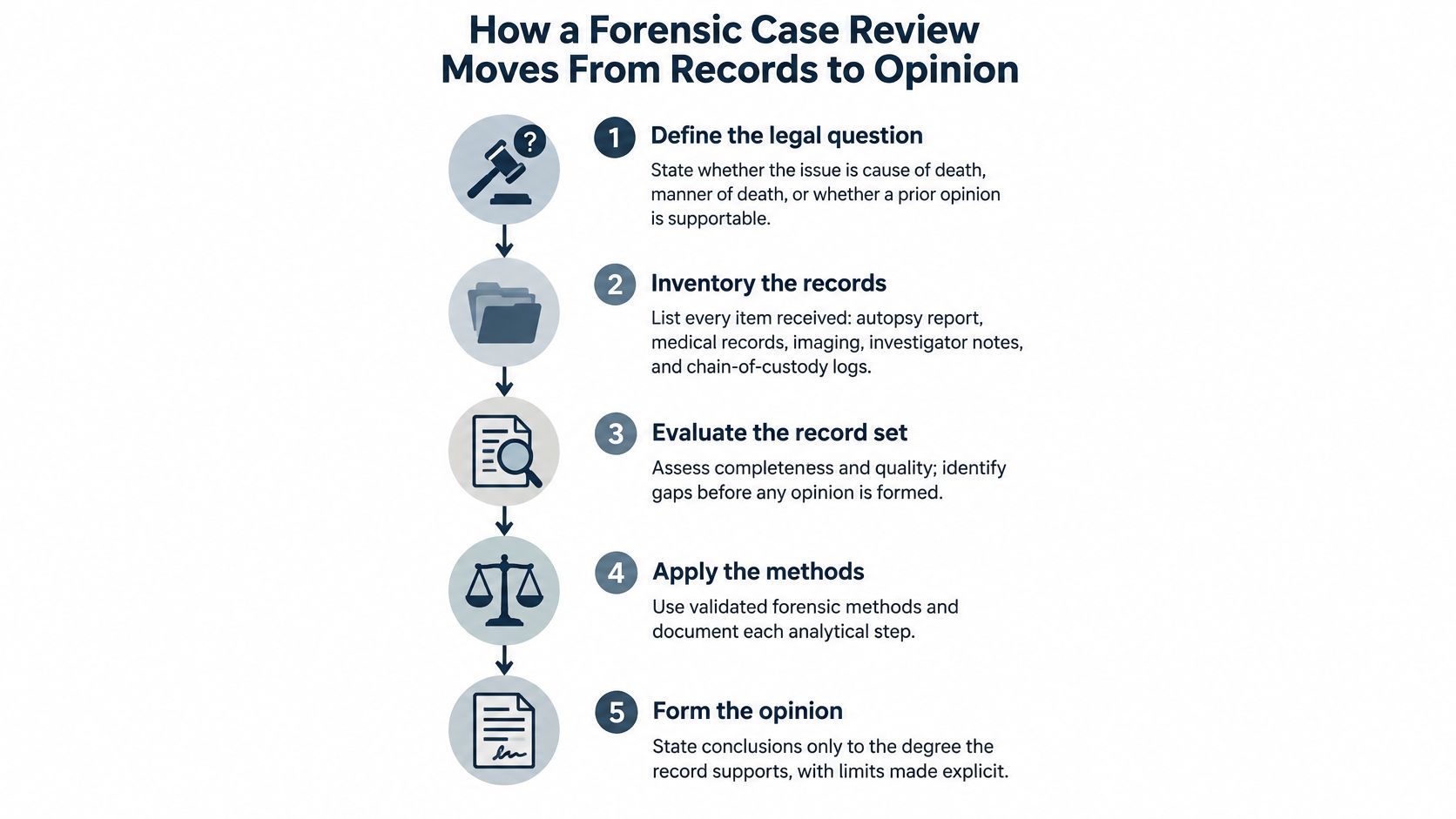
For families or attorneys gathering treatment records, Bell Law's medical records guide for injury claims offers practical background on obtaining them. Our explanation of medical-record analysis addresses how those documents contribute to forensic review.
Send complete records when possible, rather than selected pages that seem important. Medication administration records, emergency notes, imaging reports, and laboratory results may answer different parts of the same question.
Testing and timing
We use accredited forensic laboratories for specimen analysis. Final lab-confirmed results typically return in about four weeks, although required tests and the arrival of records can change the schedule. That's an expectation, not a guaranteed completion date.
Before contacting our team, write down the question you need answered and list the materials already available. This educational explanation isn't a case-specific forensic determination; an opinion requires review of the actual evidence.
How Court Admissibility Rules Shape Every Engagement
A method can enjoy wide acceptance in its field and still fail in court. That gap between professional acceptance and judicial scrutiny is where many expert engagements are decided, often before a jury hears a word of the opinion.
A University of Cincinnati Law Review analysis describes how Frye v. United States in 1923 established the general-acceptance approach and how Daubert v. Merrell Dow Pharmaceuticals in 1993 shifted responsibility to the judge to assess scientific reliability and relevance.
Under the Daubert framework, the judge acts as a gatekeeper before the jury hears challenged expert evidence. Counsel must identify the governing rules for the particular court and case rather than assume every jurisdiction applies an identical test.
What the judge examines
The Rule 702 advisory materials discussing Daubert identify relevant reliability considerations:
- Testability. Can the method or explanation be tested?
- Peer review. Has the method been examined through publication and scientific review?
- Error rate. What known or potential errors affect its use?
- Standards and controls. What procedures guide its application?
- General acceptance. How is the method regarded within the relevant field?
The toxic-tort study discussed in that law review analysis found that, after Daubert, judges excluded all of a plaintiff's general-causation experts in 81% of the cases examined. Plaintiffs whose experts were admitted offered an average of 2.4 experts, compared with 2.0 among those whose general-causation experts were entirely excluded; the difference wasn't statistically significant.
Those findings describe the studied federal toxic-tort decisions, not a predicted exclusion rate for autopsy testimony. Their practical lesson is narrower: adding experts doesn't substitute for demonstrating reliable reasoning.
Applying the standard to a death investigation
Suppose an opinion rests on an assumed time of injury that appears nowhere in the records. Even a well-qualified forensic pathology expert may face exclusion if that unsupported assumption is essential to the conclusion.
When video contributes to a proposed timeline, counsel must assess the foundation of that footage like any other exhibit. Guidance on authenticating video evidence for trial addresses that separate evidentiary question; authentication establishes what the footage is, not the medical meaning of what it shows.
A credential establishes preparation. It doesn't prove that a particular conclusion follows from the evidence.
Our discussion of forensic science and law provides further context. Before retaining an expert, ask how each material opinion can be tested, which documents support it, and what happens to the conclusion if a contested assumption is removed. An expert who answers those questions inside the report is offering work a court can evaluate, not just a name on a letterhead.
What a Defensible Report Must Hold Up Under Testing
A polished report isn't necessarily a defensible report. Opposing counsel will examine whether the author used sufficient evidence, explained the method, and reached conclusions that follow from the case facts.
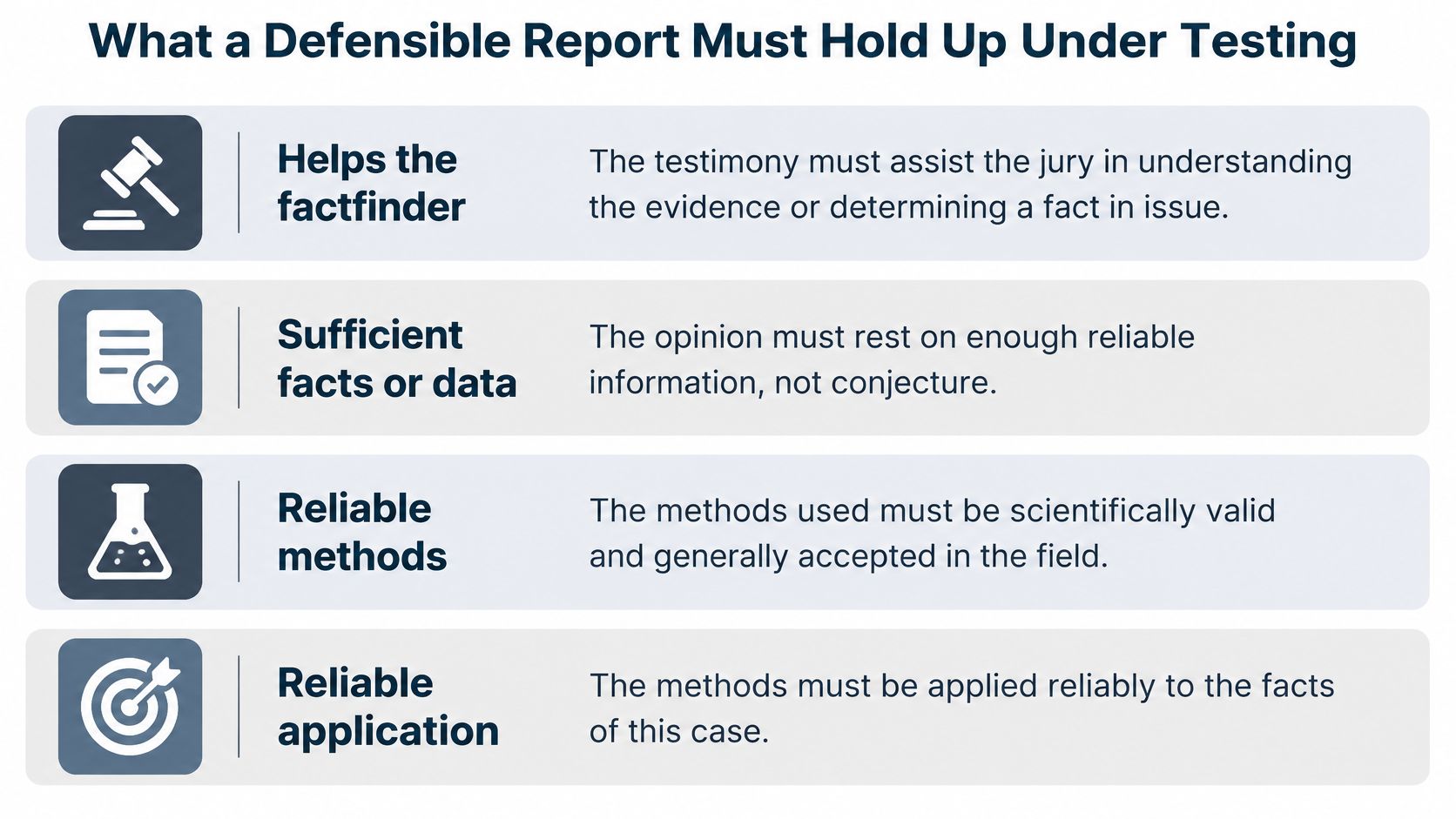
Federal Rule of Evidence 702 and its advisory notes identify four central requirements: testimony must help the factfinder, rest on sufficient facts or data, use reliable principles and methods, and apply those methods reliably to the case. The same document's 2023 notes caution against claims of absolute certainty when a forensic method is subjective or potentially error-prone.
The visual below summarizes those requirements. General acceptance can inform reliability, but it isn't a substitute for examining the method and its application.
The written report must expose the reasoning
A methodology section should identify the records, specimens, photographs, imaging, and laboratory documentation reviewed. It should also name important materials that weren't available. Missing evidence shouldn't disappear because the expert can offer an opinion without it.
Observed findings and interpretations belong in distinct parts of the analysis. An organ weight, wound measurement, or laboratory result is an observation. The explanation of what it means in the circumstances is an interpretation.
The causal analysis must connect those findings to the proposed cause and manner of death. For example, identifying disease doesn't, by itself, explain why that disease rather than another condition caused death at that time.
Alternative explanations require fair treatment. The report should explain why a competing account is less consistent with the evidence, or acknowledge when the available material can't distinguish between explanations.
Testing begins before trial
A National Center for State Courts project reviewed 57 product-liability case files and found an explicit expert-witness reference in 30%; it also identified 20 cases involving motions to exclude testimony, split between 10 filed before Daubert and 10 after. These observations illustrate that challenges to expert evidence extend beyond courtroom cross-examination.
The testing generally takes distinct forms:
- Document scrutiny. Opposing counsel compares the report with underlying records, looking for omissions, inconsistent dates, and assumptions presented as facts.
- Deposition questioning. The expert answers under oath about the materials reviewed, methods used, alternatives considered, and limits of the opinion.
- Trial examination. Counsel tests whether the expert can explain the same reasoning clearly and consistently to the factfinder.
A report should withstand each stage without requiring a new rationale invented after criticism. If new evidence changes the opinion, the expert should explain what changed and why.
The following video is an additional resource alongside the written explanation.
Preparation means accuracy, not rehearsed certainty
Before testimony, the expert should reread the report and relevant source documents. Kons Law's guidance on reviewing case documents before testimony offers useful preparation context.
An expert should answer only what the evidence supports, distinguish recollection from information in a record, and state plainly when a question falls outside the field. Recognizing a limitation is more defensible than supplying an unsupported answer.
Authorship also matters. Dentons' guidance on writing expert reports discusses risks associated with generative AI and emphasizes the expert's own opinions and reasoning. If AI-assisted tools are used, counsel should establish preservation and disclosure expectations, retain source material, and verify outputs rather than treating generated text as forensic judgment.
At our practice, the examining pathologist also writes the report and explains the findings to the family. Families aren't handed off to a technician, and every case ends with a clear, thorough written report they can understand.
A practical report checklist
- Records listed. Reviewed and unavailable materials are identified.
- Methods stated. Another qualified reviewer can follow the analysis.
- Findings separated. Observations aren't confused with interpretations.
- Alternatives addressed. Competing explanations receive reasoned consideration.
- Limits disclosed. Uncertainty and available error information are communicated.
Credentials and Records to Verify Before You Hire
Formal forensic pathology preparation matters because death investigation requires more than familiarity with medical terminology or experience reading hospital records. Buyers should distinguish a verifiable subspecialty credential from a general statement that someone performs autopsies.
The American Board of Pathology's requirements specify 12 months of training in an ACGME-accredited forensic pathology program and at least 30 autopsies completed by application. The required log records age group, sex, primary pathology diagnosis as it would appear on a death certificate, and postgraduate training year.
These are certification-application requirements, not a description of our practice's case volume. ACGME accreditation refers to the training program; board certification refers to the physician's credential. Neither should be confused with laboratory accreditation.
Every examination we provide is performed by a forensic pathologist certified by the American Board of Pathology.
Credentials and records to check
| Credential or Record | What It Shows | Question to Ask |
|---|---|---|
| Forensic pathology subspecialty certification | Completed training and passed the board process | Is the pathologist certified by the American Board of Pathology? |
| 12 months in ACGME-accredited forensic training | Formal forensic training | Which accredited program did the pathologist complete? |
| Autopsy log with at least 30 autopsies | Documented hands-on experience before applying | Can the log show age group, sex, diagnosis, and training year? |
| Accredited laboratory | Specimen testing meets recognized standards | Which accredited lab performs histology and toxicology? |
| Chain-of-custody record | Who handled each specimen and when | Is the record included with the report? |
Use written verification, not broad assurances
Request written answers and documentation appropriate to the engagement. Training logs may contain sensitive information, so verification should protect identifying details rather than require unrestricted access to other decedents' records.
Our specimen analysis uses accredited forensic laboratories. For private autopsies, histology and laboratory analysis are performed by Clinical Pathology Laboratories. Those facts answer different questions from whether the examining pathologist holds the appropriate certification.
For case-specific diligence, request the materials-reviewed list, laboratory reports, and chain-of-custody documentation. Confirm whether supporting records accompany the report or must be requested separately.
Our guide to expert witness qualifications provides additional context for evaluating the role. Relevant preparation should match the disputed issue, whether it concerns injury interpretation, disease, toxicology, or the adequacy of a prior examination.
Verification rule: Treat a credential as unverified until appropriate documentation confirms it.
What Drives the Cost of Expert Witness Services
The total work matters more than the hourly rate. A modest rate can still produce a substantial bill if records require extensive organization, additional testing is necessary, or testimony requires prolonged preparation.
The 2025 Bond Solon survey, a UK survey, reported an average expert-witness hourly rate of £238.81, a 25% increase over its 2015 survey. That isn't a Texas price benchmark or an estimate for a forensic pathology engagement.
Identify the billable work
- Preliminary review. Determine whether the available evidence can address the proposed question.
- Record organization. Retrieve and arrange medical records, imaging, scene documentation, and previous reports.
- Supplemental testing. Account for laboratory analysis needed to evaluate unresolved findings.
- Transport and storage. Include body transport and secure handling of retained specimens.
- Report supplements. Allow for new analysis when additional evidence arrives, not changes designed to favor a party.
- Testimony preparation. Distinguish preparation, deposition attendance, and trial testimony.
- Travel. Identify travel time and expenses associated with a distant proceeding.
Compare a defined scope
Our complete private autopsy service has a flat price of $5,795, without hourly billing or hidden fees for that service. It includes the examination, histology and laboratory analysis, written report, personal consultation, funeral-home coordination, and transportation within 40 miles of Elgin, Texas.
Statewide service availability doesn't mean every transport distance falls within that included radius. We provide in-house licensed transport, and the arrangement should identify the applicable transport scope before work begins.
A private autopsy package also shouldn't be assumed to cover every later litigation service. Confirm the terms for second-opinion review, deposition preparation, testimony, travel, and additional work before authorizing an engagement.
Payment plans are available for private autopsies. For families comparing options, reviewing an existing examination may be more proportionate than commissioning another one when the question can be answered from adequate records.
The written agreement should state what is included, what could change the total, and who authorizes additional work. Payment purchases professional analysis, never a preferred conclusion.
Confirm Scope and Authority Before You Engage
A second-opinion review fits when an examination already exists and the open question is whether its conclusion holds. A new independent autopsy may be appropriate when the body is available and the cause of death remains unclear, including when a medical examiner declined the case. Choosing between them starts with authority: who can lawfully request the work.
A private autopsy is authorized by the legal next of kin or their designated representative and arranged and paid for by the requesting family or party. County or medical examiner autopsies ordered under government jurisdiction are government-funded. A declined county case doesn't necessarily prevent a properly authorized private examination.
Texas authority and practical safeguards
Under Texas Code of Criminal Procedure Article 49.10, a justice of the peace may obtain a physician's or county health officer's opinion about whether an autopsy is necessary and may order sampling when a complete examination isn't needed; when the justice orders autopsy transportation, the county commissioners court pays a reasonable transportation fee.
Transport, custody, funeral arrangements, and cremation must also follow applicable Texas funeral and health regulations. Those logistics sit apart from a court's decision about expert-evidence admissibility, so confirm who coordinates each responsibility before work begins.
Before signing, establish:
- Authorization. Who has legal authority to approve the work?
- Questions. What can the proposed examination reasonably address? A private autopsy is scoped to the family's specific questions, most often how and why the death occurred and whether anything was missed.
- Cost. What does the agreed total include?
- Timing. Which records, tests, or permissions could affect completion? Specimens go to accredited forensic laboratories, and final lab-confirmed results typically return in about four weeks.
- Responsibility. Who writes and signs the report? The pathologist who performs the examination should also be the one who produces it.
- Evidence handling. How are custody and transfers documented?
Frequently asked questions
Can a private autopsy proceed after a county declines?
We can still examine the body with appropriate authorization and explain the findings to the family.
Must a second opinion include another examination?
No. An adequate report, photographs, slides, and supporting records may permit a useful independent review.
Does a report guarantee an answer or admission in court?
No. Evidence may remain inconclusive, and the court decides admissibility.
What if our family is unsure who can authorize the examination?
Our team can walk you through the authorization process and help arrange the examination quickly. Our Private Autopsies information outlines that service.
We offer independent autopsies, second-opinion reviews, and forensic pathology support from Elgin, serving all 254 Texas counties. If your family or legal team needs help defining an unanswered question, visit Texas Autopsy Services and contact our team directly to discuss the available records, authority, and appropriate scope without pressure to proceed.