November 18, 2026 · Texas Autopsy Services
What an Expert Opinion Letter Covers and When It Helps
Learn what an expert opinion letter is, what it should include, how it differs from testimony, and when a forensic pathology review can support one.
On this page
- What an Expert Opinion Letter Is
- Expert Opinion Letter Versus Expert Testimony
- What a Sound Letter Contains and How Courts Test It
- Certainty Levels and Limits Every Letter Should State
- When a Forensic Pathology Review Supports a Letter
- Frequently Asked Questions About Expert Opinion Letters
- Deciding Whether to Request an Expert Opinion Letter
An expert opinion letter is a written statement from a qualified specialist that answers a specific question, using facts the specialist identifies and a method the specialist explains. It helps when a decision turns on a technical question the record alone cannot settle, and federal courts test it against five practical requirements under Rule 702: a qualified expert, helpful testimony, sufficient facts or data, reliable methods, and reliable application.
The autopsy report arrives with a cause of death listed as undetermined. The family has medical records, a police report, and no clear explanation of how the findings fit together. An attorney may need a written opinion before filing a motion. A county official may need an independent read before deciding what comes next. The same document can serve those needs, but only when it shows its work.
Four points separate a useful letter from a persuasive one.
- A letter is evidence, not a character reference. It answers a defined question and shows the records and methods behind the answer.
- Qualifications must match the question. A specialist in the right field still needs to explain why the facts in this case support this conclusion.
- The reasoning has to be visible. A reader should be able to trace each opinion back to a record item and a stated method.
- Courts test reliability, not agreement. The question isn't whether a judge likes the conclusion. It's whether the method is sound and was applied soundly to the facts.
What an Expert Opinion Letter Is
Think of a letter as a signed map. A bare conclusion gives you only the destination. A sound letter shows the route, the landmarks, and the turns that led there, so another person can follow the same path and see whether it holds.
The author can be a physician, an engineer, an accountant, a forensic pathologist, or another specialist whose training bears on the question. What matters is that the author stays inside the field where the training applies. A pathologist can explain injury patterns and disease processes. A pathologist cannot declare what a contract meant or whether a building met a fire code.
These letters appear in civil and criminal litigation, immigration petitions, insurance disputes, employment matters, and medical-legal reviews. They may be filed with a motion, attached to an agency petition, shared during settlement talks, or prepared before a deposition.
They are not character references, general opinions about a person, or simple statements of agreement with another report. A letter that says only "I agree with the prior finding" gives a reader nothing to test. A letter that says which records were reviewed, which findings were observed, which method was used, and how the conclusion follows gives a reader something to check.
Before you rely on one, check three things. Who wrote it, what exact question it answers, and whether the author states the facts relied on. If any of those three is missing, the letter is not ready to carry weight.
Expert Opinion Letter Versus Expert Testimony
A written letter and spoken testimony serve different roles. The table below sets out the comparison readers most often need.
Expert opinion letter compared with expert testimony
| Feature | Expert Opinion Letter | Expert Testimony |
|---|---|---|
| Form | Written document | Spoken answers given in court or at deposition |
| Under oath | Usually unsworn unless drafted as a sworn affidavit | Usually given under oath |
| Direct questioning | Cannot be questioned in real time; challenged through written responses or later hearings | Subject to live cross-examination |
| Timing | Often prepared before a filing, petition or deposition | Given at a deposition, hearing or trial |
| Main purpose | Sets out the opinion and its basis on paper for counsel, a court or an agency | Lets the expert explain and defend the opinion in person |
The difference that matters most is not length or formality. A letter fixes the opinion and its reasons on paper. Testimony tests that reasoning in real time, under questions the author does not control.
A letter often becomes the basis for testimony. The expert's answers at a deposition or trial should match the written opinion, which is why a rushed letter can create problems later. If the letter is vague, the deposition will expose the gaps. If the letter overstates the evidence, cross-examination will press on the overstatement.
Can a letter alone decide a case? Often it does not. Courts usually weigh expert evidence through reports, depositions, and testimony together, and the rules on what a court accepts vary by jurisdiction. A letter may be persuasive on its own in some agency settings or negotiations, but litigation usually brings the author's reasoning into a larger process.
If you're commissioning a letter, ask early whether a deposition or trial appearance is expected. That answer affects how detailed the letter must be, how carefully the records must be cited, and how much time the author needs to prepare. For a closer view of how written opinions fit into litigation, see this discussion of the medical expert witness role.
What a Sound Letter Contains and How Courts Test It
A letter can look authoritative and still fail the first serious read. The difference isn't the font or the length. It's whether a reader can move from each conclusion back to a record item and a stated method without guessing.
Required contents of a sound expert opinion letter
| Element | What It Should Show | Why It Matters |
|---|---|---|
| Qualifications | Training, certification and relevant experience of the author | Establishes that the author has the expertise the question requires |
| Materials reviewed | Medical records, autopsy reports, photographs, toxicology, imaging and prior reports | Lets a reader trace each opinion to its source |
| Facts versus assumptions | Observed findings kept apart from inferences and interpretation | Prevents a conclusion from resting on unstated premises |
| Methodology | The method used to reach each conclusion and how it was applied to the case | Courts ask whether the method is reliable and was reliably applied |
| Opinion and certainty | Whether each conclusion is definite, probable, possible or indeterminate | Keeps the conclusion within what the evidence supports |
| Alternatives and limitations | Competing explanations and missing or conflicting records | Shows the reasoning was tested, not one-sided |
| Compensation and prior testimony | Fee arrangement, publications from the prior 10 years and cases with testimony from the prior four years | These are disclosures required of federal retained experts |
For federal litigation, the disclosure rules go further. A retained expert's written report must give a complete statement of each opinion and its basis and reasons, identify the data or other information considered, disclose supporting exhibits, describe qualifications, list publications from the prior 10 years, state compensation, and identify cases in which the expert testified at trial or deposition during the prior four years under Federal Rule of Civil Procedure 26(a)(2)(B).
That list is a useful audit even outside federal court. It forces a reader to ask whether the records behind the opinion are identified, whether the author's credentials fit the question, and whether the fee and prior testimony are disclosed rather than buried.
The court tests in plain terms
The legal tests developed over a century. The Federal Judicial Center's reference manual traces the Frye test to 1923, when the U.S. Court of Appeals for the District of Columbia Circuit held in Frye v. United States that expert opinion based on a scientific technique generally required the technique to be generally accepted within the relevant scientific community. In 1993, the Supreme Court decided Daubert v. Merrell Dow Pharmaceuticals, Inc., interpreting Federal Rule of Evidence 702 and assigning trial judges a "gatekeeping" role over expert testimony. The focus shifted from general acceptance alone to the scientific validity of the reasoning and methodology.
A separate Federal Judicial Center manual summarizes the Rule 702 framework as five practical requirements. The witness must be qualified. The expertise must help determine a factual issue. The opinion must be based on sufficient facts or data. The testimony must result from reliable principles and methods. Those principles and methods must be reliably applied. The party offering the opinion must establish compliance by a preponderance of the evidence, meaning the court must find it more likely than not that the methodology is reliable and was reliably applied.
The 2023 amendments to Rule 702 and its advisory committee note expressly emphasized that burden and urged special caution with subjective forensic methods. A useful distinction from the federal rule text is that admissibility does not require proving the opinion is correct. It requires demonstrating that the method and its application are reliable.
State courts, including Texas courts, apply their own admissibility rules. Counsel should confirm which standard governs before relying on a federal framework.
A practical audit tool
An opinion-to-evidence matrix pairs each conclusion with the specific record item or examination finding that supports it. Missing or contradictory information gets its own line. This reduces the risk that an opposing party characterizes the letter as conclusory, incomplete, or based on unexamined information.
The same discipline applies when you review expert witness qualifications. Certification opens the door. It doesn't carry the opinion. The records and method have to do that work.
Compare any letter against the table and note any missing row. A missing row is not a small formatting issue. It's a gap someone will find.
Certainty Levels and Limits Every Letter Should State
Certainty isn't a tone of voice. It's a stated level, tied to a method and to the evidence available. Under Federal Rule of Evidence 702, an opinion must remain within the bounds of what the methodology can support. For a cause or manner of death opinion, that creates a technical boundary between a supported conclusion and an impermissible leap.
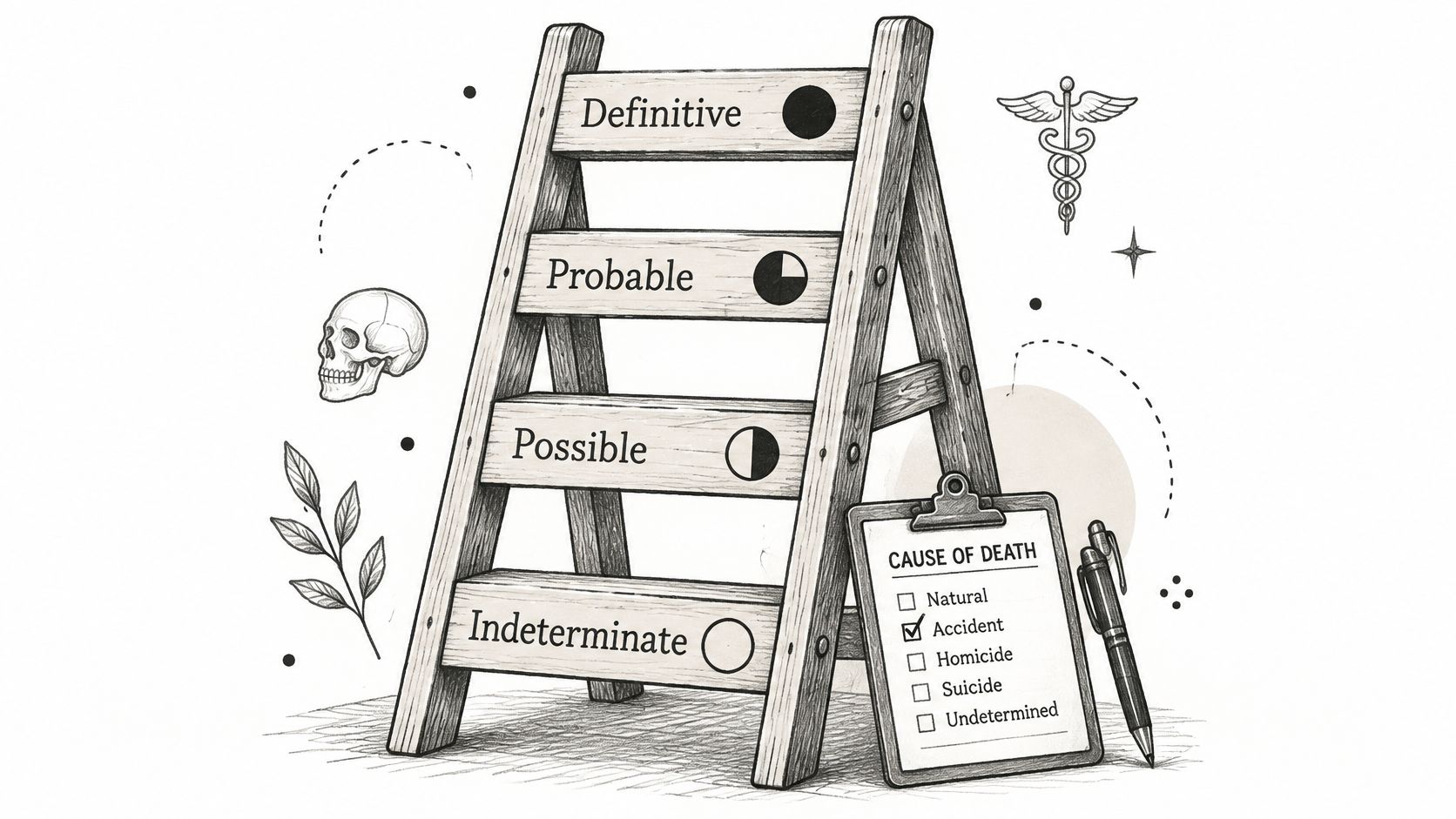
The four levels in a cause-of-death opinion
A careful letter uses four levels. A definitive conclusion means the findings and records support one explanation and exclude plausible alternatives. A probable conclusion means the evidence favors one explanation, but a competing explanation remains possible. A possible conclusion means the evidence is consistent with an explanation without distinguishing it from others. An indeterminate conclusion means the available records and specimens cannot support a reliable answer.
An example makes the difference clear. Suppose an autopsy shows a fracture pattern consistent with a fall, and the records show a known balance disorder. The pathologist may call the fall probable if the injury pattern, scene information, and medical history align. The same finding might be called possible if the records are silent on how the person fell. If the only photographs are poor and the medical history is missing, the honest answer may be indeterminate.
Overstatement weakens a letter. An opposing party can attack any conclusion that goes beyond the methods used, and the attack lands because the letter itself supplied the opening.
Why a stated limit strengthens a letter
Limits are common. Medical records may be incomplete. Specimens may no longer be available. An examination may happen long after death. Witness accounts may conflict. A limit is not a flaw when it's clearly stated, because it shows the author separated what the evidence supports from what it does not.
Practical rule: A letter that states its limits is easier to defend than a letter that pretends none exist.
Medically plausible alternative explanations belong in the letter too. The author should explain whether the evidence favors or weakens each one. The analytical pathway should connect autopsy findings, injury patterns, disease processes, toxicology, and the circumstances surrounding the death. That pathway is what lets a reader see why one explanation is stronger than another.
Watching how a finding is explained aloud can make the difference between a measured opinion and an overstated one easier to hear.
Our board-certified forensic pathologists frame opinions in calibrated language tied to reasonable medical certainty and identify limitations such as incomplete records or unavailable specimens. We avoid claiming more certainty than the evidence permits.
Read any letter with a highlighter. Mark each conclusion, match its wording to one of the four levels, and check whether a stated limit sits beside it. If the conclusion is absolute but the records are thin, ask why.
When a Forensic Pathology Review Supports a Letter
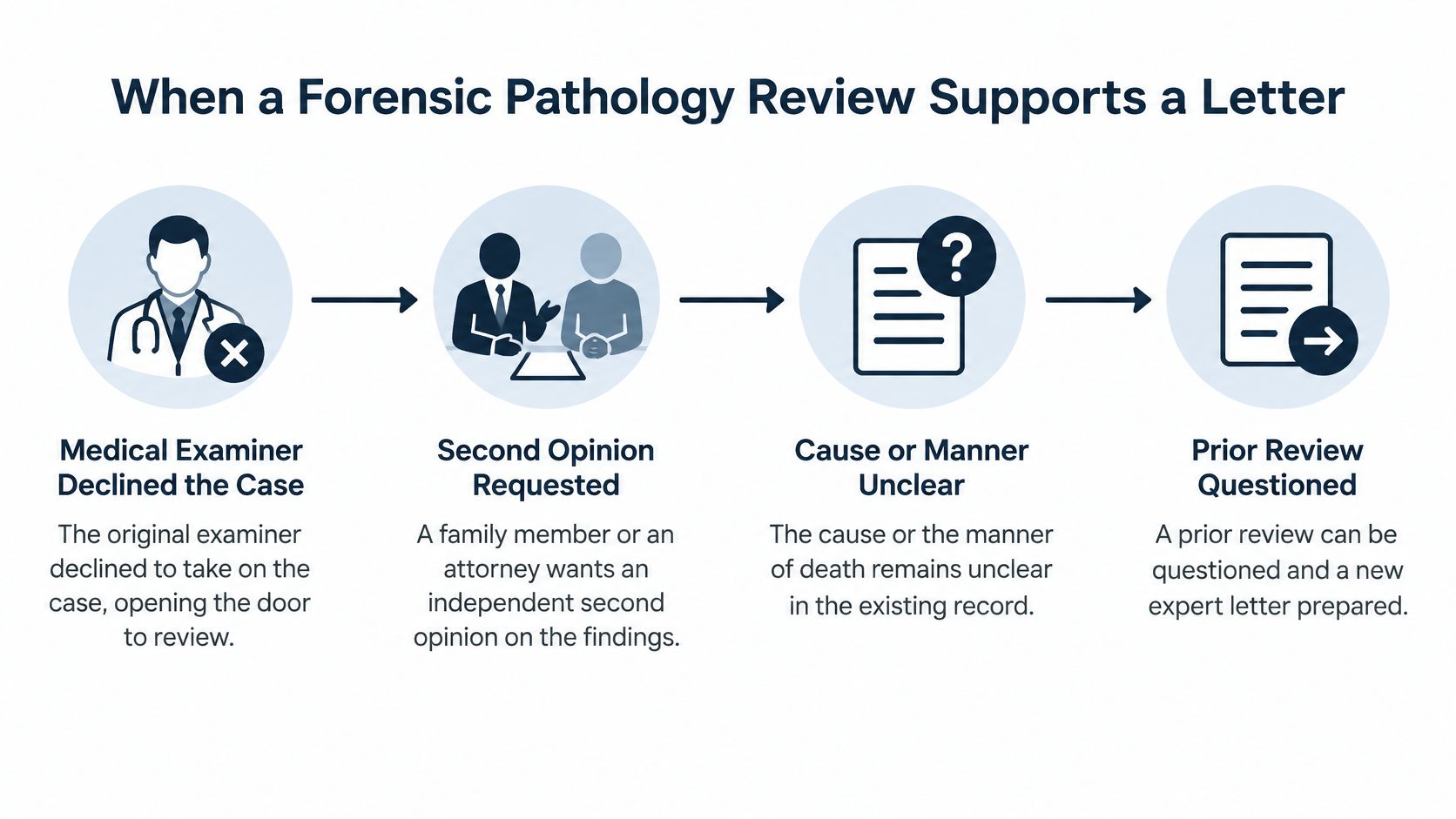
A review usually begins with a file that doesn't feel finished. Families most often request a private autopsy when the medical examiner declined the case, when they want an independent second opinion, or when the cause of death was left unclear or unexplained. Attorneys and county officials come to the same question from a different direction. The existing record has a gap, and someone needs a qualified reader to identify it.
Texas gives local officials defined authority in death investigations. Under Texas Code of Criminal Procedure Article 49.10, a justice of the peace may consult a county health officer or physician about whether an autopsy is needed to determine or confirm the nature and cause of death, and the county commissioners court must pay a reasonable fee for that consultation. When a person is injured in one county and dies in another, Texas criminal procedure lets the attorney representing the state in the county where the injury occurred ask a justice of the peace in the county where death occurred to order an autopsy.
Training matters in this work. The American Board of Pathology requires an applicant for pathology certification to complete at least 30 autopsies before submitting the application. The required documentation must identify the decedent's age group, sex, primary pathology diagnosis, and the postgraduate training year in which the autopsy was performed. That benchmark explains why a review should be handled by a board-certified forensic pathologist rather than a reader with general medical knowledge.
Five steps in a records review
- Confirm the question. A review needs a defined question, such as whether a cause of death is supportable, whether an injury pattern fits a reported mechanism, or whether a prior report missed a finding.
- Gather records and prior reports. Medical records, autopsy reports, photographs, toxicology, imaging, histology, scene information, and prior opinions form the file.
- Review slides and imaging. Tissue slides, photographs, and imaging can clarify what the original examination recorded.
- Compare findings with the prior report. The reviewer looks for agreement, omission, and contradiction, then explains each.
- Write opinions with certainty levels and limits. Each conclusion gets a level and a stated limit where the evidence requires one.
When a private examination is the next step, our private autopsies service covers the examination, laboratory work, written report, and a conversation with the family. For county-referred cases, our county forensic autopsies support justices of the peace and counties without a medical examiner.
A review cannot answer every question. Key specimens may have been discarded. Records may be missing. No review result is guaranteed, and a responsible reviewer will say so before the work begins.
Frequently Asked Questions About Expert Opinion Letters
Does a private letter change an official death certificate or manner-of-death ruling
No. A private letter is an opinion for counsel, a court, an agency, or a family. Cause of death is the injury or disease that produced death. Manner of death is the classification assigned to the death, such as natural, accident, homicide, suicide, or undetermined. The official ruling stays with the official who certified the death, and any change follows that official's own process. A letter can support a request to revisit that ruling, but it does not change the record on its own.
What does a review cost and what does it include
Texas Autopsy Services uses flat-rate, all-inclusive pricing with no surprises. With any provider, ask what the quoted fee covers: which records are reviewed, whether specimen work is part of the price, and whether the expert's time is billed separately if testimony follows. A chain of custody is the documented record of who handled a specimen and when, and it is included whenever specimens are part of the question.
How long does a review take
Timing depends on the records received, the specimens available, and the scope of the question. When the question calls for laboratory work, specimens go to accredited forensic labs, and final lab-confirmed results typically return in about four weeks. We explain the factors that apply to each case rather than promise a fixed date.
Deciding Whether to Request an Expert Opinion Letter
These decisions often arrive during a loss, when concentration is short and advice comes from several directions. Taking time to think is reasonable. A useful letter is not only persuasive; it can survive scrutiny. Persuasion sounds confident. Durability shows the question, the records relied on, the reasoning, and the limits, and it still makes sense when someone challenges each step.
Use five questions to audit the need before anyone writes a page:
- What exact question must the letter answer? "Why did this happen" is too broad. "Was this injury pattern consistent with the reported fall" is a question a pathologist can address.
- Is the author qualified in that specific field? Certification and experience should match the question, not just the general subject.
- Are the records complete enough to support that question? Missing records and unavailable specimens change what a letter can conclude.
- Where will the letter be used? A court filing, an agency petition, and a family decision call for different levels of detail.
- Does the expert expect to testify? If a deposition or trial appearance is possible, say so before the letter is written.
A first contact should cover the question and the records. Bring the death certificate if available, medical records, prior autopsy or laboratory reports, photographs, and the names of agencies that have handled the case. You can ask questions without obligation. We respond to a consultation request within 24 hours, with no pressure or obligation. If you are not certain you have the authority to request a private autopsy, we walk you through it and help arrange the examination quickly.
Transport, cremation, and cemetery arrangements sit under separate Texas chapters, which the Texas Funeral Service Commission lists as Texas Occupations Code Chapter 651, Texas Health and Safety Code Chapter 716, and Chapter 711. That separation matters when the autopsy is only one part of what a family or county must arrange.
Bring your list to the first conversation. Call (806) 230-1889 for guidance, and we will help you decide whether a letter, a records review, or a private examination fits the question you have.
Texas Autopsy Services prepares written forensic pathology opinions from medical records, prior autopsy reports, and laboratory results for families, attorneys, and county officials across all 254 Texas counties. If the records leave a question that a written opinion can answer, our board-certified forensic pathologists can review the file and explain the findings in plain language. Visit Texas Autopsy Services to start a confidential conversation.