March 28, 2026 · Texas Autopsy Services
What I Can Learn from a Body Exhumed After 10 Years
Is it possible to find answers from a body exhumed after 10 years? A forensic pathologist explains the legal and scientific process in Texas for 2026.
On this page
As a forensic pathologist, I field many difficult questions, but one of the most common is about revisiting the past. Families and attorneys often call my office and ask, "Is it really possible to find answers from a body that's been buried for 10 years?"
The answer is often yes. While a decade in the ground presents challenges, a significant amount of evidence can endure. For those seeking the truth, an exhumation offers a valid path to clarity.
TL;DR: Can a Body Exhumed After 10 Years Yield Answers?
- Yes, it's possible. A second, independent autopsy on exhumed remains can uncover critical forensic evidence even after a decade.
- Durable evidence survives. Bones, teeth, and hair are excellent sources of information about trauma, identity (DNA), and sometimes toxicology.
- The process is legally regulated. In Texas, exhumation requires a court order, ensuring it's handled with legal authority and respect.
- An independent expert is key. A private, board-certified forensic pathologist works for you, providing an unbiased, scientific second opinion.
- Answers bring closure. A comprehensive report can clarify the cause of death, helping families and legal teams find resolution.
Finding Answers a Decade Later
Recently, I worked with a family still troubled by questions about their father's death ten years prior. The official report cited an accident, but certain details never sat right with them. Over the years, that doubt grew, and they finally decided they needed a second opinion, even if it meant navigating the difficult process of an exhumation.
Their story is one I hear frequently. Families and legal teams contact my office, Texas Autopsy Services, concerned that too much time has passed and any chance for answers is lost. But from my experience, this is rarely true. A body exhumed after 10 years can absolutely provide critical forensic clues.
My work as a board-certified forensic pathologist has taught me that the truth can be incredibly resilient. It’s all about knowing where to look. Even after a decade buried in Texas soil, certain types of evidence persist.
What Evidence Can Survive a Decade?
The human body is resilient, but some parts are more durable than others. When I perform a private autopsy on exhumed remains, I focus my examination on these materials that offer the best chance of telling a story.
- Skeletal Remains: The skeleton acts as a final record. Bones can show old, healed fractures from a person's life, but they can also reveal fresh breaks or subtle tool marks from a weapon that may have been missed in an initial exam.
- Dental Evidence: Teeth are powerhouses of preservation. They are often the best-preserved part of the body, making them ideal for confirming identity against dental records. They are also an excellent, protected source for DNA.
- DNA and Hair: DNA is surprisingly hardy. We can reliably extract viable samples from bone and teeth long after death. If any hair is preserved, it can also be a source for DNA and may hold clues for toxicology testing.
Deciding to proceed with an exhumation is a significant step. It involves navigating legal requirements and facing an emotional experience. But for a family desperate for closure or an attorney building a case on solid facts, it is a scientifically sound and often necessary option. An independent cause of death investigation can deliver the objective answers needed to finally move forward.
What’s Left of a Body After a Decade? The Science of Decomposition
When families ask me if it’s possible to find answers from a body buried for 10 years, I always start by explaining the science of what happens after burial. As a forensic pathologist, I approach this objectively, but I never forget that for you, this is a personal and difficult subject. My goal is to provide a straightforward, honest picture of what to expect.
Decomposition isn’t a simple countdown. It’s a complex process where the final state depends entirely on the surrounding conditions. No two cases are ever the same.
What Affects How a Body Decomposes?
After performing both private and county forensic autopsies for years, I’ve seen firsthand how a few key factors can drastically alter the condition of remains a decade later.
- Embalming: The quality of the original embalming is a huge factor. The chemicals used are meant to slow decomposition, but their effect isn't permanent. A thorough embalming can preserve soft tissues for much longer, while a minimal one offers little protection.
- Casket and Vault: The quality of the casket makes a big difference. A sealed metal casket inside a concrete vault can act like a time capsule, shielding the body from soil, water, and insects. In contrast, a simple wood casket, or one that's damaged over time, will allow the environment in and accelerate decomposition.
- The Burial Environment: The grave itself plays a massive role. Specific soil chemistry in Texas, moisture levels, and ground temperature all contribute. For instance, very wet, oxygen-poor soil can lead to a waxy substance called adipocere, which can preserve the body's form.
This timeline gives you a visual idea of how a case can evolve, moving from an initial question about a death that happened years ago to finding real, tangible evidence a decade later.
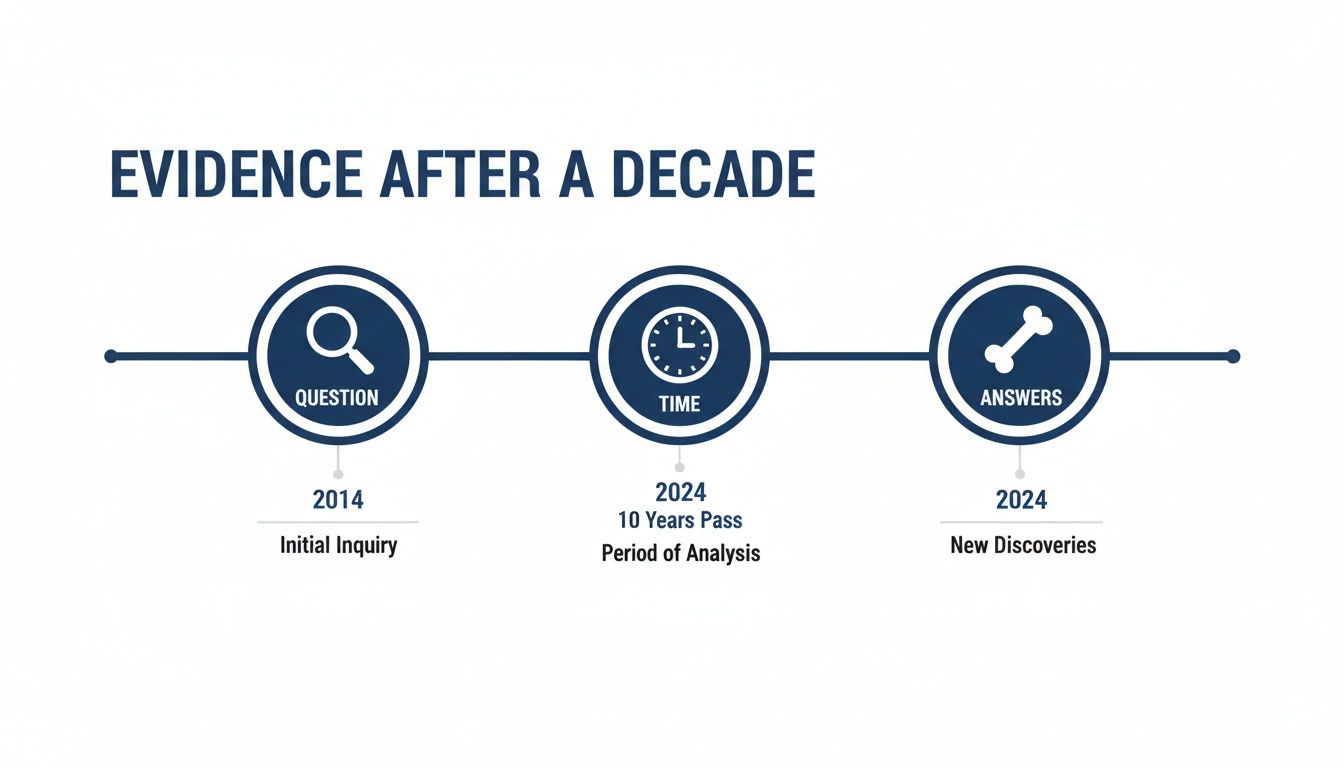
As you can see, time doesn't close the door on an investigation; it just changes what we're looking for. The focus simply shifts to the evidence that lasts.
The State of the Remains After Ten Years
So, what do we realistically expect to find? After ten years underground, most of the body's soft tissue is usually gone. What’s left are the most durable materials.
While decomposition starts right away, the process slows significantly over time. At the 10-year mark, we typically expect to find bones, teeth, and hair, and sometimes fragments of clothing. In some cases, especially in damp environments, body fat can transform into adipocere (often called "grave wax"), which can surprisingly preserve the body’s general shape and features.
A key fact to remember is that complete skeletonization, where the body is reduced to a bare skeleton, often takes 10 to 15 years. This means at the 10-year mark, we very often find much more than just a pile of dry bones.
This is precisely why a second opinion autopsy can still be so valuable after a decade. We go into it expecting to work with skeletal remains, which hold a tremendous amount of information. Teeth are fantastic for confirming identity and can be a source of DNA. And the bones themselves can tell a powerful story, revealing old fractures, signs of trauma, or diseases that might just hold the answers you've been searching for.
Navigating the Texas Exhumation Process
If you're considering having a body exhumed after 10 years, you should know that it’s not something a family or legal team can simply decide to do. In Texas, the entire process is strictly regulated by law to ensure it’s handled with dignity and clear legal authority. It is a formal, court-supervised procedure, not a private arrangement.
An exhumation, also called a disinterment, can only move forward with proper authorization. This legal framework exists to protect the deceased, the family, the cemetery, and the public interest. Let’s walk through who can provide that authorization.
Who Can Authorize an Exhumation in Texas?
In Texas, the authority to request a disinterment is specific and generally falls into two categories: obtaining consent from family or getting an order from a judge.
- Consent-Based Disinterment: This path is simpler if all immediate next of kin and the current owner of the cemetery plot are in agreement. It requires collecting written, notarized consent from every legally recognized party, which can sometimes be a challenge to coordinate.
- Court-Ordered Disinterment: This is the more common route, especially when there isn't unanimous family agreement or when the exhumation is part of a legal investigation. A district court in the county where the individual is buried must issue a formal order. This is almost always the path for cases needing a second autopsy to investigate a questionable cause of death.
The legal paperwork for an exhumation can be quite complex. Professionals like Legal assistants can be a huge help in managing the meticulous documentation required.
The Legal Roadmap for a Court Order
Getting a court order isn't just about filling out a form; it's a formal legal proceeding. Your attorney will need to file a petition with the court that clearly outlines the "good cause" or the compelling reasons for the exhumation. This might be to resolve a legal dispute, uncover evidence for a criminal investigation, or give a family peace of mind by clarifying a suspicious cause of death.
Under Texas Health & Safety Code Chapter 711, a judge must be convinced there is a valid and compelling reason for the exhumation before granting an order. This high standard ensures a grave is not disturbed without a very good reason.
To help you visualize the journey, here’s a breakdown of the key legal and logistical steps involved in the process.
Key Steps in the Texas Exhumation Process
| Step | Primary Responsibility | Key Considerations |
|---|---|---|
| 1. Legal Consultation | Family / Attorney | Determine if there is "good cause" for exhumation; gather initial facts. |
| 2. Petition the Court | Attorney | File a formal petition for disinterment with the appropriate district court. |
| 3. Obtain Court Order | District Court Judge | The court reviews the petition and, if approved, issues an official order. |
| 4. Coordinate Logistics | Attorney / Family / Pathologist | Engage a funeral home, cemetery, and forensic pathologist to plan the date and transport. |
| 5. The Exhumation | Funeral Home / Cemetery Staff | The physical disinterment is performed according to the court order. |
| 6. The Examination | Forensic Pathologist | The remains are transported to a facility for a second autopsy or examination. |
| 7. Reinterment | Funeral Home | After the examination is complete, the remains are returned to the cemetery for reburial. |
Securing a court order is just one critical part of a multi-stage process that requires careful coordination among several parties.
The timeline for getting a court order can vary. It might take several weeks or extend for a few months, depending on the court's schedule and if anyone formally objects to the request. This is where having an experienced attorney is crucial. They can build a strong case and navigate the court system efficiently.
Once that legal authorization is in hand, my work at Texas Autopsy Services truly begins. I coordinate directly with your legal team and the funeral home to manage the examination. We ensure every step, from disinterment to the final report, is handled with the precision and ethical care that the law and your family deserve. I have written more about the process of exhumation in another article if you'd like to learn more.
What Forensic Evidence Survives a Decade
When I talk with families considering an exhumation after 10 years, their first question is almost always the same: “Is there anything left to find?” It’s a completely fair question. While a decade in the ground changes things, the human body preserves evidence far better than most people think. A second autopsy can still reveal a tremendous amount of information if you know exactly what to look for.
My focus simply shifts. Instead of relying on soft tissues, I turn to the parts of the body that endure: the skeleton, teeth, and hair. These become the storytellers, holding a physical record that can help answer lingering questions about what really happened. Even after ten years, we can uncover proof of injury, confirm identity, and sometimes find traces of toxic substances.
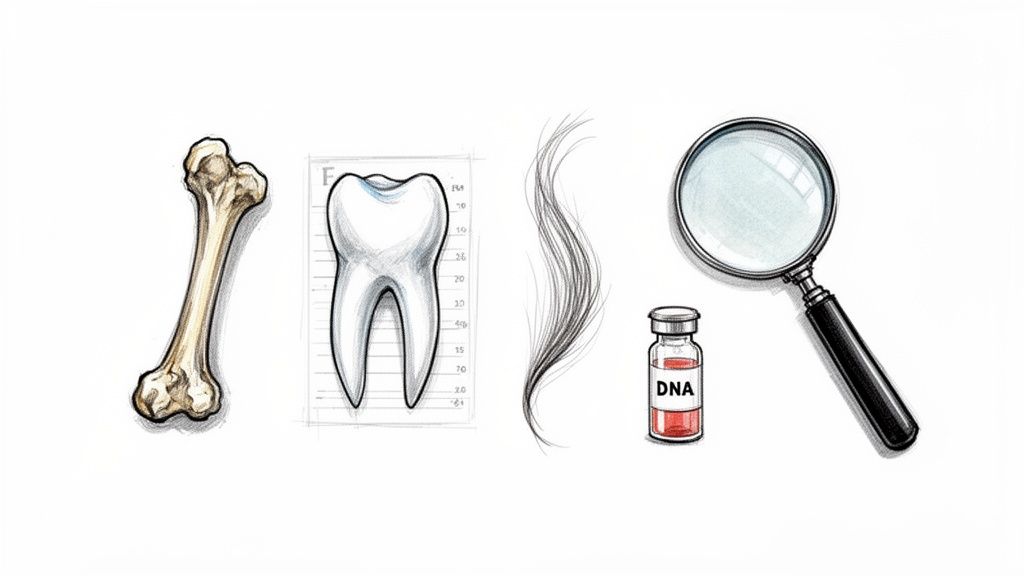
The Skeleton Tells a Story
Think of the skeleton as a permanent archive of a person's life and, more importantly, their death. When I perform a private autopsy on exhumed remains, the bones are often where the most critical discoveries are made. They can highlight details that were overlooked or misinterpreted the first time around.
I meticulously examine every single bone for clues. Here’s what I’m looking for:
- Unhealed Fractures: Breaks that happened around the time of death are a classic sign of blunt force trauma.
- Tool Marks: A weapon can leave behind subtle but unmistakable evidence, like tiny cuts, scrapes, or impressions on the bone.
- Healed Injuries: Old injuries are just as important. They help me build a picture of the person’s life and create a baseline, making it easier to distinguish old trauma from new.
A common fear is that only dust will be left. The reality is that the skeleton is usually quite well-preserved and provides a solid framework for a thorough forensic review.
Dental and DNA Evidence
Teeth are the toughest part of the human body. They can easily outlast every other tissue, making them invaluable for two main reasons. First, they are the best tool for identification. By comparing the teeth to a person's dental records, I can make a 100% positive identification. This is always the first, most crucial step in any exhumation case.
Second, both teeth and dense bones like the femur are incredible protectors of DNA.
DNA is surprisingly stable. When it’s sealed inside a tooth or a thick bone, it can remain viable for decades. We can reliably extract this genetic material to confirm who the person is or, in a criminal investigation, match it to evidence from a crime scene.
Obtaining a clear genetic profile removes all doubt about the identity of the remains and can offer irrefutable proof for legal proceedings. For many families, just getting this confirmation brings a profound sense of closure.
Toxicology and Other Trace Evidence
Just because soft tissues and organs have decomposed doesn't mean the trail for toxicology has gone cold. Hair is made of keratin, a protein that resists decay remarkably well. If we can recover a good sample, it acts as a timeline, showing exposure to certain heavy metals, poisons, and some drugs of abuse that were in the person's system for months before they died. Our guide to post-mortem toxicology explains how this works.
And while you should expect significant decomposition, it’s not always as complete as you might imagine. One study of 87 exhumations found that in some cases, soft tissue remnants were still usable for analysis after more than 16 years. This shows that valuable findings are absolutely possible well past the 10-year mark.
Finally, the examination doesn’t stop with the body. I also inspect the casket and any remaining bits of clothing or personal items. You’d be surprised what can turn up. A bullet fragment that was missed in the initial exam can sometimes be found in the coffin, providing that one critical piece of the puzzle that changes everything.
The Exhumation and Second Autopsy Explained
Once a judge gives the green light, the real work begins. The day of the actual exhumation and the second, independent autopsy is a moment that demands incredible coordination, but more importantly, a deep respect for both the deceased and their family. As a forensic pathologist, I see it as my duty to ensure every single step is handled with precision, dignity, and a focus on solid science.
When a body is exhumed after 10 years, my team at Texas Autopsy Services coordinates everything with your attorney and a licensed funeral home we trust. We often work with dedicated professionals like Waterloo Mortuary, who understand how sensitive and legally complex these situations are. We handle all the logistics with the cemetery to set the exact day for the disinterment.
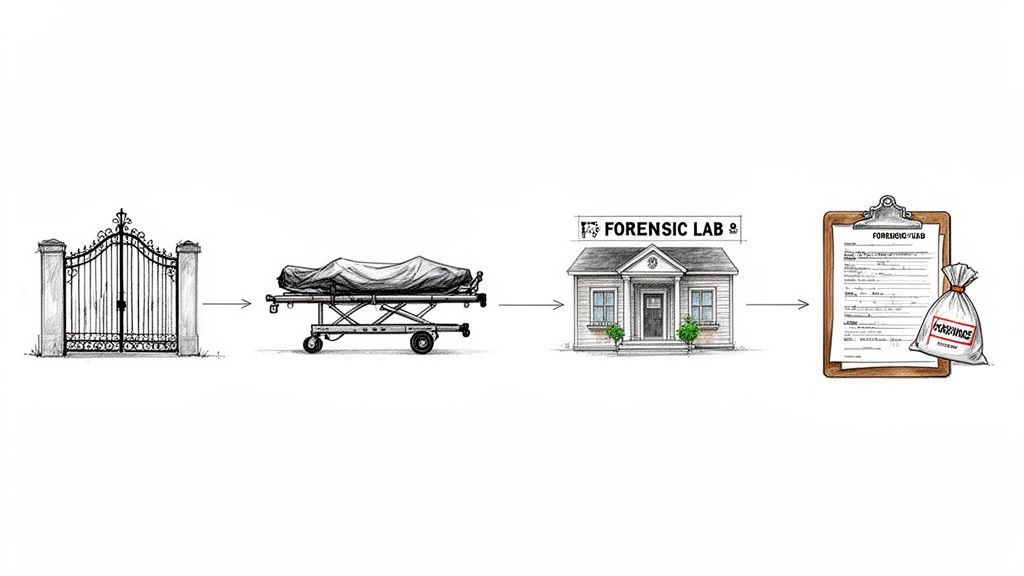
Maintaining the Chain of Custody
From the moment the earth is broken, one rule is paramount: chain of custody. Think of it as an unbroken, documented line of accountability. It’s the proof that the remains were handled correctly at every turn, with zero opportunity for tampering or contamination. This isn't just paperwork; it's the foundation of credible forensic science, especially for cases heading to court.
The funeral home staff, working under our supervision, respectfully recovers the casket and secures it in a transport vehicle. From there, the remains come straight to our facility. They are never left unattended, and every hand-off is logged down to the minute.
This strict protocol is what makes our findings legally sound. It ensures that any evidence we uncover during the second autopsy can stand up to intense scrutiny in a courtroom and protects the integrity of the whole investigation.
The Steps of the Second Autopsy
When the remains arrive, the real examination starts. This isn’t a simple repeat of a standard autopsy. It's a highly specialized analysis, honed to focus on the durable evidence that can and does survive for years. The process is methodical, patient, and detailed.
My examination follows several key stages:
- Initial Documentation: I begin by carefully photographing everything as received, including the state of the casket, any clothing, and the remains themselves.
- Skeletal Examination: The bones are the main storytellers here. I conduct a full-body skeletal survey, cleaning and examining each bone for any hint of trauma, disease, or identifying marks that might have been overlooked before.
- Dental Charting: The teeth are incredibly important. I perform a detailed dental charting, which is often the key to confirming identity when compared against old dental records.
- Sample Collection: I strategically collect specific samples for advanced testing. This usually means taking small sections of dense bone or teeth for DNA analysis and any preserved hair for toxicology screening.
Translating Findings into Answers
After the physical exam is done and all lab tests are back, I pull everything together into one comprehensive final report. I write this document in plain English, intentionally avoiding dense medical jargon. It’s crucial that you and your attorney can clearly understand the scientific facts of the case.
This report will present my professional opinion on the cause of death based on the evidence we found. It lays out what the forensic findings mean and directly answers the questions that led you to seek an exhumation. My goal isn’t just to give you data but to provide clear, objective answers that can finally bring your family some resolution.
Why an Independent Forensic Pathologist Is Essential
When a family or law firm decides to pursue an exhumation, especially for a body buried for 10 years, the single most important decision they'll make is choosing the right expert. There’s a world of difference between a government medical examiner and a private, board-certified forensic pathologist.
A government ME’s primary duty is to the state. My role at Texas Autopsy Services is entirely different. My client is you, the family or the attorney seeking answers. I work directly for you, completely outside of any county or state system, to provide objective, scientifically-backed answers to your specific questions. That independence makes a true second opinion possible.
The Importance of Unbiased Expertise
For an exhumation, you need more than just a medical doctor. You need a specialist with deep experience in the intricate field of forensic pathology. My board certification from the American Board of Pathology in Anatomic, Clinical, and Forensic Pathology is a guarantee of that specialized, verified expertise.
After performing over 1,000 autopsies, I’ve learned to spot the subtle, often-missed details that can change the entire understanding of a case. This becomes absolutely vital when we're looking at remains that have been decomposing for a decade. It takes a seasoned eye to tell the difference between natural postmortem changes and the real signs of trauma or disease.
An independent pathologist brings a completely fresh perspective. My only allegiance is to the medical facts, ensuring the final report is built on pure science, free from any outside pressure or pre-existing theories about the case.
A Commitment to Clarity and Compassion
But technical skill is only part of the story. The other part is communication. I believe families deserve more than a dense report packed with medical jargon they can't understand. I make it my mission to translate complex forensic findings into plain, clear language. I don't just give you data; I explain what the evidence actually means for you and your questions.
This work demands a careful balance of scientific precision and genuine human compassion. I never forget that behind every case is a family searching for answers and peace. Every part of the process, from our first conversation to the final reburial of your loved one, is handled with the dignity and respect you deserve. If you'd like to understand more about the examination process itself, I’ve detailed the steps of an autopsy in a previous article.
Ultimately, hiring an independent pathologist is about restoring your trust in the process. It’s about ensuring the investigation is thorough, the findings are impartial, and your loved one is honored while you get the clarity you've been seeking for so long.
FAQ: Exhumation and Second Autopsy After 10 Years
Thinking about an exhumation is an overwhelming process, and it’s natural to have a lot of questions. As a forensic pathologist, I've walked many families and attorneys through these tough decisions. Here are straightforward answers to the questions I hear most often at Texas Autopsy Services when considering a body exhumed after 10 years.
How much does a private exhumation and autopsy cost in Texas?
There isn't a single flat fee. The total cost is a combination of several services. You'll have court filing fees for the disinterment order, cemetery charges for opening and closing the grave, and funeral home fees for respectful transportation. Finally, you have the cost of the private autopsy itself. At my practice, we provide a clear, itemized quote for the examination so you have a complete financial picture from the start.
Can DNA be collected from a body after 10 years?
Yes, absolutely. DNA is incredibly durable, and we can almost always get a viable sample from bone and teeth even long after soft tissue is gone. These hard tissues act like natural containers, protecting the genetic material. With modern lab techniques, we have a very high success rate in obtaining a usable DNA profile to confirm identity.
How long does the entire process take?
The legal side is the biggest variable. Getting a court order for exhumation can take anywhere from a few weeks to several months, depending on the court's schedule. Once the order is in hand, things move much faster. We can usually schedule the physical exhumation and autopsy within a week or two. I can often provide initial findings within days of the exam, but the final, detailed report—including results from specialized tests—typically takes several weeks.
Will we be able to have a reburial service?
Yes, of course. My team and I handle every case with the deepest respect for the deceased and the family. After the examination is finished, we work directly with your funeral home to ensure the re-interment is handled promptly and with dignity. You can absolutely plan a private service or ceremony for the reburial. Our job is to find scientific answers while honoring your need to remember your loved one.
Exhuming a body after a decade is a proven practice. One study of 18 exhumations found that a clear cause of death could be established in nearly 89% of cases, even with only skeletal remains. As you can discover in this research on the medicolegal value of exhumations, this procedure has a powerful track record of uncovering the truth.
If you have more questions or need to talk through your situation, the team at Texas Autopsy Services is here to listen with compassion and complete confidentiality. Please feel free to contact our office for a direct consultation.