December 11, 2025 · Texas Autopsy Services
Why a Corpse Might Be Exhumed in Texas
Discover why might a corpse be exhumed, explained by a forensic pathologist, covering the Texas legal process and family requests.
On this page
Exhuming a body, the process of removing buried remains from a final resting place, is a serious step and never undertaken lightly. It's a measure reserved for critical moments when essential questions demand answers. A body might be exhumed for several powerful reasons: to uncover new evidence for a criminal case, to obtain a second medical opinion through an independent autopsy, or to confirm the identity of the deceased. The decision always balances the profound need for answers against the natural desire to let the departed rest in peace.
- Exhumation is a legally controlled process in Texas, requiring either a court order or consent from the next of kin and cemetery owner.
- Criminal investigations may require exhumation to re-examine remains for evidence of foul play using modern forensic techniques.
- Families may request a private autopsy after exhumation to investigate suspected medical malpractice, clarify an insurance dispute, or identify hereditary conditions.
- Even after burial and embalming, a skilled forensic pathologist can often find valuable evidence in bone, hair, and tissue.
- Historical exhumations use DNA and other scientific methods to identify figures or study ancient diseases.
Understanding the Need for Exhumation
As a board-certified forensic pathologist, I've been involved in many of these sensitive situations. I can tell you that the decision to exhume is always deliberate and surrounded by a meticulous legal process. Families and law enforcement only turn to exhumation when there's a compelling need for clarity that can’t be ignored. Much of my work at Texas Autopsy Services involves consulting on these complex cases. While the specific details change, the driving force is always the same: a search for definitive answers.
Primary Motivations for Exhumation
I consulted on a case where a family was told their father died from a sudden heart attack. Small inconsistencies in the story created nagging doubts. Was foul play involved? Could it have been medical negligence? The uncertainty was deeply distressing. The only way to find answers was to have an independent pathologist conduct an examination, which required an exhumation. This kind of story, where unresolved questions haunt a family, is more common than many people realize.
The following table breaks down the most frequent reasons why an exhumation is requested in Texas.
Primary Reasons for Exhumation in Texas
| Reason for Exhumation | Primary Goal | Typical Initiator |
|---|---|---|
| Criminal Investigations | Re-examine a suspicious death; gather new evidence. | Law Enforcement (with a court order) |
| Family-Requested Autopsy | Get a second opinion on the cause of death; investigate malpractice. | Next of Kin / Family Attorney |
| Identification of Remains | Confirm or correct the identity of the deceased via DNA or forensics. | Family or Government Agency |
| Legal/Civil Litigation | Settle insurance claims or inheritance disputes. | Family Attorney / Insurance Company |
| Cemetery Relocation | Move the deceased to a new family plot or different cemetery. | Next of Kin |
As you can see, the reasons range from legal necessity to deeply personal family wishes. Each one represents a powerful need for resolution. Here are a few more common scenarios:
- Criminal Investigations: Law enforcement may obtain a court order for an exhumation if new information surfaces. Perhaps a witness comes forward, or modern forensic technology can now test for something that wasn't previously possible.
- Family-Requested Second Autopsies: A family might have deep-seated concerns about a loved one's death and seek a private autopsy. This can help clarify insurance disputes, uncover hereditary diseases, or simply provide peace of mind.
- Identification of Remains: In rare cases, a mix-up can occur at a cemetery or mortuary. DNA testing or other forensic methods may be the only way to be certain an individual is correctly identified and buried in the right plot.
- Cemetery Relocation: Families move and may wish to bring their loved ones with them, re-interring them in a cemetery closer to home.
- Public Interest and Historical Research: Though rare, historical figures are sometimes exhumed to answer important questions about the past or settle scientific debates.
In every case, the process is governed by strict legal and ethical rules to ensure the utmost respect for the deceased and their family. Under the Texas Health & Safety Code, proper authorization from the next of kin or a district court judge is absolutely required.
Exhumation is a powerful tool for finding the truth. It can be an emotionally taxing journey, but it can provide a family with the peace that comes from knowing the full story or give our justice system the evidence it needs. My role is to bring objective, scientific insight to these situations with the compassion and precision they demand.
Criminal Investigations and Uncovering New Evidence
One of the most compelling reasons to exhume a body is to advance a criminal investigation. This major step almost always happens when new, credible information surfaces long after someone has been buried. In my experience, the driving force is the pursuit of justice.
Texas law enforcement can obtain a court order for an exhumation when a case changes direction. A new witness might come forward, or forensic science may have advanced to the point where we can test for substances that were undetectable years ago. These breakthroughs can turn a cold case into an active homicide investigation. In these situations, a second autopsy becomes the cornerstone of the new inquiry. It’s a crucial second chance to find evidence that might have been missed, misinterpreted, or was impossible to find with the technology available at the time.
Re-examining for Subtle Clues
When I perform an autopsy after an exhumation, my focus is on a meticulous, systematic re-evaluation. Although the body has undergone burial and natural changes, a surprising amount of information can still be present. My examination zeroes in on several key areas:
- Undetected Trauma: I look for subtle clues—hairline fractures, small cracks in bones, or signs of blunt force trauma that were initially overlooked.
- Toxicological Evidence: We can often find traces of heavy metals, poisons, or drugs preserved in bone, hair, or even the surrounding soil. Modern toxicology allows for incredibly precise testing. You can read more about this in our guide on what a toxicology report is and what it reveals.
- Ballistic or Weapon Evidence: Sometimes, I can locate projectile fragments or trace evidence from a weapon that wasn't found during the first examination.
This work is different from examining a recent death; it presents a unique challenge that requires a deep understanding of postmortem changes but can be just as revealing.
My sole objective in these cases is to provide a scientifically sound, unbiased cause and manner of death. This evidence must be robust enough to stand up to the intense scrutiny of the legal system.
Ensuring Legal Admissibility
From the moment evidence is collected during a post-exhumation autopsy until it’s presented in court, it is protected by an unbroken chain of custody. This is a non-negotiable, formal record that documents every person who handles the evidence, ensuring its integrity.
The scientific findings from my examination often provide the objective proof needed to move a legal case forward, either confirming or refuting suspicions of foul play. For a better grasp of the legal context, it helps in understanding different homicide offenses. This highlights why precise forensic evidence is so critical. My role is to translate what the remains tell us into clear, factual information that attorneys and the courts can use to find the truth.
Answering a Family's Questions with a Second Autopsy
Beyond criminal investigations, one of the most personal reasons a family might seek exhumation is to find answers through a second, independent autopsy. When I handle these sensitive cases, I know that what a family truly wants is the truth. The decision often comes after months or even years of nagging doubts about an official cause of death that doesn't feel right.
These are not frivolous requests. They stem from deep, legitimate concerns. A family might suspect medical malpractice played a role and need objective evidence to understand what happened. In other cases, a denied insurance claim based on the original death certificate can make a second look necessary to get the facts straight. The need for answers is a powerful driver. I've worked with families who couldn't find peace with the explanation they were given, and that lingering uncertainty was a heavy weight on top of their grief.
What a Second Autopsy Can Reveal After Burial
One of the first questions I'm always asked is, "Is an autopsy useful after someone has been embalmed and buried?" The answer is yes. While time and the embalming process add complexity, a skilled pathologist can still uncover a remarkable amount of critical information. My job is to focus on the evidence that endures.
Here are a few of the key things I look for:
- Evidence of Physical Trauma: Bones tell stories. Fractures, even hairline ones that were missed the first time, are often perfectly preserved. I can still identify signs of blunt force trauma or other injuries.
- Toxicological Analysis: Embalming fluid complicates things, but it doesn't erase everything. Certain substances are incredibly persistent. Heavy metals, for instance, can be detected in bone and hair samples long after death.
- Tissue Abnormalities: Major changes in organs, like tumors or evidence of chronic disease, can often still be identified. These findings might confirm an old diagnosis or contradict it.
The purpose of a second opinion autopsy is to bring a fresh, unbiased scientific eye to the case. It’s a painstaking process of re-examining every piece of the puzzle.
The Importance of an Independent Examination
When a family questions an official ruling, independence is crucial. My role is to be a completely objective expert, with no connection to the original hospital, doctors, or institutions involved. I build my report based purely on the forensic evidence.
This process isn't about assigning blame; it's about establishing medical fact. My findings give families the concrete information they need, whether for peace of mind, to support legal action, or to understand a hereditary condition that could affect the living.
For example, discovering an undiagnosed genetic heart condition can have life-saving implications for the deceased's children and siblings. In malpractice cases, my report can give an attorney the clear, evidence-based foundation they need to move forward. Families who take this difficult step are searching for closure. My duty is to conduct a thorough, dignified, and scientifically sound examination to provide the clarity they need.
Navigating the Legal Process for Exhumation in Texas
Exhuming a body is a profound decision handled in Texas with incredible care and legal precision. The state doesn't allow a disinterment to happen casually. There's a clear legal path that families and law enforcement must follow, designed to protect the deceased and ensure everything is done correctly.
As a forensic pathologist, I operate strictly within these legal boundaries. It’s my job to make sure every step is compliant, ethical, and respects the gravity of the situation. The foundational law is the Texas Health & Safety Code, Chapter 711, which lays out who can request an exhumation and what paperwork is needed.
Who Can Authorize an Exhumation?
The first question is who has the legal authority to start this process. The law is specific, reserving this right for a select few to prevent any baseless requests.
In most cases, getting permission involves two key consents:
- Consent from the Next of Kin: This means obtaining written permission from the surviving spouse, adult children, or parents of the deceased.
- Consent from the Cemetery Owner: The organization that owns and operates the cemetery must also give its official approval.
However, there’s a major exception. When a criminal investigation is underway, a district court judge can issue a direct order. This court order bypasses the need for family or cemetery approval, ensuring that a potential crime can be investigated without delay.
The Formal Application Process
For a family wanting to initiate an exhumation, the process begins by filing a formal application for a Disinterment Permit. This legal document must be filed correctly with the Texas State Registrar or a local registrar.
The application requires specific details like the decedent's full name, date of death, place of burial, and a clear reason for the exhumation. Critically, it must include the signed consent forms from all necessary parties.
Once issued, the permit becomes the official authorization. It gives the cemetery legal permission to allow the disinterment and authorizes a licensed funeral director to manage the transportation of the remains. This creates a solid chain of authority and accountability. To get a deeper look at the procedure, you can read our overview of what exhumation is and how it works in Texas.
The flowchart below shows some of the common reasons that lead families down this path.

Lingering questions about a person's death—whether from suspected medical malpractice, an insurance dispute, or a need to check for hereditary conditions—are powerful motivators. In these difficult moments, my work is to provide objective, scientific answers. By carefully following the state’s rigorous legal process, we can find the truth while upholding the highest standards of respect.
Revisiting History Through Forensic Science
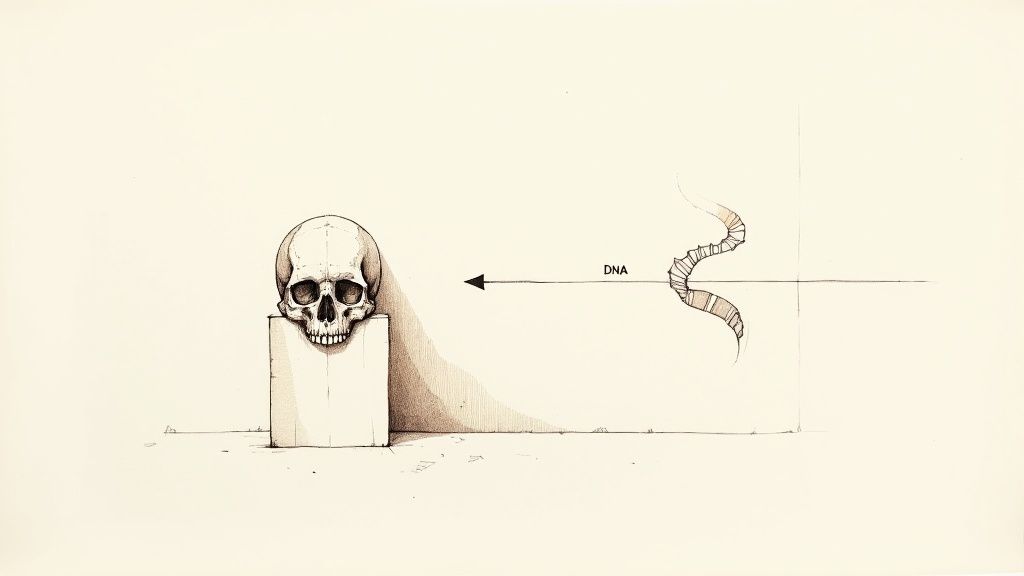
Exhumations are not just about solving recent deaths. Sometimes, they're about reaching back in time to answer old questions, verify the identities of historical figures, trace family trees, or track the spread of diseases from centuries ago. From my perspective, it’s like applying my skills to a much longer timeline. The same modern tools we use in active cases—like DNA analysis and toxicology—can pull incredible new information from remains that are hundreds of years old.
Applying Modern Science to Historical Mysteries
When examining historical remains, the focus shifts from establishing a cause of death for a court case to gathering hard scientific data for history. It's a delicate process, blending the precision of forensic science with the careful handling of fragile remains. The main goals are:
- DNA Profiling: This can confirm someone's identity by matching their genetic material to known living descendants or other historical items.
- Isotope Analysis: Chemical signatures in bones and teeth can uncover clues about a person's diet and where they lived or traveled.
- Paleopathology: This is the study of ancient diseases. Marks on the skeleton can point to conditions like tuberculosis, syphilis, or arthritis.
Unlocking the Past, One Case at a Time
A huge driver for these historical exhumations is scientific curiosity. For example, in 2006, Poland exhumed what was believed to be the skull of astronomer Nicolaus Copernicus to finally confirm his identity. Researchers have also been granted access to the Medici family crypt in Italy, studying ancestral remains to learn more about conditions like rheumatoid arthritis and cancer. Each case adds a crucial piece to the puzzle of our past. You can dive deeper into this with a great report on historical exhumations and their scientific goals.
This work underscores how forensics reaches far beyond the courtroom. It connects the detailed work I do every day to compelling historical stories, showing how a postmortem examination can bring our shared past to life.
None of this is possible without the right tools. Understanding how medical testing and other labs acquire specialized equipment gives a sense of the support required for this high-stakes work. Whether the exhumation is for a grieving family or to solve a centuries-old mystery, it all comes down to having precise, reliable tools.
Common Questions About Exhumation and Autopsies
Considering an exhumation often happens during a difficult, emotionally charged time. The topic brings up many questions and myths. My goal here is to answer the most common questions I hear from families and their attorneys, drawing from my experience as a forensic pathologist.
How Long After Burial Can an Autopsy Still Be Useful?
This is the number one question I get. People worry that after a certain amount of time, there's nothing left to find. The truth is, an autopsy can be valuable even years—sometimes decades—after burial. It all depends on what we're looking for and the condition of the remains. Bone, hair, and teeth are remarkably durable and can hold evidence for a very long time.
A skilled pathologist can still uncover:
- Skeletal Trauma: We can spot things like healed fractures or subtle breaks from blunt force trauma that might have been overlooked.
- Toxicological Clues: Certain poisons, heavy metals, and some drugs can bind to bone and hair, making them detectable long after soft tissues have decomposed.
- Foreign Objects: It’s possible to find and identify things like bullet fragments that may have been missed.
While the passage of time presents challenges, it rarely closes the door on finding answers.
Does Embalming Destroy Evidence for an Autopsy?
This is a huge misconception. Many people believe that once a body is embalmed, a meaningful autopsy is impossible. That’s simply not true. Embalming does change things. The chemicals alter tissues and can make some toxicology tests more difficult, but it does not destroy all evidence.
Major physical trauma—like stab wounds, broken bones, or gunshot injuries—can't be hidden by the embalming process. A pathologist experienced with examining embalmed remains knows what to look for and how to interpret the chemical artifacts. An autopsy on an embalmed body is often a critical and informative step.
Who Can Authorize an Exhumation in Texas?
You cannot decide to do this on your own. Texas law is specific about who can authorize an exhumation to ensure respect for the deceased. There are two paths:
- For Private Requests: This is when a family wants to proceed. It generally requires a court order. To get one, you'll need written consent from the next of kin (such as a spouse or adult child) and the owner of the cemetery plot. This process is laid out in the Texas Health & Safety Code, and you must file for a formal disinterment permit.
- For Criminal Investigations: Law enforcement can petition a district court judge for an exhumation order. If the judge grants it, that order bypasses the need for family consent, allowing an investigation to move forward.
What Is the General Cost of a Private Exhumation and Autopsy?
There isn't a single price tag. The final cost is a combination of several services and depends on the specific circumstances.
The total cost is a sum of several parts: legal fees for the court order, cemetery fees for the disinterment and reinterment, transportation costs, and the professional fee for the forensic pathologist to perform the examination and write the report.
Because every case is different, I provide families and their lawyers with a detailed, transparent cost estimate after our first conversation. You should know exactly what to expect before making any commitment.
Navigating these decisions in a time of grief is one of the hardest things a family can do. If you have questions about whether a second autopsy is the right path for your family, my team is here to offer guidance with compassion and medical clarity.
Contact Texas Autopsy Services for a confidential consultation