May 21, 2026 · Texas Autopsy Services
What Does An Exhumed Body Look Like: Pathologist Explains
What does an exhumed body look like - Discover what does an exhumed body look like. A forensic pathologist details decomposition, influencing factors, & what
On this page
When families or attorneys call me about an exhumation, the first question is often the hardest to ask out loud. They want to know what will be in the grave. Not in abstract terms, but in practical ones. What does an exhumed body look like?
At Texas Autopsy Services, every examination is performed by a board-certified forensic pathologist experienced in medicolegal death investigations. Our work centers on one principle: follow the evidence carefully, explain it plainly, and treat the deceased and their family with respect.
The honest answer is that there is no single appearance. Exhumed remains can be partly preserved, heavily decomposed, mummified in areas, converted in part to adipocere, or largely skeletal. What I find depends on the burial environment, the time since burial, the casket and surrounding materials, and whether any tissues survived in a form that still holds forensic value.
A Difficult Question Deserving a Clear Answer
A family may come to me years after a burial because something about the original death investigation never sat right. An attorney may have new records, a changed witness statement, or a dispute about identity, trauma, or toxicology. In both situations, the decision to exhume is never routine. It carries legal, emotional, and practical weight.
I approach that conversation carefully because people deserve a straight answer without dramatics. The body that was buried is still there in the legal and human sense, but the visible condition of the remains may be very different from what one might expect. By the time a grave is reopened, families are often confronting the reality that burial changes what can still be seen and tested.
An exhumation is not a replay of the original funeral viewing. It is a forensic recovery and examination of whatever burial has left behind.
That distinction matters. Many people imagine either a fully preserved body or, at the other extreme, nothing useful at all. In practice, it usually falls somewhere between those extremes. Some structures may be lost, while others remain very useful for identification or evidence.
Why this question comes up
The request usually grows out of one of several concerns:
- Unresolved cause of death: A family wants an independent review when the original explanation never felt complete.
- Possible trauma: An attorney or investigator wants to know whether bone injuries, fractures, or retained foreign material can still be evaluated.
- Identity concerns: Dental findings, bone structure, and DNA from dense tissues may still help answer who the decedent was.
- Toxicology questions: Surviving hair or certain preserved tissues may still be sampled, although decomposition can sharply limit what those results mean.
When I explain this process, my goal is not to make promises. It is to help people understand what an exhumation can realistically show, and equally, what it may no longer be able to show.
The Appearance of Remains After Burial
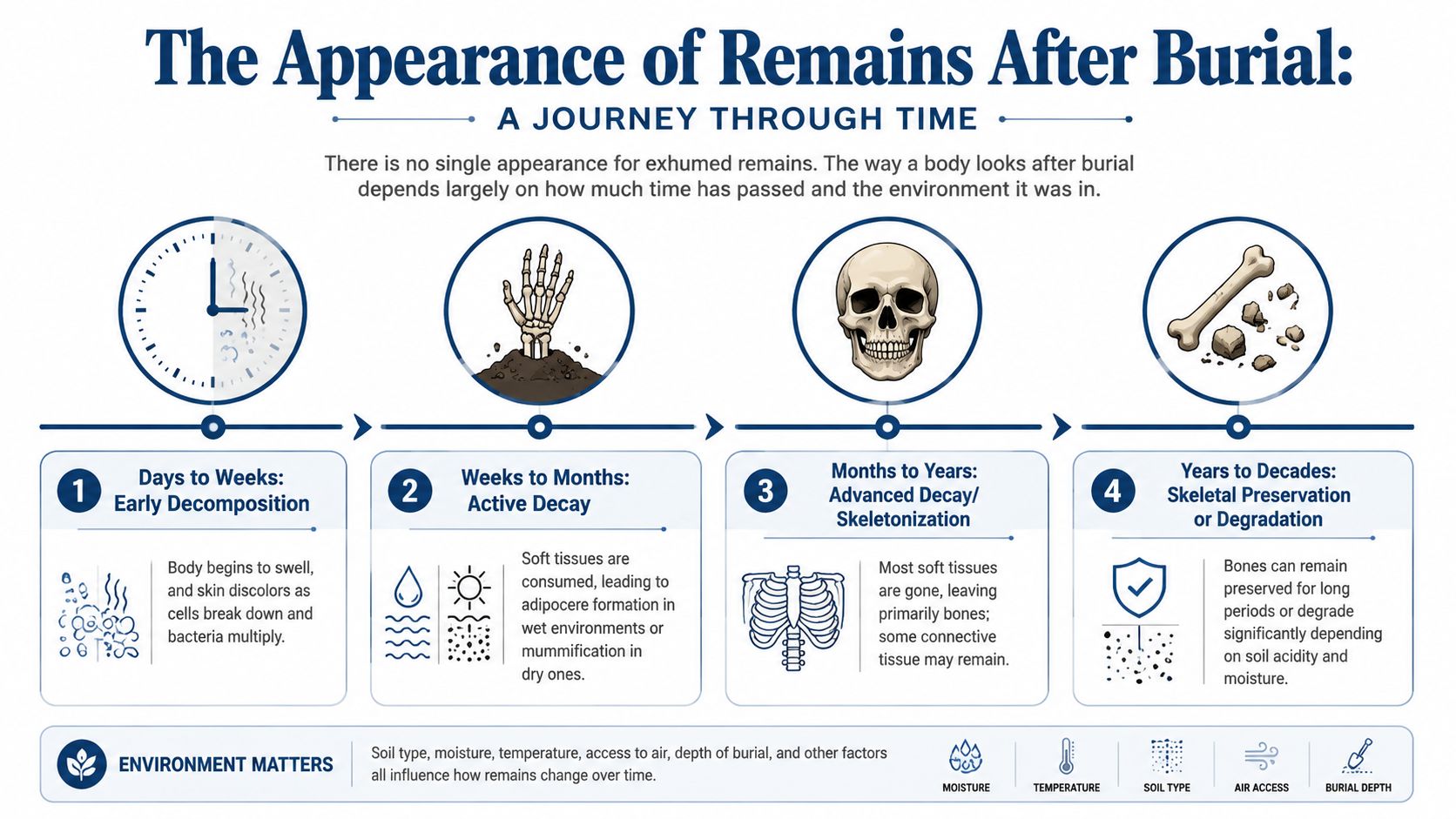
The simplest accurate answer is this. An exhumed body often no longer looks like a “body” in the everyday sense once enough time has passed. A historical summary of forensic exhumation notes that after months, recognizable facial features may remain only in early burial stages, after about a year or more, decomposition usually advances to the point that only skeletal remains are typically present, and after several decades, remains may be fragmented and scattered, with soft tissues largely gone, while burial conditions can change that timeline substantially (forensic exhumation overview from Ever Loved).
What burial changes
Burial doesn't stop decomposition. It changes it.
A body in the ground is less exposed to sunlight, weather, and surface scavenging than a body left in open air. That can slow some forms of breakdown, but the tissues still undergo postmortem change. Cells break down, bacteria continue to act, gases and fluids change the tissues, and over time the body loses the features people normally associate with a recognizable person.
What may still be present
What I may see at exhumation can range widely:
- Early burial stages: Some soft tissue and facial form may still be present.
- Selective preservation: Certain areas may be preserved while others are not.
- Partial adipocere or mummification: Burial can produce preserved-looking areas rather than uniform decay.
- Mostly skeletal remains: Bones and teeth often become the most important structures.
- Fragmented remains: After long intervals, recovery itself can be more difficult because remains may not be consolidated in one clear form.
This is why two exhumations with similar burial dates can look very different. The remains reflect the environment, not just the calendar.
Why some tissues look preserved
In some graves, a moist, low-oxygen setting can favor adipocere, sometimes called grave wax. In others, dry conditions can favor mummification, where tissues dry and persist in a leathery form. Neither pattern means the body is unchanged. It means decomposition followed a different path.
Practical rule: Families should expect variability, not a fixed visual stage tied to a specific number of years.
For attorneys, that variability matters because appearance alone doesn't answer the legal question. Forensic value comes from what survived well enough to document, sample, and interpret.
Factors That Determine the State of Decomposition
When I evaluate what an exhumation may reveal, I start with conditions, not assumptions. The state of the remains is shaped by several overlapping factors, and no single factor tells the whole story.
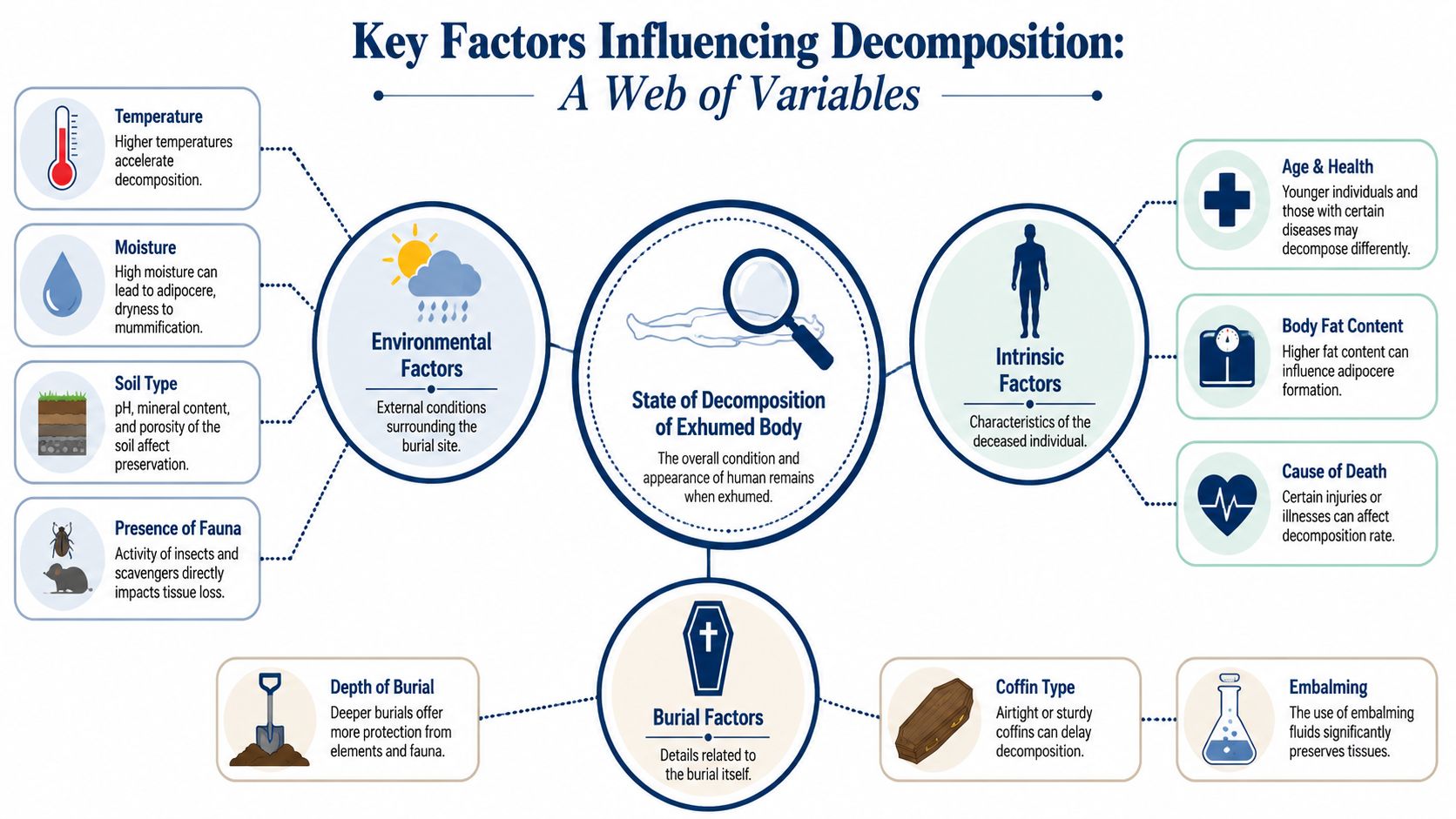
The main variables I consider
Burial environment often matters most. Soil moisture, drainage, temperature, and local chemistry can preserve some structures and destroy others. A wet setting may favor adipocere. A dry setting may preserve tissue by desiccation. Acidic or otherwise aggressive soil can damage bone over time.
Casket and burial container also matter. Different materials alter airflow, moisture retention, and the degree of protection from surrounding soil. A casket may delay some external influences, but it does not prevent decomposition indefinitely.
Embalming can change the short- and medium-term appearance of tissues. In some cases, it helps preserve recognizable structures for longer than would otherwise be expected. In others, the preservation is incomplete, uneven, or eventually overwhelmed by the burial environment.
Elapsed postmortem interval still matters, but only in context. Time tells me how long decomposition has been acting. It does not tell me exactly what the remains will look like without the rest of the burial history.
How burial conditions affect remains
| Factor | Effect on decomposition | Typical visual outcome |
|---|---|---|
| Embalming | May delay tissue breakdown, but does not stop it | Possible temporary preservation of soft tissues, often uneven |
| Casket type | Changes moisture and air exchange around the body | Better containment in some cases, but not permanent preservation |
| Soil moisture | Can shift decomposition toward adipocere or accelerated breakdown | Waxy preserved tissue in some settings, marked soft tissue loss in others |
| Dryness | Encourages desiccation rather than wet decay | Mummified or leathery preserved areas |
| Soil chemistry | Can preserve or damage bone and remaining tissue | Stronger skeletal preservation in some graves, degradation in others |
| Burial interval | Gives decomposition more time to alter tissues | From partially preserved remains to mostly skeletal recovery |
A practical discussion of long-term burial from Texas Autopsy Services on a body exhumed after years makes the same central point I give families in consultation. The visible condition is governed mainly by burial environment and elapsed time, not by a single expected appearance.
What works and what doesn't
What works in forensic planning is obtaining as much burial history as possible before the exhumation. Funeral records, cemetery records, embalming information, and any prior autopsy records help frame expectations.
What doesn't work is assuming that all graves produce the same result after the same amount of time. They don't. That is one of the most common misconceptions I have to correct.
What a Forensic Pathologist Examines
Once remains are recovered, my focus shifts from appearance to evidence. The central question is not whether the remains look intact. It is whether the surviving structures can still answer the question that led to exhumation in the first place.

A practical forensic summary notes that an exhumed body rarely looks intact in the ordinary sense, that investigators often encounter advanced decomposition, and that the examination commonly centers on skeletal survey, dental charting, targeted sampling of dense bone and teeth for DNA, and preserved hair for toxicology, with appearances ranging from partial adipocere or mummification to mostly skeletal remains (Texas forensic pathology discussion of exhumed remains).
What I document first
I begin with recovery condition and chain of custody. Chain of custody means the documented handling of the remains and collected evidence from one person or facility to the next, so the record shows who had control of what, when, and under what conditions.
Then I document the remains as recovered. That includes burial materials, clothing or personal effects if present, the position and condition of the remains, and any immediately visible anatomical findings. Photography and written documentation are part of that process.
For readers who want a broader overview of the mechanics of postmortem examination, this outline of the autopsy procedure gives helpful context for how examination steps are structured.
What often remains useful
When soft tissues are limited, the most useful evidence often comes from durable structures:
- Bones: These can show fractures, blunt force injury patterns, old healed trauma, or other skeletal findings.
- Teeth: Dental structures can assist with identification and can support DNA testing from dense tissues.
- Hair: If preserved, hair may be useful for selected toxicology questions.
- Dense bone or teeth for DNA: These are often among the better-preserved sources when soft tissue is poor.
Preserved evidence is rarely uniform. One tissue may be uninformative while another still answers the key question.
Terms families and attorneys often hear
A few definitions help:
- Cause of death means the disease or injury that led to death.
- Manner of death means the forensic classification of how the death occurred, such as natural, accident, suicide, homicide, or undetermined.
- Independent autopsy means a postmortem examination performed outside the original investigating authority, with objective review of the body, records, and any surviving evidence.
In some cases, families or counsel seek Private Autopsies when they need an independent forensic review of exhumed remains, prior records, and the medical questions that were left unresolved.
The limits of the exam
A second autopsy on exhumed remains can still be valuable, but some evidence may be gone. Soft tissue injuries may no longer be visible. Organ pathology may be difficult or impossible to assess if organs are no longer preserved. Toxicology may be constrained by what tissue remains and whether that tissue still holds interpretable compounds.
Experience is vital. A forensic pathologist has to distinguish between absence of evidence because nothing was there and absence of evidence because time and burial erased it. Those are not the same thing.
The Exhumation and Examination Process in Texas
Families often feel less anxious once they understand the sequence. Exhumation in Texas is not an improvised event. It is a controlled legal and forensic process carried out with documentation, coordination, and respect for the decedent.

The process usually starts well before anyone goes to the cemetery. Legal authorization must be obtained, and the cemetery, funeral professionals, transport personnel, and forensic examiner all need a defined plan. If you want a general background on the subject, this discussion of exhumation of a body is a useful starting point.
The usual sequence
- Legal authorization is secured. In Texas, exhumation requires compliance with the governing legal process. Depending on the circumstances, courts and other authorities may be involved.
- Stakeholders are coordinated. This can include the family, cemetery, funeral home, attorneys, and investigating agencies.
- Disinterment is performed carefully. The grave is opened, the casket or remains are recovered, and all handling is documented.
- Transport occurs under controlled conditions. The remains are moved to the examination facility with attention to identification and continuity of custody.
- The forensic examination is performed. That may include documentation, radiology if available, skeletal assessment, dental review, and collection of samples.
- The remains are released for final disposition. Reinterment or other lawful disposition occurs after the examination.
A funeral service provider may assist with practical logistics and respectful handling. In some Texas cases, families coordinate that work through the Waterloo Mortuary pathology partnership.
This short video gives a visual sense of the topic's practical setting:
Why expectations matter
One of the most important conversations happens before the exam begins. Families and attorneys need to know that toxicology after exhumation can be limited by decomposition. A 2023 case report involving exhumation after more than two years found that toxicological testing on heavily degraded muscle tissue did not detect substances expected from the decedent's medication history, and the same paper notes that the most frequently used specimens in exhumation toxicology are blood or plasma, hair, liver, and brain, with methods including TLC, CE, GC, HPLC, and UHPLC (2023 exhumation toxicology case report).
That does not mean toxicology is useless. It means the results must be interpreted cautiously, in light of what was recovered and how decomposition may have altered it.
Frequently Asked Questions About Exhumation
Can an exhumation still help if the burial happened a long time ago
Yes, sometimes. The answer depends on what question needs to be answered and what structures remain. Skeletal trauma, dental identification, and DNA from dense tissues may still be useful even when soft tissue evidence is limited.
Does an exhumed body usually look intact
Usually not in the ordinary sense. Families should expect that burial changes the body substantially, and the remains may be partially preserved, selectively preserved, or largely skeletal. The visual condition does not by itself determine whether the exhumation has forensic value.
What is chain of custody and why does it matter
Chain of custody is the documented history of who handled the remains and collected evidence from recovery through examination and release. It matters because courts, agencies, and families need confidence that the body and samples were identified correctly and handled in a traceable, accountable way.
What can still be tested
That depends on preservation. In some cases, bone, teeth, hair, or isolated preserved tissues may still be suitable for selected studies. In others, decomposition has removed or altered the material to the point that testing yields little or must be interpreted with caution.
The right question is not “Can everything still be tested?” It is “Which surviving tissues are still reliable enough to answer the specific forensic question?”
Is exhumation legal in Texas
Yes, but it must follow the proper legal process. Texas families and attorneys should expect coordination with the appropriate authorities and compliance with the relevant legal framework, including Texas Health and Safety Code provisions and applicable cemetery and funeral regulations. The pathologist does not authorize the exhumation alone. The legal authority for disinterment comes first.
Will an exhumation always change the cause or manner of death
No. Sometimes the original findings are confirmed. Sometimes the exhumation adds new detail without changing the ultimate opinion. Sometimes it identifies important limits, such as evidence that can no longer be evaluated. The value of the process is that it replaces guesswork with documented forensic analysis.
If you're considering an exhumation and need a clear, respectful explanation of what the process may or may not reveal, contact Texas Autopsy Services. I can review the circumstances, explain the forensic limits, and help you understand what questions an examination of exhumed remains may still be able to answer.