June 10, 2026 · Texas Autopsy Services
Can I Get AIDS from a Mosquito Bite in Texas
Can I get AIDS from a mosquito? No. Our forensic pathologists explain the evidence-based reasons why HIV cannot be transmitted by mosquitoes and what to know.
On this page
No, you can't get AIDS from a mosquito bite. HIV does not replicate inside mosquitoes, it is digested in the mosquito's gut instead of reaching the salivary glands, and even an exaggerated calculation found that a mosquito would need to start with about 1,000 units of HIV and still face roughly a 1-in-10-million chance of injecting a single unit into another person.
That question often comes up in Texas after a cluster of mosquito bites, especially during a long evening outside when people are already thinking about disease risk. The concern is understandable. Mosquitoes do spread some infections, and when a person knows HIV is a blood-related virus, the idea can seem plausible at first glance.
From a forensic pathology standpoint, this kind of question matters because cause of death work depends on getting the biology right. Our board-certified forensic pathologists spend their careers separating what sounds possible from what the body and the science support. Disease transmission is not guesswork. It follows very specific pathways, and HIV through mosquito bites is not one of them.
A Common Question During Texas Summers
A Texas evening can set the stage for this question quickly. A family sits outside after sunset, the mosquitoes come out, and by bedtime several bites are already swelling. Someone then asks the same worried question physicians, investigators, and forensic pathologists hear every summer: if mosquitoes bite one person and then another, can they spread HIV?
The answer is no.
In forensic pathology, questions like this are more than casual curiosity. When a family wants a clear explanation of disease risk, or when an attorney asks whether a proposed route of transmission is biologically realistic, we start with mechanism. We ask what the insect does, what the virus requires, and whether those two processes fit together. For HIV and mosquitoes, they do not.
A mosquito is a known vector for some infections. That fact often drives the confusion. But disease transmission is not interchangeable. A mosquito can spread certain pathogens because those organisms can survive and function within the insect's biology. HIV cannot. That distinction is central in medicine, public health, and careful cause of death investigation.
Practical rule: A mosquito bite is not a route of HIV transmission.
The fear usually comes from a reasonable comparison. A mosquito takes in blood. Later, it bites someone else. On the surface, that can sound similar to a contaminated needle.
The comparison breaks down once you examine the biology. A needle is a device that can directly transfer blood from one person into another person's tissue. A mosquito does not work that way. It feeds through its own separate biological system, and that difference changes everything.
For readers who want a plain-language refresher on how true blood exposure risks are evaluated in real settings, this bloodborne pathogens safety guide offers a practical overview.
That is why forensic specialists do not decide transmission questions by intuition or by what sounds plausible in conversation. We decide them by whether the proposed pathway can occur in the body. For HIV and mosquito bites, the pathway does not exist.
Understanding How HIV Is Actually Transmitted
HIV is spread through direct exposure to certain infected body fluids when those fluids enter another person's bloodstream or cross a mucous membrane. That is the central principle. Without that direct route, transmission does not occur.
HIV needs a direct route into the body
The most important point is that HIV is not spread by casual contact. It requires a pathway into tissue where infection can begin. In plain terms, the virus cannot merely sit on an insect and become infectious to the next person by proximity alone.
A useful way to think about this is entry. A locked building requires the right key and the right door. HIV also needs the right kind of access. It does not spread just because it was once present in blood. It has to reach the next person's body in a form and location that allows infection.
For readers who want a plain-language refresher on exposure precautions and how bloodborne diseases are handled in real-world settings, this bloodborne pathogens safety guide offers a practical overview.
Why that matters for everyday contact
The nature of HIV transmission helps to debunk many myths. If HIV requires direct exposure to infected body fluids entering the bloodstream or mucous membranes, then many common fears become easier to sort through. Casual environmental contact is not the same thing as a true transmission event.
That distinction also helps explain why mosquito transmission does not fit. A mosquito bite may break the skin, but the important issue is what is being introduced. HIV transmission is not about any skin puncture in the abstract. It is about whether infectious material is delivered in a biologically meaningful way.
In forensic pathology, precision matters. We look for a supported route of exposure, not a feared one.
When families or attorneys ask questions about possible infection, we approach it the same way every time. What body fluid was involved. How did it enter the body. Was the organism capable of surviving that route. Those details matter because medicine is specific, and HIV is especially specific.
The Biological Reason Mosquitoes Cannot Transmit HIV
The clearest answer comes from what happens inside the mosquito itself. HIV does not ride through the insect unchanged. It is broken down.
What happens after the mosquito feeds
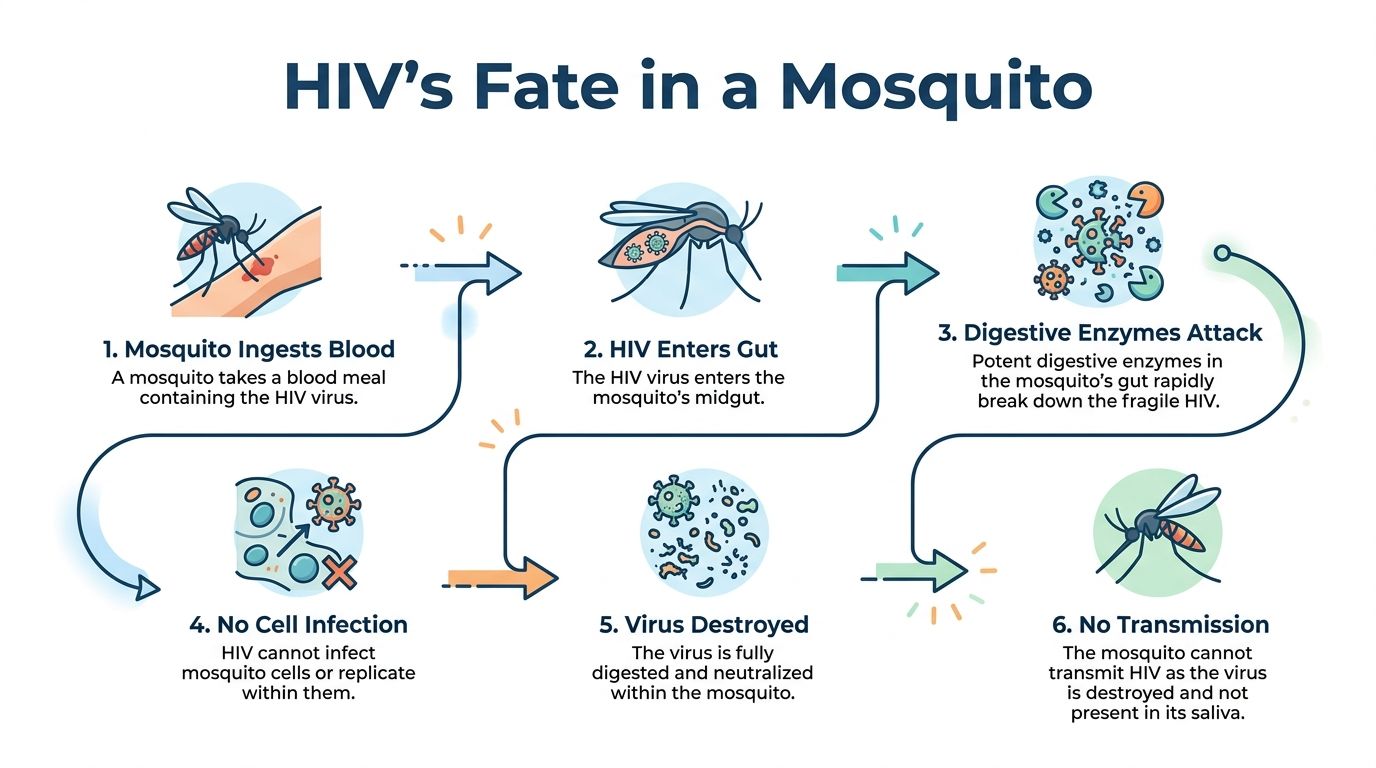
When a mosquito takes a blood meal from a person, that blood goes into the mosquito's digestive tract. HIV does not survive there as an infectious passenger waiting for the next bite. It is digested in the gut instead of moving to the salivary glands. That point is central, because the salivary glands are what matter for the next bite, not the previous blood meal.
The biology is hostile to HIV from the start. The virus is fragile outside its preferred environment. Inside the mosquito, it is treated like ingested material, not preserved as a transferable infection.
A detailed explanation from aidsmap on HIV and mosquito bites notes that HIV is not transmitted by mosquito bites because the virus does not replicate in mosquitoes and is digested in their gut instead of reaching the salivary glands. The same review notes that a mosquito would need to have begun feeding on blood with about 1,000 units of HIV and would still face roughly a 1-in-10-million chance of injecting a single unit into another person.
Later in the same logic chain, the numbers become even more implausible. A mosquito-transmission review summarized in this public health paper on why mosquitoes cannot transmit AIDS states that 70% to 80% of HIV-infected persons may have undetectable virus particles in their blood, that infected individuals rarely circulate more than 10 units of HIV, and that an AIDS-free person would need exposure to about 10 million mosquitoes that had started feeding on an HIV-positive host to receive even a single unit of virus.
Why HIV cannot use a mosquito as a host
This is the second part people often miss. HIV doesn't just need blood. It needs the right cells to reproduce. Mosquitoes do not provide those cells. Without human T-cells, HIV cannot replicate inside the insect.
That makes the mosquito a dead end for the virus. A simple analogy is a key that fits only one lock. HIV is adapted to human biology. A mosquito is the wrong lock entirely. The virus cannot establish itself there, multiply there, or travel into the saliva in an infectious form.
This visual summary shows that process in motion.
- Blood is ingested: The mosquito takes in blood as food.
- The virus enters the gut: It does not bypass digestion.
- Digestion destroys it: The mosquito's internal processes break it down.
- No replication occurs: HIV cannot copy itself in mosquito cells.
- No infectious saliva forms: The virus never reaches the salivary glands in a transmissible way.
That is why the science is so definitive. The bite may be irritating. It is not a route for HIV transmission.
Why a Mosquito Is Not a Flying Syringe
A mosquito bite can look deceptively similar to an injection. The skin is pierced. A small amount of fluid enters. For a worried parent, spouse, or attorney reviewing a possible exposure, that resemblance is often what drives the fear.
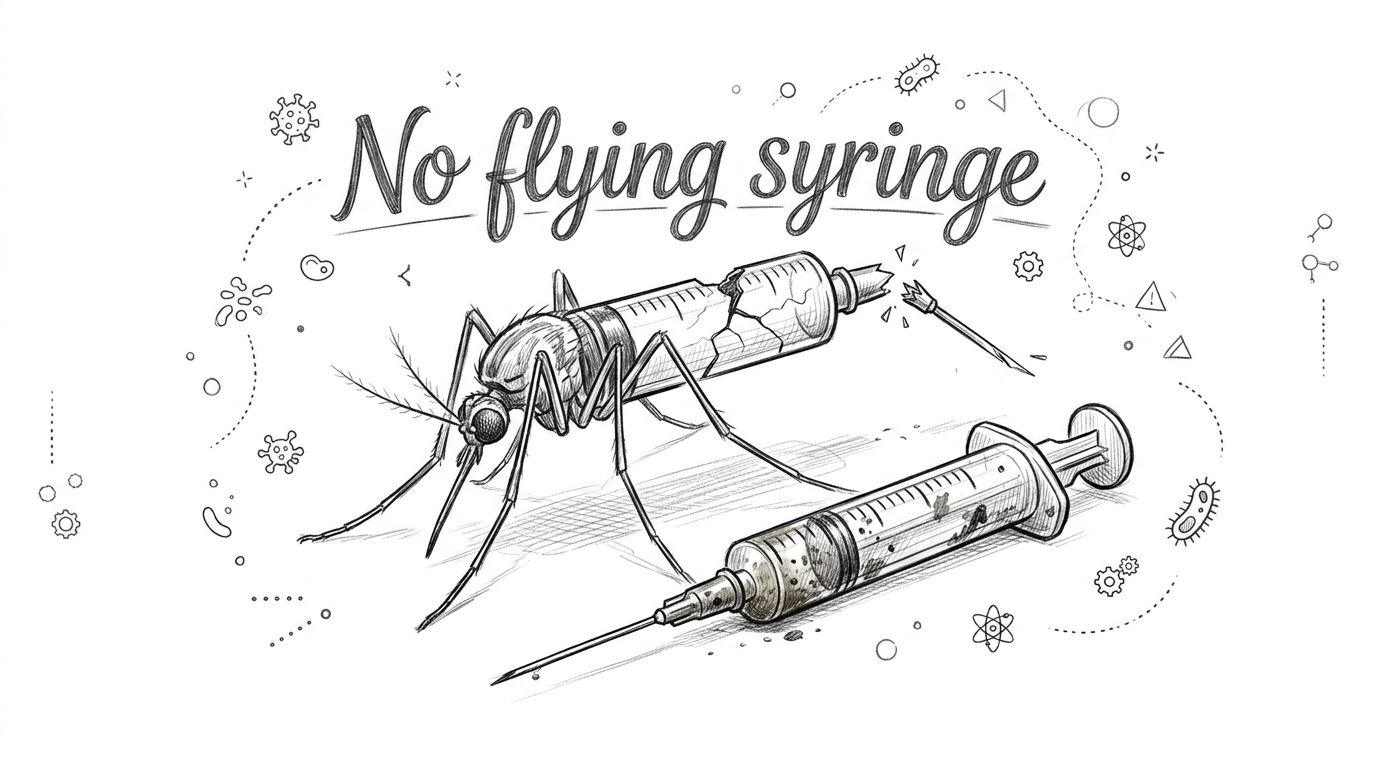
A syringe and a mosquito follow different pathways
A used syringe can carry blood from one person and place that blood directly into another person's tissue or bloodstream. That is direct transfer. In forensic medicine, direct transfer matters because the material entering the body is the same material that was present in the source.
A mosquito operates by a different mechanism. It feeds on blood, but when it bites again, it releases saliva, not a small stored dose of the last person's blood. Saliva helps the insect feed. It is not a replay of the prior blood meal.
That distinction answers the central concern.
A mosquito does not function as a reused needle. It pierces skin, but it does not inject another person's blood from the prior bite.
This is the same kind of question forensic pathologists sort out in death investigations. A puncture mark alone does not tell us what entered the body. We examine the route, the material, the timing, and whether the biology fits a real mechanism of transmission. A theory can sound plausible at first glance and still fail once the pathway is examined closely.
Where the comparison breaks down
The misunderstanding usually comes from sequence. A mosquito bites Person A, then later bites Person B. On the surface, that sounds like blood moving from one person to the next.
Biologically, that is not what happens. The blood meal taken from the first person goes into the mosquito's gut for digestion. The later bite comes from the insect's salivary system. Those are separate compartments, with separate functions, much like a kitchen sink and a water line are part of the same house but do not move fluid in the same direction or for the same purpose.
Readers who want a practical explanation of how blood is handled once it leaves the body may find this overview of what happens to blood after testing useful, because it shows why pathway tracking matters whenever people are trying to understand possible blood exposure.
| Situation | What enters the body | Why the HIV risk is different |
|---|---|---|
| Contaminated syringe | Blood from another person can be introduced directly | Direct blood exposure can create a real transmission route |
| Mosquito bite | Mosquito saliva enters the skin | The previous person's blood is not injected into the next person |
For cause-of-death review and exposure analysis, that difference is more than academic. It is how we separate a compelling image from an actual biological event.
Forensic Insights on Disease Transmission
Forensic pathology often involves correcting assumptions. Families, attorneys, and agencies may hear several possible explanations for an illness or death, and some of those explanations sound convincing until the underlying biology is examined.
How forensic pathologists use transmission science
When our field evaluates infectious disease questions, we don't treat all exposures as equal. We look at timing, anatomy, known transmission routes, laboratory findings, and the decedent's medical context. That is true whether the issue is a natural infection, an incidental finding, or a disputed theory offered during litigation or a family review.
A cause of death is the medical reason a person died. A manner of death is the broader category, such as natural, accident, suicide, homicide, or undetermined. If an infection is part of that analysis, the route of transmission has to make biological sense.
For readers who want to understand how specimens are handled in medical-legal work, this overview of specimen collection procedures helps show why chain-of-evidence thinking matters in forensic medicine.
Why ruling out myths matters
An independent autopsy or file review sometimes involves ruling out theories that are emotionally powerful but medically unsupported. That is not dismissive. It is part of being accurate. A good forensic pathologist has to say both what the evidence supports and what it does not support.
The same principle applies to HIV and mosquitoes. If a family fears that a mosquito somehow caused an HIV-related illness or death, the transmission theory has to be tested against actual biology. Here, the biology closes that door.
People seeking more information about a private review process can learn how independent examinations work through private autopsies. The value in that setting is objectivity. Every examination is performed by a forensic pathologist certified by the American Board of Pathology, and the conclusions must remain grounded in evidence rather than speculation.
Staying Safe and Getting Clear Answers
Mosquito bites still matter in Texas, just not as a source of HIV. Practical mosquito prevention is worthwhile because some mosquito-borne diseases are real concerns. Long sleeves, screens, repellents, and reducing standing water remain sensible public health measures.
What to focus on in real life
If a person is worried about HIV exposure, the right response is to focus on actual transmission routes, not mosquito bites. Clear information reduces unnecessary fear and helps people make better decisions about testing and care.
For those who are looking for a private home option, some people prefer discreet services such as discreet HIV antibody screening. The important point is not the product itself. It is choosing a legitimate testing pathway when there is a real exposure concern.
People also benefit from understanding what a blood test can and cannot answer. This explanation of what to do after a blood test may help frame the next steps when questions remain unresolved.
Clear answers usually come from matching the right test to the right exposure, not from chasing a myth.
When families need certainty after a death
After a death, concerns about infection can become part of a larger search for truth. That is especially common when relatives received conflicting information or when a possible exposure is mentioned without clear support. In those moments, a calm and evidence-based review matters.
In forensic medicine, chain of custody means documenting who handled evidence or specimens, when they handled them, and how they were preserved. That process protects the integrity of findings. It also helps families and attorneys trust that the medical conclusions are based on documented facts.
FAQ
Can I get AIDS from a mosquito bite?
No. HIV is not transmitted by mosquito bites because the virus is digested in the mosquito's gut, does not replicate inside the insect, and does not reach the salivary glands in an infectious form.
Why do people think mosquitoes can spread HIV?
The idea sounds plausible because mosquitoes feed on blood. The missing detail is that they do not inject one person's blood into the next person. They inject saliva, and HIV does not survive and replicate inside the mosquito in a way that would allow transmission.
Does a mosquito carry blood from one person to another like a needle?
No. A contaminated needle can directly transfer blood. A mosquito does not function that way. The previous blood meal is digested.
If mosquitoes can't spread HIV, why can they spread other diseases?
Some organisms are biologically suited to survive and develop inside mosquitoes. HIV is not. In vector biology, that difference is everything.
Why would a forensic pathologist care about a question like this?
Because accurate cause of death investigation depends on understanding what disease routes are real and what routes are not. Ruling out unsupported transmission theories is part of sound forensic analysis.
If your family, agency, or law office needs a careful review of a death, our team at Texas Autopsy Services is available to provide clear, evidence-based guidance. We serve all 254 Texas counties, and every examination is performed by a board-certified forensic pathologist with a commitment to objective findings, respectful communication, and full chain of custody.