July 11, 2026 · Texas Autopsy Services
How Many Spiders Do We Eat a Year? an Expert Answer
Wondering how many spiders do we eat a year? Our forensic experts explain why the answer is zero and debunk the popular myth with scientific and medical facts.
On this page
How Many Spiders Do We Eat a Year
People eat zero spiders in their sleep per year. The claim that humans swallow eight spiders a year while sleeping is a confirmed urban legend with no basis in scientific or forensic evidence.
That answer surprises people because the myth has been repeated for so long that it feels familiar. In forensic pathology, familiarity is not evidence. We look for physical findings, documented patterns, and records that hold up under scrutiny. When a claim says something happens regularly to large numbers of people, there should be a trail of consistent evidence. Here, there isn't one.
For families, attorneys, and medical professionals, this is a useful example of how fact-finding works. A claim may sound vivid and still be false. A forensic process asks a simpler question. What can be shown from the body, the scene, records, and established biology? That same discipline is what guides every cause of death investigation, every independent autopsy, and every second opinion autopsy.
Summary
- The true answer is zero. The average number of spiders people eat in their sleep each year is zero.
- The "eight spiders a year" claim is a myth. It traces back to a fabricated 1993 magazine article created to show how easily false information spreads.
- Biology does not support the story. Spiders avoid the hot airflow of human breathing and the disturbance of a sleeping person.
- Forensic evidence does not support the story either. No documented cases of routine spider ingestion during sleep exist in scientific or forensic literature.
- This matters beyond a myth. Forensic pathology separates rumor from fact by relying on objective findings, chain of custody, and careful documentation.
Answering the Question How Many Spiders We Eat
The answer is effectively zero. As a forensic pathologist, I do not treat that as a casual internet debunk. I treat it as an evidence question. If people routinely swallowed spiders in their sleep, that pattern would appear somewhere in examinations, case histories, emergency presentations, or documented investigations. It does not.
That absence matters. Repeated biological events leave repeated records. In forensic medicine, we prove ordinary things because they recur and leave physical findings, witness accounts, scene context, or medical documentation. The yearly-spider claim has none of that support.
The question also needs cleaner wording. People usually mean accidental swallowing during sleep, not intentional eating. Those are different scenarios. For the average person, the practical answer remains zero in any meaningful sense.
I also separate folklore from mechanisms. Sleeping people still breathe, swallow reflexively, cough, and wake when something irritates the mouth or airway. A spider is not passive debris. It is a mobile animal with every reason to avoid a warm, moist, moving face. Readers who want a plain-language explanation of the actual medical issue can see what happens if you swallow a bug.
From a postmortem standpoint, this is the key point: claims become facts only when they can be tied to physical evidence. During an examination, we look for injuries, foreign material, aspiration, obstruction, toxic exposures, and disease processes that explain what happened. We do not confirm a popular story because it sounds vivid or because a number gets repeated often enough online.
For people who are trying to make their homes less hospitable to spiders in the first place, practical housekeeping and exclusion matter more than folklore. Readers looking for home-focused guidance may find these pest management tips for Humble spiders useful because they address prevention rather than myth.
The Anatomy of a Viral Myth
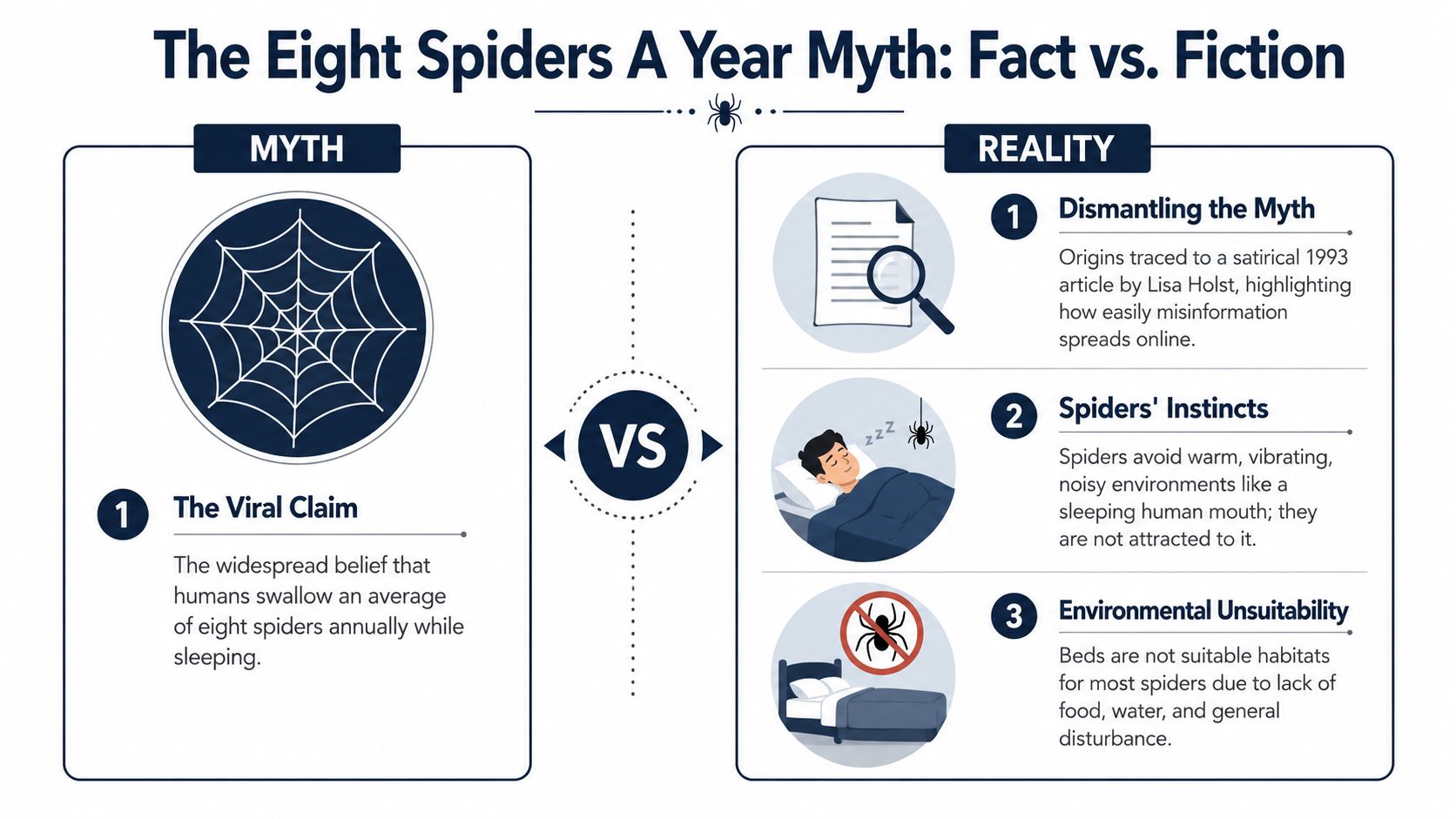
The "eight spiders a year" claim has one reason for surviving. It sounds measured, memorable, and specific. In medicine and forensic work, that combination often gives a false story more staying power than the evidence ever could.
Where the story came from
The number did not come out of a clinical study, an autopsy series, or any documented forensic review. Britannica notes that the myth is commonly traced to a 1993 magazine article written to show how easily people accept invented facts online, as explained in Britannica's discussion of whether people really swallow spiders in sleep.
That matters because it changes the status of the claim completely. This was not an observed pattern that later became exaggerated. It was a fabricated example that people repeated until it began to sound like a fact.
Our fuller review of whether you swallow spiders when you sleep explains why stories with a clean number and a strong disgust reaction spread faster than plain explanations.
Why myths like this persist
A vivid claim travels well because it gives readers a ready-made picture. People remember a strange image more easily than they remember the absence of evidence. That is a poor standard for medical truth, but it is a reliable engine for folklore.
From a forensic standpoint, origin matters. If a story begins as a deliberate fabrication, the burden shifts to documentation. Someone then has to show real case evidence, repeatable observation, or published medical reporting that supports it. That support does not appear.
Why the biology still does not fit
The scenario also fails on ordinary mechanics. A sleeping person continues to breathe, swallow, shift position, and react to irritation. A spider is an active animal, not dust settling through still air.
Several practical points make routine spider swallowing implausible:
- Human breathing creates moving air. Spiders generally avoid disturbance rather than seek it out.
- Sleep is not motionless. Normal facial movement, swallowing, and repositioning interrupt the tidy scenario the myth requires.
- Contact usually triggers a response. Sensation on the lips, face, or inside the mouth often leads to waking, coughing, or brushing the object away.
In forensic pathology, repeated real-world events leave traces in records, case histories, and examinations. Viral myths leave repetition without proof.
The View from a Forensic Pathologist

Forensic pathology approaches this question differently from casual myth-busting. We don't ask whether a story is popular. We ask what a body examination, record review, and documented literature would show if the story were true.
What a postmortem examination looks for
An autopsy process is a structured medical examination after death. In a cause of death investigation, a forensic pathologist examines the body externally and internally, reviews available records, and correlates findings with known mechanisms of injury and disease. If a claimed event happened regularly and had medical relevance, we would expect that pattern to appear somewhere in the literature or case documentation.
In this context, routine nighttime spider ingestion should leave some combination of recognizable evidence in at least some examinations. That could include material in the airway or digestive tract, associated scene history, or related complications recorded by clinicians or investigators. Instead, the literature does not show a routine pattern.
Discover Magazine summarizes the key point clearly: expert arachnologists and biologists confirm that no documented cases of spider ingestion during sleep exist in scientific or forensic literature, and accidental ingestion might possibly occur only in extremely rare, random events, not as a regular occurrence, as described in Discover Magazine's review of the sleeping spider myth.
Readers who want a broader forensic discussion of the fear behind this claim can review our article on fear factor and spider eating.
How forensic pathology determines facts
The absence of evidence does not always prove a thing never happened once. It does matter when a myth claims a regular annual average across the population. Forensic medicine sees real patterns. Real patterns repeat.
A few terms help here:
| Term | Plain language meaning |
|---|---|
| Cause of death | The disease or injury that produced death |
| Manner of death | The classification of how the death occurred, such as natural, accident, suicide, homicide, or undetermined |
| Chain of custody | The documented handling of evidence so its identity and integrity can be verified |
In forensic pathology, we don't fill gaps with folklore. We document what the body shows and what the evidence supports.
That same approach is why independent autopsy work can matter in disputed cases. A second opinion autopsy or record review does not depend on rumor, internet repetition, or assumptions drawn from fear.
What We Actually Ingest Unintentionally
Forensic examinations deal in physical findings, not vivid rumors. The things people ingest by accident are usually small, ordinary, and hard to notice. They are also very different from the image of swallowing a whole spider during sleep.
In practice, unintentional ingestion usually involves saliva, mucus, dust, food residue, tiny environmental particles, and occasionally a small insect fragment. Those exposures fit normal daily life. They do not create the kind of repeatable bodily pattern that a claimed yearly spider average would leave behind if it were real.
What shows up in the real world
From a forensic standpoint, ordinary exposure is mundane. Microscopic material reaches the mouth and throat constantly because people breathe, eat, talk, sleep, and live in indoor environments that contain dust and debris. That is the physical reality.
What does not appear as a routine finding is evidence that people regularly consume intact spiders in any meaningful, repeated way. If that were common, it would not remain a folklore claim. It would show up in histories, scene patterns, specimen review, or repeat observations tied to actual examinations.
Home conditions matter more than internet mythmaking. Irritation in a bedroom or house is far more likely to involve dust, allergens, or poor cleaning conditions than a hidden pattern of spider ingestion. For that reason, households often get more practical value from effective dust mite control strategies than from worrying about a made-up annual total.
Why forensic context matters
A forensic pathologist is trained to separate what is theoretically possible from what is regularly supported by evidence. A rare, isolated event can happen in almost any setting. That is not the same as a population-wide habit. The difference matters.
The body does not reward dramatic storytelling. It leaves findings, or it does not.
For readers who want the practical medical side rather than the myth, our discussion of what happens if you swallow a bug explains what accidental ingestion usually looks like and when it deserves attention.
- Ordinary exposure is real. People cannot avoid ingesting tiny particles from their environment.
- Whole-spider folklore is unsupported. Routine forensic work does not produce a pattern that matches the claim.
- Facts come from documented findings. In my field, repeated claims need repeated evidence. This one does not have it.
Health Implications and When to Be Concerned
Most anxiety around this topic comes from the imagined aftermath. People want to know whether accidental ingestion would be dangerous if it did happen.
Accidental ingestion versus a true medical problem
In general terms, swallowing a small non-food object or insect by accident is not the same thing as suffering a toxic exposure, airway obstruction, or envenomation. A true emergency usually involves choking, significant allergic reaction, persistent vomiting, respiratory distress, or a known bite with worsening symptoms. Those are clinical issues, not folklore.
The spider myth also gets tangled with fear of venom. A venomous spider bite is an external event. It is not the same as eating a spider during sleep. Those are completely different scenarios.
The useful question isn't whether a rumor sounds disturbing. The useful question is whether there are signs of an actual medical problem.
When concern is reasonable
A person should seek clinical care when there are symptoms that suggest airway compromise, an allergic reaction, or another acute illness. Without those features, the feared event itself is usually not the issue.
Forensic pathology has a narrower role here. We do not provide medical treatment, and nothing here should be taken as personal medical advice. Our role is postmortem examination and factual interpretation when a death has occurred and the circumstances require objective review.
The Importance of Evidence in Finding Answers
The spider myth is a simple lesson in a larger principle. Claims feel convincing when repeated often enough, but repetition does not turn a rumor into proof.
Why forensic independence matters
When families or attorneys need answers after a death, speculation is not enough. A careful independent autopsy can clarify findings that remain uncertain after an initial review. The same is true when a county needs objective forensic support in a medicolegal case.
Every examination is performed by a forensic pathologist certified by the American Board of Pathology. The process is governed by evidence handling, statutory requirements, and documentation standards that support court-admissible reporting. In Texas, that work sits within a broader legal framework that includes the Texas Funeral Service Commission and the Texas Health & Safety Code, including Chapter 716 and related provisions depending on the issue involved.
Plain language terms families should know
A few practical safeguards matter in any serious review:
- Independence matters. An unbiased opinion is strongest when it is tied to documented findings rather than assumptions.
- Chain of custody matters. Evidence has to be accounted for from collection through reporting.
- Clarity matters. Families deserve plain explanations, and attorneys need precise language that can stand up in litigation.
When people need factual postmortem answers, they often begin with Private Autopsies for family-directed review or County Forensic Autopsies when a jurisdiction needs forensic pathology support. Some cases also involve coordinated mortuary logistics, including the Waterloo Mortuary Partnership.
Frequently Asked Questions

Is the number really zero
Yes. For the general population, the average number of spiders eaten during sleep is zero, and the old "eight spiders a year" figure is fabricated rather than measured.
Could someone ever swallow a spider by accident
A random accidental event is not impossible in the abstract, but that is very different from a routine annual average. The claim of regular occurrence is what the evidence does not support.
Why would a forensic pathology practice discuss this topic
Because it shows how evidence works. In forensic medicine, we test claims against documented findings, established biology, records, and physical examination.
What does chain of custody mean in plain language
It means the documented handling of remains, specimens, and related evidence so that identity and integrity can be verified throughout the process.
When is a private autopsy appropriate
It can be appropriate when families, attorneys, or agencies need an independent review of cause of death, unresolved medical questions, or a second opinion on prior findings.
If your family, office, or agency is facing a real cause of death question, clear evidence matters more than rumor. Texas Autopsy Services provides independent forensic pathology services across Texas with compassionate communication, full chain of custody, and examinations performed by a board-certified forensic pathologist. If guidance would help, contact our team directly and we will explain the process with clarity and respect.