July 2, 2026 · Texas Autopsy Services
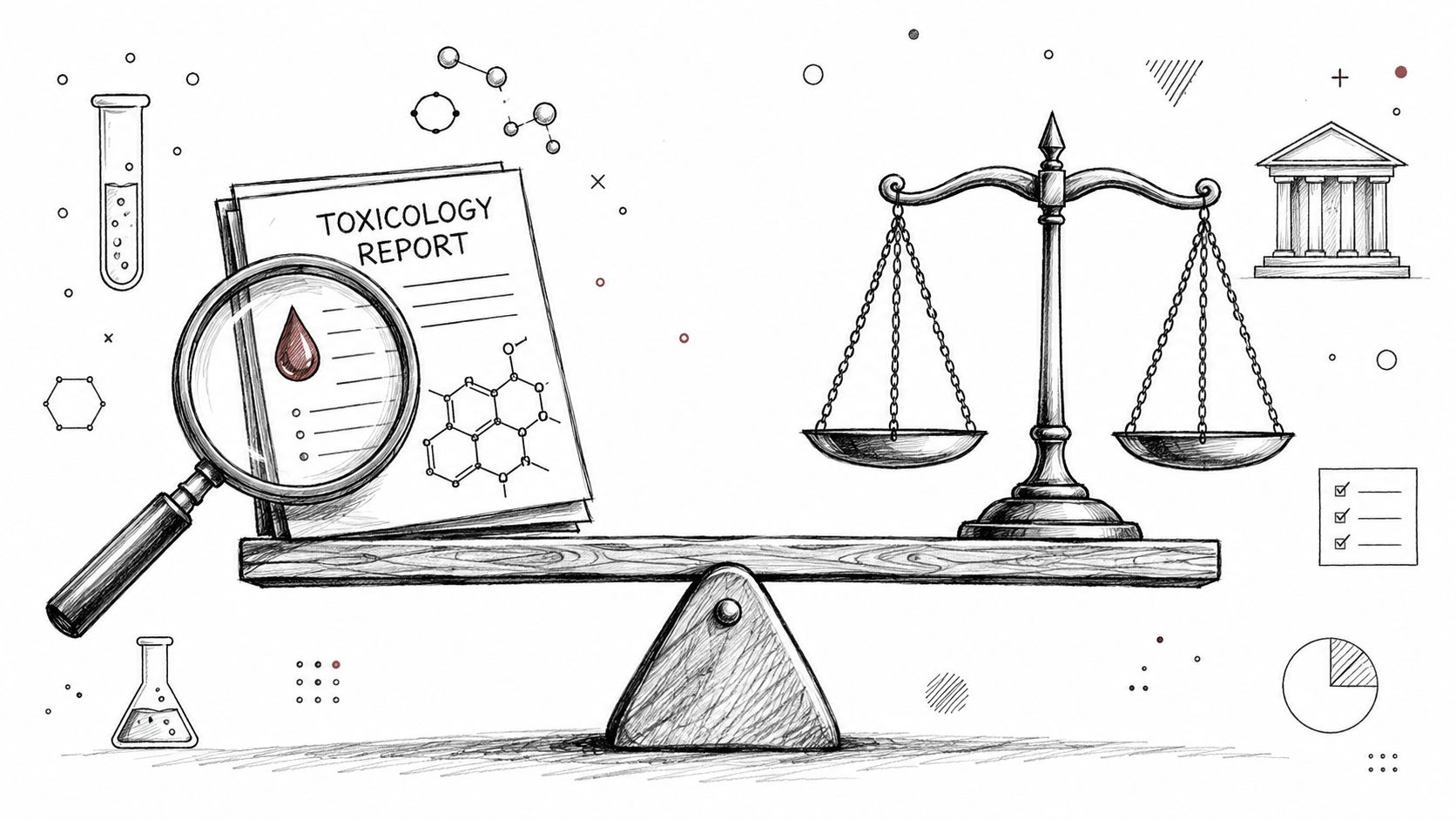
Toxicology Report DUI: Your 2026 Guide to Challenging
Understand your toxicology report DUI in Texas. Our 2026 guide explains lab methods, legal standards, and how to challenge results.
On this page
- The Unexpected Complexity of a DUI Charge
- What a Toxicology Report Reveals in a DUI Case
- Forensic Laboratory Methods and Specimen Analysis
- Decoding Your Report Substance by Substance
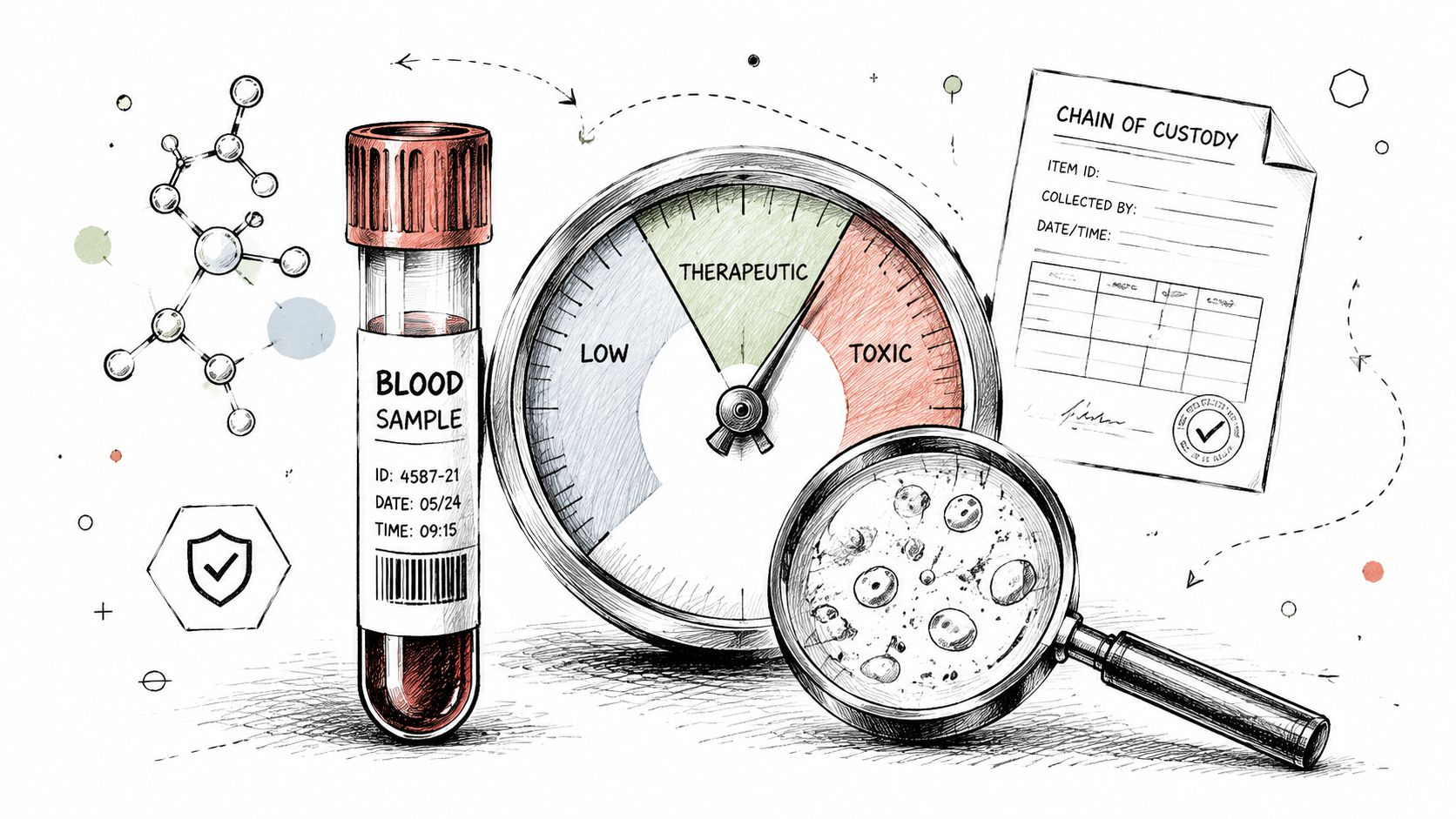
- The Critical Role of Chain of Custody in Texas Courts
- Limitations and Grounds for an Independent Review
- Frequently Asked Questions About DUI Toxicology Reports
Understanding a DUI Toxicology Report in Texas
- A DUI toxicology report is more than a lab printout. It can shape charging decisions, civil claims, and court admissibility.
- In Texas DWI cases involving suspected intoxication, a toxicology report is mandatory when the driver is arrested and the officer observes signs of impairment, with 0.08% BAC as the criminal threshold under Texas Penal Code §49.01(2), as noted by Texas Autopsy Services.
- Modern DUI cases often involve more than alcohol. In adult DUI cases requiring both alcohol and toxicology testing, 90% of toxicology results found at least one drug present, according to the Idaho State Police FY 2025 Annual Toxicology Report.
- A report can be scientifically accurate yet still fail in court if the chain of custody is incomplete.
- Families and attorneys should read the report for three things first: what was tested, how it was confirmed, and who handled the specimen from start to finish.
A family member calls after an arrest or a fatal crash. An attorney emails a PDF full of abbreviations, concentration units, accession numbers, and analyst notes. Someone has already said, “the toxicology came back,” as if that settles the matter.
It usually doesn't.
A toxicology report in a DUI case is one of the most misunderstood documents in the file. Families often read it as a verdict. Lawyers know better, but even experienced counsel may need a careful forensic review when a report mixes alcohol findings, prescription medication, and drug metabolites in the same specimen. That's where confusion starts, and in Texas, confusion around a medical-legal document can become a serious evidentiary problem.
The Unexpected Complexity of a DUI Charge
At 2 a.m., a family may hear that the arrest was for alcohol, then learn days later that the laboratory report names prescription medication, cannabis metabolites, or another drug class that changes the legal posture of the case. Attorneys see the same shift. An arrest narrative built around odor of alcohol and poor balance can turn into a combined-substance case once the toxicology paperwork is produced.
That pattern is common enough that experienced counsel and forensic reviewers should expect it. In practice, the report often raises harder questions than the offense report answers. It can introduce alternate explanations for observed behavior, expose a gap between impairment allegations and laboratory findings, or show multiple substances that require careful interpretation rather than quick assumptions.
From a forensic pathologist's perspective, the difficulty is not just scientific. It is legal and practical. In Texas, the same report may be reviewed by prosecutors, defense counsel, insurers, and in fatal cases, surviving relatives trying to understand what happened. Each reader is asking a different question, and the document does not explain itself.
Why one report can change the entire case
A toxicology report can affect far more than the charging decision. It may shape plea negotiations, support or weaken an insurance position, influence a civil claim, or raise questions about the blood draw and handling of the specimen. In a death investigation, it can also affect how relatives understand the final hours of the decedent's life.
Practical rule: Never read a toxicology report as a pass-fail document. Read it as a laboratory record that must be tied to timing, symptoms, specimen quality, and Texas legal standards.
Attorneys looking at options for challenging DWI charges often start with the stop, field sobriety testing, and probable cause. That is reasonable. The laboratory report deserves equal scrutiny because mixed substances, reporting limits, or specimen issues may alter the strength of the State's theory.
What families usually need to know first
Families usually are not looking for trial strategy. They want plain answers they can trust.
The first issue is the sample itself. Blood and urine serve different purposes, and they do not carry the same weight when the question is impairment at a specific time. The second issue is the name of the substance on the report. A listed compound may be the active drug, a metabolite left after the body processed it, or a medication taken under a valid prescription. The third issue is proof. A detected substance does not, by itself, prove intoxication under Texas law. The fourth is documentation. Even a damaging result can become vulnerable if the paperwork is incomplete or the specimen history is poorly documented.
Those are the points that change real cases. They also explain why a DUI toxicology report needs careful medical and legal reading, especially when the consequences extend beyond the courtroom.
What a Toxicology Report Reveals in a DUI Case
A family gets a copy of the lab report after a DWI arrest, or an attorney receives it in discovery before the first meaningful hearing. The first reaction is often the same. People look for one number and expect one answer. In practice, a toxicology report is more demanding than that.
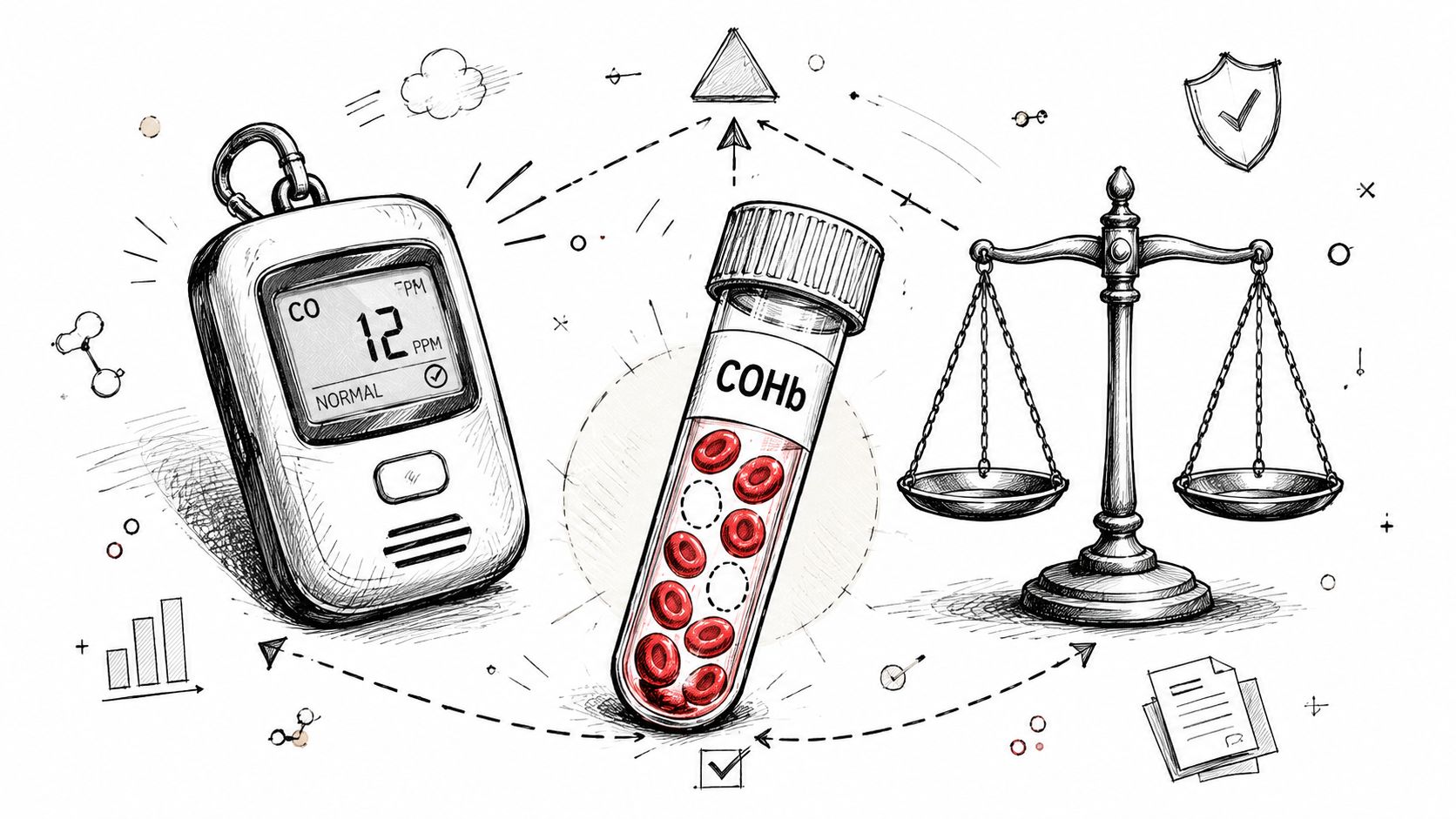
A toxicology report is a laboratory analysis of a biological specimen, usually blood or urine, that identifies and measures alcohol, drugs, medications, or related compounds. In a Texas DWI case, it serves as scientific evidence of what was detected in the specimen submitted for testing. It does not, by itself, resolve whether the person was intoxicated at the legally relevant time.
That distinction matters because the report often reaches beyond alcohol. A roadside breath test estimates alcohol only. A toxicology report may identify alcohol, prescription medication, illicit drugs, inactive metabolites, or multiple substances in combination. From a forensic pathology perspective, those combinations often create the hardest interpretive questions, especially when the police narrative, medical records, and laboratory findings do not line up cleanly.
Texas law defines intoxication in two different ways. One is having an alcohol concentration of 0.08 or more. The other is lacking the normal use of mental or physical faculties because of alcohol, a drug, a controlled substance, a dangerous drug, a combination of substances, or another substance. A report can support either theory, but the legal question and the laboratory question are still separate.
The report answers two different questions
First, the report addresses chemistry. What substance was found, in what specimen, and at what reported concentration?
Second, the report may bear on a legal issue. Do those findings support the State's claim of intoxication under Texas law?
Those questions overlap, but they are not interchangeable. A detected substance may be consistent with impairment, unrelated to impairment, or impossible to time with confidence from the report alone. That is why attorneys review the laboratory result alongside officer observations, body camera footage, medical history, and specimen collection procedures in Texas forensic cases.
Plain language definitions that help
A few terms appear often in DWI files and in death investigation records tied to a crash:
| Term | Plain language meaning |
|---|---|
| Cause of death | The medical reason a person died, such as injuries, disease, or toxic effects |
| Manner of death | The classification of how the death occurred, such as accident, homicide, suicide, natural, or undetermined |
| Chain of custody | The documented record of who collected, transferred, tested, and stored the specimen |
In a fatal crash case, these terms may appear in the same packet of records, but they do different work. Toxicology may inform the medical examiner's opinion. It does not replace the autopsy, scene investigation, or review of injuries and medical treatment.
A toxicology result is one part of the evidence record, not the entire explanation.
For families, that often brings some relief because a positive result does not automatically answer every painful question. For lawyers, it frames the actual task. Read the report as a medical and forensic document, then test whether the State can connect that document to impairment, timing, and admissibility in a Texas court.
Forensic Laboratory Methods and Specimen Analysis
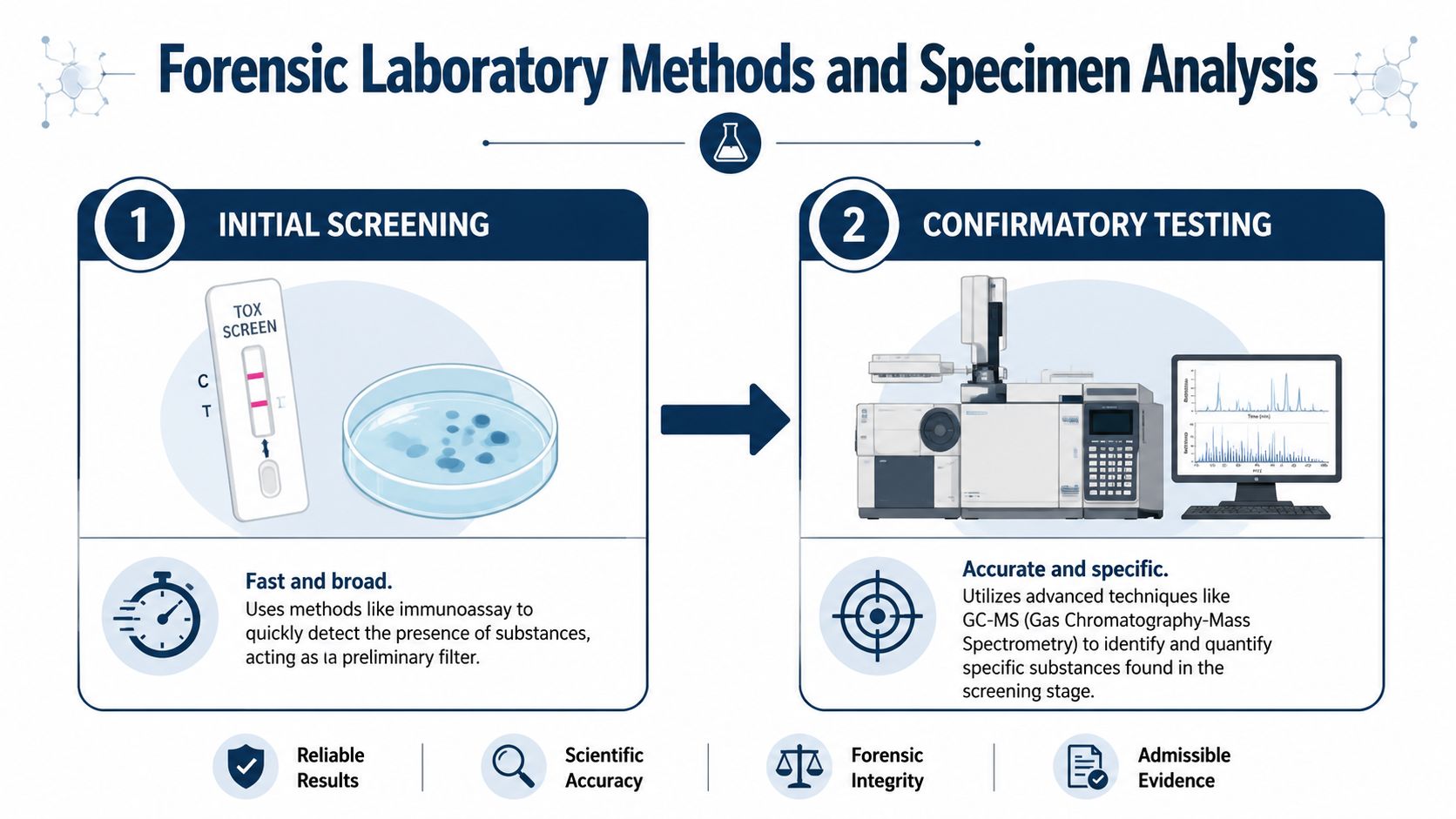
A reliable DUI toxicology report depends on method, not just outcome. The strongest reports show a clear sequence from collection to screening to confirmation, with the specimen type and analytical limits stated in a way that another qualified reviewer can follow.
Why screening is not the final answer
Screening is the first pass. It is designed to detect whether a specimen may contain a drug or drug class. It is fast and useful, but it is not specific enough to serve as the final word when a case may be litigated.
Confirmation is the second pass. It identifies the compound more precisely and quantifies it with a validated analytical method. In drug-impaired driving toxicology reports, laboratories must follow strict thresholds. For cocaine, the minimum screening threshold is 10 ng/mL in blood and the confirmation threshold is 20 ng/mL, and confirmatory analyses must use gas chromatography-mass spectrometry, or GC-MS, according to the consensus toxicology standards discussed in the NIH publication.
That distinction matters in practice:
- A screen suggests a possible presence.
- A confirmation identifies the substance with greater specificity.
- A quantified result gives the court something it can evaluate, rather than a vague positive.
Our board-certified forensic pathologists often review whether the report documents this sequence cleanly. If it doesn't, the issue is not technical nitpicking. It goes directly to reliability.
For readers who need a specimen handling overview before they review the laboratory paperwork, our discussion of specimen collection procedures explains the practical steps that affect what the lab can and cannot conclude later.
Why blood usually carries more weight than urine
Blood and urine do different jobs.
Blood is generally the more useful specimen when the question is present impairment because it reflects substances circulating in the body at the time of collection. Urine often tells a different story. It can show that a substance or metabolite passed through the body, but that does not always answer whether the person was impaired when driving.
A few practical differences help:
| Specimen | What it usually helps show | Main limitation |
|---|---|---|
| Blood | More direct evidence of substances in circulation | Timing still matters |
| Urine | Prior exposure or metabolite presence | Less direct for present impairment |
Laboratory insight: A toxicology report is strongest when the specimen type matches the legal question being asked.
This is also why collection details matter. A valid report needs enough specimen, the proper container, and records that show the sample remained identifiable and suitable for retesting if needed. In court, a well-run method is often as important as the chemical result itself.
Decoding Your Report Substance by Substance
Upon opening a toxicology report, immediate attention is often drawn to the result column. That's understandable, but it's rarely the best place to start. A useful reading begins at the top of the document and moves in order, because each section gives context for the lines that follow.
The sections that matter most
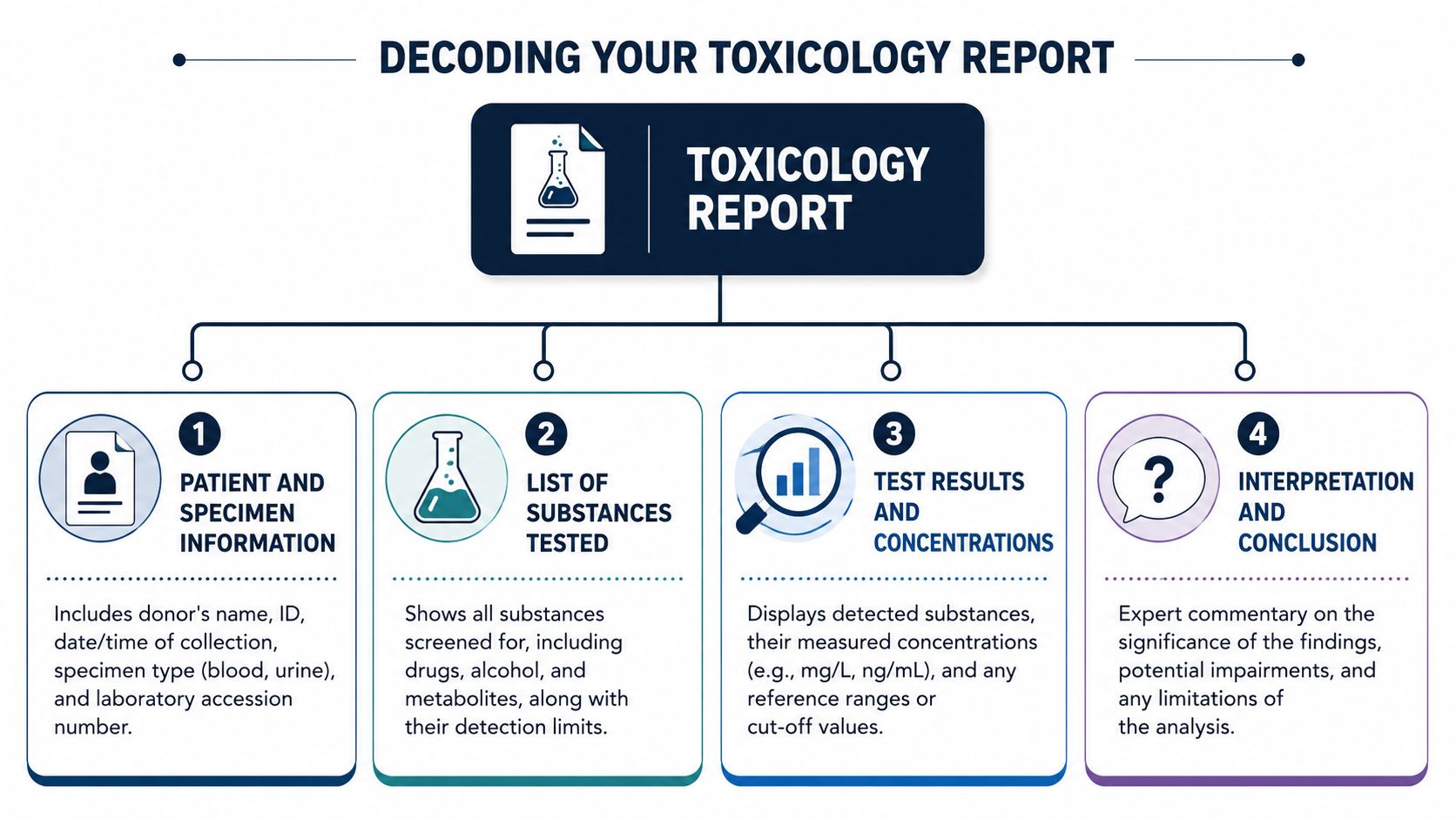
A typical report has four parts that deserve close attention.
Patient and specimen information
This section identifies the donor, specimen type, date and time of collection, and the laboratory accession or case number. Errors here can create confusion before the chemistry is even considered.
List of substances tested
This section tells you what the lab looked for. If a substance is not included in the panel, the report cannot exclude it. That sounds obvious, but readers often assume a negative report means “nothing else was present,” when it may only mean “nothing else on this panel was detected.”
Results and concentrations
The document lists the findings and the measured amount, often in units such as mg/L or ng/mL. A legally defensible toxicology report should include precise quantification with concentration units and disclose analytical methodology, as described in the discussion of forensic toxicology report standards by California Drunk Driving Defense Lawyers.
Interpretation and conclusion
This section may explain whether a detected amount falls within therapeutic, toxic, or lethal ranges, especially for medications. It may also note analytical limitations. That commentary matters because a positive result without interpretation can be misleading.
What concentration numbers actually mean
The concentration is not just a technical detail. It is often the difference between presence and significance.
For example, a medication may appear at a level consistent with prescribed use, or it may appear at a level that raises concern. A result can also show a metabolite rather than the active compound itself. That distinction matters because metabolites may reflect prior use rather than active impairment.
When reading a toxicology report dui file, focus on these checkpoints:
- Match the substance name carefully: A parent drug and its metabolite are not interchangeable.
- Check the unit of measurement: mg/L and ng/mL are not the same scale.
- Look for interpretation language: The report should indicate how the finding is understood medically.
- Note any limits: If the report mentions detection thresholds or limitations, those comments are important.
A “positive” result does not answer every forensic question. The concentration, specimen type, and interpretation decide whether the finding has real evidentiary weight.
For families, this reading often lowers anxiety because it separates what the report says from what others assume it says. For attorneys, it helps identify whether the document is analytically complete or merely superficially persuasive.
The Critical Role of Chain of Custody in Texas Courts
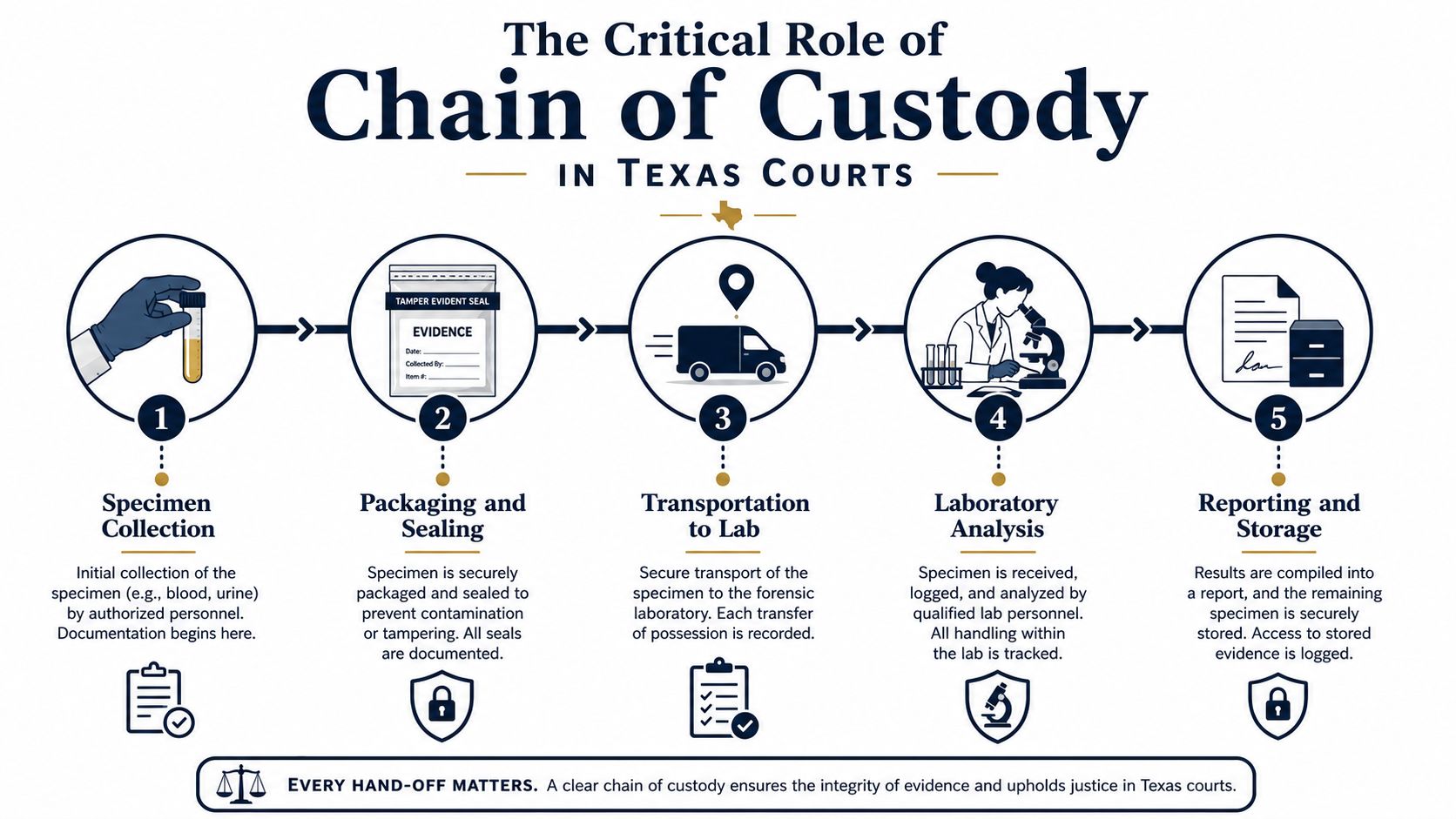
The most accurate toxicology result in the world can still fail as evidence if the specimen cannot be tracked from collection to analysis. That is the role of chain of custody. In plain language, it is the written record showing who handled the sample, when they handled it, and what happened to it at each transfer point.
What chain of custody means in plain language
A proper chain begins when the specimen is collected. It continues through sealing, transport, laboratory receipt, analysis, reporting, and storage. Every handoff should be documented.
In Texas, that record is not optional. A toxicology report for a DUI case must be signed by a board-certified forensic pathologist and include a full chain-of-custody document listing every handler of the blood sample, from the arresting officer to the laboratory analyst, with time-stamped records for each transfer. Failure to include that documentation renders the report inadmissible in court under Texas Rules of Evidence 901, as described by the Institute of Forensic Sciences in Harris County.
For readers outside the legal system, a practical explanation of chain of custody guidance for SMEs can help illustrate why documented handoffs matter in any evidence-sensitive setting.
A closer look at the document trail can also help. Our article on chain of custody procedures explains how specimen control affects admissibility and later review.
After the paperwork, the court often needs the process explained clearly. This short overview helps illustrate why that paper trail carries so much weight:
Why lawyers scrutinize it first
Chain of custody problems are often easier to understand than chromatography, but they can be just as decisive.
A few recurring issues raise concern:
- Unclear labeling: If the vial identity is unclear, the result may not be tied confidently to the right person.
- Missing transfer entries: A gap in possession creates room for challenge.
- Incomplete timestamps: Sequence matters. Without time records, the trail weakens.
- Poor storage documentation: The court may ask whether the sample remained stable and secure.
If the record cannot show whose specimen was tested and how it moved through the system, the reported concentration may never reach the jury in a usable form.
That is why a forensic review does not stop at the toxicology number. In many Texas DUI cases, the main dispute begins.
Limitations and Grounds for an Independent Review
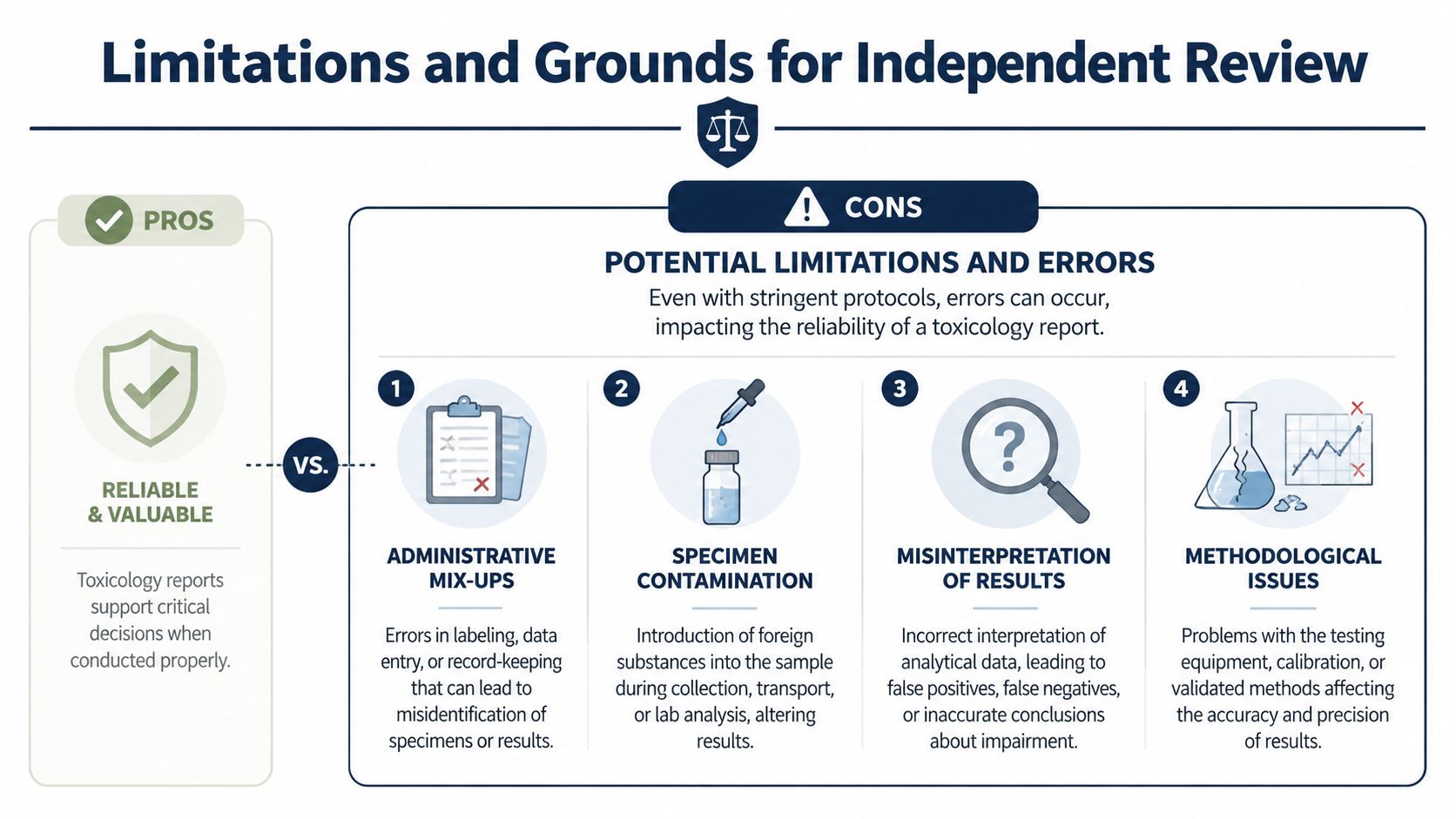
Toxicology reports are important, but they are not immune from error. A result may look polished on the page and still rest on weak collection practices, incomplete documentation, or overconfident interpretation. Families often assume the report is final because it carries scientific language. Attorneys know that finality has to be earned.
Where toxicology reports can fall short
Some limitations are administrative. A specimen can be mislabeled, logged incorrectly, or linked to incomplete accession data. Some problems are analytical, such as a screening result that is treated too casually as proof without adequate confirmation or a report that does not clearly explain the method used.
Other limitations involve interpretation. A detected substance may be real, but the conclusion drawn from it may go further than the data supports. That is especially important when the issue is impairment rather than simple presence.
The broader system also has a structural weakness. There are no agreed-upon national minimum guidelines for toxicological investigations in motor vehicle crashes and drug-impaired driving cases in the U.S., which allows testing protocols to vary by state, as noted in the FAAR report on toxicological investigations. That lack of uniformity matters because one jurisdiction may test broadly and document thoroughly while another may not.
When an independent forensic review is justified
An independent review is often warranted when the report will carry major legal or personal consequences and the original file leaves unanswered questions.
Common reasons include:
- The interpretation appears stronger than the data
- The specimen type does not fit the legal issue well
- The chain-of-custody record is incomplete
- The testing method is not fully disclosed
- The family or attorney needs a neutral second opinion
In those situations, an outside forensic review can examine the toxicology report, supporting records, and underlying assumptions without adopting either side's narrative. For families seeking postmortem answers, Private Autopsies may also be relevant when the toxicology findings are only one part of a larger cause-of-death question. For attorneys or officials evaluating whether a file needs fresh forensic scrutiny, our case review process is outlined in review my case.
The point is not to assume the original report is wrong. The point is to determine whether it is complete, defensible, and interpreted within its actual limits.
Frequently Asked Questions About DUI Toxicology Reports
The questions below come up often because people need direct answers after they receive a report, not more laboratory jargon.
| Question | Answer |
|---|---|
| Does a positive toxicology result automatically prove impairment? | No. Presence and impairment are related but not identical. The meaning of the result depends on the substance, concentration, specimen type, and the surrounding facts. |
| Is blood better than urine for a DUI case? | Often yes when the issue is present impairment, because blood more directly reflects substances in circulation. Urine may still be useful, but it usually answers a narrower question. |
| Can a report be challenged even if the lab found a substance? | Yes. Lawyers may challenge the collection process, confirmation method, chain of custody, interpretation, or admissibility. |
| What should families look at first? | Start with the specimen type, the list of substances tested, the concentration units, and whether the report includes interpretation rather than only raw findings. |
| Can alcohol show up on every kind of drug test? | No. Alcohol testing depends on the method and specimen used. For a basic explanation of how alcohol detection differs from other testing approaches, this overview of Tru Dallas Detox alcohol testing is a helpful general resource. |
When attorneys contact us about a toxicology report dui question, the most useful first step is usually document review, not immediate conclusion. That means gathering the report, chain-of-custody records, collection details, and any related death investigation or medical records before drawing a forensic opinion.
For families, the next step is usually simpler. Ask for plain language. Ask what the result proves, what it does not prove, and whether the findings have been reviewed by a qualified forensic pathologist. Those questions are practical, respectful, and often clarifying.
If you need help understanding a DUI toxicology report, a related death investigation, or whether an independent forensic review is appropriate, contact Texas Autopsy Services. We serve all 254 Texas counties, and every examination is performed by a forensic pathologist certified by the American Board of Pathology. Our team can explain the record in clear language and help families, attorneys, and agencies understand what the findings support and where caution is warranted.