September 1, 2026 · Texas Autopsy Services
Exhumed Body After 50 Years: What Forensics Can Still Find
Exhumed body after 50 years: learn what forensic testing can still reveal, Texas legal requirements for disinterment, and how exhumation is handled.
On this page
- What an Exhumation Involves
- Why 50 Years Is Not the End of the Road
- How Burial Environment Shapes What Survives
- Testing Options That Still Work After Decades
- Texas Law for Disinterment and Who Must Supervise
- Chain of Custody and the Exhumation Workflow
- Logistics, Costs, and Timeline Realities
- Deciding Whether Exhumation Makes Sense
- Frequently Asked Questions
A family may uncover an old death certificate, question a burial record, or revisit a medical issue that never received a satisfactory answer. With a grave approaching 50 years, relatives often assume the remains can no longer clarify anything. That conclusion is understandable, but calendar time alone cannot determine the evidence.
An exhumed body after 50 years may be mostly skeletal, fragile, and difficult to interpret. Teeth, dense bone, surgical hardware, healed injuries, and occasional soft-tissue remnants may still help address identity or possible trauma. The burial environment acts like a long-term storage system: moisture, oxygen, soil chemistry, coffin condition, temperature, and later handling all influence what survives.
- Fifty years does not automatically erase forensic value. Preservation differs greatly between graves. Some remains retain useful features, while others provide mainly skeletal and contextual evidence.
- Evidence changes rather than disappears. As soft tissue is lost and bone becomes fragile, the examination may focus on teeth, bone structure, implants, healed fractures, clothing, coffin materials, and the position of the remains. A forensic paper on exhumation after more than 30 years explains why these findings can become more important than ordinary autopsy observations.
- Adipocere may preserve selected features. This wax-like substance can form in certain stable, damp, low-oxygen conditions and slow decomposition in localized areas. Its presence does not preserve every part of a body, but it can protect some tissues and anatomical details. A forensic review of adipocere describes this effect.
- Texas procedures govern disinterment. Authorization, notices, permits, and supervision depend on the circumstances and the authority with jurisdiction. Texas administrative rules on exhumation supervision set out specific requirements.
- The examination starts before the grave is opened. Investigators must define the legal question, review burial history, assess site conditions, plan recovery and transport, and protect the chain of custody. Those steps determine whether findings after five decades can support a defensible conclusion rather than speculation.
What an Exhumation Involves
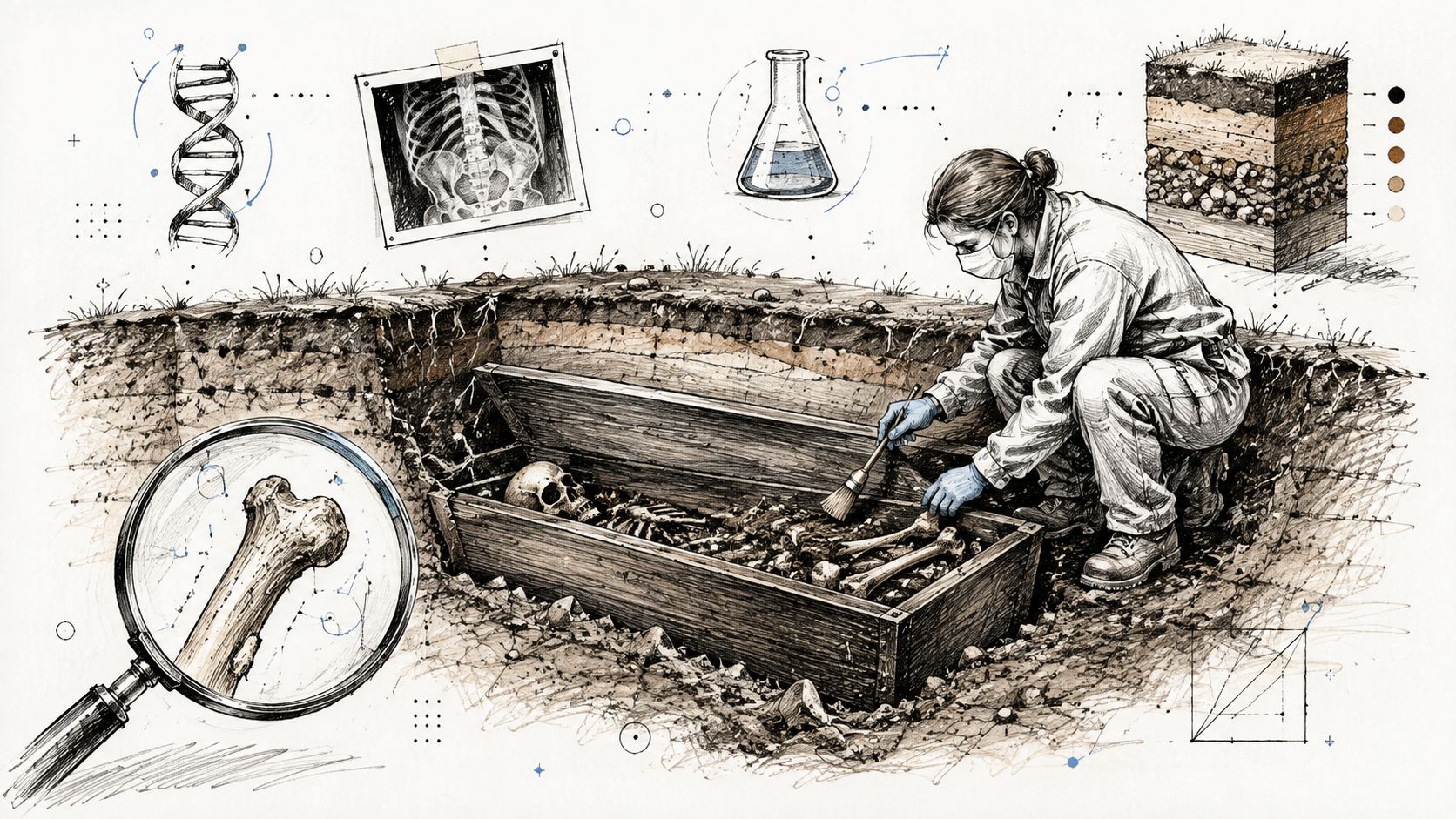
A family may believe that a burial ended an unanswered question, until an attorney reviewing old records sees a possible path to clarifying identity, trauma, or the recorded cause of death. Exhumation then becomes a legal, supervised removal of human remains, followed by a forensic examination conducted years after death.
A routine autopsy occurs soon after death, under the authority and consent that apply at that time. Exhumation involves several linked stages: disinterment, recovery, transport, documentation, and postmortem examination. Burial changes the evidence, so the later examination must account for conditions inside the grave, casket, clothing, soil, and surrounding area.
The purpose is evidence, not speculation
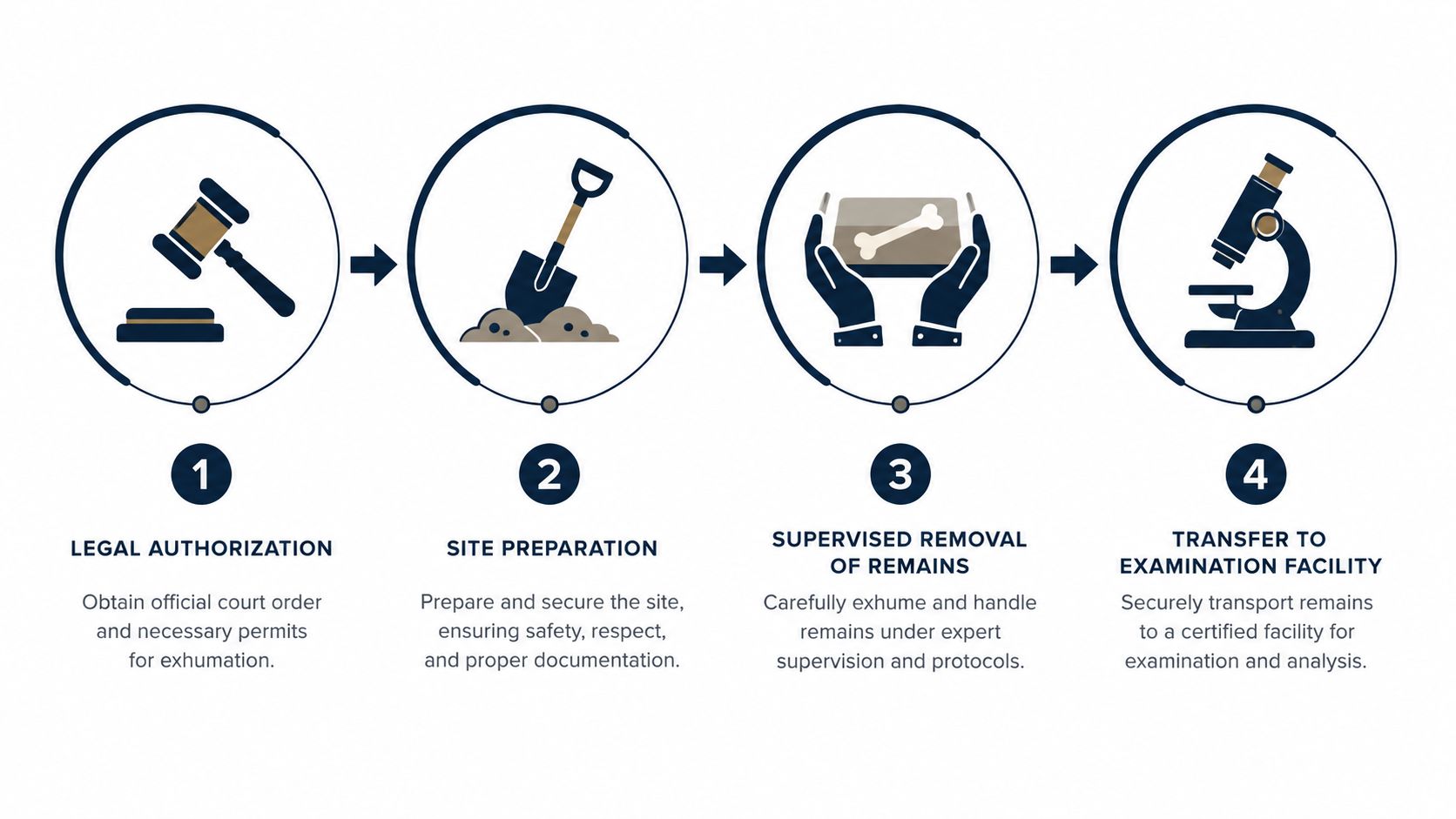
An exhumation may proceed under a court order, at the request of next of kin, or through direction from a county medical examiner, coroner, justice of the peace, or another authority with jurisdiction. The appropriate route depends on the death circumstances, cemetery, requesting party, and applicable Texas procedures.
People commonly involved include:
- A licensed funeral director or authorized disinterment agent, who manages lawful removal and mortuary logistics.
- Cemetery personnel, who identify the plot, record site conditions, and coordinate access.
- A forensic pathologist or qualified examination professional, who helps determine how recovery and evaluation should be performed.
- Additional specialists, including a forensic anthropologist or odontologist, when skeletal or dental evidence is central.
The team has two related responsibilities. It must recover the remains while preserving potentially useful evidence, then record each action so later findings can be understood and defended. Documentation starts at the grave, before the remains reach a laboratory.
After five decades, the grave is much like a sealed evidence scene. Soil, casket materials, clothing, and the remains may each hold information, and separating them too early can destroy context.
Practical rule: Treat the grave, casket, clothing, soil, and remains as one evidence scene until qualified professionals have documented them separately.
Why 50 Years Is Not the End of the Road
A family may open a grave after 50 years and find little more than dry bone. Another family, in a similar cemetery and time period, may encounter preserved soft tissue, adipocere, or material protected inside a casket. The calendar gives investigators a starting point, not a final answer. Burial duration affects physical condition, while the burial environment controls much of the pace and pattern of decomposition. As noted earlier, physical condition after exhumation is more closely related to burial duration than to characteristics such as sex or age.
The practical question is not whether a complete body remains. It is whether the surviving material can answer a specific question.
What investigators may still examine
Identification may use teeth, bone, medical hardware, healed fractures, or distinctive anatomy. Investigators may also attempt DNA testing from suitable bone or teeth. Preservation and contamination affect whether that testing produces a useful result. Antemortem dental or medical records can strengthen a comparison by giving examiners something specific to evaluate.
Cause of death means the disease, injury, or condition that produced death. After five decades, investigators may be unable to reconstruct every medical detail. Preserved trauma, healed or fresh fractures, retained projectiles, or other skeletal findings may still support or limit a cause-of-death opinion.
Manner of death describes the classification, such as natural, accident, suicide, homicide, or undetermined. Cause and manner are different questions. Manner depends on medical findings combined with investigative and historical information, so an exhumation rarely establishes it through one isolated finding.
The same 50-year interval can therefore produce very different evidence:
| Evidence Type | Dry or Aerobic Burial | Wet or Anaerobic Burial | Sealed Casket |
|---|---|---|---|
| Soft tissue | Often reduced, desiccated, or absent | May persist as adipocere or protected remnants | May be unusually preserved if the seal remains effective |
| Bone | May remain useful, but surface damage can occur | May be protected in some settings, or weakened by prolonged moisture | Condition depends on internal moisture and casket failure |
| Teeth | Often valuable for identification | May remain useful despite surrounding decomposition | May be protected from some environmental exposure |
| Trace and contextual evidence | Soil, roots, and exposure can alter findings | Water chemistry and low oxygen can change decomposition | Casket materials and contents become important evidence |
A 50-year interval calls for realistic expectations rather than automatic dismissal. In Texas practice, the decision should connect the requested examination to a defined evidentiary question and the records available for comparison. Results remain case-dependent. No responsible forensic examiner can promise identification or a cause-of-death opinion before evaluating the remains, the grave context, and the supporting records.
How Burial Environment Shapes What Survives
A grave opened after 50 years may contain dry bone, fragile tissue, adipocere, or very little recognizable material. The calendar interval sets the age of the burial, but the surroundings determine how decomposition progressed. Moisture, oxygen, temperature, soil chemistry, groundwater, coffin integrity, and nearby biological activity interact throughout that period.
Adipocere develops when bacteria convert body fats into fatty acids and their salts. Warm, moist, low-oxygen conditions favor this process, including waterlogged soil and airtight burial. Once formed, adipocere can greatly slow further decomposition and preserve parts of the remains for a very long time, as noted earlier.
In open, damp conditions, adipocere may become visible in about 3 to 6 months and extensive by about one year, according to the forensic literature summarized in this review of adipocere in forensic examination. Those time frames describe one possible pattern, not a schedule that applies to every Texas grave.
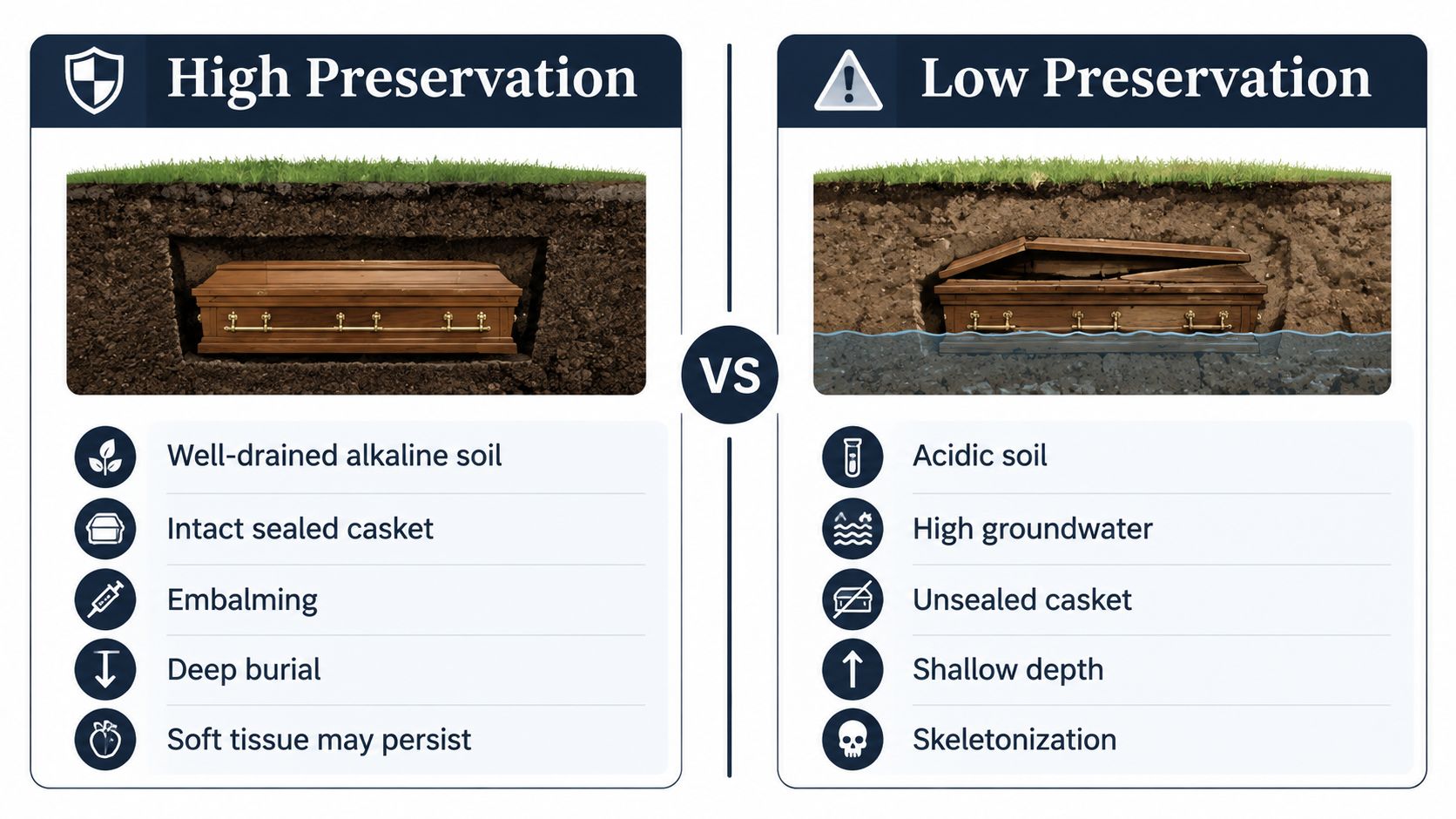
Texas sites can produce different conditions
Texas burial sites may include expansive clay, rising groundwater, caliche, uneven drainage, or rocky substrates. Conditions can change from one county to another, and even between plots in the same cemetery. A sealed casket can reduce direct soil contact for a period, but corrosion, wood rot, pressure, and water entry may eventually change that protection.
Investigators usually ask:
- Was the soil dry, saturated, acidic, alkaline, or frequently disturbed?
- Did groundwater enter the burial space?
- Did the casket remain intact, or did corrosion, rot, or collapse expose the remains?
- Was the grave deep enough to maintain a relatively stable temperature?
- Do records describe embalming, the casket, a vault, or later cemetery work?
The surrounding soil can preserve some evidence while damaging other evidence. Water chemistry may alter bone, roots can disturb the grave, and container materials may become part of the interpretation. A sealed space may protect tissue yet create conditions that support adipocere.
A clay-soil exhumation described in an Australian hearing showed that decomposition can remain slow enough for 50 years to be too soon for an uncomplicated recovery. That example establishes no Texas rule. It does show why the interval on a death certificate cannot predict the condition of every grave.
Before investigators forecast what may survive, they should assess the grave, container, soil, drainage, and burial records. Site history and burial conditions are part of the forensic record.
Testing Options That Still Work After Decades
After 50 years, testing begins with a question, not a shopping list. A forensic pathologist first determines what remains are present, what records exist, and which examination can address the issue without consuming irreplaceable material.
Skeletal and dental examination
Long bones, the skull, and teeth may offer the most durable evidence. A physical anthropologist can assess skeletal characteristics relevant to biological profile, including sex, age, and height, while examining bone for trauma, disease, or unusual anatomy. Findings must be stated with appropriate limits, especially when bones are fragile or incomplete.
Dental comparison can be particularly valuable when reliable antemortem records exist. Teeth may remain available when other tissues are gone, allowing comparison of restorations, missing teeth, dental structures, or other documented features. Identification still requires a defensible comparison, not merely a visual impression.
DNA, toxicology, and imaging
DNA testing may be attempted from compact bone, tooth material, or preserved tissue. A laboratory may begin with nuclear profiling and consider other methods when the sample is degraded, but preservation, contamination, and the availability of a reference sample strongly affect the outcome.
Toxicology has narrower limits after decades. Some inorganic elements, including heavy metals such as arsenic and lead, may persist in bone or hair. Organic drugs are more vulnerable to leaching and environmental change, although adipocere or protected tissue can alter that expectation. Radiography and other imaging may reveal retained projectiles, surgical hardware, healed fractures, or bone disease.
For families and attorneys considering molecular work, our educational explanation of molecular testing in forensic examinations describes why specimen selection and interpretation matter.
| Test Type | Specimen | Usable Result Likelihood | Primary Value |
|---|---|---|---|
| Anthropology | Bone and teeth | Case-dependent | Biological profile and skeletal trauma |
| Dental comparison | Teeth and dental records | Stronger when records exist | Personal identification |
| DNA analysis | Compact bone, teeth, preserved tissue | Variable | Identification or relationship testing |
| Toxicology | Bone, hair, adipocere, preserved tissue | Highly dependent on environment | Selected substances or elements |
| Radiology | Whole remains, bone, casket contents | Often useful when structures remain | Hardware, projectiles, fractures, and disease markers |
The examination may establish a finding, narrow possibilities, or show that the available evidence can't support a conclusion. That last result is still important in legal and family decision-making.
Texas Law for Disinterment and Who Must Supervise
A family may have a clear reason to reopen a grave after 50 years, yet the legal process still starts with authority, records, and permission. The age of the burial does not by itself remove these requirements. Texas Health and Safety Code Chapter 711 addresses cemeteries and human remains, while Chapter 716 covers perpetual-care and endowment matters that may affect access to older cemeteries. County officials and other agencies may also have a role, depending on the location and circumstances.
Texas administrative rules require the prescribed notifications to next of kin and other Chapter 711 procedures before disinterment begins. Removal authorized under that chapter must be supervised by a cemetery keeper, licensed funeral director, medical examiner, coroner, or professional archeologist. The Texas administrative rule sets out these supervision requirements.
The permit and authority questions
The permit process is handled through Texas vital statistics procedures. A Texas Health and Safety Code flowchart directs applicants toward a disinterment permit from the State Registrar. Chapter 694 also authorizes the Department of State Health Services to regulate disposal, transportation, interment, and disinterment as needed to protect public health and safety. The Texas Historical Commission flowchart summarizes the disinterment permit pathway.
Before work is scheduled, the requesting party should be ready to document:
- Authority to request the removal, such as the legally authorized person or governing agency.
- The grave's identity and location, supported by cemetery records.
- Required next-of-kin notifications and consent, where applicable.
- The licensed professional or public official who will supervise the work.
- The receiving facility and examination plan.
An unmarked or abandoned cemetery requires added care because grave boundaries and identities may be uncertain. Texas rules call for professional archaeological work and, when appropriate, help from a physical anthropologist to gather demographic information and assess possible cause of death.
The practical sequence is described in our explanation of exhumation of a body. Early coordination with the cemetery, county authority, funeral director, and State Registrar can prevent delays, even when the burial occurred decades ago.
Chain of Custody and the Exhumation Workflow
Chain of custody is the documented history of evidence from recovery through examination, storage, testing, and reporting. It shows who possessed an item, when the transfer occurred, how it was sealed, and whether the packaging remained secure. In an exhumation, that record begins at the gravesite.
The team should photograph the site and casket, record the excavation location and observations, identify the remains, and document the presence of cemetery staff and the supervising licensed professional. Remains are placed in an appropriate sealed transport pouch or documented container, and the custody paperwork travels with them.
Chain of custody protects the meaning of the result. A scientifically sound test can become difficult to use if the evidence history is incomplete.
At the Elgin facility, exhumation cases are scheduled separately from routine autopsies. The setting may require additional protective equipment, decontamination, and ventilation controls. On arrival, the receiving pathologist verifies the seal, photographs the condition of the remains, and records packaging and temperature observations before collecting specimens.
From recovery to laboratory testing
Bone, teeth, preserved tissue, and other samples receive case identifiers that correspond with the custody record. If material is sent to an outside laboratory for DNA, anthropology, histology, or toxicology, the transfer is recorded and the receiving laboratory confirms its condition.
Readers who need a general explanation of custody records across regulated handling environments may find this chain of custody UK business guide useful. The legal requirements for human remains and forensic evidence are specific, but the central principle is the same, every transfer must be traceable.
Our chain of custody procedures for forensic cases describe why signatures, seals, case numbers, and transfer documentation matter. These details can seem administrative during a difficult recovery, but they support the credibility of every later finding.
Logistics, Costs, and Timeline Realities
An exhumation after 50 years requires coordination among several parties. The cemetery may control access to the plot, the State Registrar may be involved in the disinterment permit, a licensed funeral director may handle removal and transport, and a forensic facility must be prepared to receive the remains.
A permit process may take 2 to 4 weeks, and the planned infographic below presents that interval as a practical planning estimate. Actual timing depends on the completeness of the records, agency response, cemetery requirements, court involvement, and whether next-of-kin issues must be resolved.
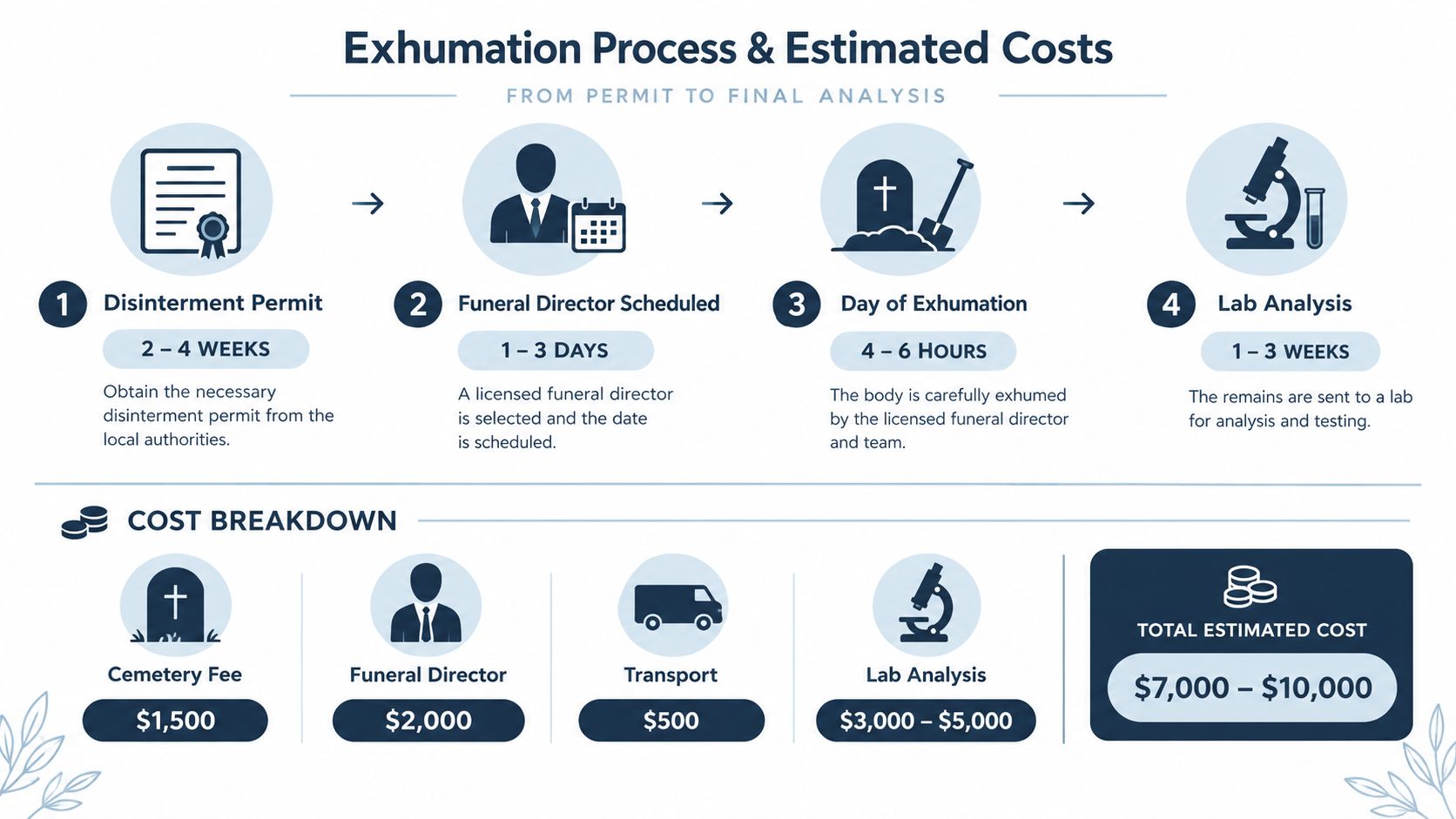
What affects the schedule
The day of recovery may require several hours, particularly when the grave is difficult to access, the casket has collapsed, or the burial location is uncertain. Remains are transported in a sealed and documented container. Refrigerated transport may be needed when soft tissue remains or when the receiving facility's protocols require temperature control.
Laboratory work can extend beyond the examination itself. Bone and teeth may be selected for DNA, toxicology, radiology, or anthropology, and outside testing can return on a different schedule from the initial report. A planned range of 6 to 12 weeks for results is shown in the supplied process graphic, but no responsible practice should guarantee a fixed turnaround.
Costs vary with jurisdiction, cemetery requirements, transport distance, examination scope, laboratory testing, court orders, reinterment, and chain-of-custody needs. Cemetery operators, attorneys, county officials, or families may coordinate payment depending on who requested the work and why. A written scope and transparent fee arrangement should be obtained before recovery begins.
Deciding Whether Exhumation Makes Sense
The decision turns on the question the examination must answer and the probability that the burial environment preserved material relevant to that question. A family may seek identity confirmation. An attorney may need to assess trauma or challenge a prior conclusion. A county official may be reviewing a decades-old death investigation. Each purpose calls for a different evidence plan.
The most useful preliminary review considers:
- The unanswered question: Is the issue identity, cause of death, manner of death, toxicology, trauma, or the reliability of an earlier record?
- Available records: Are there dental charts, radiographs, surgical records, photographs, death certificates, investigative reports, or family reference samples?
- Burial conditions: What is known about soil, groundwater, casket construction, vaults, cemetery disturbance, and the site's drainage?
- Legal authority: Who may request disinterment, which agency must issue or approve the permit, and who will supervise recovery?
- Evidence handling: Can the team document, transport, store, and test the remains with a complete custody record?
A forensic examination may produce a clear answer, a qualified answer, or no definitive answer. That uncertainty should be discussed before authorization, not after the grave has been opened.
Texas Autopsy Services is an independent private autopsy and forensic pathology practice based in Elgin, Texas. The practice serves families, attorneys, healthcare professionals, agencies, and county officials across all 254 Texas counties, with examinations performed by a forensic pathologist certified by the American Board of Pathology. Support may include legal coordination, cemetery communication, licensed transport, examination, laboratory testing, and a clear written report. The purpose isn't to promise a result. It is to preserve and evaluate whatever evidence remains with medical precision, respect, and a defensible chain of custody.
Frequently Asked Questions
Can an exhumed body after 50 years still provide DNA?
Sometimes. DNA recovery depends on the condition of teeth, compact bone, preserved tissue, soil exposure, contamination, and the availability of appropriate comparison samples. A qualified laboratory must evaluate the specimen before anyone can estimate whether identification testing is likely to succeed.
Is a body completely decomposed after 50 years?
Not necessarily. Many exhumations at that interval involve fragile skeletal remains and little recognizable soft tissue, but moisture, oxygen, soil chemistry, and casket conditions can produce adipocere or other preservation patterns. The forensic evidence shows that 50 years isn't a universal endpoint.
Can an exhumation determine the cause of death?
It may, but no result is guaranteed. Preserved trauma, skeletal injury, retained projectiles, medical hardware, or other findings may support a cause-of-death opinion. The absence of suitable tissue or the loss of relevant structures may limit the conclusion.
Who supervises an exhumation in Texas?
Texas rules identify authorized supervisors that can include a cemetery keeper, licensed funeral director, medical examiner, coroner, or professional archeologist, depending on the circumstances. Required notices, permits, and public-health procedures must be completed before disinterment begins.
Is an exhumation the same as a second autopsy?
No. Exhumation is the lawful removal and recovery process. A deferred forensic examination may follow at a qualified facility, but the examination must account for burial conditions, decomposition, recovery methods, and the evidence that remains.
When a long-buried grave raises an important medical, legal, or identification question, our team can help review the records, coordinate Texas authorization and recovery logistics, arrange licensed transport, and perform an independent forensic examination when appropriate. Contact Texas Autopsy Services directly so we can discuss the known burial conditions, the question you need answered, and the most careful next step for your family, case, or county.