November 14, 2026 · Texas Autopsy Services
What a Medical Record Reviewer Does and How Reviews Work
Learn what a medical record reviewer does, how records are checked for gaps and conflicts, and when an independent review helps clarify a death.

On this page
- What a Medical Record Reviewer Does Day to Day
- How Records Are Assessed in Six Steps
- Documentation Gaps That Change a Review's Answer
- Patient Matching and Copied-Forward Entries
- Medical Record Review Compared With Autopsy and Inquest Roles
- When an Independent Review Helps Clarify a Death
- Gather Your Records Before You Request a Review
Three envelopes land on the same afternoon. One holds emergency department notes, one a portal export from a specialist, and one a medication log missing two pages. You asked for the medical records because you need an answer about someone's death, and what you have is a stack of paper that doesn't agree with itself.
That gap between having the records and being able to rely on them is where a medical record reviewer works. The job isn't reading faster. It's confirming what each document is, who it belongs to, when it was written, and what it can prove.
What a Medical Record Reviewer Does Day to Day
A medical record reviewer reads, organizes, and verifies clinical documents so a question about care or cause of death can be answered from the written record. The work is sequencing and checking: confirming what was documented, when, and by whom, then placing entries on one timeline so each one can be tested against the others.
The role has firm edges. A reviewer doesn't examine the body, doesn't diagnose, and doesn't decide a legal outcome. Those belong to the pathologist performing an examination, the treating clinicians, and the court or county official with jurisdiction. What a reviewer produces is a sourced chronology with the gaps marked, which is useful precisely because it separates what the file says from what people remember.
The occupation is larger than most families expect. The U.S. Bureau of Labor Statistics counted 185,690 medical records specialist jobs nationally in May 2023, including 19,870 in Texas, where the mean annual wage was $48,030. A 2024 median annual wage of $50,250 appears in a Grand Canyon University overview of health information management careers. The same federal series projects about 7% growth in the occupation from 2024 through 2034, against 3.1% across all occupations, and about 13,800 additional jobs during that period.
The sources a reviewer lines up
Every document type answers a different question about timing and detail. This is the working map.
| Record type | What the reviewer checks | Why it matters |
|---|---|---|
| Emergency department notes | Arrival time, triage findings and first treatment | Sets the earliest documented condition |
| Inpatient and outpatient notes | Diagnoses, plans and follow-up visits | Shows how the diagnosis changed over time |
| Laboratory results | Test values, collection times and result times | Confirms what was known at each decision point |
| Imaging reports | Findings, study dates and ordering provider | Links clinical notes to objective findings |
| Medication administration records | Doses, times and the staff member who gave them | Shows what was given, not only what was prescribed |
| Nursing notes | Observations, vital signs and changes in condition | Often records symptoms before a physician note does |
| Autopsy and toxicology reports | Findings and results after death | Connects the chart to the cause-of-death question |
Read alone, any single row can mislead. A triage note without the medication record can suggest nothing was given. A medication record without the nursing notes can suggest a dose was tolerated. Lining the sources up is the entire method, and it's why a careful review rarely produces a one-line answer.
Coding teams work from the same raw material, which is why documentation standards overlap so closely. A medical coder reads a chart to assign codes and needs every statement traceable to a signed, dated entry. A reviewer reading for causation needs the same discipline applied to a different question.
How Records Are Assessed in Six Steps
The Agency for Healthcare Research and Quality's review of patient safety measurement describes retrospective chart review as a high-detail method for identifying diagnostic-safety events, missed opportunities, contributing factors, and harm. It also names the limits. Records vary in quality, important clinical context may be absent, and manual review commonly requires one or more clinicians. The same review reports that medical-record review detects more adverse events than other approaches, while cautioning that the underlying research quality is often moderate.
Powerful and imperfect at once. That's why the work follows a protocol rather than a careful read.
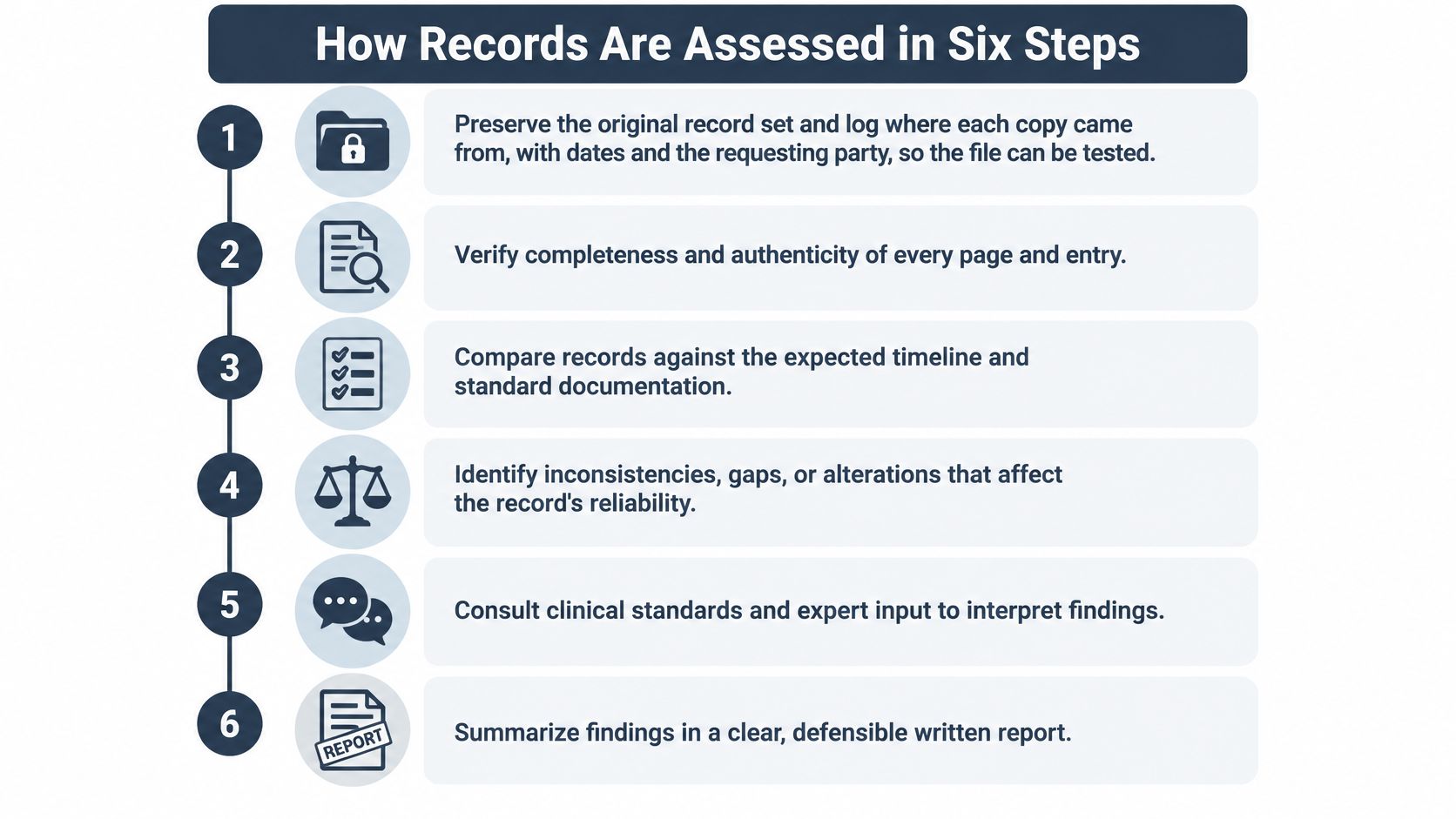
The six steps
1. Preserve the original record set. Before anyone marks up a page, the file is copied, hashed or otherwise locked, and logged with the date each copy arrived and who requested it. A file that changes shape during review can't be tested later.
2. Confirm patient identity on every page. Misfiled pages are a known risk when records move between systems. Two identifiers, typically full name plus date of birth or medical record number, get checked page by page, and any page carrying another patient's details is pulled and flagged rather than discarded.
3. Build a source inventory. A reviewer lists every document received and every one still missing, whether that's an emergency note, a medication log, or a toxicology result. The missing list is a finding in its own right because it defines the limits of what the review can say.
4. Reconstruct the chronology from timestamps. Dates and times come off the documents, not from memory, a discharge summary, or a family account. A summary written days later is a different kind of evidence than a note written during the event.
5. Cross-check narrative against objective data. Notes get compared with laboratory values, imaging reports, and administration records. Copied-forward diagnoses are the usual culprit here, since a line carried over from an earlier note may no longer describe the patient in front of the clinician.
6. Label every conclusion. Each statement is marked as documented, inferred, or unsupported, with the records needed before a conclusion can be firm. That labeling is what makes an expert report survive cross-examination.
Why a second reviewer and a chain of custody matter
Disputed cases benefit from a second trained reviewer who codes the same records independently. Disagreements get settled against written criteria rather than by discussion, and the rate of agreement is recorded. Alongside that, a documented chain of custody shows who held the file, when, and in what form.
Appellate work raises the same standard. Attorneys building a challenge from a trial record need to know exactly what that record contains and what it omits, and Law Office of Bryan Fagan's overview of records review on appeal shows how much of the argument turns on that inventory.
The test to apply: can every claim be traced to a dated source, and does the file say who provided it?
Documentation Gaps That Change a Review's Answer
A hospital sends the records as a tidy PDF, pages indexed by date and source. A family assumes, reasonably, that everything the clinicians wrote down is in the file. A reviewer assumes the opposite.
A systematic review of documentation errors screened 7,624 articles, included 48 studies, and found that 47 of the 48 reported some form of incompleteness or deficiency. Incompleteness, in other words, is the normal condition of clinical documentation across settings, so the reviewer treats every file as partial until the evidence shows otherwise.
| Problem type | Studies reporting it (of 48) | What the reviewer does |
|---|---|---|
| Inaccuracy | 14 | Compare the entry with laboratory, imaging and medication records |
| Inconsistency | 8 | Place conflicting entries side by side with their dates |
| Illegibility | 7 | Request a clearer copy or mark the entry as unreadable |
| Unsigned documents | 4 | Establish the author, the date and whether the entry was authenticated |
| Irrelevant documents | 2 | Confirm the page belongs to this patient and this episode of care |
| Any incompleteness or deficiency | 47 | Treat the chart as partial and list what is missing |
What each problem does to a review
A blurred dose changes the medication timeline and can hide an overdose or a missed dose. An unsigned note leaves a question the document cannot answer on its own: who wrote it, and were they qualified to. An inconsistency between a progress note and a laboratory value often marks the moment a clinician was working from stale information. An irrelevant page can invent a history that never happened to this patient at all.
The scale of the problem is measurable. In one hospital setting the review summarizes, 43% of patient charts contained at least one error. The same review reports 65 errors among 1,934 prescribed agents, roughly 3.4%, with transcription errors accounting for 53% of the medication-related errors identified, prescribing errors for 37%, and administration-documentation errors for 10%.
Transcription errors deserve particular attention in a death investigation. A drug name mistyped in one system and copied forward into three others looks, on the page, like a consistent clinical decision. Only the original order shows what was intended.
Practical rule: a missing note can mean missing care, missing documentation, or an outside record that never arrived. The reviewer's job is to state which of the three the evidence supports, and to say so plainly when it can't be settled.
Patient Matching and Copied-Forward Entries
A clean digital file can still be wrong about who it describes and what it says. A federal progress report on interoperability identifies data formatting and patient matching as continuing barriers when organizations exchange records, which means a reviewer may receive partial, duplicated, or misidentified pages even when the transfer itself worked.
Identity checks that catch a misfiled page
- Match two identifiers per page. Full name plus date of birth, or name plus medical record number. One identifier alone fails when two patients share a common surname.
- Flag pages carrying another patient's details. Note them in the log, notify the requesting party, and never fold them into the chronology.
- Record the source system. A page exported from one hospital's portal isn't interchangeable with a faxed copy of the same note, because the formats and the metadata differ.
Copied-forward text is the quieter problem. A diagnosis or exam line repeated from an earlier note may no longer reflect the patient's condition on the day it appears. The reviewer compares the repeated line with same-day observations and marks whether the entry is original or carried forward.
Automated summaries need the same suspicion. A 2025 review in the Journal of Medical Internet Research found that only 5% of 761 large-language-model evaluation studies assessed performance on real patient-care data, with most relying on examination-style questions. The same review reports that speech-recognition documentation can improve efficiency but continues to produce clinically relevant deletions, substitutions, and medication-name errors. A software-drafted summary is therefore a secondary source, checked against the original entries before anyone relies on it.
Medical Record Review Compared With Autopsy and Inquest Roles
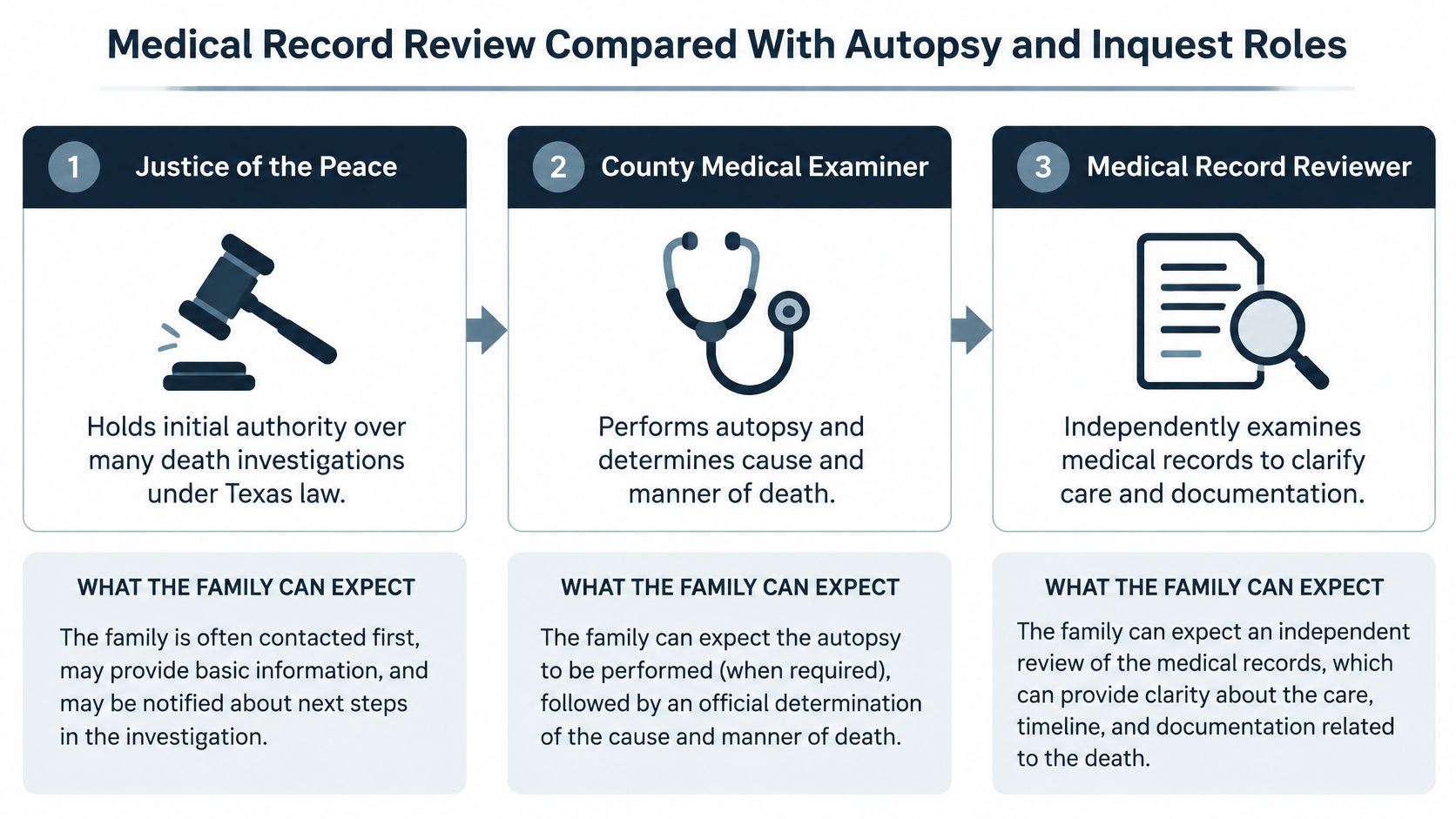
Families usually meet these roles in a set order, and knowing which one holds authority prevents a lot of confusion.
Under Texas death investigation law, a justice of the peace may order an autopsy when it's necessary to determine or confirm the nature and cause of death, and in a county that has established a medical examiner's office, the medical examiner assumes those powers and duties. The medical examiner or an authorized deputy performs an autopsy immediately when the examiner considers it necessary or when a district attorney or criminal district attorney requests one.
A private autopsy is different in who authorizes it. It's arranged and paid for by the family or the party requesting it, while a county or medical examiner autopsy ordered under jurisdiction is covered by the government. A private autopsy is authorized by the legal next of kin or their designated representative, and it doesn't replace a government inquest where one is legally required.
The credential behind the examination is verifiable. The American Board of Pathology's forensic pathology requirements call for 12 months of training in an ACGME-accredited forensic pathology program and completion of at least 30 autopsies by the time the certification application is submitted, recorded in a log listing age group, sex, primary pathology diagnosis, and training year. That specificity is why we describe our examinations as performed by a board-certified forensic pathologist.
| Role | Who requests or holds authority | What it involves | Output |
|---|---|---|---|
| Justice of the peace or medical examiner inquest | Justice of the peace, medical examiner or county authority | Inquest, with an autopsy when necessary | Official determination of cause and manner of death |
| Medical examiner autopsy | Medical examiner or deputy, or a prosecutor's request | Full post-mortem examination | Official autopsy report for the case file |
| Private autopsy | Family or legal next of kin | Independent post-mortem examination by a board-certified forensic pathologist | Independent written report delivered to the family |
| Medical record review | Family, attorney or agency | Document review only, with no physical examination | Sourced chronology with documented findings and gaps |
A record review answers a documentary question. It can't answer a physical one, and it doesn't try. When a review moves toward testimony, the standard shifts from explanation to defensibility, which is what our notes on forensic pathology as a medical expert witness address.
When an Independent Review Helps Clarify a Death
Families come to us for an independent review in four situations. Each one asks a slightly different question of the same documents.

- The medical examiner declined the case. A private examination can still be performed, and we explain what the findings mean for the family.
- A second opinion is needed on an existing autopsy report. The prior report, the medical file, and the toxicology results get read together rather than one at a time.
- The cause of death was left unclear or unexplained. The review establishes what was documented, when, and what was never recorded at all.
- The death crosses county lines. When a person is injured in one county and dies from those injuries in another, Texas law lets the prosecutor in the county of injury ask the justice of the peace in the county of death to order an autopsy, with the county of injury reimbursing the county of death.
In each case, the same pathologist who performs the examination writes the report and walks the family through every finding. No handoff to a technician, no summary written by someone who never saw the case.
A chart with three problems
Say a hospital chart ends with a nursing note from the morning of the death. There's no medication entry for the previous evening, and a laboratory result appears under a date two days earlier than the collection time printed on the specimen.
The review handles each item differently. The morning nursing note is documented fact and goes on the timeline with its timestamp. The missing evening entry is an absence, and the reviewer checks whether a pharmacy record or a separate administration log fills it before concluding anything about care. The misfiled laboratory result gets reconciled against the collection time and flagged as a date discrepancy rather than a clinical change. The video below explains how an independent examination supports that same chronology.
A record review can show what was documented and when. It can't create findings that were never recorded, and it doesn't substitute for a government inquest where the law requires one. For deaths inside a hospital, the internal process runs alongside, and our explanation of how hospital mortality review works covers what that committee does and doesn't produce.
Gather Your Records Before You Request a Review
The quality of a review depends on the completeness of the file you send. Collect the following.
- Hospital, emergency and clinic records, with dates, including any transfer summaries between facilities.
- Laboratory, imaging and medication administration records, ideally with collection times rather than just report dates.
- Nursing notes, EMS reports and first responder records, which often capture the earliest observations.
- Any prior autopsy report, toxicology result or death certificate, even a preliminary copy.
- A short written list of the questions the review must answer, in plain language.
- Documents showing who has authority to request the review, such as proof of legal next of kin status or a written designation.
An incomplete set is normal. The list of what's still missing is useful, because it marks exactly what the review can confirm and what it can't.
On confidentiality: a private report belongs to the family who requested it, is delivered directly to them, and they decide who else sees it. Family information and findings are handled with strict confidentiality.
Requesting the file is often the slowest part. If a hospital returns your authorization unprocessed, healthcare record release templates show the fields a compliant form usually contains. Our own notes on requesting medical records cover how to route the request so it doesn't stall.
If you aren't sure what you need, call us at (806) 230-1889 before you start gathering. We'll talk through the records, tell you which ones matter most for your question, and let you decide what to do next.
A medical file that arrives in fragments can still yield a clear answer once someone verifies the sources, matches each page to the right patient, and builds the chronology in order. Texas Autopsy Services reviews records for families, attorneys, and county officials, with every examination performed by a board-certified forensic pathologist and every finding explained in writing the family can follow. Visit Texas Autopsy Services to see how private autopsies, second-opinion reviews, and county forensic services fit together, or call (806) 230-1889 to discuss a case with our team directly.